Key Takeaways
Request an itemized fee breakdown from your DMV rather than accepting a single total on your renewal notice. Errors in assessed vehicle value — which directly affect value-based registration taxes — do occur, and catching one can save you $50–$200 in a single year.
State motor vehicle databases sometimes carry outdated trim level information or incorrect model years that inflate assessed values; a few minutes of verification pays off disproportionately.
If you're buying a used vehicle and plan to hold it long-term, ask the seller for their last three registration receipts. This shows you exactly how fees have trended for that specific vehicle in that state — giving you a real data point rather than an estimate.
Actual historical registration bills eliminate guesswork and reveal whether any unusual local levies or inspection fees apply to that vehicle's registration profile.
In states with value-based registration, never use MSRP to project future fees — use the state's own assessed value schedule, which often uses a fixed depreciation table that differs significantly from real market depreciation.
Projecting from MSRP can overestimate future registration costs by 20–30% in states that use standardized depreciation tables, leading to budget miscalculations in either direction.
For EV buyers in high-surcharge states, verify whether the annual EV fee is indexed for inflation or fixed by statute. Fees fixed by statute offer cost predictability; inflation-indexed fees can quietly grow your registration bill year over year.
Several states have begun adjusting EV surcharges annually based on road funding needs, making what looked like a fixed cost into a creeping one that reshapes the lifetime math.
If you're a veteran, disabled, or on active military duty, apply for your state's registration discount before your next renewal — not at the DMV counter, but online in advance. Processing a mid-cycle exemption often takes 30–60 days, and starting the application early ensures you get the discount on your very next bill.
Exemptions applied after the renewal deadline don't produce retroactive refunds in most states; timing the application correctly is the only way to capture the full annual savings.
Why Lifetime Registration Cost Is a Real Number Worth Knowing
When drivers calculate the true cost of owning a car, they almost always focus on the big-ticket items: the purchase price, monthly loan payments, insurance premiums, fuel, and major repairs. Registration fees get treated as a minor administrative nuisance — something you pay in a few minutes at the DMV and forget about until next year. That framing is a mistake.
Think of registration as a subscription fee the government charges for the right to operate your vehicle on public roads. Unlike most subscriptions, you cannot cancel it without losing the use of your car entirely. And like any recurring charge, what seems trivial on a monthly basis becomes substantial over a decade or more.
A vehicle held for ten years might accumulate $1,500 to $7,000 in registration costs alone, depending entirely on where you live and what you drive. That range is wide because state fee structures vary enormously — but even at the low end, we're talking about money that deserves a line in your ownership budget.
This guide walks through every layer of that cost: what makes up the annual fee, how it shifts as your vehicle ages, how state law shapes the total, and what avoidable costs (late fees, lapses, and penalties) can add on top. By the end, you'll be equipped to estimate your own vehicle's lifetime registration burden and make smarter decisions around it.
What Goes Into Your Registration Fee Each Year
Your annual registration bill is rarely a single, simple charge. In most states it is a bundled sum of several distinct fees and taxes, each serving a different government funding purpose. Understanding the components helps you anticipate which parts are stable and which are likely to change over time.
The Core Fee Categories
- Base registration fee: A flat administrative charge for maintaining your vehicle record in the state's motor vehicle database. This is often the most stable portion — it may stay the same for decades regardless of your car's value or age.
- Ad valorem or vehicle value tax: Many states — including Virginia, Georgia, and Arizona — assess a tax based on the fair market value or assessed value of your vehicle. This is the fee most likely to decrease year over year as your car depreciates.
- Weight-based fees: Some states charge proportionally to a vehicle's gross vehicle weight rating (GVWR). Heavier vehicles pay more on the premise that they cause greater road wear.
- Emissions and smog inspection fees: States with mandatory emissions testing programs often embed the inspection charge directly into registration. California, for example, includes a smog abatement fee.
- Local and county levies: In many states, county or municipal governments add their own surcharges on top of the state base. These can range from a few dollars to over $100 in high-cost metro areas.
- Special program fees: Depending on your state, you may see add-ons for personalized plate programs, state park funds, EV infrastructure, or transportation authority funding.
Understanding what each line item funds puts you in a stronger position to spot errors on your bill and to forecast how costs will evolve as your car ages.
Request an itemized fee breakdown from your DMV rather than accepting a single total on your renewal notice. Errors in assessed vehicle value — which directly affect value-based registration taxes — do occur, and catching one can save you $50–$200 in a single year.
State motor vehicle databases sometimes carry outdated trim level information or incorrect model years that inflate assessed values; a few minutes of verification pays off disproportionately.
If you're buying a used vehicle and plan to hold it long-term, ask the seller for their last three registration receipts. This shows you exactly how fees have trended for that specific vehicle in that state — giving you a real data point rather than an estimate.
Actual historical registration bills eliminate guesswork and reveal whether any unusual local levies or inspection fees apply to that vehicle's registration profile.
In states with value-based registration, never use MSRP to project future fees — use the state's own assessed value schedule, which often uses a fixed depreciation table that differs significantly from real market depreciation.
Projecting from MSRP can overestimate future registration costs by 20–30% in states that use standardized depreciation tables, leading to budget miscalculations in either direction.
For EV buyers in high-surcharge states, verify whether the annual EV fee is indexed for inflation or fixed by statute. Fees fixed by statute offer cost predictability; inflation-indexed fees can quietly grow your registration bill year over year.
Several states have begun adjusting EV surcharges annually based on road funding needs, making what looked like a fixed cost into a creeping one that reshapes the lifetime math.
If you're a veteran, disabled, or on active military duty, apply for your state's registration discount before your next renewal — not at the DMV counter, but online in advance. Processing a mid-cycle exemption often takes 30–60 days, and starting the application early ensures you get the discount on your very next bill.
Exemptions applied after the renewal deadline don't produce retroactive refunds in most states; timing the application correctly is the only way to capture the full annual savings.
It's worth requesting an itemized breakdown from your DMV if your bill arrives as a single lump sum. Some states mail a consolidated number without explanation, but the underlying components are always on record — and knowing them helps you spot miscalculations.
How Fees Change as Your Car Ages
Here's the dynamic most car owners don't fully appreciate: registration costs are not static. They follow a trajectory that's shaped by the fee structure your state uses, and that trajectory can either work heavily in your favor or stay stubbornly flat across a car's entire life.
$2,000–$6,000+
Typical lifetime registration cost per vehicle
Based on average state fee structures and a 10–12 year ownership period; high-cost states and heavier vehicles skew toward the upper end.
30+
U.S. states charging annual EV registration surcharges
As of 2024, more than 30 states levy supplemental fees on battery electric vehicles to offset lost gasoline tax revenue, per the National Conference of State Legislatures.
$211
Annual EV surcharge in Georgia (among highest in U.S.)
Georgia charges one of the highest EV-specific registration surcharges in the country, significantly increasing lifetime registration costs for EV owners in that state.
15–20%
Average vehicle value depreciation in year one
Industry depreciation benchmarks from sources like Edmunds and Kelley Blue Book consistently show the steepest drop in value during the first 12 months of ownership.
$100–$300
Typical citation for driving on expired registration
Fine amounts vary by state and jurisdiction, but most first-offense expired registration citations fall in this range, per state traffic fine schedules.
Value-Based States: Fees Decline With Depreciation
In states that tie fees to vehicle value — often called ad valorem or excise tax states — registration costs typically front-load the expense. A new $45,000 SUV might carry an $800 registration bill in year one. By year eight, with the vehicle worth perhaps $12,000, that same bill might be under $200. The cumulative cost over a decade could still reach $3,500–$4,500, but the annual burden lightens as the car ages — which at least aligns with a period when the car may be requiring more in maintenance spending.
Flat-Fee States: Predictable but Never Cheaper
States like Texas and Illinois primarily use flat base fees that don't change with vehicle age or value. This creates cost predictability — you know roughly what you'll owe every year — but it also means you never get relief. A 12-year-old car that's worth $4,000 pays the same base fee as when it rolled off the lot.
Weight-Based States: Constant Unless You Trade Up or Down
In weight-based states like Montana or Oregon, the fee stays relatively flat unless you switch to a heavier or lighter vehicle class. This structure tends to penalize truck and SUV owners most.
The Age-Discount Tier
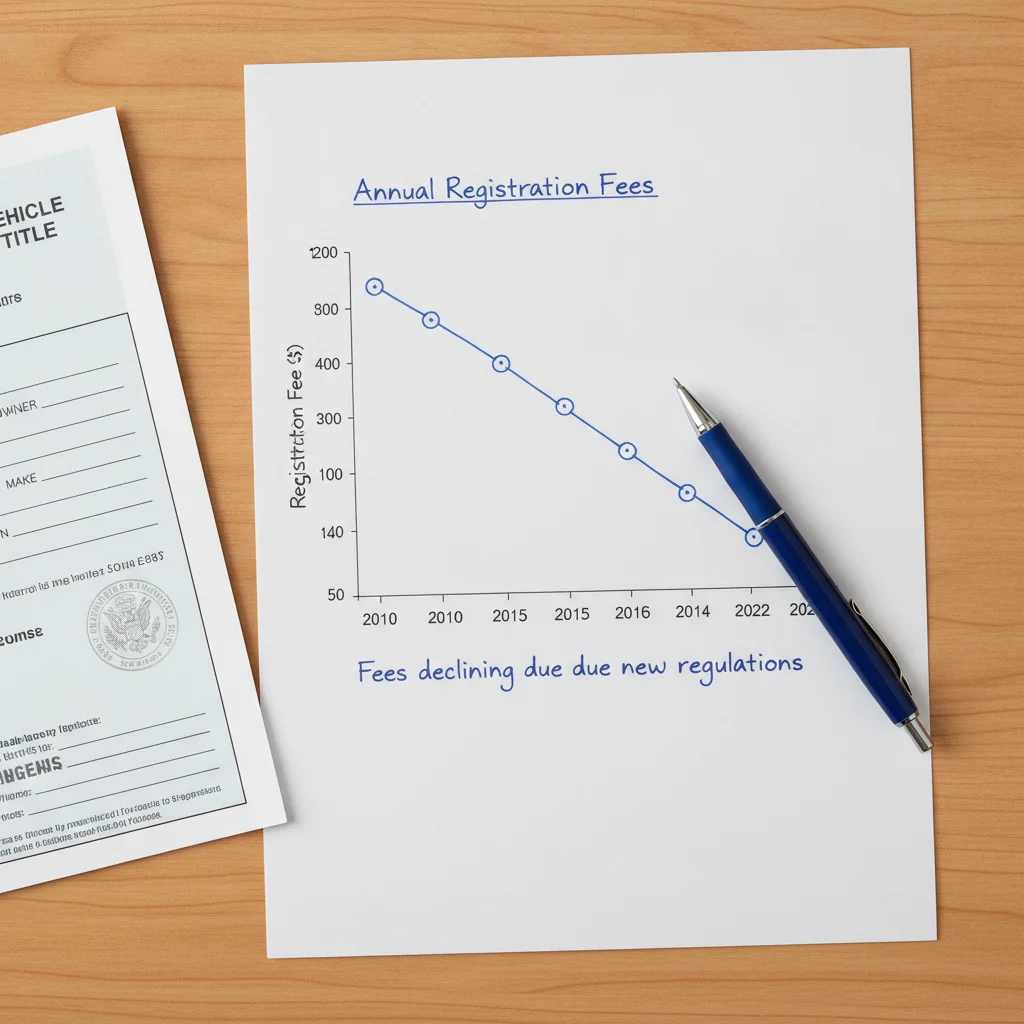
Some states offer reduced flat fees for older vehicles — typically those more than 10 or 15 years old — as a concession to owners of high-mileage cars of diminished value. California, for example, has historically offered reduced fees for vehicles over a certain age under specific programs. These age-based discounts can produce a meaningful drop in your annual cost if you hold a vehicle into its second decade.
What changes at renewal each year and what stays the same is a critical factor in projecting your total ownership cost — especially if you're comparing a five-year ownership plan to a ten-year one.
State-by-State Variation: The Biggest Variable in Your Total
No single factor affects your lifetime registration cost more than the state where you register your vehicle. The difference between the lowest-cost and highest-cost states isn't marginal — it can mean thousands of dollars over a vehicle's lifespan.
“Vehicle registration taxes are one of the most transparent forms of government revenue, yet most drivers treat them as unpredictable. They follow clear statutory formulas — once you understand the formula for your state, you can forecast your cost to within a few percent for the entire life of the vehicle.”
— Michael Sargent, Transportation Policy Analyst, Tax Foundation
A Comparative Snapshot
| State | Fee Basis | Estimated Year-1 Fee (Midsize Sedan) | Estimated 10-Year Total |
|---|---|---|---|
| Montana | Flat + weight | ~$217 | ~$2,000 |
| Texas | Flat | ~$75 | ~$900 |
| Virginia | Value-based (personal property tax) | ~$700–$1,100 | ~$4,500–$6,500 |
| California | Value-based (VLF) + fees | ~$300–$700 | ~$2,500–$4,500 |
| New Hampshire | Value + weight | ~$200–$400 | ~$1,500–$2,800 |
| Arizona | Value-based (60% assessed) | ~$400–$600 | ~$2,000–$3,500 |
Estimates are illustrative and based on publicly available state fee schedules. Actual costs vary by vehicle, county, and annual adjustments.
What's notable in this comparison is that a flat-fee state like Texas looks inexpensive in year one — but the total for ten years is genuinely low because the fee doesn't inflate. A value-based state like Virginia looks shocking in year one but does moderate over time as the vehicle depreciates. Neither system is inherently better; they simply create different cash-flow patterns.
Multi-Year Registration Options
A number of states allow two-year registration renewals, which can offer a modest administrative convenience but rarely a financial discount. If your state offers multi-year registration and you're confident you'll keep the vehicle, locking in two years at once reduces the chance of a missed renewal — but verify whether the two-year fee is calculated at current or future-year rates before committing.
Title Transfer Fees Are Separate From Registration
When you buy a used vehicle, you'll typically pay both a title transfer fee and a registration fee in the first year of ownership. These are distinct charges processed separately by the DMV. The title transfer is a one-time cost; the registration fee recurs annually. Many buyers conflate the two and underestimate the ongoing annual commitment.
Fee Calculators Vary in Accuracy
State DMV fee calculators are useful for estimation but may not always reflect the most current county levy rates, recent legislative changes, or specialty plate fees. For the most accurate figure, call your local DMV office or check the current year's fee schedule published in the state's motor vehicle code.
The County Layer
Even within a single state, county-level additions can create meaningful variation. In California, a vehicle registered in Los Angeles County carries different local charges than one registered in rural Shasta County. In Colorado, county fees can vary by $50 or more across jurisdictions. This matters most for buyers who live near state or county lines and have flexibility about where they establish residence.
If you're relocating, it's worth modeling the registration cost trajectory for your specific vehicle in the new state before assuming the move is cost-neutral from a registration standpoint.
Late Fees, Penalties, and the Hidden Cost of Lapses
The stated annual registration fee is just the floor cost. What many owners actually pay over a vehicle's lifetime includes a series of avoidable add-on charges that accumulate from missed deadlines, administrative oversights, or willful delay. These costs are entirely preventable — but they're also remarkably common.
Late Registration Penalties
Most states impose a penalty for renewing past the expiration date. The structure varies: some charge a flat penalty (commonly $10–$50), others assess a percentage of the base fee (typically 10–25% per month past due), and a few escalate penalties in tiers — one rate for 1–30 days late, a higher rate for 31–90 days, and a steep penalty beyond that.
A single late renewal might cost an extra $25–$100. Over a 10-year ownership period, if you're late even three times, that's $75–$300 in penalties tacked on top of your baseline total — for nothing except administrative delay.
Never Drive on an Expired Registration
An expired registration sticker isn't just a minor paperwork issue — it creates a legally documented violation that can result in a $100–$300 citation, potential impoundment in some jurisdictions, and complications with your auto insurance. In several states, an insurer can use an expired registration as grounds to dispute a claim if an accident occurs while the vehicle was unregistered. The risk is never proportionate to the convenience of delaying renewal.
Moving Between States Resets Your Fee Trajectory
When you register a vehicle in a new state after relocating, the new state typically assesses fees as if the vehicle is being registered for the first time under their formula — which can mean a sharp one-year increase even for an older vehicle. Factor this into relocation planning, especially if you're moving from a flat-fee state to a value-based one.
The Lapse Scenario
A lapsed registration — where a vehicle is driven with an expired sticker — introduces a much more serious financial risk. Beyond the DMV penalty for late renewal, you're exposed to:
- Traffic citations for expired registration, which in most states range from $100–$300 for a first offense
- Potential impoundment fees if stopped by law enforcement in a zero-tolerance jurisdiction
- Insurance complications, since some policies include conditions about maintaining legal vehicle status
- The requirement to pass any missed inspections before renewal is granted, which can surface repair costs you weren't expecting
The full consequences of a lapsed registration extend well beyond a simple late fee — understanding them is important for any owner who's ever been tempted to let renewal slide for a few months.
Title Transfer Fees When Buying Used
Registration costs for used vehicles also include a one-time title transfer fee at the point of purchase, which ranges from $15 in some states to over $100 in others. If you're a serial buyer of used vehicles — cycling through two or three cars over a decade — these transfer fees stack up in a way that doesn't appear in your annual renewal math but absolutely belongs in a true lifetime cost calculation.
Request an itemized fee breakdown from your DMV rather than accepting a single total on your renewal notice. Errors in assessed vehicle value — which directly affect value-based registration taxes — do occur, and catching one can save you $50–$200 in a single year.
State motor vehicle databases sometimes carry outdated trim level information or incorrect model years that inflate assessed values; a few minutes of verification pays off disproportionately.
If you're buying a used vehicle and plan to hold it long-term, ask the seller for their last three registration receipts. This shows you exactly how fees have trended for that specific vehicle in that state — giving you a real data point rather than an estimate.
Actual historical registration bills eliminate guesswork and reveal whether any unusual local levies or inspection fees apply to that vehicle's registration profile.
In states with value-based registration, never use MSRP to project future fees — use the state's own assessed value schedule, which often uses a fixed depreciation table that differs significantly from real market depreciation.
Projecting from MSRP can overestimate future registration costs by 20–30% in states that use standardized depreciation tables, leading to budget miscalculations in either direction.
For EV buyers in high-surcharge states, verify whether the annual EV fee is indexed for inflation or fixed by statute. Fees fixed by statute offer cost predictability; inflation-indexed fees can quietly grow your registration bill year over year.
Several states have begun adjusting EV surcharges annually based on road funding needs, making what looked like a fixed cost into a creeping one that reshapes the lifetime math.
If you're a veteran, disabled, or on active military duty, apply for your state's registration discount before your next renewal — not at the DMV counter, but online in advance. Processing a mid-cycle exemption often takes 30–60 days, and starting the application early ensures you get the discount on your very next bill.
Exemptions applied after the renewal deadline don't produce retroactive refunds in most states; timing the application correctly is the only way to capture the full annual savings.
Electric Vehicles: Higher Base Fees, Different Trajectories
Electric vehicles have upended the traditional registration cost model in ways that are still evolving. Because EV owners pay no gasoline excise tax — the fuel tax that funds road infrastructure for conventional vehicle drivers — many states have responded by levying supplemental annual registration fees specifically on EVs. These surcharges are the registration world's equivalent of a gas tax substitute, and they're not trivial.
The EV Surcharge Landscape
As of 2024, more than 30 states charge an additional annual EV registration fee above the standard rate. These surcharges typically range from $50 to $200 per year, with some states — including Georgia ($211), West Virginia ($200), and Wyoming ($200) — at the high end. A few states, such as Illinois, charge over $250 annually for EVs as a flat transportation infrastructure contribution.
$2,000–$6,000+
Typical lifetime registration cost per vehicle
Based on average state fee structures and a 10–12 year ownership period; high-cost states and heavier vehicles skew toward the upper end.
30+
U.S. states charging annual EV registration surcharges
As of 2024, more than 30 states levy supplemental fees on battery electric vehicles to offset lost gasoline tax revenue, per the National Conference of State Legislatures.
$211
Annual EV surcharge in Georgia (among highest in U.S.)
Georgia charges one of the highest EV-specific registration surcharges in the country, significantly increasing lifetime registration costs for EV owners in that state.
15–20%
Average vehicle value depreciation in year one
Industry depreciation benchmarks from sources like Edmunds and Kelley Blue Book consistently show the steepest drop in value during the first 12 months of ownership.
$100–$300
Typical citation for driving on expired registration
Fine amounts vary by state and jurisdiction, but most first-offense expired registration citations fall in this range, per state traffic fine schedules.
How This Affects Lifetime Registration Math
Consider a battery-electric vehicle held for 12 years in a high-surcharge state. At $200 per year in EV surcharges alone, that's $2,400 before the standard registration fee is added. Combined with value-based fees that start high and taper, the total lifetime cost for an EV registered in a state like Georgia could easily exceed $5,000–$7,000 over a 10–12 year ownership horizon.
This doesn't mean EVs are always more expensive to register than gas vehicles — in states with no EV surcharge and value-based fees, the lower assessed value of an aging EV may actually produce lower late-year registration bills. But owners who assume EVs reduce all vehicle costs uniformly are often surprised when the registration bill arrives.
A direct comparison of EV and gas car registration costs by state shows where the surcharge gap is widest and where EVs actually come out ahead.
Set a 45-Day Renewal Reminder Every Year
Mark your calendar 45 days before your registration expiration date and handle the renewal online the same day. Most state DMV portals process renewals instantly and mail the sticker within a week. Staying 45 days ahead gives you time to address any inspection requirements or address mismatches without risking an expired tag.
EV Buyers: Check for Surcharge Exemptions
Some states exempt certain lower-income households or early EV adopters from supplemental EV registration fees — but these exemptions require a separate application. Before assuming you owe the full surcharge, verify your state's EV fee exemption criteria on the DMV website. A five-minute check could save you $100–$200 annually.
Running a Lifetime Registration Estimate for Your Vehicle
Most people have never sat down to estimate what registration will cost them over the full time they own a vehicle. Doing this exercise — even roughly — changes how you think about car ownership economics. Here's a practical framework for building that estimate.
Step 1: Identify Your State's Fee Structure
Determine whether your state uses a value-based, weight-based, flat-fee, or hybrid approach. Your state's DMV website or motor vehicle department will list the formula. Make note of whether your county adds local charges and what they are.
Step 2: Find Your Year-1 Fee
Use your state's fee calculator (most state DMV sites offer one) with your vehicle's MSRP or purchase price, model year, and weight. This gives you a baseline. For a used vehicle you already own, use the current assessed value as your starting point rather than original MSRP.
Step 3: Project the Depreciation Curve (Value-Based States)
If your state uses vehicle value, you need a rough depreciation schedule. As a general rule:
- Year 1–2: 15–20% value decline per year
- Year 3–5: 10–15% per year
- Year 6–10: 5–10% per year
- Year 10+: stabilizes at residual/scrap value range
Apply your state's assessment rate to each year's estimated value and sum the results. That total is your baseline registration spend for the period.
Step 4: Add Fixed and Semi-Fixed Costs
On top of value-based fees, add any flat components that don't change: base registration fee, county surcharge, EV surcharge if applicable, and emissions inspection fees if your vehicle requires them on a recurring schedule.
Step 5: Add a Buffer for Avoidable Costs
Based on your own organizational tendencies, build in a conservative buffer of 5–10% for potential late fees or inspection-related renewals. If you've been late before, bump that buffer to 15%.

Sample Estimate: 10-Year Ownership in California
| Year | Estimated Vehicle Value | VLF (0.65% of value) | Base + County Fees | Annual Total |
|---|---|---|---|---|
| 1 | $38,000 | $247 | $120 | $367 |
| 3 | $26,000 | $169 | $120 | $289 |
| 5 | $18,000 | $117 | $120 | $237 |
| 7 | $12,000 | $78 | $120 | $198 |
| 10 | $7,000 | $46 | $120 | $166 |
California VLF rate illustrative only. Actual VLF is based on purchase price, not depreciated value, until transfer of ownership. Consult the CA DMV fee calculator for precise figures.
Adding up a simplified curve like this for 10 years produces a rough total of approximately $2,400–$2,800 for this example vehicle in California, before any late fees or special assessments. That's a meaningful number — roughly the cost of one moderately serious car repair.
Strategies to Manage and Reduce Registration Costs Over Time
You cannot opt out of registration, but you can make deliberate choices that reduce how much you spend on it over a vehicle's lifetime. Some of these strategies are available at the time of purchase; others are ongoing habits.
Choose Your State Registration Wisely
If you live near a state border or are planning a relocation, compare the registration cost trajectories for your specific vehicle in both states. A $300 difference per year across ten years is $3,000 — real money. This is especially relevant for owners of heavier vehicles like trucks and SUVs, where weight-based fee states can be punishing.
Time Your Vehicle Purchase Strategically
In value-based states, buying a vehicle that is one or two model years old rather than brand new meaningfully reduces your year-one registration bill — since the assessed value will be lower. The registration savings in years one through three alone can be $200–$500, depending on the original MSRP.
Automate Renewal Reminders
This sounds trivially simple, but the data is clear: late fees are primarily a behavioral problem, not a financial hardship problem. Set a calendar reminder 45 days before your registration expiration each year. Most state DMV portals allow online renewal that takes less than five minutes. Eliminating even two late fees over a decade saves $50–$200 at zero effort cost.
Keeping your registration and tax records organized also helps you track what you've paid historically, catch billing errors, and stay ahead of inspection deadlines that can delay renewal.
Don't Overlook Exemptions and Discounts
Many states offer registration fee reductions or exemptions for specific groups: disabled veterans, active military personnel, low-income households, or owners of vehicles over a certain age. These exemptions are rarely advertised proactively — you typically have to apply. Checking your state's DMV exemption list once is worth the ten minutes it takes.
Account for Registration When Calculating Total Cost of Ownership
Whether you're deciding between two vehicles, comparing a five-year versus a ten-year ownership plan, or evaluating an EV against a comparable gas vehicle, registration cost should appear as a line item in your analysis — not an afterthought. For a high-value vehicle in a value-based state, registration over ten years can cost as much as a year of comprehensive insurance.
Registration Costs Belong in Every Ownership Budget
Most car ownership budgets account for loan payments, insurance, fuel, and maintenance — but omit registration entirely or treat it as negligible. For a vehicle held ten years in a high-fee state, registration alone can rival a full year of insurance premiums. Build the projected lifetime registration cost into your total-cost-of-ownership calculation before you buy, not after.
Set a 45-Day Renewal Reminder Every Year
Mark your calendar 45 days before your registration expiration date and handle the renewal online the same day. Most state DMV portals process renewals instantly and mail the sticker within a week. Staying 45 days ahead gives you time to address any inspection requirements or address mismatches without risking an expired tag.
EV Buyers: Check for Surcharge Exemptions
Some states exempt certain lower-income households or early EV adopters from supplemental EV registration fees — but these exemptions require a separate application. Before assuming you owe the full surcharge, verify your state's EV fee exemption criteria on the DMV website. A five-minute check could save you $100–$200 annually.
Registration fees are one of the most predictable costs in vehicle ownership — they follow known schedules and are almost entirely avoidable as a source of penalty spending. Treating them with the same planning discipline you'd apply to a loan payment or insurance premium is simply smart ownership.

All claims are backed by peer-reviewed research. Sources on request.