Key Takeaways
Emissions Testing
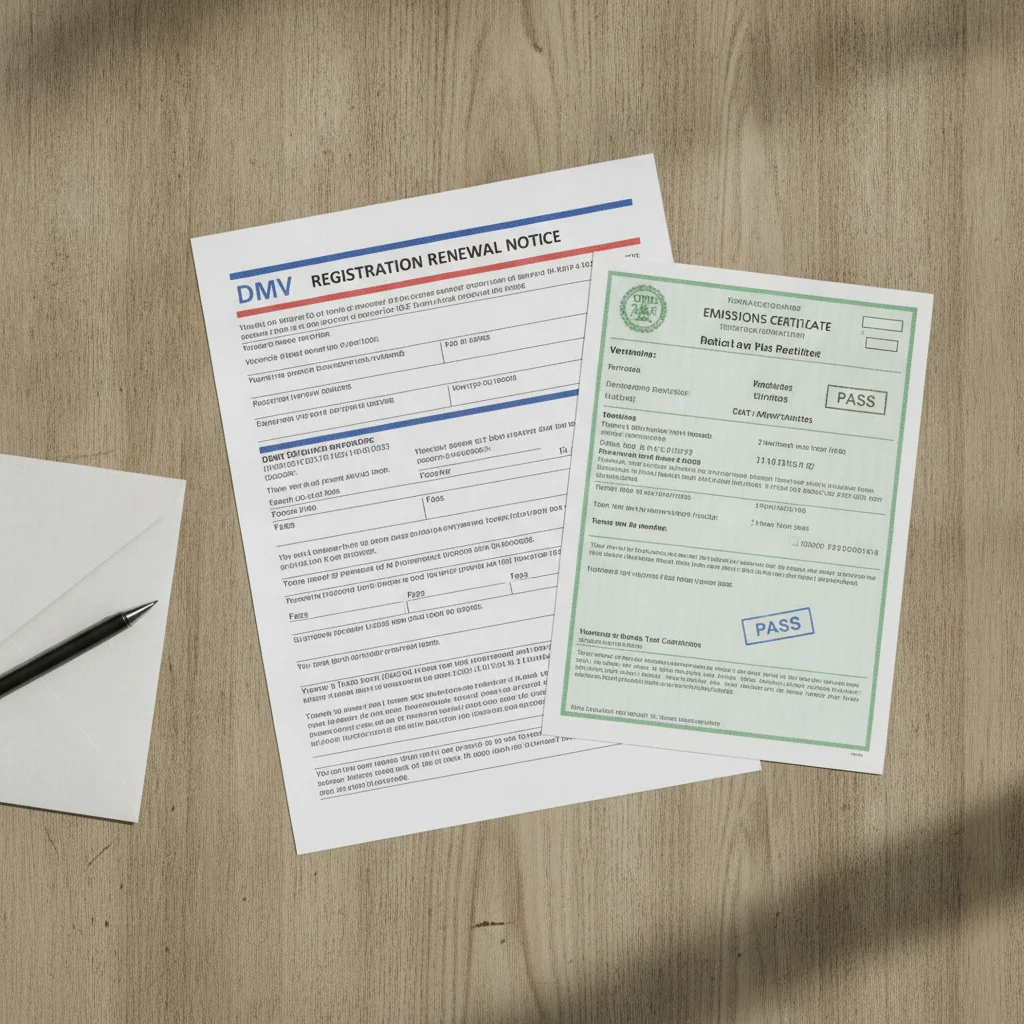
Emissions testing is a government-mandated inspection that measures the pollutants your vehicle's engine releases into the air. Most states that require it tie a passing result directly to your ability to renew your vehicle registration. Without a passing certificate, the DMV won't issue new registration tags. The test is designed to ensure vehicles on public roads meet minimum air-quality standards set by state and federal environmental agencies.
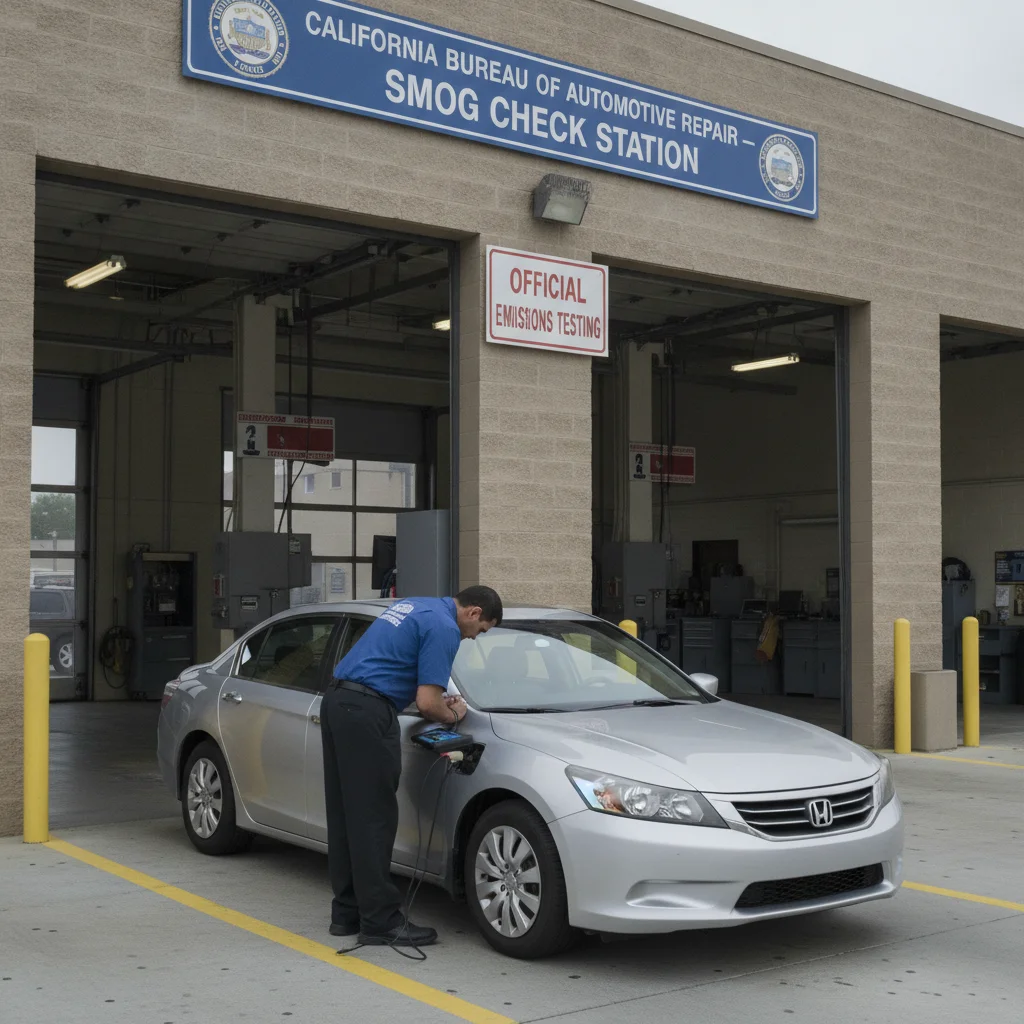
Depending on vehicle age, modern tests use On-Board Diagnostics II (OBD-II) port scanning rather than a tailpipe probe — the scanner reads the vehicle's own internal monitors to determine whether emissions systems are functioning correctly.
Why Emissions Testing Exists — and Why It Affects Your Registration
If you've ever been surprised to find an emissions test requirement standing between you and a simple registration renewal, you're not alone. Most drivers understand that registration is an annual government requirement, but many don't realize that air quality regulations are baked directly into that process. The two systems are intentionally linked.
The federal Clean Air Act requires states in non-attainment areas — regions that don't meet federal air quality standards — to implement vehicle inspection and maintenance (I/M) programs. States that run these programs tie them to the registration system because that's the most efficient enforcement mechanism available: every vehicle owner must renew registration to legally drive, creating a natural checkpoint.
Think of it like this: the DMV holds the keys to your registration, and the emissions program uses that leverage to ensure cars on the road aren't pumping out excessive hydrocarbons, nitrogen oxides, or carbon monoxide. Fail the test, and the DMV simply won't hand over your renewal sticker until the problem is fixed.
For a broader view of what your annual registration fee actually funds — including emissions program administration — see Vehicle Registration Fees Explained.
Which States Require Emissions Testing — and Who's Exempt
As of the mid-2020s, roughly 30 states plus the District of Columbia operate some form of vehicle emissions or inspection program. The specifics, however, vary dramatically. Some states test in every county; others only in urban counties that fail to meet federal air quality benchmarks. A handful of states have no testing requirement at all.
~30
U.S. states with active emissions programs
Approximately 30 states plus Washington D.C. operate some form of vehicle emissions or inspection/maintenance program as of 2024, per EPA program data.
$10–$50
Typical emissions test fee range
State-licensed testing stations across the U.S. charge between $10 and $50 per test, depending on jurisdiction and test type.
$500–$2,500
Catalytic converter replacement cost
The catalytic converter is among the most expensive emissions-related repairs, with costs varying significantly by vehicle make, model, and OEM versus aftermarket parts.
1996
Model year OBD-II scanning begins
Federal law required all cars sold in the U.S. from the 1996 model year onward to include a standardized OBD-II diagnostic port, enabling modern emissions scanning methods.
$150–$800
Typical repair cost waiver minimum threshold
Most state emissions programs set a minimum repair expenditure between $150 and $800 that owners must document before qualifying for a registration renewal waiver after a failed test.
Even within a required state, exemptions are common. The most typical exemption categories include:
- Vehicle age: Cars older than 25 years (sometimes 15 or 20) are often exempt, based on the assumption that their total emissions contribution is minor compared to modern vehicles and that parts may be unavailable.
- New vehicles: Brand-new cars are typically exempt for their first one to three model years, since they've just passed federal certification.
- Electric vehicles (BEVs): Fully electric cars produce no tailpipe emissions and are exempt in every state program.
- Diesel vehicles: Some state programs test diesels under opacity (smoke) standards rather than OBD-II scanning.
- Farm and off-road equipment: Vehicles not registered for highway use are generally excluded.
Before assuming you need a test — or assuming you don't — verify your specific county and vehicle type on your state DMV's website. Rules change, and neighbor states can have completely different systems.
County-Level Rules Can Differ Significantly
Even within a state that requires emissions testing, not all counties participate. For example, in Texas, only vehicles registered in certain urban counties — including the Dallas-Fort Worth metroplex and the Houston area — must pass an emissions test. A vehicle registered in a rural Texas county has no such requirement. Always verify requirements at the county level, not just the state level.
Watch for Cleared Codes When Buying Used
An OBD-II scanner that shows multiple readiness monitors marked 'Not Ready' or 'Incomplete' is a red flag during a used car purchase. It typically means the vehicle's ECM was recently reset — possibly to hide a fault code before the sale. Allow the car to complete a full drive cycle and recheck the monitors before making a final purchase decision.
How the Testing Process Actually Works
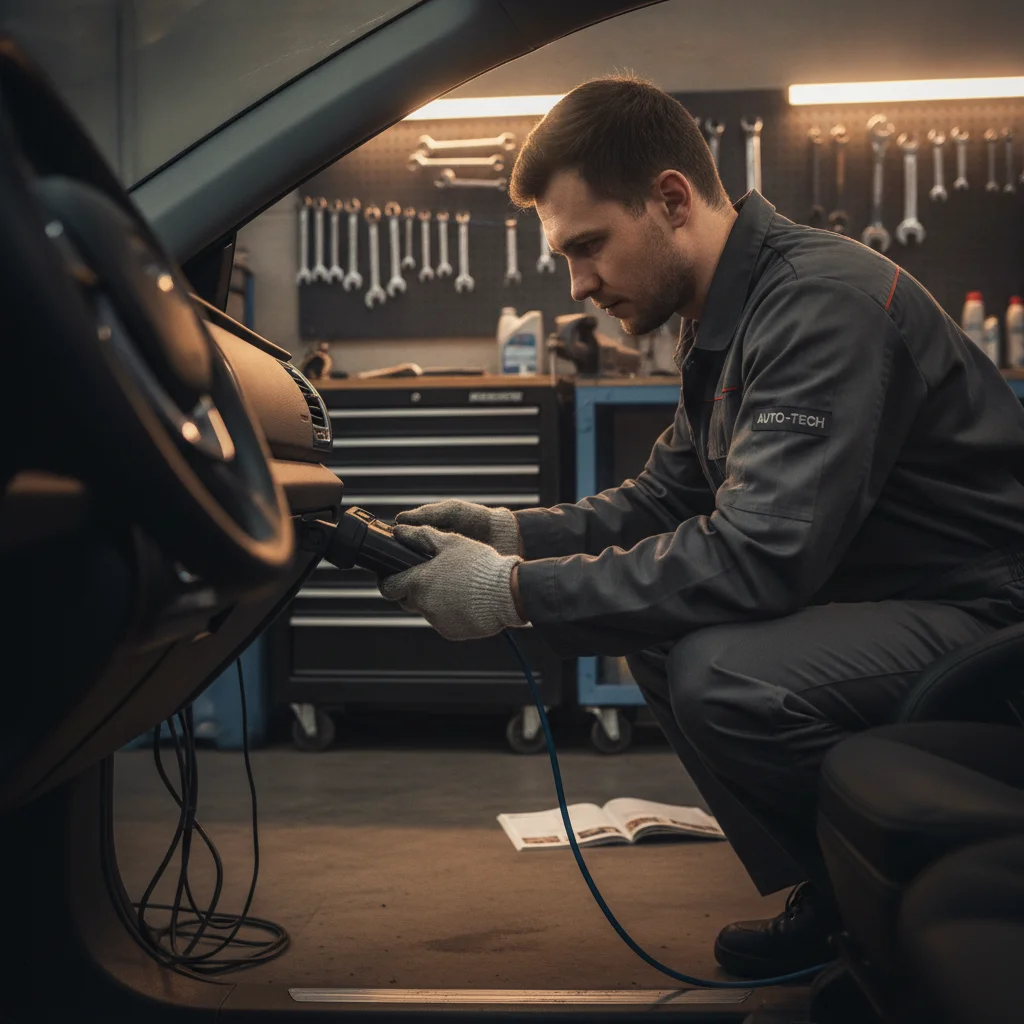
Most people imagine emissions testing as a tailpipe probe measuring exhaust in real time. While that method still exists in a few jurisdictions, the dominant testing method for vehicles from 1996 onward is an OBD-II scan — a plug-in diagnostic check that reads the vehicle's own internal computer.
OBD-II Scan Testing (1996 and Newer)
Your vehicle's engine control module (ECM) continuously monitors a set of readiness monitors — internal self-tests covering systems like the oxygen sensors, catalytic converter, evaporative emissions system, and exhaust gas recirculation valve. During an OBD-II test, a technician plugs a scanner into the port typically located under the driver's side dash. The scanner reads:
- Whether any emissions-related trouble codes are stored (active or pending)
- Whether all required readiness monitors have completed their self-tests
If the computer reports a stored fault code or shows incomplete readiness monitors, the vehicle fails — even if it visually looks fine and runs smoothly. This is why a car with a lit check engine light will almost always fail an emissions test: the light means the ECM has logged a fault code.
Tailpipe Testing (Older Vehicles)
For vehicles manufactured before OBD-II standardization (pre-1996), many programs use a two-speed idle test: a probe inserted into the tailpipe measures actual exhaust output while the engine runs at idle and then at a higher RPM. Some programs also use a loaded-mode dynamometer test, where the vehicle is driven on rollers under simulated load conditions to produce a more realistic emissions reading.
Visual Inspection Components
Beyond the scan or tailpipe check, most programs require a visual inspection to confirm the catalytic converter is present (not removed or gutted), the fuel filler cap seals properly, and no visible smoke is evident from the exhaust. Missing or tampered catalytic converters are an automatic failure.
Fix the Check Engine Light Before Testing
Never take a vehicle to an emissions test with the check engine light on. The stored fault code is an automatic failure in every OBD-II testing program. Have the code read first (many auto parts stores do this free), then make targeted repairs before presenting the car for inspection. This saves both the test fee and the retest fee.
Complete a Drive Cycle After Battery Disconnect
If your car's battery was recently disconnected or replaced, the OBD-II monitors will show as incomplete — which can trigger a test failure even with no underlying problem. Drive the vehicle through a full warm-up and highway cycle over 1–2 days before testing. Consult your owner's manual or ask a mechanic for the specific drive cycle your vehicle model requires.
The Cost Equation: Test Fees, Repair Bills, and Waivers
Emissions testing creates a two-part cost exposure for car owners: the test fee itself, and any repairs required to pass. Understanding both helps you budget accurately and avoid being blindsided.
Test Fees
State-licensed testing stations typically charge between $10 and $50 for a standard emissions test, depending on your state and the type of inspection performed. Some states set a statutory maximum fee; others allow the market to price it. Retest fees after a repair are commonly discounted or waived within a defined period (usually 30–90 days) at the same station.
Repair Costs
Here's where the real financial exposure lies. Common emissions failures include:
- Oxygen sensor replacement: $150–$300 per sensor, parts and labor
- Catalytic converter replacement: $500–$2,500 depending on vehicle and whether an OEM or aftermarket unit is used
- EVAP system leak repair: $100–$600, ranging from a simple gas cap to a purge valve or charcoal canister
- EGR valve cleaning or replacement: $150–$500
- Mass airflow sensor replacement: $150–$400
These aren't arbitrary charges — a failing emissions system often correlates with reduced fuel economy, so there's frequently a practical payback on the repair beyond just clearing the test.
“Emissions failures are rarely random — they almost always point to a specific system that's been degrading over time. Fix the root cause, not just the symptom the scanner flags, and you'll likely see fuel economy improve along with a passing test result.”
— John Ibbotson, Chief Mechanic, Consumer Reports Auto Test Center
Repair Cost Waivers
Every serious state emissions program includes a safety valve for owners whose vehicles still fail despite good-faith repair efforts. Called a repair cost waiver (or economic hardship waiver), it allows the DMV to process a registration renewal even after a failed test, provided the owner has spent at least the state's minimum repair threshold — typically between $150 and $800 in documented repair receipts from a licensed shop.
A waiver is not a free pass forever. It usually covers one renewal cycle, and the underlying problem must be addressed before the next test. Keep all repair receipts carefully organized; the DMV will want to see them. For good record-keeping habits that help you document these costs over time, see Best Practices for Keeping Your Registration and Tax Records Organized.
What to Do If You Fail — A Step-by-Step Approach
A failing emissions test result isn't a dead end; it's a diagnosis. Here's how to work through it efficiently without losing money on unnecessary repairs or missing your registration deadline.
- Read the failure report carefully. The testing station is required to give you a printout specifying exactly which monitors failed or which codes are stored. This is your repair roadmap — don't lose it.
- Don't guess at repairs. Take the failure report to a reputable shop and ask for a diagnostic inspection focused on the specific codes or monitors listed. Replacing parts at random is expensive and often doesn't fix the underlying cause.
- Get a written repair estimate first. Before authorizing work, get a written estimate. If the cost appears likely to exceed the car's value, weigh your options before committing — a waiver may be more practical if the car is near end-of-life.
- Address readiness monitor issues strategically. If your only failure is incomplete readiness monitors (no stored fault codes), the fix isn't a part replacement — it's driving the vehicle through a specific drive cycle so the ECM can complete its self-tests. Your shop or the testing station can provide the recommended drive cycle sequence for your vehicle.
- Return for a retest promptly. Most programs allow a retest within 30–90 days at a reduced or waived fee. Don't delay past that window, or you may pay for a full test again.
- Track the clock on your registration deadline. If repairs are taking time, make sure you're aware of your registration expiration date. Driving on an expired registration while you resolve an emissions issue can compound your problems significantly — see What Happens If You Let Your Vehicle Registration Lapse for the full picture on lapse consequences.
Timing Your Test to Avoid Registration Crunches
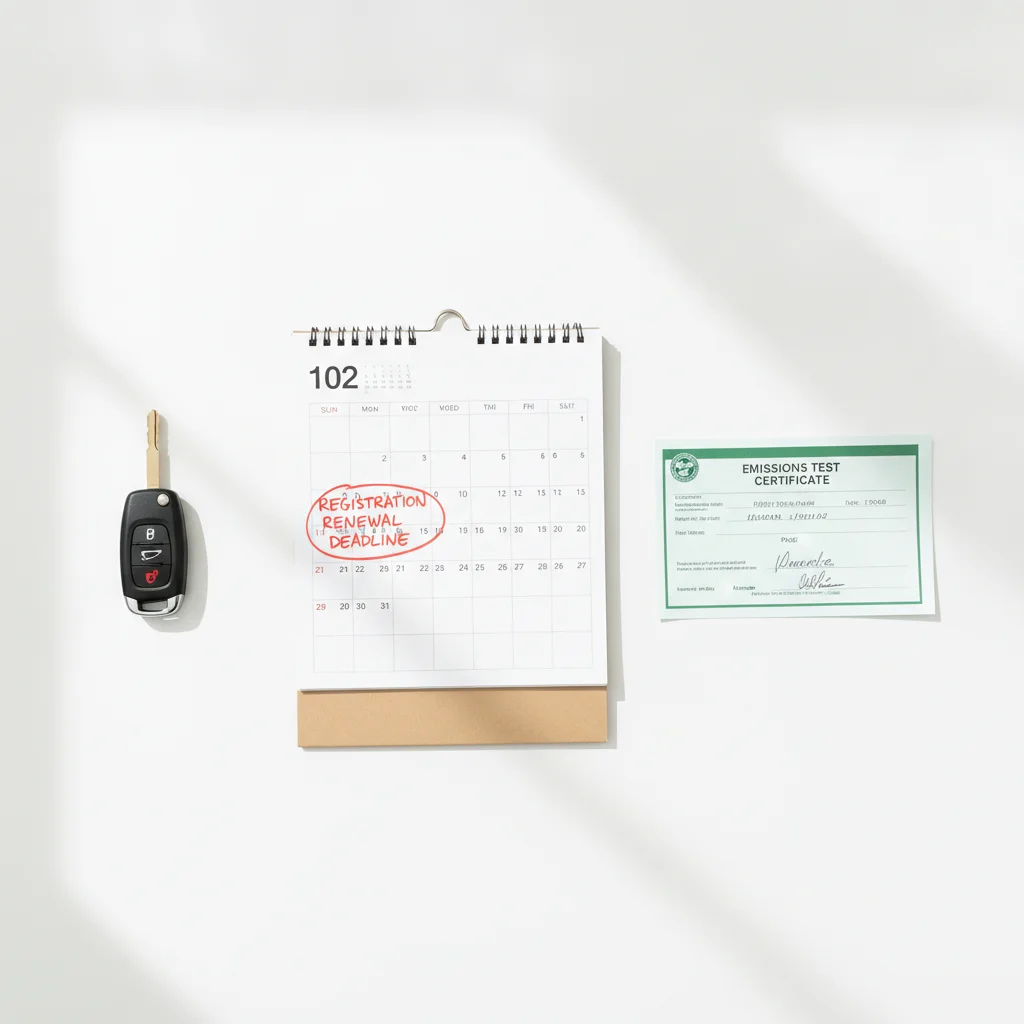
Many drivers wait until the last week of their registration period to get tested. That's a mistake. If you fail, you have almost no buffer to repair and retest before your registration expires. A smarter approach is to treat the emissions test as the first step in your renewal process, not the last.
Most state programs allow you to test anytime within a defined window before your renewal is due — commonly 60 to 90 days in advance. Testing early means:
- You have time to get a proper shop diagnosis and repair estimate
- You can compare repair costs and avoid rushed decisions
- You won't be scrambling with an expired registration sticker while waiting for parts
- If you need a waiver, you have time to accumulate the required repair documentation
Registration renewal fees themselves can also change year to year based on vehicle value, weight, and local levies. For a breakdown of what drives those changes, see Annual Registration Renewal: What Changes Each Year.
If you've recently moved to a new state, be aware that your new state's emissions requirements may differ entirely from what you were used to — and re-registration timelines are usually tight. Moving to a New State With Your Car covers exactly what to check before your deadline hits.
Emissions Testing When Buying a Used Car
Emissions status matters before you buy, not just when you own. A used vehicle with a stored fault code or a recently disconnected battery (which clears readiness monitors) may appear fine during a test drive but fail inspection within weeks of purchase — leaving you holding the repair bill.
Before finalizing a used car purchase, ask these questions:
- When was the last emissions test, and did it pass?
- Is the check engine light on or has it been recently reset?
- Has the catalytic converter ever been replaced?
A pre-purchase inspection by an independent mechanic can catch emissions system faults before they become your problem. If you're in the process of evaluating a used vehicle, Test Drives & Inspections provides a structured approach to what to look for and ask.
Sellers occasionally clear fault codes right before a sale to temporarily extinguish the check engine light. You can detect this by checking whether OBD-II readiness monitors show as incomplete — a telltale sign the car's computer was recently reset. Any reputable pre-purchase inspection will check this automatically.
County-Level Rules Can Differ Significantly
Even within a state that requires emissions testing, not all counties participate. For example, in Texas, only vehicles registered in certain urban counties — including the Dallas-Fort Worth metroplex and the Houston area — must pass an emissions test. A vehicle registered in a rural Texas county has no such requirement. Always verify requirements at the county level, not just the state level.
Watch for Cleared Codes When Buying Used
An OBD-II scanner that shows multiple readiness monitors marked 'Not Ready' or 'Incomplete' is a red flag during a used car purchase. It typically means the vehicle's ECM was recently reset — possibly to hide a fault code before the sale. Allow the car to complete a full drive cycle and recheck the monitors before making a final purchase decision.

All claims are backed by peer-reviewed research. Sources on request.