

Key Takeaways
Why Steering Symptoms Deserve Immediate Attention
Your steering system is the most direct mechanical link between you and the road. When something goes wrong inside it — whether in the rack, the tie rods, the power assist pump, or the wheel bearings — the car tells you immediately through the feel of the steering wheel. The problem is that many drivers have learned to live with subtle changes: a little extra play, a slight pull to the right, a faint groan on cold mornings. Those adaptations are how a manageable $200 repair becomes a $1,400 overhaul.
Steering problems don't fix themselves. They progress. A loose tie rod end wears faster once it's loose. A low power steering fluid reservoir suggests a leak that will eventually leave you without assist entirely. Understanding what a symptom is telling you — and how urgent it actually is — is the difference between a quick shop visit and a roadside breakdown or worse.
This guide breaks down the most common steering warning signs, what's likely causing them, and what happens to your wallet if you ignore them. If you've already noticed something off behind the wheel, the driver's guide to recognizing pre-failure signals is a good companion read for understanding the bigger picture.
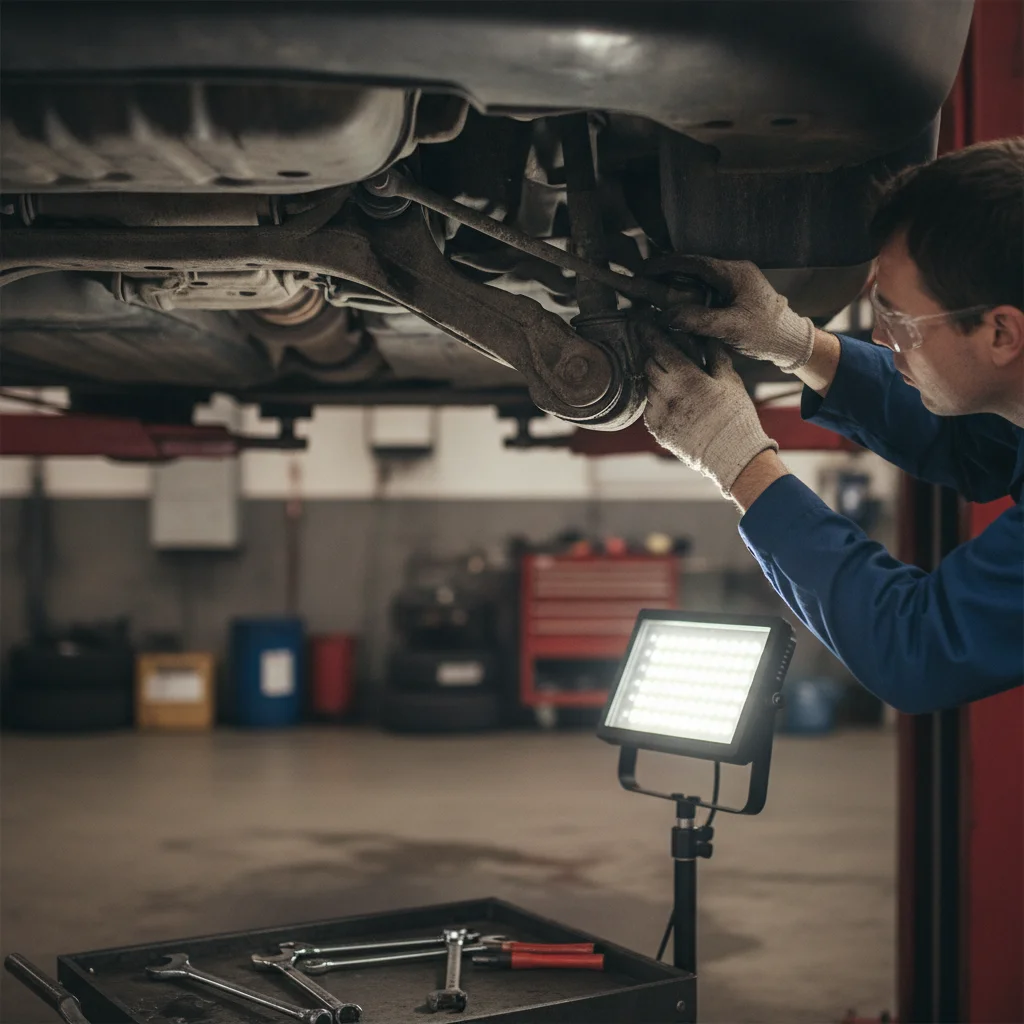
Below are seven steering symptoms you should never rationalize away — and the mechanical realities behind each one.
The Car Pulls Consistently to One Side
A steady pull — where you have to hold the wheel slightly off-center just to go straight — is one of the most common and most misunderstood steering complaints. Drivers often assume it's a tire pressure issue and move on. Sometimes it is. But persistent pulling that doesn't resolve after correcting tire pressure points to something that needs hands-on diagnosis.
The most frequent causes, in rough order of likelihood:
- Wheel alignment out of spec — The most common culprit. Camber, toe, or caster angles have shifted, usually from hitting a pothole or curb. An alignment is a quick, inexpensive fix ($80–$150) that prevents uneven tire wear from compounding the problem.
- Uneven tire wear or a belt-shifted tire — A tire with a shifted internal belt creates its own directional force. Rotation or replacement solves it.
- Brake drag on one side — A sticking caliper creates uneven braking force, which pulls the car toward that wheel. This is more urgent because it generates heat that can damage rotors and compromise stopping power.
- Worn or collapsed strut/spring on one side — Asymmetric suspension height changes how the car tracks. This one is rarely cheap to fix, but it's also rarely subtle.
Understanding why your car pulls to one side matters before you authorize any repair — misdiagnosis here leads to repeat shop visits and wasted money.
A persistent pull often signals alignment, tire, or brake issues — not something to correct and ignore.
Excessive Play or Looseness in the Steering Wheel
Pick up the steering wheel and move it gently side to side without the car responding. A small amount of play — roughly an inch or less measured at the rim — is normal in most vehicles, particularly older ones. When that free movement grows to two or three inches, or you notice a loose, imprecise feeling during normal cornering, something in the steering linkage is worn.
[in_content_images:1]The most likely sources:
- Worn tie rod ends — These ball-and-socket joints connect the steering rack to the wheel hubs. As the socket wears, clearance develops. Shake the front wheel at 9 and 3 o'clock with the car on a lift — movement indicates a worn tie rod. Replacement typically runs $150–$400 per side including alignment.
- Worn steering rack bushings — The rack mounts to the subframe via rubber bushings. When they deteriorate, the whole rack shifts slightly under steering input, creating a vague, floating sensation.
- Loose steering column coupler or intermediate shaft — Less common but worth checking if the looseness feels centralized in the column itself rather than at the front wheels.
Excessive play is a safety concern because it reduces your ability to make precise corrections. On a highway, that margin matters enormously. This is not a "monitor it" situation — have it inspected promptly.
More than an inch of steering wheel play usually means worn tie rod ends — a direct safety issue.
Stiff or Heavy Steering, Especially at Low Speed
Power steering systems — hydraulic or electric — exist specifically to reduce the effort required to turn the wheel at parking lot speeds. When the wheel feels unusually heavy, something in that assist system is failing.
For hydraulic power steering systems:
- Low fluid level — Check the reservoir under the hood. Low fluid almost always means a leak somewhere in the system: the hose, the pump, the rack seals, or the steering gear itself. Topping it off without finding the source is a temporary solution.
- Failing power steering pump — A worn pump doesn't generate enough pressure to assist the rack. You may also hear a whine or groan, especially on cold starts or during full-lock turns.
- Restricted or collapsed hose — Less common, but a kinked or deteriorating hose reduces fluid flow under pressure.
For electric power steering (EPS) systems:
- A steering warning light on the dash often accompanies EPS failure. Common causes include a faulty torque sensor, failing EPS motor, or loss of power to the EPS control module.
- Some EPS faults are software-related and can be resolved with a module update — others require physical replacement of the EPS rack assembly, which can run $800–$2,000 or more.
Stiff steering that's worst in cold weather and improves as the car warms up often points to a hydraulic pump that's on its way out. The thickened cold fluid overwhelms a marginally functioning pump. That warm-up improvement is a false reprieve — the underlying wear continues.
Stiff steering at low speeds often points to a failing power steering pump or low hydraulic fluid level.
Steering Wheel Vibration or Shimmy
A vibration that travels through the steering wheel is the chassis talking directly to your hands. Pinpointing the cause requires noting when it happens: at a specific speed, during braking, continuously, or only on rough roads.
- Vibration at highway speed (usually 60–75 mph) — Almost always a wheel balance issue. An out-of-balance tire creates a rotational wobble that resonates through the suspension at specific speeds. A $15–$20-per-wheel balance service fixes it. If balancing doesn't resolve it, suspect a belt-shifted tire or a bent wheel.
- Shimmy during braking — Warped brake rotors. The rotor thickness variation causes the caliper to pulse under braking force, which travels back through the steering. Resurface or replace the rotors; don't drive on them for long since heat buildup accelerates the damage.
- Vibration at all speeds on rough roads — Worn shock absorbers or struts allow excessive wheel movement over bumps. This isn't just comfort — poor damping degrades tire contact with the road surface, affecting braking and cornering stability.
- Steering shimmy through a speed range that then clears — Often a worn wheel bearing. Listen for an associated hum or roar that changes pitch with vehicle speed. See symptom #6 below for more on wheel bearings.
The companion guide to strange car noises can help you pair any sounds with the vibration to narrow down the source.
Speed-specific steering vibration usually means a wheel balance or tire issue — the cheapest fix on this list.
Wandering or Vague Steering That Won't Hold a Line
If you feel like you're constantly making small corrections to keep the car tracking straight — a sensation sometimes called "highway wander" — the steering system lacks the crispness it should have. This is different from a pull: the car doesn't consistently drift one direction, it just never settles into a stable line.
[in_content_images:2]Key causes of wandering steering:
- Incorrect toe alignment — Toe-out causes each front wheel to point slightly away from the other, creating a tendency to wander. A proper four-wheel alignment corrects it.
- Worn ball joints — Ball joints allow the steering knuckle to pivot. As they wear, they introduce small, inconsistent movements that prevent the wheel from tracking precisely. Severely worn ball joints can separate — a catastrophic failure — so take this seriously.
- Worn strut bearings or upper mounts — These components allow the strut to pivot as you steer. When they wear or corrode, steering feel becomes notchy and vague rather than smooth and linear.
- Loose or worn steering rack mounts — If the rack itself shifts slightly under load, precise steering inputs get blurred.
Wandering steering is exhausting and distracting on long drives, but more importantly, it signals structural looseness that compounds over time. Each worn component allows adjacent parts to move more than they should, accelerating wear across the system. For more on what to feel for during normal driving, see steering and suspension feel — what to notice from the driver's seat.
Highway wander often signals worn ball joints or incorrect alignment — both of which worsen quickly if ignored.
Grinding, Humming, or Clunking Noises When Turning
Steering-related noises are among the most diagnostic symptoms your car produces. They frequently point to specific components, and the character of the sound — when it happens and what it sounds like — tells a trained ear a great deal.
- Grinding or groaning during low-speed turns (parking lots, U-turns) — Classic power steering pump distress signal in hydraulic systems. Often louder when the fluid is cold or the wheel is held at full lock. Check fluid immediately.
- Clunking over bumps or during turning — Loose or worn sway bar end links or bushings are a common cause. The clunk is the worn bushing allowing the bar to knock against its mount. Also suspect a worn strut top mount or loose ball joint.
- Humming or roaring that increases with vehicle speed — A wheel bearing on its way out. This sound typically changes pitch when you swerve gently left or right at highway speed: it gets louder when weight shifts onto the bad bearing. Failing wheel bearings can eventually seize, locking the wheel.
- Clicking or popping during sharp turns — In front-wheel-drive vehicles, this almost always indicates a worn CV (constant velocity) axle joint. The boot may have torn, allowing the grease to escape and contamination to enter. CV axle replacement runs $150–$400 per side.
Any new noise during steering input is worth investigating. The strange car noises guide provides more detail on matching sounds to specific failure modes.
Clicking during sharp turns on a front-wheel-drive car almost always means a worn CV joint — address it before it fails.
Steering Wheel That Isn't Centered When Driving Straight
Sit in a parking lot with the car pointing straight ahead and look at your steering wheel. In a properly aligned vehicle, the wheel should be level — the logo centered, the spokes horizontal. If the wheel sits noticeably off-center while the car tracks straight, alignment is off. This is not purely cosmetic.
An off-center steering wheel means your front wheels are not pointing where your steering geometry expects them to. That misalignment causes:
- Accelerated tire wear — The tire scrubs the road at a slight angle, wearing the inner or outer edge prematurely. You may not notice it for months, but when you do, the tires may already be unsafe.
- Suspension component stress — Consistent misalignment puts uneven load on tie rods, ball joints, and wheel bearings, shortening their service life.
- Reduced steering precision — Your hands are always compensating for the offset, which fatigues you on longer drives and delays corrective steering inputs.
An off-center wheel is almost always corrected during a standard four-wheel alignment. However, if the wheel was centered before a recent collision — even a minor one — have the steering geometry inspected carefully. Impact forces can bend steering components that look intact visually but are structurally compromised.
[tip_callout]For anyone evaluating a used car, a noticeably off-center steering wheel is a red flag worth probing. It could mean deferred maintenance, an unreported accident, or a prior repair done without a proper alignment. Check the test drives and inspections hub for a full checklist of what to assess before buying.
An off-center steering wheel while driving straight signals alignment issues that are quietly wearing your tires down.
When to Stop Driving and Get an Inspection
Not every steering symptom requires pulling over immediately, but a few absolutely do. If your steering wheel suddenly becomes extremely heavy with no warning, if your car drifts sharply to one side without steering input, or if you hear a loud clunk followed by a noticeable change in steering response, those are stop-the-car situations. Continuing to drive risks losing directional control entirely.
For symptoms that are gradual — a slow-developing pull, intermittent groaning, or increasing play — schedule a shop visit within a few days, not a few weeks. Ask your technician to perform a full suspension and steering inspection, not just a visual check. Many steering failures are tactile before they're visible.
EPS Warning Lights Are Not Always Catastrophic
Electric power steering systems often illuminate a warning light for faults that range from minor (a low battery voltage event that reset the module) to serious (a failed torque sensor or EPS motor). If the light comes on but steering still feels normal, it's appropriate to drive carefully to a shop — but don't delay. Some EPS faults are intermittent at first and then become permanent, at which point you're driving without assist.
Hydraulic vs. Electric Power Steering — Key Difference
Vehicles built before roughly 2012 predominantly use hydraulic power steering, driven by a belt-driven pump and fluid reservoir. Most modern vehicles use electric power steering (EPS), which uses a motor mounted on the steering column or rack. The diagnostic approach for stiffness, noise, and failure is entirely different between the two systems. Knowing which system your car has before visiting a shop helps you have a more informed conversation with your technician.
If you're evaluating a used car and notice any of these symptoms during a test drive, take them seriously. The guide to steering and suspension feel from the driver's seat explains exactly what to feel for before you commit to a purchase. And if you're assessing how urgent any symptom is, this list of warning signs you should never ignore while driving draws a clear line between monitor-and-address and pull-over-now.
Check Your Fluid Before Anything Else
If your steering suddenly feels heavy, the first thing to check — before booking a shop appointment — is the power steering fluid reservoir. It's usually a small translucent reservoir near the engine labeled with a steering wheel icon. Low fluid is a quick diagnosis you can make yourself in 30 seconds. If it's low, that tells you there's a leak somewhere; topping it off buys you time to get to a shop safely, but it's not the fix.
Get a Four-Wheel Alignment After Any Suspension Repair
Any time a suspension or steering component is replaced — tie rod, ball joint, strut, control arm — the alignment must be reset afterward. Skipping the alignment after a parts replacement is false economy: the new component will wear unevenly and the car will pull or wander just as before. Budget $100–$150 for a four-wheel alignment as a standard part of any steering or suspension repair.
Steering repairs caught early are almost always cheaper and simpler. A wheel alignment runs $80–$150. A full rack-and-pinion replacement runs $1,000–$2,500 depending on the vehicle. The math is straightforward — the sooner you act, the less it costs.

All claims are backed by peer-reviewed research. Sources on request.