Key Takeaways
Tire Pressure & Wheel Alignment
Tire pressure is the amount of air inside each tire, measured in pounds per square inch (PSI), which determines how the tire contacts the road. Wheel alignment refers to the angle and direction your tires point relative to each other and the road surface. Together, these two settings govern your car's handling, braking performance, fuel economy, and tire lifespan. When either is off — even slightly — the effects compound quietly until something fails or wears out prematurely.
Alignment is measured across three angles: camber (vertical tilt), toe (inward/outward angle), and caster (steering axis tilt). Modern vehicles often require four-wheel alignment checks, not just front-axle adjustments.
Why These Two Services Are Almost Always Treated Separately — and Why That's a Mistake
Walk into most service centers and you'll find tire pressure and wheel alignment treated as completely unrelated services — one checked during an oil change, the other performed only when a driver complains about pulling or vibration. That separation reflects how auto service is typically billed, not how tire mechanics actually work.
In reality, these two maintenance items are deeply interdependent. Misalignment accelerates uneven tire wear. Uneven tire wear changes how contact pressure is distributed across the tread. Abnormal pressure distribution alters the effective inflation behavior of the tire. The cycle feeds itself until tires are ruined, fuel economy is suffering, and — in the worst cases — vehicle handling is genuinely compromised.
The good news is that monitoring both is straightforward and inexpensive. The expensive part is ignoring them. This article breaks down exactly what each service does, what the science says about the consequences of neglect, and how to build a simple, sustainable maintenance routine around both.
For a deeper look at what tire condition can tell you before you buy a used car, see our piece on tire wear patterns and what they reveal about a used car.
Tire Pressure: What It Does and What Happens When It's Wrong
Every tire on your car is designed to carry the vehicle's weight at a specific inflation level. That number — the recommended PSI — is engineered to balance load capacity, ride quality, handling response, and tread wear. It's not an approximation. It's a calibrated specification.
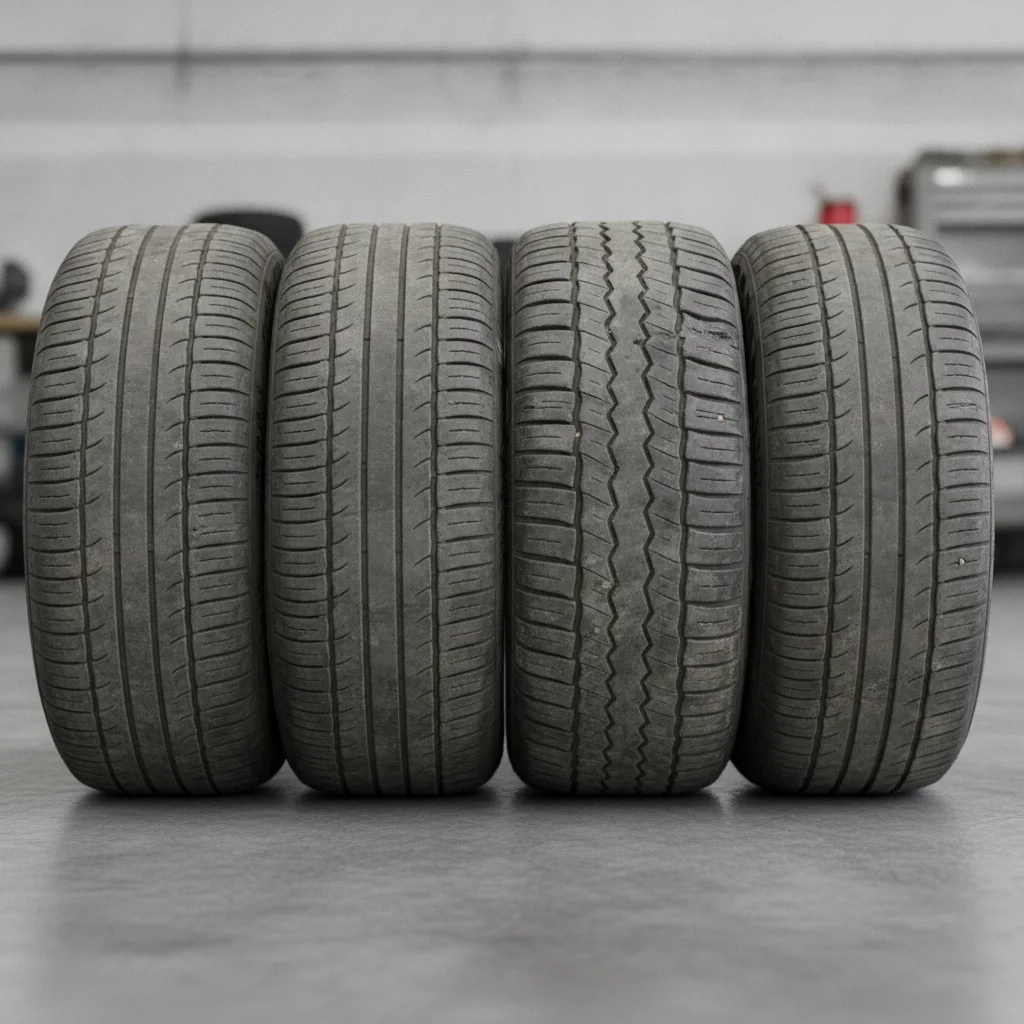
When pressure drops below that spec, the tire's sidewalls flex more than intended with each rotation. This generates excess heat, the primary driver of internal tire degradation. The tread footprint also widens, which sounds like more grip but actually causes the contact patch to carry load unevenly, wearing the outer edges of the tread faster than the center.
~50%
Vehicles with at least one underinflated tire
The Tire Safety Coalition estimates roughly half of all passenger vehicles on U.S. roads have at least one significantly underinflated tire at any given time.
0.2%
Fuel economy lost per 1 PSI below spec
The U.S. Department of Energy reports that fuel economy drops approximately 0.2% for every 1 PSI of underinflation below the recommended level.
28 ft
Sideways drag per mile from minor misalignment
A tire just 0.17 degrees out of alignment effectively scrubs sideways approximately 28 feet for every mile traveled, according to alignment engineering references.
25%
TPMS activation threshold below recommended PSI
Federal regulations require TPMS warning lights to activate when pressure reaches 25% below the vehicle manufacturer's recommended inflation — well past the point where performance is already degraded.
1–2 PSI
Natural pressure loss per month
Tires lose approximately 1–2 PSI per month through normal permeation, independent of leaks or temperature changes, according to tire industry standards.
When pressure exceeds the recommended level, the contact patch narrows. The center of the tread bears disproportionate load, creating center-wear patterns. Overinflated tires are also less able to absorb road impacts, transmitting more force into wheel and suspension components.
The Tire Safety Coalition has found that roughly half of all passenger vehicles on American roads have at least one significantly underinflated tire at any given time. Most drivers don't notice because underinflation at moderate levels — say, 5 to 8 PSI low — is virtually undetectable by feel. It's only when pressure drops to around 25% below the recommended level that the Tire Pressure Monitoring System (TPMS) light illuminates. By that point, the tire has already been sustaining stress for weeks or months.
TPMS Is a Last Resort, Not a Monitoring Tool
The Tire Pressure Monitoring System required on all U.S. passenger vehicles since 2008 is a safety floor, not a maintenance guide. It alerts you only when pressure has dropped to roughly 25% below the manufacturer's recommended level — a point at which the tire has already been under stress for some time. Relying on the TPMS light as your primary pressure gauge means you're always reacting to a problem rather than preventing one.
Front-End vs. Four-Wheel Alignment
Many older or simpler vehicles offer only front-end alignment adjustment, since the rear suspension geometry is fixed. Modern vehicles with independent rear suspension typically require four-wheel alignment, which costs more but provides a complete picture of how all four tires relate to each other. If your shop only offers front-end alignment for a vehicle with adjustable rear suspension, it's worth asking why.
Your Owner's Manual Overrides Everything
Tire inflation specs vary significantly between vehicles and even between trim levels of the same model. Some performance or luxury vehicles specify different pressures for front and rear tires. The sticker inside the driver's door jamb is your authoritative reference — always cross-check it against any third-party recommendation before adjusting inflation.
For the full picture on how pressure loss quietly drains your MPG, tire pressure and fuel economy: what the numbers actually mean is worth reading alongside this article.
Wheel Alignment: The Invisible Force Shaping Every Mile You Drive
Alignment is a concept that's easy to dismiss as abstract — until you understand the geometry. Every tire on your car rolls on a slightly defined angle relative to vertical and horizontal planes. Factory alignment specs position those angles within tight tolerances so that tires roll straight, steering returns to center naturally, and wear is distributed evenly across the tread.
Even a small deviation changes everything. Research by automotive engineers often cited in alignment training materials illustrates the problem with a striking analogy: a tire that's just 0.17 degrees out of alignment — barely detectable without instruments — effectively drags sideways for 28 feet with every mile driven. Multiply that across 15,000 miles annually, and the cumulative scrubbing force on the tread is enormous.
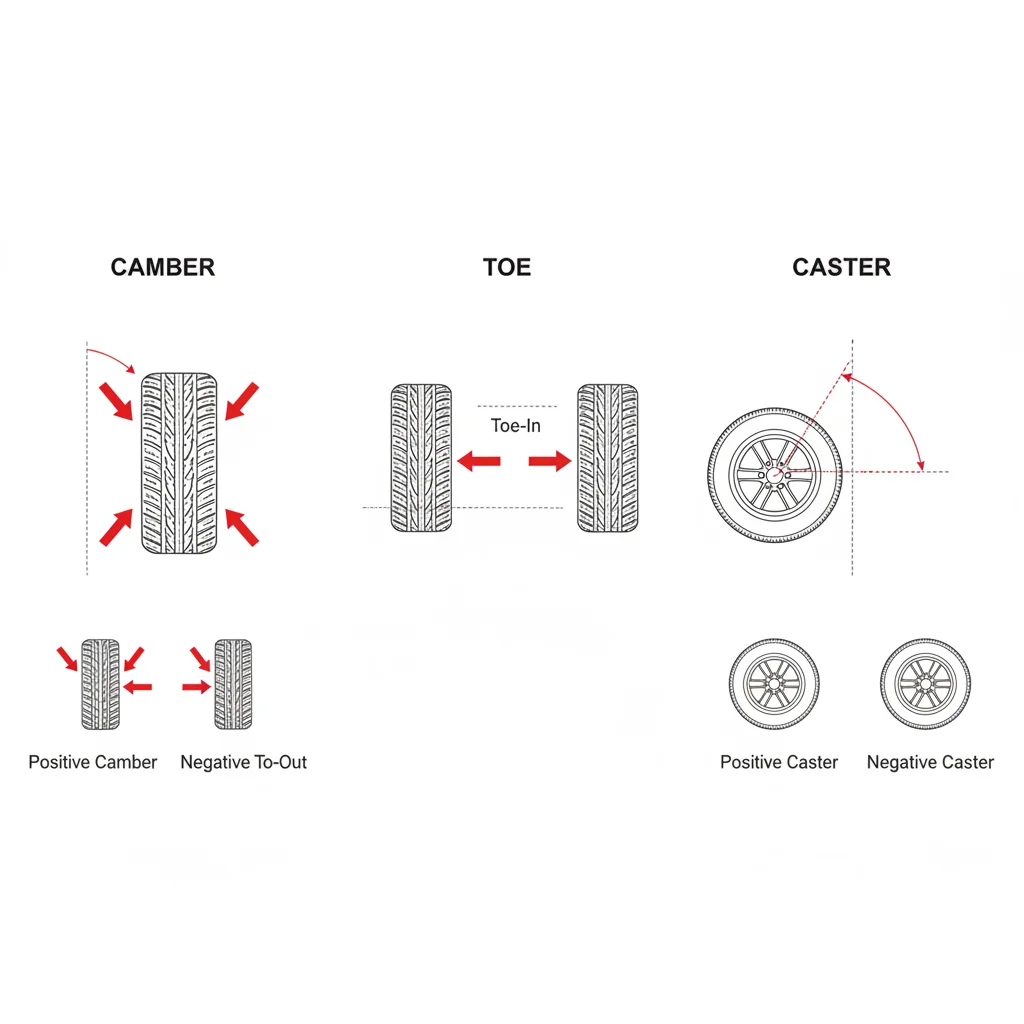
The three alignment angles that matter most are:
- Camber: The inward or outward tilt of the tire when viewed from the front. Excessive negative camber (top of tire leaning inward) wears the inner edge; excessive positive camber wears the outer edge.
- Toe: Whether the fronts of the tires point inward (toe-in) or outward (toe-out) relative to each other. Toe errors are the most common and cause feathering or diagonal wear across the tread face.
- Caster: The angle of the steering axis viewed from the side. Uneven caster between left and right sides causes pulling to the lower-caster side.
Alignment can drift out of spec gradually through ordinary driving — road vibration slowly shifts components — or suddenly through a significant impact like a pothole or curb strike. Either way, it typically won't cause a sudden crisis. It simply costs you tire tread, fuel, and handling precision a little at a time.
“Alignment is the one adjustment that affects everything simultaneously — tire wear, fuel consumption, handling, and even brake effectiveness. Most drivers only think about it when something obvious goes wrong, but by then the damage is already done.”
— John Rastetter, Director of Tire Information Services, Tire Rack
If your vehicle has been pulling to one side, our article on why your car pulls to one side and the fixes that actually work explains how to distinguish alignment problems from brake and suspension causes before paying for a repair.
The Real Cost of Neglecting Both — Simultaneously
Individual consequences are significant enough. Combined neglect is where maintenance costs truly compound.
Consider a scenario most mechanics recognize immediately: a driver runs tires 6 PSI underinflated for several months. The soft tires develop accelerated shoulder wear. The driver notices uneven tread and heads to a tire shop. New tires are purchased. But if the alignment that contributed to the uneven wear isn't corrected at the same appointment, the new tires will begin developing the same pattern within months. This cycle — new tires, same misalignment, premature wear, repeat — is one of the most preventable expenses in vehicle ownership.
Stack These Services Together to Save
The most cost-efficient time to check alignment is immediately after installing new tires. Many tire retailers include a free alignment check with installation — take them up on it. Even if alignment turns out to be fine, the printout gives you a baseline for comparison at your next annual check.
Check Pressure When Tires Are Cold
Always measure tire pressure before driving more than one mile or after the car has sat for at least three hours. Heat from driving temporarily raises pressure by 4–6 PSI, which can make an underinflated tire appear acceptable. The PSI listed on your door jamb sticker is the target cold inflation pressure.
The financial case for simultaneous service is straightforward:
- A set of mid-range passenger tires costs $400–$800 installed. Chronic misalignment can reduce tread life by 25% or more, effectively adding hundreds of dollars in early replacement costs.
- According to the U.S. Department of Energy, proper tire inflation can improve fuel economy by up to 3% compared to significantly underinflated tires. At $3.50/gallon and 15,000 miles annually, that's a meaningful real-dollar saving depending on your vehicle's MPG baseline.
- Misalignment stresses tie rods, ball joints, and wheel bearings. Correcting alignment proactively is far cheaper than replacing suspension components after they've been worn by abnormal loading.
The safety implications extend beyond money. NHTSA research on tire pressure and road safety documents how underinflated tires meaningfully extend stopping distances and raise blowout risk — risks that are easily and cheaply avoided.
Building a Practical Monitoring Routine
Consistency matters more than precision here. A simple, regular habit eliminates most of the risk that neglect creates.
Tire Pressure: Monthly and Seasonal
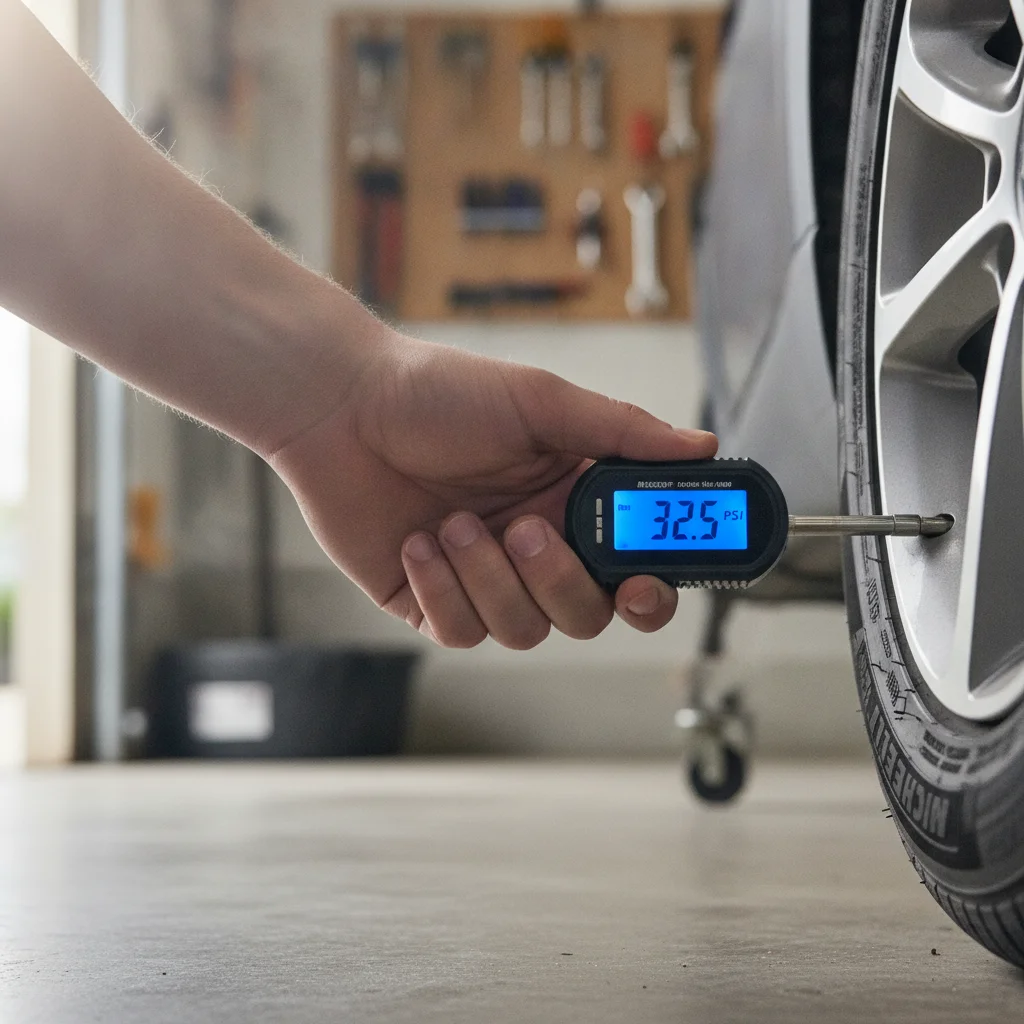
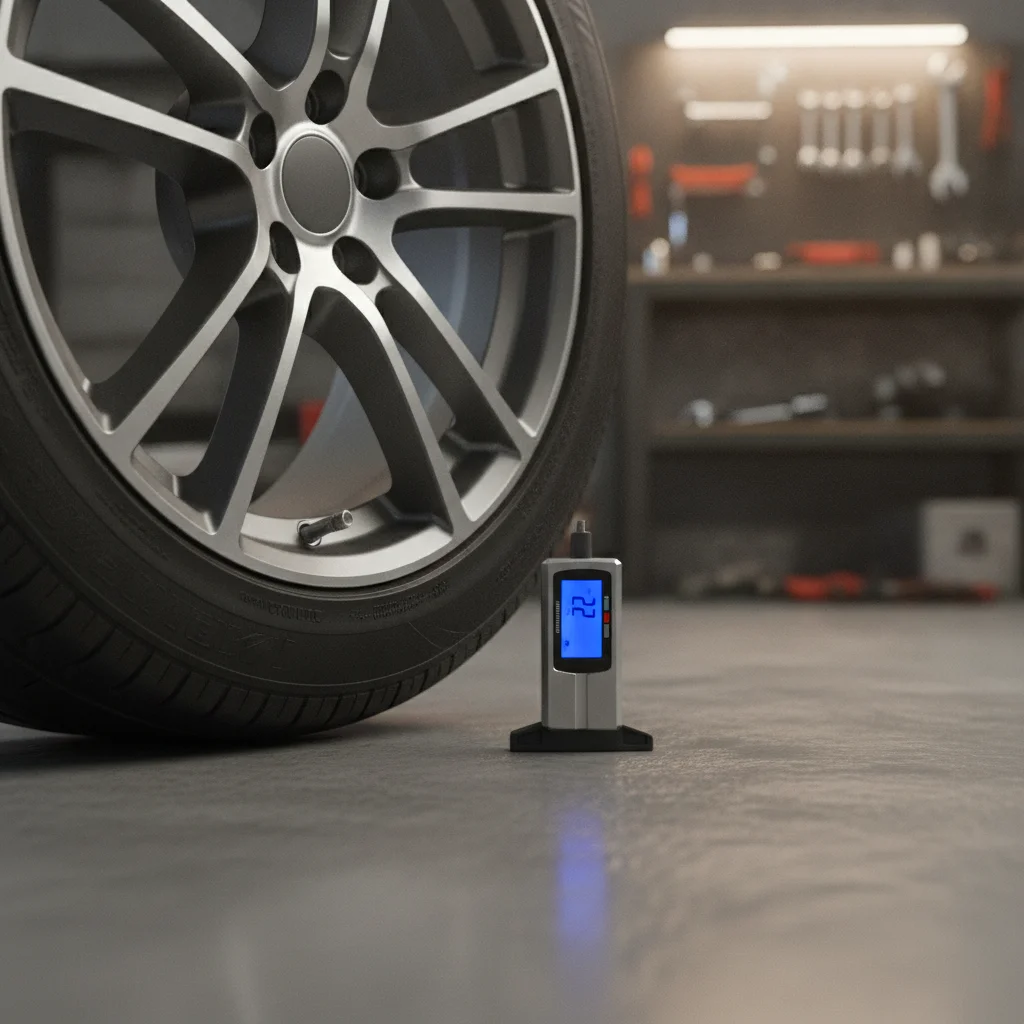
Check tire pressure once a month and before any road trip. Always measure when the tires are cold — meaning the car has been parked for at least three hours and driven fewer than one mile since. Heat from driving temporarily inflates pressure readings by 4–6 PSI, which can mask underinflation. A quality analog or digital gauge costs $10–$20 and will outlast multiple sets of tires.
During seasonal transitions — particularly as fall temperatures drop — add an extra check. Tire pressure falls approximately 1 PSI for every 10°F drop in ambient temperature. A tire correctly inflated at 35 PSI in September could easily read 30–31 PSI by December without ever losing air to a leak.
Wheel Alignment: Annual and Event-Based
The standard industry recommendation is an alignment check once per year or every 12,000–15,000 miles. Beyond the calendar, there are specific events that warrant an immediate check regardless of schedule:
- Striking a significant pothole, curb, or road debris at speed
- Any front-end collision, even minor
- Installation of new tires (especially if you noticed uneven wear on the outgoing set)
- Any suspension or steering component replacement
- A sudden change in how the vehicle tracks or steers
For EV owners, tire maintenance carries additional urgency. The added weight of battery packs and the instant torque of electric motors accelerate wear in ways most owners don't anticipate. Our reporting on the hidden cost of ignoring EV tire rotation covers this in depth, and the same logic applies to pressure and alignment management.
General tire maintenance discipline — rotation, balance, pressure, alignment — is also covered in our fuel and efficiency hub for drivers focused on reducing overall operating costs.
Reading the Warning Signs Before Damage Gets Expensive
Both problems telegraph themselves if you know what to look for. The challenge is that most drivers only notice symptoms when they've already escalated.
Pressure Warning Signs
- TPMS light illuminated (remember: this activates late, at roughly 25% below spec)
- Visibly soft-looking tire — though this is unreliable; many underinflated tires look normal
- Sluggish steering response or a feeling of vagueness through corners
- Fuel economy dropping without a clear cause
- Increased road noise, particularly a droning or humming sound
Alignment Warning Signs
- Steering wheel sitting visibly off-center when driving straight on a flat road
- Vehicle consistently drifting to one side when you release the wheel briefly on a flat, straight road
- Steering wheel vibration, particularly at highway speeds
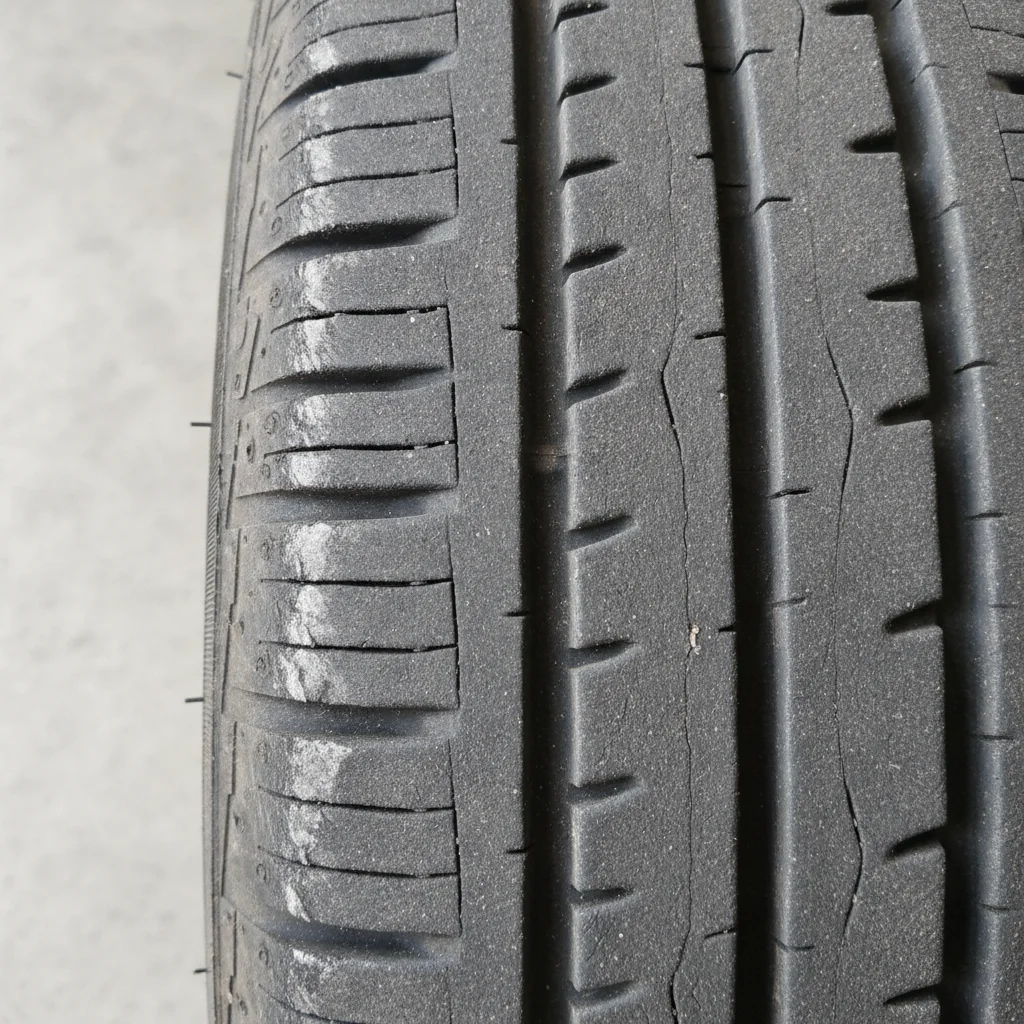
- Rapid or uneven tire wear — especially wear limited to one edge of the tread
- Squealing from tires in low-speed turns
Our Warning Signs hub covers the broader landscape of dashboard alerts and vehicle feedback indicators worth knowing.
If you want to perform a basic visual inspection yourself, our guide to tire rotation at home walks through the process of getting under the car safely and evaluating tread condition while you work.
Stack These Services Together to Save
The most cost-efficient time to check alignment is immediately after installing new tires. Many tire retailers include a free alignment check with installation — take them up on it. Even if alignment turns out to be fine, the printout gives you a baseline for comparison at your next annual check.
Check Pressure When Tires Are Cold
Always measure tire pressure before driving more than one mile or after the car has sat for at least three hours. Heat from driving temporarily raises pressure by 4–6 PSI, which can make an underinflated tire appear acceptable. The PSI listed on your door jamb sticker is the target cold inflation pressure.
What to Expect at the Shop — and How to Avoid Unnecessary Upsells
Alignment and pressure checks are among the most straightforward services in auto maintenance, but they're also among the most commonly used as entry points for upselling. Understanding what a legitimate service involves makes it easier to push back on anything that isn't warranted.
At a Pressure Check
A pressure check is free at most tire shops and gas stations with air pumps. If you're there for an oil change or tire rotation, pressure adjustment should be included at no extra charge. The only scenario requiring additional cost is if a leak is detected — a valve stem replacement runs $5–$15, while a plug-and-patch repair for a puncture typically costs $20–$35.
At an Alignment Service
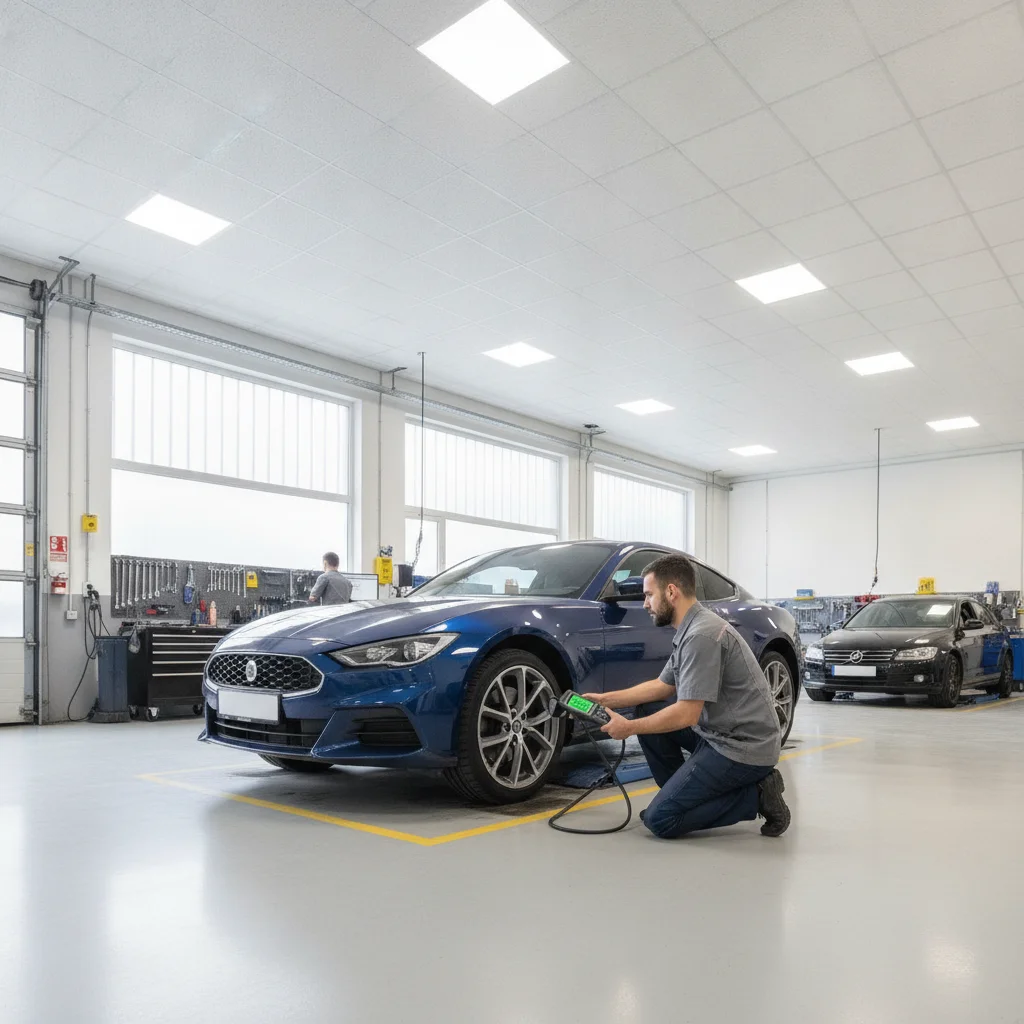
A technician will mount your vehicle on an alignment rack, attach sensors to all four wheels, and use computerized equipment to measure each alignment angle against your vehicle's factory specification. The printout will show before and after measurements — always ask to see it. Legitimate alignment work corrects the angles that are out of spec; it doesn't require new parts unless components are actually damaged or worn.
Red flags include vague explanations of what was wrong, no before/after printout offered, or pressure to replace ball joints, tie rod ends, or control bushings without clear evidence of failure. While those components do eventually wear and can prevent alignment from holding, good shops show you the measurements and the physical evidence before recommending replacement.
TPMS Is a Last Resort, Not a Monitoring Tool
The Tire Pressure Monitoring System required on all U.S. passenger vehicles since 2008 is a safety floor, not a maintenance guide. It alerts you only when pressure has dropped to roughly 25% below the manufacturer's recommended level — a point at which the tire has already been under stress for some time. Relying on the TPMS light as your primary pressure gauge means you're always reacting to a problem rather than preventing one.
Front-End vs. Four-Wheel Alignment
Many older or simpler vehicles offer only front-end alignment adjustment, since the rear suspension geometry is fixed. Modern vehicles with independent rear suspension typically require four-wheel alignment, which costs more but provides a complete picture of how all four tires relate to each other. If your shop only offers front-end alignment for a vehicle with adjustable rear suspension, it's worth asking why.
Your Owner's Manual Overrides Everything
Tire inflation specs vary significantly between vehicles and even between trim levels of the same model. Some performance or luxury vehicles specify different pressures for front and rear tires. The sticker inside the driver's door jamb is your authoritative reference — always cross-check it against any third-party recommendation before adjusting inflation.
A useful framing: tire pressure and alignment are calibration services, not repairs. They restore your vehicle to the specification it was designed to operate at. Treated that way — as routine calibration rather than crisis response — they become far easier to manage on a predictable schedule and budget.

All claims are backed by peer-reviewed research. Sources on request.