Key Takeaways
Insurance Rate Factors Beyond Driving History
Auto insurers don't price policies on driving record alone. Even two drivers with spotless histories can receive vastly different quotes because insurers weigh dozens of variables — including where you live, what you drive, your credit profile, and how much you drive each year. These factors, called rating variables, are proprietary models each insurer develops independently. That's why your neighbor's clean-record quote might be hundreds of dollars less than yours.
Insurers use actuarial data to assign statistical risk to rating variables. Each carrier weights these variables differently, which is why premiums for identical drivers can diverge significantly across companies.
The Clean Record Paradox
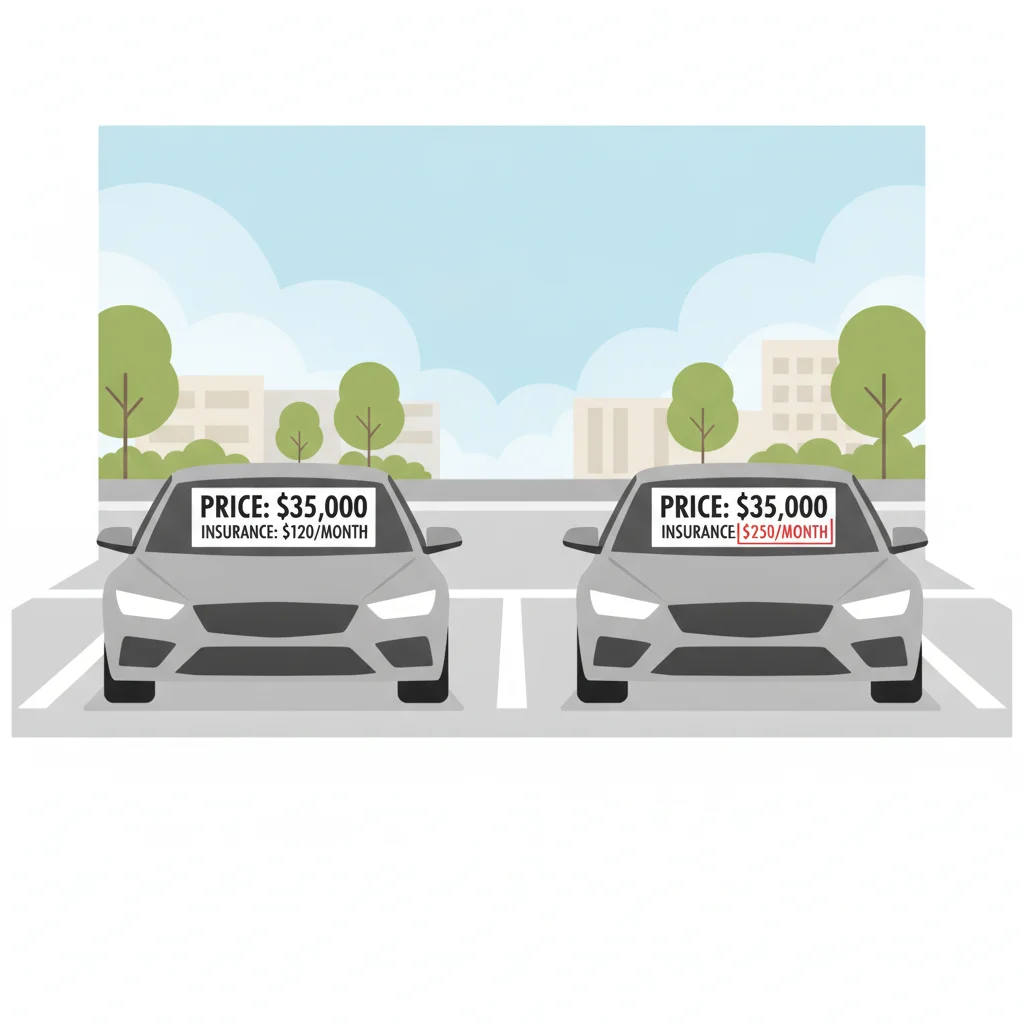
Imagine two drivers — both 38 years old, both with zero accidents or violations over the past decade, both carrying the same liability limits. One gets a quote for $1,100 a year. The other gets $1,750. Same clean record, same coverage request, same insurer. The difference isn't a mistake or a system error. It's the result of a sophisticated actuarial model that looks far beyond the rearview mirror.
This is the clean record paradox: your driving history matters, but it's only one input into a pricing equation that can have dozens of variables. Understanding what those variables are — and how heavily each one pulls on your premium — is the first step toward making smarter insurance decisions.

Auto insurers are fundamentally in the business of predicting risk. They're not evaluating you as an individual in any moral sense; they're placing you into statistical risk pools based on characteristics that correlate with claim frequency and severity. Some of those characteristics you control, and some you don't. The important thing is knowing which is which.
Where You Live: The ZIP Code Effect
Of all the non-driving factors that shape your premium, your geographic location is arguably the most powerful — and the one most drivers underestimate. Insurers slice their risk data down to the ZIP code level, and sometimes even finer. They're looking at local theft rates, accident density on nearby roads, average repair costs at shops in your area, frequency of weather-related claims, and even the quality of local emergency medical services, which influences injury claim costs.
Up to 91%
Premium variation by ZIP code within the same city
Analysis by the Consumer Federation of America found premiums for the same driver profile could vary by up to 91% between ZIP codes in the same metropolitan area.
20–40%
Credit score impact on premium for identical driving records
A 2020 Consumer Reports investigation found drivers with poor credit paid 20 to 40 percent more than those with excellent credit for equivalent coverage and driving profiles.
$847
Average annual savings from shopping multiple insurers
According to the Insurance Information Institute, drivers who compare quotes from at least three carriers save an average of several hundred dollars annually compared to renewing without shopping.
6 in 10
Drivers who haven't compared quotes in over two years
A J.D. Power survey found approximately 60% of auto insurance customers had not compared competitive quotes in the prior two policy cycles.
The practical result: two drivers with identical profiles can see their premiums diverge by 30 to 50 percent simply by living in different ZIP codes within the same city. A driver in a quiet suburban ZIP on the edge of a metro area will often pay meaningfully less than someone three miles away in a dense urban corridor, even if they commute into the same downtown every day.
Moving is obviously not something most people do for insurance savings. But understanding the ZIP code effect does matter in a few practical situations — when deciding where to garage a vehicle, when moving to a new city and building your housing budget, and when evaluating whether a preferred ZIP code is worth any premium cost increase.
States That Restrict Credit Scoring
If you live in California, Hawaii, Massachusetts, or Michigan, your credit profile cannot be used as a rating factor for auto insurance. These states have determined that credit-based scoring creates unfair pricing disparities. Drivers in these states should focus their attention on other rating variables when trying to understand and reduce their premiums.
Garaging Address vs. Mailing Address
Insurers typically rate your policy based on the address where your vehicle is regularly parked overnight — called the garaging address — not necessarily your mailing address. If you move, update your garaging address promptly. Failure to do so isn't just a pricing issue; it can affect the validity of a claim if the insurer discovers a material discrepancy.
Your Credit-Based Insurance Score
This is the factor that surprises — and frustrates — the most drivers. In the majority of U.S. states, insurers are permitted to use a credit-based insurance score as a rating variable. This score is calculated from elements of your credit profile, including payment history, outstanding balances, length of credit history, and credit mix. It is not your FICO score, but it draws from the same underlying data.
The reason insurers use this factor is statistical: decades of actuarial research have shown a correlation between lower credit-based insurance scores and higher claim frequency and severity. The industry argues this relationship holds even after controlling for driving record. Critics counter that it can create pricing disparities that disproportionately affect lower-income drivers.
“Credit-based insurance scores have become one of the most significant pricing variables in auto insurance, yet most consumers have no idea they're being used. That information asymmetry costs drivers real money every year.”
— J. Robert Hunter, Former Director of Insurance, Consumer Federation of America
Regardless of where one falls in that policy debate, the practical impact is real. A driver with an excellent credit-based insurance score may pay 20 to 40 percent less than a driver with a poor score — even if both have spotless driving records. Some states have responded: California, Hawaii, Massachusetts, and Michigan restrict or prohibit the use of credit information in auto insurance pricing. If you live elsewhere, your credit profile is almost certainly part of your rate calculation.
The actionable takeaway: improving your broader credit health — paying down revolving balances, avoiding late payments, and not opening too many new accounts at once — can translate into insurance savings over time. It's not immediate, but it compounds.
What You Drive and How You Drive It
Two drivers with the same record don't necessarily drive the same car. And the vehicle you choose is one of the most direct levers on your insurance cost. Insurers evaluate each make and model on several dimensions:
- Repair and replacement cost: A vehicle with expensive parts, specialized repair requirements, or limited aftermarket availability will cost more to insure. Luxury and European import brands often fall into this category.
- Theft rates: Certain vehicles are targeted by thieves far more frequently than others. The National Insurance Crime Bureau publishes annual data on the most stolen vehicles, and insurers use similar data to price comprehensive coverage.
- Safety ratings: Vehicles that perform well in crash tests and have advanced safety features — automatic emergency braking, lane-keeping assist, blind-spot monitoring — often earn discounts because they're statistically less likely to be in severe accidents.
- Horsepower and performance profile: High-performance vehicles correlate with higher-speed driving and more severe accidents when crashes do occur, so insurers typically price them accordingly.
For a deeper look at how your specific vehicle affects your quote, see our guide on how the car you drive shapes the price you pay to insure it.

Beyond the vehicle itself, how you use it matters. Annual mileage is a standard rating variable: more miles driven means more exposure time on the road, which correlates with higher claim likelihood. Drivers who commute long distances will typically pay more than those who work from home or use their car only on weekends. Usage-based insurance programs — which use a mobile app or plug-in device to monitor actual driving behavior and mileage — have emerged as a way to let low-mileage or safe-driving-style drivers demonstrate their profile directly, sometimes earning significant discounts.
If you drive an electric vehicle, the insurance picture has its own nuances. EVs often carry higher repair costs due to battery complexity and specialized labor, but many earn safety and theft-related advantages. The EV Insurance Guide breaks down how coverage for electric vehicles differs from conventional gas-car policies.
Coverage History, Lapses, and Policy Tenure
Insurance companies don't just look at what you've done on the road — they look at what you've done as an insurance customer. Continuous coverage is one of the most overlooked rate factors. A driver who has maintained uninterrupted auto insurance for several years is seen as a lower risk than one who has had gaps, even if both have clean records.
A coverage lapse — even a short one — signals to insurers that you may have driven uninsured, which correlates statistically with higher-risk driving behavior. It can also indicate financial instability. The penalty for a recent lapse varies by carrier, but it can raise your rate noticeably for the first policy term after you return to coverage.
Don't Let a Coverage Gap Linger
If you've experienced a lapse in auto insurance — even a brief one — getting back into continuous coverage as quickly as possible limits the financial damage. The longer you maintain uninterrupted coverage after a gap, the faster the surcharge effect fades. Some insurers also allow you to document the reason for a lapse, which may mitigate the penalty.
Shop the Market Every 12–18 Months
Your risk profile changes over time — your credit improves, violations age off, your vehicle depreciates — and the insurance market shifts around you. Setting a calendar reminder to compare at least three competitive quotes annually ensures you're not paying a loyalty tax. Switching carriers doesn't require a mid-term cancellation; you can time it to your renewal date.
Loyalty also plays a nuanced role. Some insurers reward long-tenured customers with rate stability or loyalty discounts. But research has shown that some carriers quietly raise rates for customers who don't shop around — a practice sometimes called price optimization. The counterintuitive reality: a driver who has been with the same insurer for ten years without comparison shopping may actually be paying more than a new customer with a similar profile who shopped the market. This is part of why discount rates vary so much between insurers for the same driver.
Demographic Factors and Household Composition
Age and marital status remain widely used rating variables in most states. Younger drivers pay the highest premiums, reflecting their statistically elevated accident rates. But the relationship between age and premium isn't simply linear: rates tend to peak in the late teens and early twenties, decrease through the thirties and forties, and then begin rising again in the late sixties and seventies as reaction times and vision decline on average across the population. For a detailed look at the younger-driver side of this equation, see our article on which discounts actually move the needle for young drivers.
Marital status is used in many states as well. Married drivers statistically file fewer claims than single drivers of comparable age, and this actuarial reality translates into a measurable rate difference. It may seem like a remote factor, but it shows up clearly in the numbers.
Household composition matters too. If your household includes a young or high-risk driver who shares or has access to your vehicles, most insurers will rate that driver on your policy even if they're not the primary user of your car. Bringing a teenage driver into the household — or having one reach driving age — can substantially affect the household's overall premium.
How Carrier Pricing Models Amplify the Gap
Everything described above assumes you're comparing two drivers at the same insurer. The gap becomes even wider when you factor in the variation between carriers. Each insurance company uses its own proprietary models to weight rating variables. One insurer might penalize a recent credit dip heavily; another might barely register it. One might aggressively discount for advanced safety features; another might consider it a minor factor.
This means your personal profile isn't just priced differently from someone else's — it's priced differently depending on which carrier you ask. A driver who looks like a preferred risk to one company may land in a standard or even non-standard tier at another. That's why comparing quotes across multiple insurers isn't optional for finding the best rate — it's the core strategy.
For a closer look at how these inputs shift quotes even within a single carrier, our guide on what drives the price difference between two quotes from the same carrier walks through the mechanics in detail. And once you've found a quote you like, it's worth understanding that price isn't the only dimension that varies — see why two policies with the same premium can offer completely different protection before making a final decision.

The Discounts & Deals hub is a useful resource for identifying savings opportunities that are often left unclaimed — bundling home and auto, telematics programs, low-mileage discounts, and affinity group memberships among them. These are worth exploring regardless of how your rating factors stack up, because discounts operate independently of your base rate calculation.
Don't Let a Coverage Gap Linger
If you've experienced a lapse in auto insurance — even a brief one — getting back into continuous coverage as quickly as possible limits the financial damage. The longer you maintain uninterrupted coverage after a gap, the faster the surcharge effect fades. Some insurers also allow you to document the reason for a lapse, which may mitigate the penalty.
Shop the Market Every 12–18 Months
Your risk profile changes over time — your credit improves, violations age off, your vehicle depreciates — and the insurance market shifts around you. Setting a calendar reminder to compare at least three competitive quotes annually ensures you're not paying a loyalty tax. Switching carriers doesn't require a mid-term cancellation; you can time it to your renewal date.
What You Can — and Can't — Control
Understanding the full picture of auto insurance pricing is useful not just as an intellectual exercise, but because it helps you identify where your energy is actually worth directing. Some factors are fixed in the near term: your age, your location, your vehicle. Others are movable levers you can act on.
| Factor | Controllable? | Timeframe for Impact |
|---|---|---|
| Driving record | Yes | Violations drop off in 3–5 years |
| Credit-based insurance score | Partially | Months to years of consistent credit behavior |
| Annual mileage | Yes | Immediate with usage-based programs |
| Vehicle choice | Yes (at purchase) | Immediate upon vehicle change |
| Coverage continuity | Yes | Lapses penalized for 1–3 years |
| Geographic location | Partially | Changes with moves |
| Insurer selection | Yes | Immediate with shopping |
| Age | No | N/A |
The most immediate action available to nearly every driver is comparison shopping. If you haven't gotten competitive quotes in the past 12 to 18 months, the market has likely shifted around you. Premiums across the industry have changed significantly in recent years, and your current carrier's rate may no longer be the best available for your profile — even if it was when you originally signed up.
States That Restrict Credit Scoring
If you live in California, Hawaii, Massachusetts, or Michigan, your credit profile cannot be used as a rating factor for auto insurance. These states have determined that credit-based scoring creates unfair pricing disparities. Drivers in these states should focus their attention on other rating variables when trying to understand and reduce their premiums.
Garaging Address vs. Mailing Address
Insurers typically rate your policy based on the address where your vehicle is regularly parked overnight — called the garaging address — not necessarily your mailing address. If you move, update your garaging address promptly. Failure to do so isn't just a pricing issue; it can affect the validity of a claim if the insurer discovers a material discrepancy.
A clean driving record is genuinely valuable — it keeps you eligible for preferred tiers and signals to insurers that you're a responsible driver. But it's a floor, not a ceiling. The dozen other variables working alongside it determine where in that range your actual premium lands. Knowing those variables — and acting on the ones you can influence — is what separates drivers who pay less from drivers who simply assume their quote is fair.

All claims are backed by peer-reviewed research. Sources on request.