| USAA Eligibility | Active duty, veterans (honorable conditions), and immediate family of members (USAA membership eligibility guidelines) |
| Geico Military Discount | Up to 15% off premium for qualifying military status (Geico public discount disclosures) |
| Documentation Required | DD-214 for veterans; military ID or orders for active duty (Standard carrier documentation requirements) |
| Discount Auto-Application | Military discounts are NOT automatically applied — you must request them (Industry standard practice across major carriers) |
| Storage Reduction Availability | Deployed storage discounts available at USAA and select carriers; terms vary (Carrier policy comparisons) |
| Stackability | Military discounts typically stack with good-driver, multi-policy, and loyalty discounts (Multi-carrier policy review) |
| USAA Savings Versus Market | USAA rates often run 20–30% below comparable mainstream carrier quotes for eligible members (Consumer Reports and J.D. Power annual auto insurance studies) |
| PCS Coverage Risk | State-line PCS moves require immediate policy update to meet new state minimums (State insurance regulatory requirements) |
Why Military Auto Insurance Discounts Are Different
Most auto insurance discounts work the same way: you exhibit a low-risk behavior, the insurer prices that lower risk in your favor, and you get a break on your premium. Military discounts operate on a different logic. They're part marketing strategy, part actuarial reality, and part competitive positioning within a niche that a handful of insurers — USAA being the most prominent — have built entire businesses around.
The practical result: active duty service members, veterans, and their immediate families can access meaningful savings that never show up prominently on comparison sites and that many standard carriers only offer if you explicitly ask. If you've never specifically asked your insurer about military status during the quoting process, there's a reasonable chance you're leaving money on the table.
This guide maps out what's available, who qualifies, and how to actually claim what you're owed. See the broader picture of how insurers structure savings in our overview of the auto insurance discount landscape.
| USAA Eligibility | Active duty, veterans (honorable conditions), and immediate family of members (USAA membership eligibility guidelines) |
| Geico Military Discount | Up to 15% off premium for qualifying military status (Geico public discount disclosures) |
| Documentation Required | DD-214 for veterans; military ID or orders for active duty (Standard carrier documentation requirements) |
| Discount Auto-Application | Military discounts are NOT automatically applied — you must request them (Industry standard practice across major carriers) |
| Storage Reduction Availability | Deployed storage discounts available at USAA and select carriers; terms vary (Carrier policy comparisons) |
| Stackability | Military discounts typically stack with good-driver, multi-policy, and loyalty discounts (Multi-carrier policy review) |
| USAA Savings Versus Market | USAA rates often run 20–30% below comparable mainstream carrier quotes for eligible members (Consumer Reports and J.D. Power annual auto insurance studies) |
| PCS Coverage Risk | State-line PCS moves require immediate policy update to meet new state minimums (State insurance regulatory requirements) |
Who Qualifies: Eligibility Basics
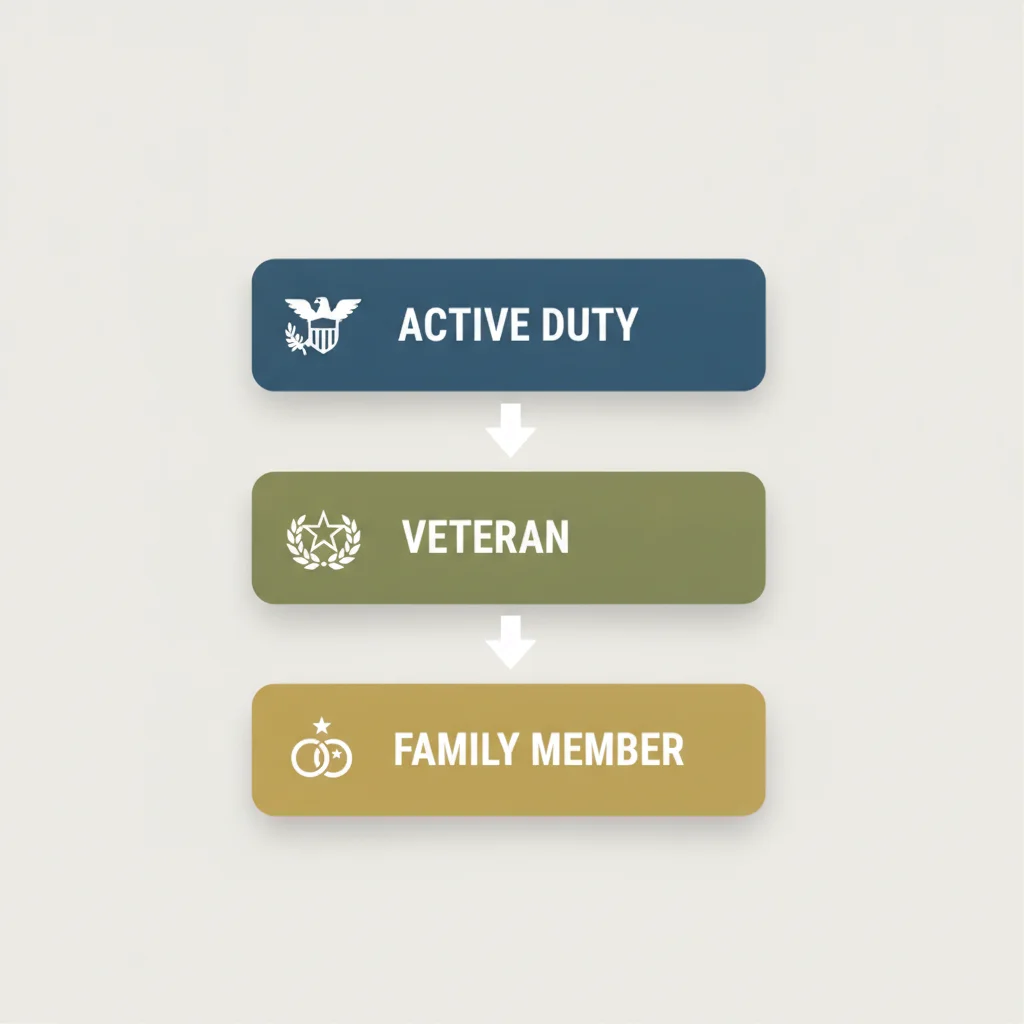
Eligibility definitions vary significantly from insurer to insurer, so understanding the general landscape before you shop is important. Most military-related discounts fall into one of three eligibility tiers:
Active Duty Service Members
If you are currently serving in any branch of the U.S. Armed Forces — Army, Navy, Air Force, Marines, Coast Guard, Space Force — you qualify for the broadest set of military discounts. National Guard and Reserve members typically fall into this category during periods of active federal service.
Veterans and Retired Military
Veterans who received an honorable or general discharge qualify with most major providers offering veteran discounts. Eligibility for USAA, the gold standard here, extends to those who have served and separated under honorable conditions — that definition covers the majority of the veteran population. Some carriers narrow this to retired military (20+ years of service with a pension), so it's worth verifying before assuming.
Military Families
USAA extends membership — and thus full access to its rate structure — to children and spouses of USAA members, including widows and widowers of members who had USAA at the time of death. Many mainstream carriers that offer a military discount extend it to the policyholder only, not to dependent children on a separate policy.
National Guard members, Reservists not on active duty orders, and surviving spouses of veterans each occupy nuanced eligibility territory. If your status is anything other than straightforward active duty or clear veteran status, call the insurer directly rather than relying on a quote tool — those systems often default to the narrowest eligibility interpretation.
The Discount Landscape: What's Actually on the Table
Military auto insurance savings come in several distinct forms. Knowing which type you're being offered — and whether you could qualify for more than one — is critical to maximizing your benefit.
15%
Maximum military discount at Geico
Geico publicly advertises up to 15% off for active duty military and qualifying veterans, making it one of the largest advertised military discounts among mainstream carriers.
20–30%
Typical USAA premium advantage over mainstream carriers
Consumer Reports and J.D. Power data consistently show USAA rates running materially below mainstream carrier equivalents for eligible military members and families.
18M+
Veterans and service members in the U.S.
According to the U.S. Department of Veterans Affairs, over 18 million veterans live in the United States — a substantial population that may qualify for military auto discounts they haven't claimed.
#1
USAA ranking in customer satisfaction
USAA has ranked first or near-first in J.D. Power's Auto Insurance Customer Satisfaction Study for multiple consecutive years, particularly among military and veteran policyholders.
Straight Military/Veteran Discount
The simplest form: a percentage off your premium for verified military or veteran status. Geico, which has offered this discount for decades, advertises up to 15% for active duty and certain veteran categories. Progressive, Farmers, Allstate, and others offer comparable discounts in the 5–15% range, though the exact amount is never publicly itemized and varies by state.
Deployed / Vehicle Storage Discount
If you're deployed and storing a vehicle rather than driving it, some insurers — most notably USAA — will allow you to reduce your coverage to comprehensive-only (dropping liability and collision) for a significantly reduced rate. This acknowledges the simple actuarial fact that a car sitting in a storage facility presents almost no liability risk. Not every insurer makes this easy; some require a minimum coverage level regardless of circumstances. Always ask specifically whether a storage reduction is available, and get the reinstatement process in writing before you leave.
USAA's Rate Structure (Not a "Discount" — a Different Baseline)
It bears saying directly: USAA doesn't simply apply a discount to standard market rates. USAA's rates are built from the ground up for a membership base that is statistically lower-risk than the general insured population — higher income, more stable employment, fewer lapses in coverage, lower fraud rates. For eligible members, this often produces premiums 20–30% below comparable coverage from mainstream carriers, without a separately itemized "military discount" at all. If you're eligible for USAA membership and haven't gotten a quote recently, that's your first call.
Bundling and Loyalty Discounts Layered on Top
Military-specific savings can stack with standard multi-policy, multi-vehicle, and loyalty discounts. A veteran insured through USAA who bundles renters or homeowners coverage, adds a second vehicle, and has maintained continuous coverage for five-plus years is capturing multiple discount categories simultaneously. The same principle applies at mainstream carriers — your military discount doesn't replace your good-driver discount, it stacks on top of it. See our comprehensive list of every auto insurance discount worth knowing about to make sure you're not leaving any other savings unclaimed.

DD-214
The Certificate of Release or Discharge from Active Duty issued to U.S. military veterans. It is the primary document used to verify military service and discharge status when applying for veteran auto insurance discounts.
CAC Card
The Common Access Card — the standard identification card for active duty U.S. military personnel, DoD civilian employees, and eligible contractors. Many insurers accept it as proof of active duty status.
Storage Discount
A premium reduction available when a vehicle is stored and not driven, typically during deployment. Coverage is usually reduced to comprehensive-only, eliminating liability and collision premiums since the vehicle is not on the road.
PCS (Permanent Change of Station)
An official military relocation order requiring a service member to move to a new duty station. PCS moves across state lines require immediate updates to auto insurance to meet the new state's coverage minimums.
SOFA (Status of Forces Agreement)
A bilateral agreement between the U.S. and a host nation governing the legal status of U.S. military personnel stationed overseas. SOFA terms often dictate local vehicle insurance requirements for service members stationed abroad.
Honorable Discharge
A separation from military service characterized by satisfactory conduct and performance. Most veteran auto insurance discounts and USAA eligibility require an honorable or general (under honorable conditions) discharge.
LES (Leave and Earnings Statement)
The monthly pay stub issued to active duty U.S. military personnel. It shows branch of service, pay grade, and service dates — information some insurers accept as proof of active duty status.
Multi-Policy Stacking
The practice of combining multiple discount categories on a single policy — for example, a military discount layered on top of a multi-vehicle discount and a bundling discount for home or renters insurance.
Carriers With Notable Military Programs
Here's a straightforward comparison of the major players and what they actually offer — because the marketing language is sometimes more impressive than the underlying benefit.
| Carrier | Military Discount Type | Eligibility | Notable Feature |
|---|---|---|---|
| USAA | Membership-based rate structure | Active duty, veterans (honorable discharge), immediate family of members | Deployed storage reduction; consistently top-rated for military service |
| Geico | Up to 15% off | Active duty, National Guard, Reserves, veterans (varies by state) | One of the most widely available non-USAA military discounts |
| Armed Forces Insurance (AFI) | Specialty military carrier | Active duty, veterans, DoD civilians, family | Deep military familiarity; strong in PCS/relocation scenarios |
| Progressive | Military discount available | Active duty and veterans (check state availability) | Stacks well with Snapshot telematics program |
| Farmers | Military discount available | Active duty, veterans (honorable discharge) | Some agents specialize in military transitions |
| Allstate | Military discount available | Active duty and qualified veterans | Drivewise telematics can layer additional savings |
Specialty carriers like Armed Forces Insurance deserve more attention than they typically get in mainstream comparison coverage. They understand the logistics that standard insurers often fumble — Permanent Change of Station (PCS) moves across state lines, overseas assignments, vehicles stored on base, and coverage transitions between states with different minimum requirements.
USAA Is Not Available to Everyone
USAA consistently offers the most competitive rates for military and veteran policyholders, but eligibility is strictly membership-based. If you've never established USAA membership — even if you're a veteran — you'll need to apply and verify eligibility before you can get a quote. Children of USAA members must establish their own membership when they reach adulthood. If a parent or spouse who had USAA coverage has passed away, surviving family members may still be eligible — contact USAA directly to confirm.
State Law Affects What Discounts Apply
Military discount percentages and availability vary by state due to insurance regulation. A 15% discount advertised nationally may apply differently — or not at all — in certain states. California, for example, has strict regulations on how insurers can apply non-driving-related factors to premiums. Always confirm the actual discount amount in your specific state when getting a quote.
Deployment Storage Gaps Can Affect Future Rates
Reducing your coverage to comprehensive-only during deployment can be a smart financial move, but it creates a technical gap in your liability coverage history. Some insurers treat any coverage lapse — even an intentional storage reduction — as a gap that can raise future rates. Ask your insurer explicitly whether a storage reduction is noted as a voluntary reduction (not a lapse) before making the change.
How to Claim and Document Your Discount
Military discounts are not automatically applied. You have to ask, and you usually have to provide documentation. Here's the practical process:
Step 1: Identify Every Discount Category You Might Qualify For
Before you contact a carrier, make a list: military/veteran status, current deployment status, how long you've been with this insurer, whether you own or rent and could bundle, how many vehicles you insure, and any telematics programs you'd be comfortable enrolling in. This is exactly the kind of exercise our guide on discounts hiding in plain sight on your policy walks through in detail.
Step 2: Gather Documentation
Documentation requirements differ by carrier, but you should be prepared to provide:
- Active duty: Military ID (CAC card), current orders, or a Leave and Earnings Statement (LES) showing branch and pay grade
- Veterans: DD-214 (Certificate of Release or Discharge from Active Duty) is the standard document; most carriers will accept a copy
- National Guard / Reserves: Current orders for active federal service periods; some carriers accept your NGB-22 or equivalent
- Family members: Evidence of your relationship to the qualifying service member (marriage certificate, birth certificate)
Step 3: Ask the Right Questions Explicitly
Don't ask "do you have a military discount?" — ask: "What specific discounts are available for active duty / veterans, and do they apply to storage situations during deployment?" The specificity matters. For a broader framework on how to interrogate your insurer about savings, see our guide on asking your insurer the right questions.
Step 4: Get the Discount Confirmed in Writing
Once a discount is applied, request a declarations page or written confirmation showing the discount line-item. If a discount is promised verbally and never appears on your policy, you need a paper trail to dispute it.
Step 5: Revisit at Renewal
Your circumstances change — discharge status, storage situations, PCS moves, additional family members. Review your policy at every renewal and re-verify which discounts still apply and whether any new ones have become available.

Deployment, PCS Moves, and Coverage Gaps to Watch
The standard advice about auto insurance doesn't always translate cleanly into military life. A few specific scenarios where gaps commonly appear:
Deployment and Vehicle Storage
Reducing coverage during deployment is smart financially, but reinstatement must be seamless when you return. Carriers differ dramatically on how easy this is. USAA built this process into its product design; mainstream carriers often treat it as a coverage change requiring a new quote, which can cause a technical lapse in coverage. A coverage lapse — even an involuntary one during deployment — can raise your rate when you reinstate. Confirm the reinstatement process is automatic and gap-free before you drop coverage.
PCS Moves Across State Lines
Each state has different mandatory minimum coverage requirements, and some states have coverage types that others don't (personal injury protection, uninsured motorist requirements, etc.). When you PCS to a new duty station, your policy needs to reflect the new state's requirements. Some insurers make this update easy; others require a policy rewrite. Specialty military carriers like AFI often have staff familiar with PCS logistics specifically.
Overseas Assignments
If you're stationed overseas with a vehicle stored stateside, the storage discount scenario applies. If you're driving overseas — whether a personal vehicle shipped or a locally purchased vehicle — U.S. auto insurance typically does not cover you. SOFA (Status of Forces Agreement) requirements vary by country; confirm coverage with both your U.S. insurer and local requirements before you assume anything.
For service members considering add-ons like roadside assistance during deployment preparation or PCS transitions, our overview of optional coverage add-ons explains which extras are genuinely worth the premium.
Military-to-Civilian Transition
The biggest coverage risk point for many veterans is the separation or retirement date itself. USAA membership is permanent once established — your eligibility doesn't expire when you leave service. But if you're insured through a different carrier and relied on an active-duty discount, your rate may adjust at renewal after separation. Get ahead of this: shop your rate before you separate, not after.
If you've relied on membership-based benefits through your employer or branch association, the transition is also a natural moment to check what professional and membership discounts you might now qualify for as a veteran through organizations like the VFW, American Legion, or other military service associations.
USAA Membership Eligibility Checker
USAA's official eligibility tool lets you confirm whether you or a family member qualifies for membership before committing to the quoting process. Start here if you're unsure of your status.
VA Benefits Explorer
The U.S. Department of Veterans Affairs maintains a benefits explorer that covers financial, housing, and insurance-adjacent benefits available to veterans — useful context when evaluating your full financial picture alongside auto insurance costs.
Armed Forces Insurance (AFI)
AFI specializes exclusively in military and veteran insurance needs, including auto, home, and renters. Worth a quote if you're navigating PCS moves, overseas assignments, or complex deployment scenarios that standard carriers handle poorly.
DD-214 Request Portal (milConnect)
If you need a copy of your DD-214 to document veteran status for an insurance discount, milConnect is the official Defense Manpower Data Center portal for requesting military service records.
State Insurance Department Locator
The National Association of Insurance Commissioners (NAIC) maintains a directory of every state's insurance regulatory body — useful for verifying what military discounts must be offered under your state's law, or for filing a complaint if a promised discount isn't applied.

All claims are backed by peer-reviewed research. Sources on request.