Key Takeaways
Option A
Personal Injury Protection (PIP)
The broader, no-fault medical coverage required in many states.
Best for: Drivers in no-fault states who need coverage for lost wages, passengers, and non-medical expenses beyond emergency care.
Option B
Medical Payments Coverage (MedPay)
The leaner, widely available supplement for out-of-pocket medical bills.
Best for: Drivers in fault-based states who want a straightforward add-on to cover immediate medical costs without income or service benefits.
If you live in a no-fault state with mandatory PIP requirements
Personal Injury Protection (PIP)
You're legally required to carry it, and maximizing your PIP limits is smarter than relying on MedPay to fill gaps your mandated minimum won't cover.
If you live in a fault-based state and want basic medical cost backup
Medical Payments Coverage (MedPay)
MedPay is widely available, affordable, and handles immediate medical expenses without the complexity of a broader PIP policy.
If you're self-employed or lack paid sick leave and get into an accident
Personal Injury Protection (PIP)
PIP's lost-wages benefit is critical when you can't work after an injury and have no employer income protection to fall back on.
If you already have strong health insurance with low deductibles
Medical Payments Coverage (MedPay)
MedPay can cover your deductible and co-pays at a low cost, without paying for PIP benefits — like income replacement — that your employer benefits already handle.
If you regularly drive passengers, including rideshare or family trips
Personal Injury Protection (PIP)
PIP extends to all occupants of your vehicle, and in many states covers pedestrians you strike. MedPay also covers occupants but without the wage and service benefits.
What PIP and MedPay Actually Do
After a car accident, medical bills don't wait. Emergency room visits, ambulance rides, physical therapy — costs stack up fast, regardless of who caused the crash. Both Personal Injury Protection (PIP) and Medical Payments Coverage (MedPay) exist to put money toward those costs immediately, without requiring you to first prove the other driver was at fault.
That shared characteristic — paying regardless of fault — is why these two coverages are frequently confused. But understanding where they diverge is what determines whether your policy actually protects you or leaves you short.
PIP and MedPay are distinct in three critical ways: the expenses they cover, the states where they're available or required, and the limits they typically offer. This isn't just academic. If you're comparing policies or deciding whether to add optional coverage, knowing the structural difference between these two is how you evaluate quality rather than just price.

It's also worth clarifying what neither coverage does: they don't pay for vehicle damage (that's collision and comprehensive), and they don't pay for injuries you cause to other people. That's handled by bodily injury liability. PIP and MedPay are solely about covering you, your passengers, and — depending on the policy — you as a pedestrian.
How Personal Injury Protection Works
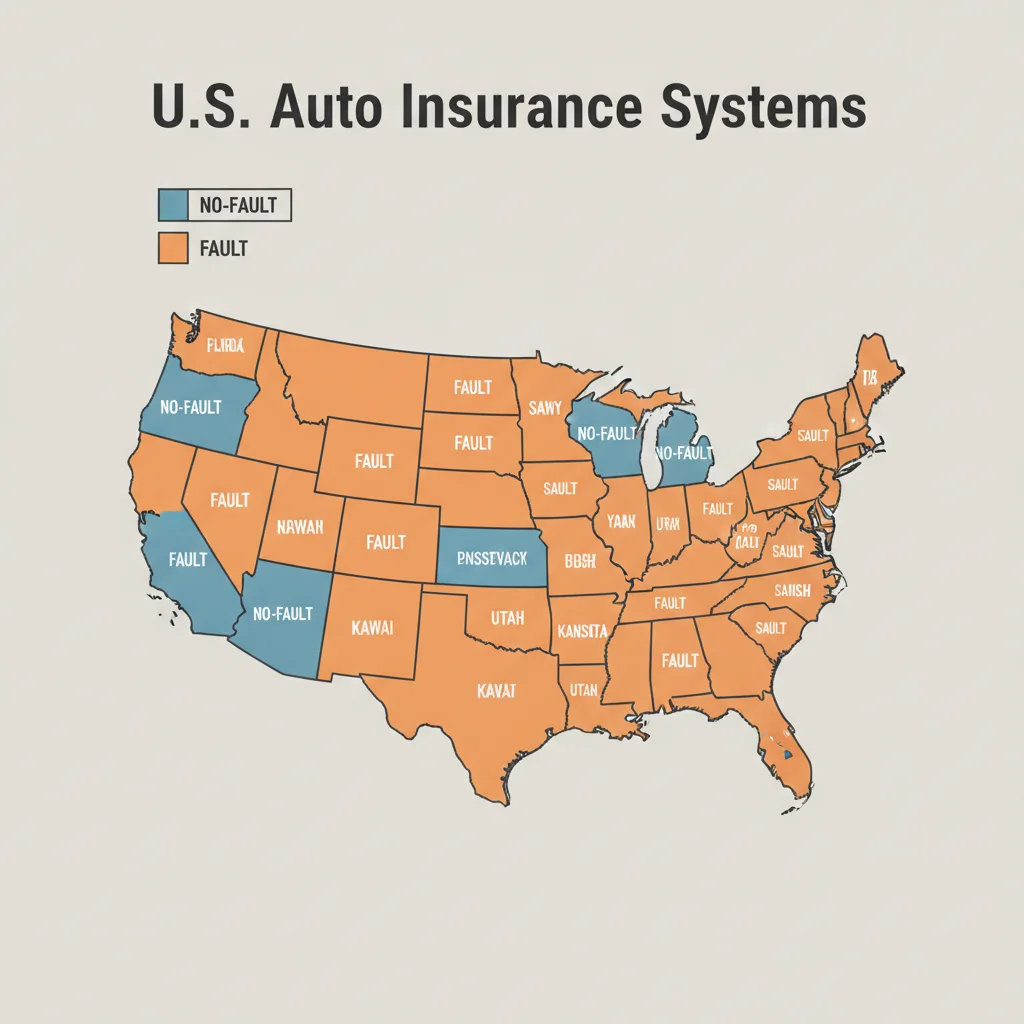
PIP is the more expansive of the two. It was built alongside no-fault insurance systems, where the idea is that each driver's own insurer covers their injuries regardless of blame. Twelve states plus Washington D.C. operate under some form of no-fault law, and most of them require PIP as a mandatory coverage.
The core of PIP goes beyond just medical bills. A typical PIP policy covers:
- Medical expenses — hospital stays, surgery, rehabilitation, chiropractic care, dental and vision injuries caused by the crash
- Lost wages — a portion of income you lose while recovering and unable to work
- Household services — costs of hiring help for tasks you can't perform while injured (like cleaning or childcare)
- Funeral expenses — in the event of a fatal accident
- Survivor benefits — in some states, payments to dependents if the policyholder dies
The lost-wages and household-services components are what set PIP apart. These aren't medical costs — they're economic costs of being unable to function normally after an accident. For freelancers, gig workers, or anyone without robust employer disability coverage, this benefit can be the difference between financial stability and crisis.
PIP Subrogation: Your Insurer Can Recoup
In many no-fault states, your insurer has the right of subrogation — meaning if you recover damages from the at-fault driver, your insurer can reclaim the PIP benefits it paid you. This is standard practice and shouldn't discourage you from filing a PIP claim, but it's important to know when negotiating a settlement. Your attorney or insurer should factor this into any demand calculation.
MedPay Doesn't Always Require Subrogation
Unlike PIP in many states, MedPay in some states does not come with subrogation rights — meaning your insurer may not reclaim those funds even if you later receive a liability settlement. This makes MedPay a particularly clean benefit in those states. Check your policy language or ask your agent directly, as subrogation rules vary by state and insurer.
Coverage Can Stack in Some States
In a handful of states, drivers can carry both PIP and MedPay simultaneously. When this is allowed, MedPay can act as a supplement to PIP, covering expenses or applying limits that PIP doesn't fully address. If you're in a state where both are available, ask your agent whether stacking is permitted and whether the combined cost justifies the added protection.
PIP also typically covers you as a pedestrian. If you're struck by a car while on foot, your own PIP policy can cover your injuries — an often-overlooked provision that doesn't apply to MedPay in all states.
State minimums for PIP vary considerably. Florida requires $10,000 in PIP coverage. Michigan — which has a unique no-fault system — once mandated unlimited PIP, though residents can now choose lower limits. Always check your state's specific minimums before assuming the default policy meets your actual needs.
12+
U.S. states with mandatory no-fault PIP laws
The Insurance Information Institute identifies twelve states plus Washington D.C. as true no-fault jurisdictions requiring PIP coverage.
$10,000
Florida's minimum required PIP limit
Florida mandates $10,000 in PIP coverage, but the average ER visit cost for injury treatment often exceeds this minimum in serious accidents.
~$30
Typical annual MedPay premium cost
According to industry surveys, MedPay at a $5,000 limit frequently adds as little as $20–$40 annually to a standard auto policy.
38%
Americans with high-deductible health plans
The CDC reports that more than one-third of privately insured adults are enrolled in high-deductible health plans, making MedPay or PIP a meaningful gap-filler after accidents.
How Medical Payments Coverage Works
MedPay is simpler by design. It covers medical and funeral expenses — full stop. No wage replacement, no household service reimbursement, no survivor benefits. What it does, it does cleanly: pay medical bills for you and your passengers after an accident, regardless of who's at fault.
MedPay is available in most states, including fault-based states where PIP isn't an option. It's almost always optional, making it a discretionary add-on rather than a legal requirement. Because it's narrower in scope, it tends to cost less — and it tends to carry lower coverage limits, often ranging from $1,000 to $10,000, though higher limits are available in some markets.
Here's where MedPay earns its place in a smart coverage stack: it functions as a first-payer for medical costs. When you go to the ER after a crash, your health insurer may require you to pay a deductible and co-pays before coverage kicks in. MedPay can cover those out-of-pocket costs immediately, without subrogation complications in some states.

MedPay also covers you as a pedestrian or cyclist in most states, and extends to passengers in your vehicle — even if they have their own health insurance. That makes it a practical backup for situations where people get hurt in your car and don't want to immediately involve their own health plans.
For a deeper look at how these two coverages play out differently when you actually file a claim, see MedPay vs. PIP in the claims process.
PIP vs. MedPay: Side-by-Side Comparison
The differences between PIP and MedPay become clearest when you put them next to each other on the same criteria. Here's how they stack up across the factors that matter most when evaluating coverage quality:
| Criterion | Personal Injury Protection (PIP) | Medical Payments Coverage (MedPay) |
|---|---|---|
| Medical expenses covered | Yes | Yes |
| Lost wages covered | Yes | No |
| Household services covered | Yes (most states) | No |
| Funeral expenses covered | Yes | Yes |
| Pays regardless of fault | Yes | Yes |
| Covers passengers | Yes | Yes |
| Covers policyholder as pedestrian | Yes (most states) | Yes (most states) |
| State availability | Required in no-fault states; optional in some others | Optional in most states |
| Typical coverage limits | $10,000–$50,000+ | $1,000–$10,000 |
| Relative premium cost | Higher | Lower |
A few things stand out in this comparison. First, PIP's broader scope comes at a cost — both in premium dollars and complexity when filing a claim. Second, MedPay's simplicity makes it attractive as a supplement to health insurance, not a replacement for it. Third, your state's regulatory environment heavily determines which options are even on the table for you.
If you're in a no-fault state, the PIP vs. MedPay question often resolves itself — you likely have PIP by law. The real question becomes whether your PIP limits are high enough. In fault-based states, you'll need to actively weigh whether MedPay is worth adding. For most drivers with modest health insurance deductibles, it usually is — the premium cost is low relative to the benefit.
State Laws Shape Your Options
The coverage you can buy — and what you're legally required to carry — depends directly on where you register your vehicle. This isn't optional fine print; it determines the whole framework of your policy.
No-fault states (including Florida, New York, Michigan, New Jersey, Pennsylvania, and others) require PIP. Drivers in these states typically cannot sue each other for minor injuries — each person's own insurer handles their medical costs up to PIP limits. If you exceed those limits, then tort claims may become available depending on the state's threshold rules.
Fault-based states (also called tort states) don't require PIP, and many don't offer it at all. In these states, MedPay fills the role of immediate medical coverage while fault is being determined. The at-fault driver's liability insurance ultimately pays for the other party's injuries, but that process takes time — MedPay bridges the gap.
Choice no-fault states (like Kentucky, New Jersey, and Pennsylvania) let drivers opt into or out of the no-fault system — a decision with significant implications for your right to sue after an accident.
Understanding your state's system matters because it shapes how your entire claim works, not just which coverage applies. Liability coverage works very differently depending on whether you're in a fault or no-fault state, and that context affects how PIP and MedPay interact with the rest of your policy.
Choosing the Right Coverage for Your Situation
The right answer isn't universal — it depends on your state, your health insurance, your employment situation, and how many people typically ride in your vehicle. Here's a practical framework for thinking it through:
Start with what's required
Check your state's minimum coverage requirements. If PIP is mandatory, you already have the baseline. The question then becomes whether the minimum limit is adequate — and in most states, it isn't. Florida's $10,000 PIP minimum sounds like a lot until you price an ER visit.
Audit your health insurance
If your health plan has a high deductible — $3,000, $5,000, or more — MedPay at even a $5,000 limit can absorb that deductible after an accident. If your health plan is robust with low out-of-pocket costs, MedPay's marginal value is lower but still positive at a low premium cost.
Consider your income continuity
If you're self-employed, a contractor, or have no paid sick leave, PIP's lost-wages benefit could be essential. A two-month recovery from a serious accident could mean two months of zero income. MedPay won't help with that. PIP will — up to its limits.
Think about your passengers
Both coverages extend to vehicle occupants. But PIP extends further — covering lost wages and services for passengers too, in some states. If you frequently drive others, that extended coverage has real value. See how per-person and per-accident limits work separately under liability coverage, which affects payouts to others when you're at fault.
Don't conflate cost with quality
MedPay's lower premium doesn't make it the smarter choice by default. PIP costs more because it covers more. The question is whether you're paying for benefits you'll actually use. A thorough policy comparison — beyond the sticker price — is the only way to answer that honestly.
For context on how other injury-related coverages interact with these, gap insurance and physical damage coverage is a useful related comparison if you're also financing your vehicle.

All claims are backed by peer-reviewed research. Sources on request.