Key Takeaways
Insurance Risk Tier
A risk tier is a category that auto insurers use to group policyholders based on how likely they are to file a claim. Insurers analyze dozens of variables — from driving history and credit score to vehicle type and ZIP code — and place each driver into a tier that determines which insurance pool they qualify for and what base rate they pay. The three main tiers are preferred, standard, and non-standard (also called high-risk).
Each insurer maintains its own proprietary tier definitions and cutoffs; a driver placed in the standard tier at one carrier may qualify as preferred at another, which is why shopping across multiple carriers can yield meaningfully different quotes.
The Invisible Sorting System Behind Every Auto Insurance Quote
Before an insurance company agrees to cover you — and before it names a price — it runs your profile through an underwriting engine designed to answer one fundamental question: how much of a risk are you? The answer doesn't just influence your rate. It determines which pool of policyholders you join and, in many cases, which subsidiary company within a carrier's family will actually write your policy.
This sorting process produces what the industry calls a risk tier. It's a classification that most drivers never see on paper but that shapes every dollar they spend on car insurance. Understanding how tiers work — and what pushes you up or down the scale — is one of the most practical things a driver can know about insurance pricing.

The concept isn't unique to auto insurance. Mortgage lenders, credit card issuers, and personal loan companies all use risk-based pricing that groups borrowers into categories. Credit score tiers in auto lending — subprime, prime, superprime — follow a similar logic: the higher your perceived risk, the worse your terms. Insurance tiers operate on the same principle, just with a broader set of inputs.
The Three Core Tiers: Preferred, Standard, and Non-Standard
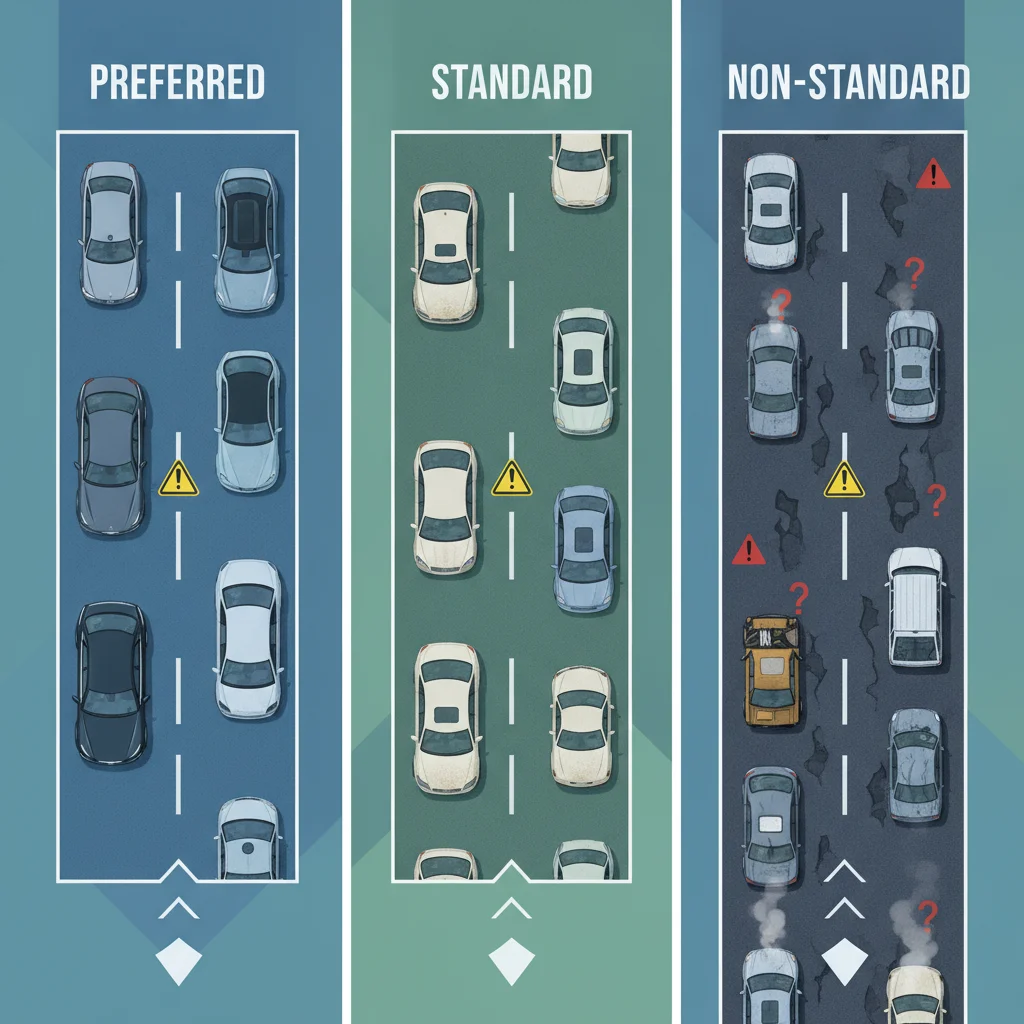
While individual carriers may slice their customer base into five, seven, or even more internal tiers, the industry generally maps onto three broad categories that determine your options and your costs.
Preferred Tier
Preferred drivers are the customers every insurer wants. They typically have clean driving records spanning three to five years, solid credit-based insurance scores, no gaps in coverage, and a claims history that is minimal or nonexistent. Carriers compete aggressively for these drivers — sometimes offering loyalty discounts, accident forgiveness programs, and vanishing deductibles to keep them enrolled.
Preferred rates are the baseline you see advertised. When an insurer runs a commercial promoting low monthly rates, those figures reflect preferred-tier pricing. The majority of drivers don't qualify.
Standard Tier
Standard is the middle ground — and where most American drivers actually land. A standard-tier driver may have a minor violation on record (a single speeding ticket, for example), average credit, or a vehicle in a higher-theft category. Rates are higher than preferred, but the driver is still considered a manageable risk worth covering under a mainstream policy.
Many of the largest carriers — State Farm, GEICO, Progressive, Allstate — maintain standard-tier pools alongside their preferred books. Drivers often move between preferred and standard simply by accumulating or aging off a violation.
Non-Standard (High-Risk) Tier
The non-standard tier covers drivers that most carriers consider elevated risks. This includes drivers with DUI convictions, multiple at-fault accidents, serious violations like reckless driving, lapsed coverage, or a combination of factors that together signal a higher probability of claims. Young drivers with no insurance history are frequently placed here by default.
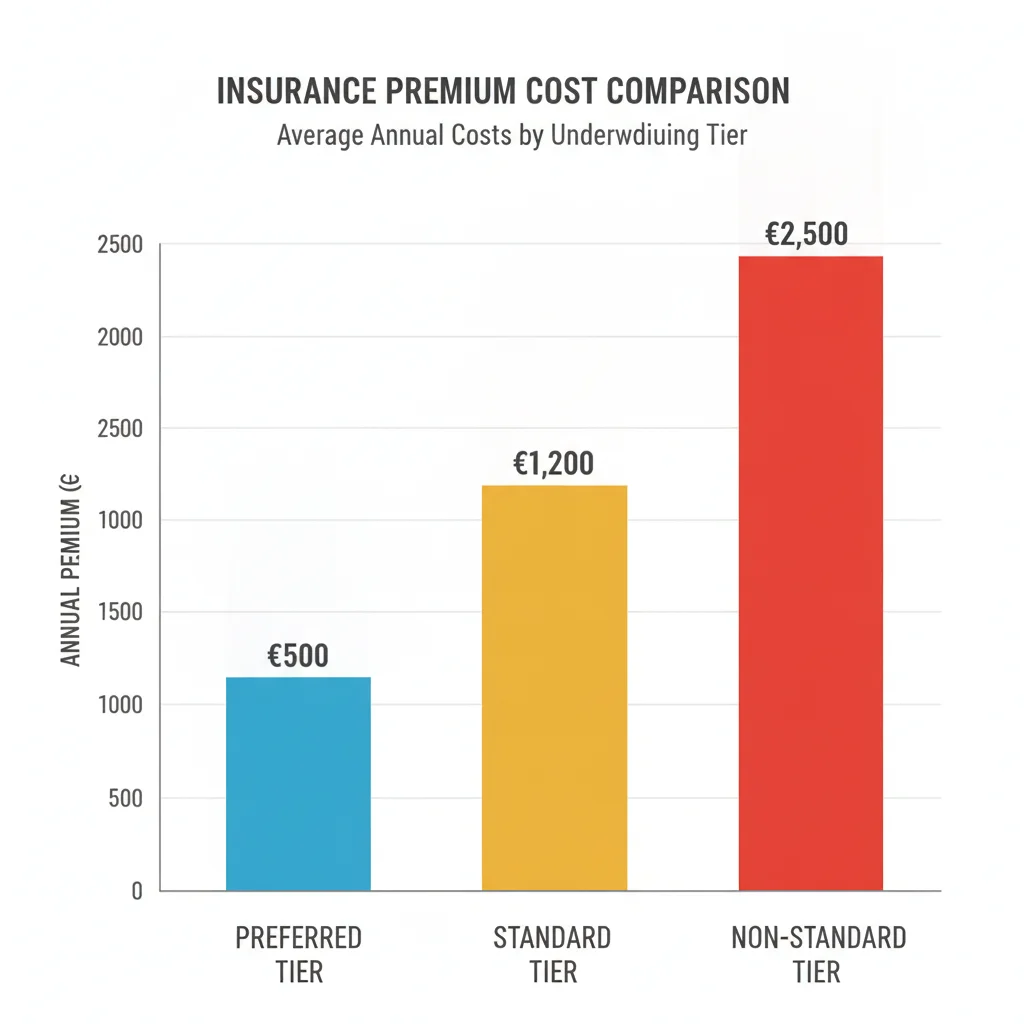
Non-standard coverage is legally available in every state, but it comes at a steep price. Premiums for non-standard drivers can run two to three times the cost of equivalent preferred-tier coverage. Some carriers flatly decline to write non-standard policies and instead refer applicants to specialty carriers or state-assigned risk pools.
“Insurers are essentially running a continuous actuarial experiment on every policyholder. The tier you're assigned to isn't a moral judgment — it's a probability estimate. And probability estimates can change.”
— J. Robert Hunter, Former Federal Insurance Administrator and Director of Insurance at the Consumer Federation of America
The Variables That Determine Your Tier
Underwriters don't flip a coin — they run your profile against a model built from decades of actuarial data. The variables carry different weights at different carriers, but the following factors are nearly universal.
2–3x
Non-standard vs. preferred premium difference
Industry data consistently shows non-standard drivers paying two to three times more than preferred-tier policyholders for equivalent coverage limits.
47
States permitting credit-based insurance scoring
Only California, Hawaii, Massachusetts, and Michigan prohibit the use of credit-based insurance scores in auto insurance underwriting, per state regulatory records.
3–5 years
Typical duration of at-fault accident surcharge
Most insurers assess surcharges for at-fault accidents over a three-to-five-year window, after which the incident typically no longer affects tier placement.
6%
Average premium increase per speeding ticket
A 2023 rate analysis by insurance research organizations found that a single speeding ticket raises average premiums by approximately 24%, though tier shifts compound that figure.
73%
Drivers who never comparison-shop at renewal
Research from the Insurance Information Institute suggests a large majority of auto insurance customers renew without obtaining competing quotes, leaving potential tier-improvement savings uncaptured.
Driving Record
This is the single most influential factor at most carriers. At-fault accidents, DUI/DWI convictions, reckless driving citations, and excessive speeding violations all push drivers toward the non-standard tier. Minor violations — a single speeding ticket, a rolling stop — typically keep a driver in the standard tier. A truly clean record over three to five years is usually sufficient to qualify as preferred.
Credit-Based Insurance Score
Distinct from your FICO credit score, a credit-based insurance score is calculated from similar data — payment history, outstanding balances, length of credit history — but weighted to predict insurance claims rather than loan defaults. The correlation between poor credit and increased claim frequency is well-documented in actuarial research, which is why insurers in 47 states are permitted to use it. If you're working on your credit, know that the same improvements that help your loan preapproval odds can also shift your insurance tier favorably.
Years of Continuous Coverage
A lapse in insurance coverage — even a brief one — is a red flag for underwriters. It signals either financial instability or a period of uninsured driving. Drivers who can demonstrate uninterrupted coverage for three or more years are viewed more favorably, all else being equal.
Vehicle Type
What you drive matters. A high-performance sports car, a luxury import with expensive replacement parts, or a vehicle with a high theft rate all push your profile toward a higher-cost tier. Practical sedans and crossovers with strong safety ratings tend to be tier-neutral or favorable. The emerging complexity of electric vehicles adds another dimension — insurers calculate EV and plug-in hybrid risk differently, sometimes resulting in higher base rates even for otherwise preferred-tier drivers.
Age and Experience
Teen drivers and drivers in their early twenties carry statistically higher accident rates, which is why they are often placed in the standard or non-standard tier by default — regardless of their driving record, which is simply too short to evaluate meaningfully. Rates generally decrease through a driver's mid-twenties and level off, then may rise again for drivers in their late seventies as reaction times and vision factors emerge in actuarial data.
Geographic Location
Your ZIP code influences your tier and your rate. Insurers analyze local claims frequency, traffic density, weather patterns, vehicle theft rates, and the cost of medical care and auto repair in your area. Drivers in dense urban areas almost always pay more than drivers in rural counties, and some high-risk ZIP codes can effectively move a borderline driver from standard to non-standard.
Shop Before Your Violation Ages Off
Don't wait until your renewal date after a violation drops off your record. Get quotes two to three months early, so you have competing offers ready the moment the incident no longer appears on your MVR. Insurers pull your record at the time of application, so timing your shopping window correctly can make the difference between standard and preferred tier pricing.
Ask for Your Tier Classification Directly
Most consumers don't know they can simply ask their insurer which tier or rating plan their policy falls under. An agent or customer service representative can usually tell you — and if you're on the border of a better tier, they can tell you what factors are holding you back. That information is actionable.
How Carriers Structure Their Tier Systems Internally
The preferred/standard/non-standard framework is a useful simplification, but in practice, most major carriers operate a more granular internal structure. A large insurer might have six to ten internal rate tiers, each with its own pricing multiplier applied to the base rate.
Large carrier families also use distinct subsidiary companies to serve different tiers. Progressive, for example, writes policies across multiple companies depending on the driver's risk profile. Allstate operates Encompass for preferred customers and has historically used separate entities for non-standard business. State Farm maintains a single-brand approach but adjusts pricing internally across its tier structure.
This architecture matters for consumers because the parent brand's advertised rate may not reflect what you'll actually be quoted once underwriting is complete. A driver who applied expecting preferred-tier pricing may be counter-offered a standard-tier policy at a significantly higher rate — a practice sometimes called a "re-rate" during the binding process.
Tier Placement Can Change Mid-Policy
While tier assignment happens at underwriting, some carriers conduct mid-term re-underwriting if new information surfaces — such as a newly discovered violation or a significant drop in credit score. This is less common than renewal-time re-rating but is permitted in most states. Review your policy terms to understand when and how your carrier may adjust your classification.
SR-22 Doesn't Always Mean Non-Standard Forever
An SR-22 requirement is typically set for a fixed period — commonly three years — by the court or state DMV. Once that period expires and the underlying violation ages off your record, you may be eligible to move back into the standard tier and should shop aggressively to capture that improvement. Carriers that write SR-22 policies are not always the best option once the filing requirement ends.
It also explains why a driver rejected by one carrier's preferred pool might be accepted as a standard customer at another. The tier cutoffs are proprietary, and they vary. Shopping multiple carriers isn't just about finding a better number — it's about finding the carrier whose underwriting model places you in the most favorable tier given your specific profile.
For context on how rigorous financial stability evaluation looks on the insurer's side, it's worth understanding insurer financial strength ratings — because a carrier that accepts high-risk drivers aggressively may also be stretching its capital reserves.
How to Move Into a Better Tier
Risk tiers are not permanent. They are recalculated at every renewal — and sometimes in between, if you request a re-evaluation. There are concrete steps that can move the needle.
Wait Out Violations and Accidents
Most moving violations drop off your record after three years in most states; serious violations like DUI can persist for five to ten years. The moment a violation ages off, you may qualify for a better tier. Set a calendar reminder for your renewal cycle after the violation's expiration date and shop proactively at that point.
Improve Your Credit-Based Insurance Score
Paying bills on time, reducing revolving debt balances, and avoiding new credit inquiries all improve the underlying data that feeds your credit-based insurance score. Improvements don't happen overnight, but a meaningful credit improvement over 12 to 18 months can be enough to shift tiers at renewal. This improvement also tends to carry benefits across financial products — the same habits that raise your insurance tier can improve your standing with auto lenders.
Maintain Continuous Coverage
Never let your policy lapse, even briefly. If you're between vehicles, consider a non-owner auto policy to keep your coverage history intact. A continuous coverage history is one of the cleaner signals of a responsible driver in underwriting models.
Take a Defensive Driving Course
Many states allow voluntary defensive driving courses to offset a violation or earn a discount. Some carriers will apply a course completion credit that can, in combination with other factors, push a driver from non-standard to standard pricing.
Shop at Every Renewal
Because tier cutoffs vary by carrier, simply shopping at renewal — especially after a record improvement — is one of the most reliable ways to find better tier placement. Get at least three to four quotes. Ask each carrier explicitly what tier or program your profile qualifies for.

What Non-Standard Drivers Should Know
If you've been placed in the non-standard tier, your options are more limited but not absent. Here's what the landscape looks like and how to navigate it.
State-Assigned Risk Pools
Every state operates a mechanism to ensure that legally required auto insurance remains available to drivers who cannot obtain coverage in the voluntary market. These are called assigned risk pools or plans (sometimes branded as FAIR Plans or equivalents). Coverage is available but typically expensive, with limited options. Think of it as a last resort, not a first stop.
Specialty Non-Standard Carriers
Several national and regional carriers specialize in non-standard business — The General, Dairyland, Acceptance Insurance, and others. These carriers have built underwriting models specifically designed for high-risk profiles and often offer coverage that mainstream carriers won't. Rates are still elevated, but comparing specialty carriers against each other can yield meaningful differences.
SR-22 Requirements
If your non-standard placement stems from a serious violation — DUI, driving without insurance, or a reckless driving conviction — your state may require an SR-22 filing. This is not a separate insurance policy; it's a certificate your insurer files with the state confirming you carry the minimum required coverage. Not all carriers offer SR-22 filings, which further narrows your options. If you need one, confirm before binding that the carrier can accommodate the filing.
Tier Placement Can Change Mid-Policy
While tier assignment happens at underwriting, some carriers conduct mid-term re-underwriting if new information surfaces — such as a newly discovered violation or a significant drop in credit score. This is less common than renewal-time re-rating but is permitted in most states. Review your policy terms to understand when and how your carrier may adjust your classification.
SR-22 Doesn't Always Mean Non-Standard Forever
An SR-22 requirement is typically set for a fixed period — commonly three years — by the court or state DMV. Once that period expires and the underlying violation ages off your record, you may be eligible to move back into the standard tier and should shop aggressively to capture that improvement. Carriers that write SR-22 policies are not always the best option once the filing requirement ends.
Timeline Out of the Non-Standard Tier
A realistic timeline for moving from non-standard back to standard is typically three to five years of clean driving and consistent coverage. Serious violations like DUI can extend that window. Non-standard placement is not a life sentence, but it requires patience and consistent behavior to overcome.

All claims are backed by peer-reviewed research. Sources on request.