Key Takeaways
Lapse in Coverage
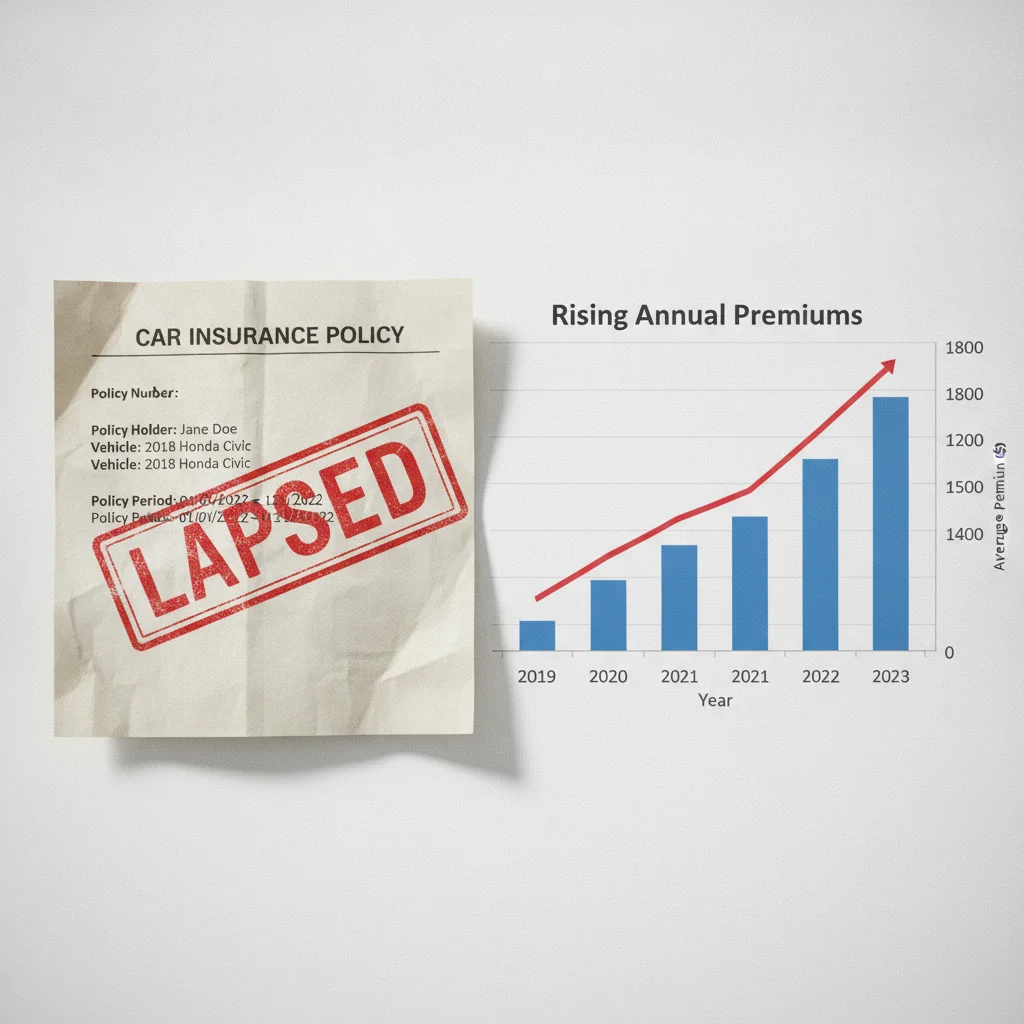
A lapse in coverage is any period of time — even as short as one day — during which a driver has no active auto insurance policy. It can happen when a policy is canceled, not renewed, or allowed to expire without a replacement in place. Insurers treat this gap as a signal that a driver poses a higher financial risk.
In underwriting models, a coverage lapse is a rated factor that can increase premiums independently of a driver's accident history or credit score — it functions as its own risk variable.
What Insurers Actually See When They Pull Your Coverage History
When you apply for a new auto insurance policy, the insurer doesn't take your word for your driving history or your previous coverage. They run a formal check — typically through the Comprehensive Loss Underwriting Exchange (CLUE), state DMV records, and sometimes direct verification with your prior carrier. What they're looking for is a continuous, unbroken line of coverage stretching back at least six months, and often three years.
Any break in that line registers as a lapse. The system doesn't distinguish between a lapse caused by financial hardship, administrative error, or a simple oversight in policy renewal timing. It's a binary marker: you were covered, or you weren't.

What makes this particularly consequential is that a coverage gap functions as an independent risk variable in most underwriting models — separate from your accident history, credit score, or driving record. In other words, even a driver with a spotless claims history and excellent credit can face a surcharge simply because there's a 45-day gap in their insurance record from three years ago.
Common policy management mistakes — like missing a renewal notice or letting a policy lapse while waiting for a new job's benefits to kick in — are precisely the kind of administrative slip-ups that create these gaps. Understanding why they matter starts with understanding what insurers believe the gap signals about you as a driver.
The Risk Logic Behind the Lapse Penalty
Insurers are fundamentally in the business of predicting future losses. Every variable they collect — your zip code, your vehicle type, your driving history — feeds into actuarial models that estimate how likely you are to file a claim. A coverage lapse fits into this framework in two specific ways.
The Financial Stability Signal
The most common reason drivers let coverage lapse is that they couldn't afford the premium. Insurers know this. And research in the field of behavioral economics has long shown that financial stress correlates with elevated accident risk — not because financially stressed people are worse drivers per se, but because stress affects attention, decision-making, and the likelihood of deferred vehicle maintenance. A driver who lets insurance lapse is statistically more likely to also skip oil changes, defer tire replacements, or drive a car with a known mechanical issue.
“A coverage lapse doesn't just tell us that something went wrong once — it tells us something about how that driver manages financial obligations and risk in general. That's a signal we're trained to weight carefully.”
— Robert Hartwig, Clinical Associate Professor of Finance and former President of the Insurance Information Institute
The Uninsured Driving Signal
The second inference is more direct: if your coverage lapsed while you owned a vehicle, there's a meaningful chance you drove uninsured during that period. Driving without insurance is both illegal in most states and a strong behavioral predictor. Insurers reason that someone willing to accept the legal and financial exposure of uninsured driving is more likely to take risks behind the wheel generally.
~13%
U.S. drivers estimated to be uninsured
According to the Insurance Research Council's most recent study, roughly 1 in 8 drivers on American roads carries no insurance at any given time.
Up to 35%
Premium increase for a 30–90 day lapse
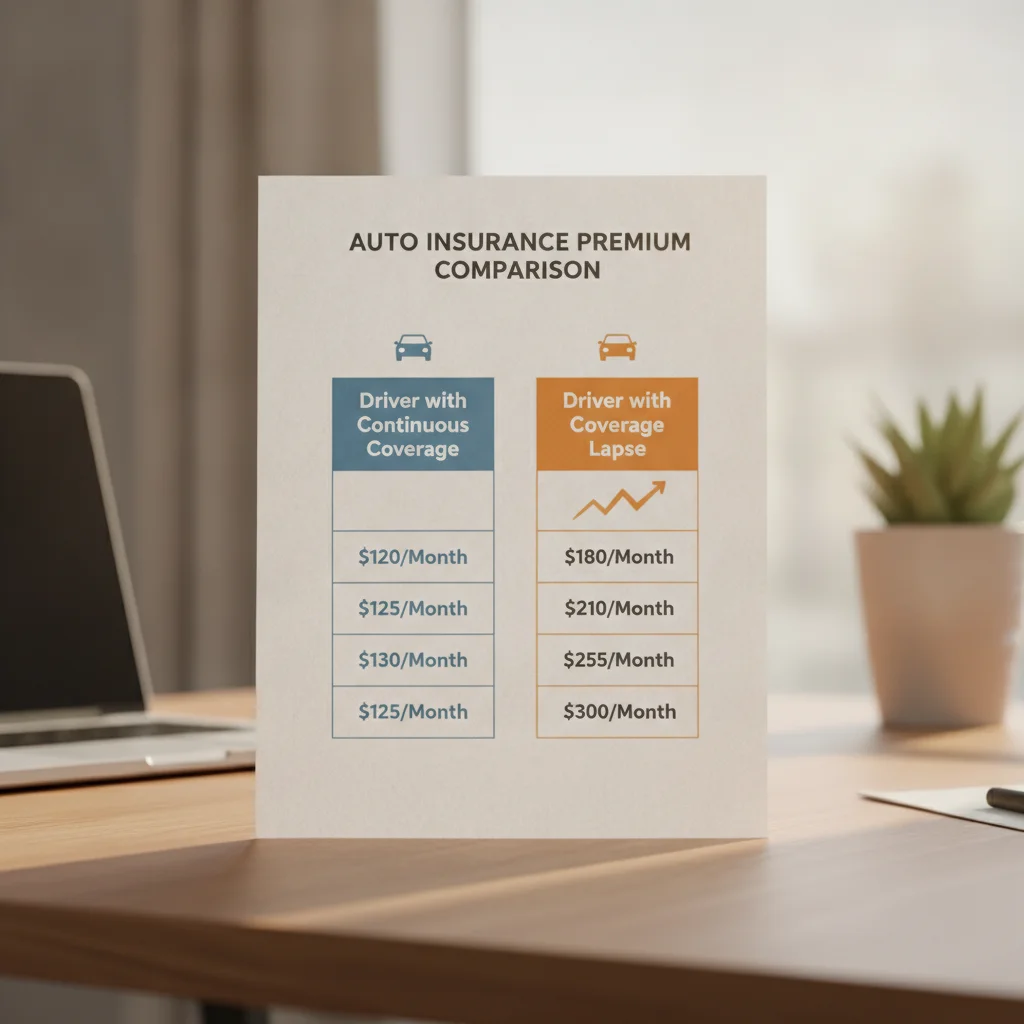
Industry underwriting data suggests drivers with a coverage gap in the 30-to-90-day range can face surcharges of 20% to 35% compared to continuously covered drivers with otherwise identical profiles.
3 years
Maximum typical lapse look-back window
Most standard-market carriers review the prior three years of coverage history during underwriting, meaning a single lapse can affect pricing across multiple policy renewal cycles.
6–12 months
Time to recover from a short lapse
Drivers who experienced gaps of fewer than 30 days and maintained continuous new coverage typically see surcharges age off within six to twelve months, based on common carrier underwriting guidelines.
Neither inference is perfectly accurate for any individual driver. But actuarial pricing doesn't work at the individual level — it works at the population level. If drivers with recent coverage lapses file claims at a higher aggregate rate than those with continuous coverage, the premium surcharge is the mathematically justified response, regardless of why your specific lapse occurred.
How Long Does the Penalty Last — and How Much Does It Cost?
The financial impact of a coverage lapse varies considerably by insurer, state, and the length of the gap itself. But the broad parameters are consistent enough to be useful:
- Gaps under 30 days: Many carriers treat this as a minor infraction. Surcharges are typically modest — often in the range of 5% to 15% above what a continuous-coverage driver would pay — and they tend to age off within six to twelve months of maintaining uninterrupted new coverage.
- Gaps of 30 to 90 days: This range triggers more significant underwriting scrutiny. Some carriers will decline coverage altogether; others apply surcharges of 20% to 35%. The look-back penalty often persists for 12 to 24 months.
- Gaps exceeding 90 days: A gap of three or more months is treated as a serious lapse by most standard-market insurers. Drivers in this situation are frequently redirected to nonstandard or high-risk carriers, where premiums can be 50% to 100% higher than the standard market. The penalty window can extend to three years.
Bridge Coverage Can Prevent a Lapse
If you're between policies — for example, selling one car and waiting for delivery of another — ask your insurer about a short-term or non-owner policy. Non-owner auto insurance covers you as a driver even when you don't own a vehicle, preserving your continuous coverage record for as little as $30 to $50 per month in many markets.
Rebuild Faster with Telematics Programs
If you're stuck with a lapse surcharge, enrolling in a telematics or usage-based insurance program is one of the fastest routes back to competitive rates. Clean driving data over six months can partially offset the statistical weight of a recent gap, particularly with insurers that explicitly score behavioral data against historical risk factors.
It's also worth noting that some states regulate how heavily insurers can penalize coverage lapses. California, for instance, restricts the use of prior insurance history as a rating factor in certain contexts. Knowing your state's rules can help you evaluate whether a quote you've received is being applied fairly.
Discounts that reward continuous coverage are increasingly common among major carriers — meaning the flip side of the lapse penalty is a tangible financial reward for drivers who maintain an unbroken record. That reward can compound significantly over several years.
Situations Where a Lapse May Not Hurt You
Not all coverage gaps are treated equally, and experienced insurance shoppers know there's sometimes room to negotiate the interpretation of a lapse. Several specific circumstances can reduce or eliminate the penalty:
Vehicle Ownership Gap
If you sold your car and had no vehicle registered in your name during the coverage gap, most insurers will treat the lapse as benign. The underlying risk logic is sound: if you weren't driving, you weren't creating risk. Be prepared to document this — a bill of sale, a de-registration record, or a gap in DMV ownership records can support your case.
Military Deployment
Active-duty service members who store their vehicles and suspend coverage during deployment are protected from lapse penalization under many carriers' underwriting guidelines and, in some cases, state law. Deployment orders are the standard supporting document.
Extended Medical Incapacitation
Some carriers will consider documented medical circumstances — a hospitalization, a condition that required someone to be off the road for an extended period — as grounds for a hardship exception. This is more variable and less guaranteed than the military provision, but worth raising with an agent.
Not All States Treat Lapses the Same Way
State insurance regulations vary significantly in how much weight insurers can give to coverage history when setting rates. California, for instance, places strict limits on the use of prior coverage lapses as a primary rating factor. Before assuming a surcharge is inevitable, check your state's insurance commissioner website or consult a licensed agent familiar with your state's rules.
Hardship Exceptions Are Underutilized
Many drivers don't know that insurers often have formal or informal processes for reviewing lapse circumstances. If your gap resulted from documented hardship — job loss, a medical crisis, a natural disaster — it is worth asking an underwriter directly whether an exception applies. The worst outcome is that they say no; the best is a materially lower rate.
Continuous Coverage Compounds Like Interest
Every year of uninterrupted coverage makes the next year of insurance marginally cheaper, not just because of discounts, but because it progressively pushes older lapses further outside insurers' look-back windows. Drivers who maintain clean coverage records for a decade or more often qualify for the most competitive tiers of standard-market pricing — a cumulative benefit that's easy to underestimate in the short term.
In all these cases, the burden of proof rests with you. The insurer's default is to apply the lapse surcharge; your job is to present documentation compelling enough to warrant an exception. Having that documentation organized before you start shopping for a new policy is a practical first step.
Strategies for Recovering Your Coverage Standing
If you're dealing with the aftermath of a lapse — whether it just happened or you're still carrying elevated rates from one that occurred a year or two ago — there are concrete strategies that accelerate your return to standard-market pricing.
Don't Let Another Lapse Happen
The single most impactful thing you can do is establish continuous coverage and protect it. Even if you're currently paying a surcharge on a nonstandard policy, every month of uninterrupted coverage is rebuilding your record. Set automatic payments. Calendar your renewal dates. Review your policy at least 30 days before it expires.
Canceling a policy without creating a gap is a learnable skill — one that becomes critically important whenever you're switching carriers, even for a better rate.
Shop Multiple Carriers Aggressively
Different carriers weight the lapse factor differently. Some are more forgiving of short gaps; others specialize in helping drivers with imperfect records rebuild their coverage history. Getting quotes from five to eight carriers — including regional insurers and direct writers you might not have considered — is not overkill when a lapse is involved. The spread between the highest and lowest quote for the same driver profile can exceed 40%.
Ask About Continuous Coverage Discounts
Some carriers will begin rewarding you for continuous coverage even before your lapse fully ages off their look-back window. Ask specifically whether a continuous coverage discount applies after three months, six months, or one year of uninterrupted coverage with them.
Bridge Coverage Can Prevent a Lapse
If you're between policies — for example, selling one car and waiting for delivery of another — ask your insurer about a short-term or non-owner policy. Non-owner auto insurance covers you as a driver even when you don't own a vehicle, preserving your continuous coverage record for as little as $30 to $50 per month in many markets.
Rebuild Faster with Telematics Programs
If you're stuck with a lapse surcharge, enrolling in a telematics or usage-based insurance program is one of the fastest routes back to competitive rates. Clean driving data over six months can partially offset the statistical weight of a recent gap, particularly with insurers that explicitly score behavioral data against historical risk factors.
Consider Usage-Based or Telematics Programs
If your driving behavior is genuinely low-risk, telematics programs — which monitor speed, braking, and mileage through an app or plug-in device — can provide real-time behavioral data that offsets the statistical weight of a coverage gap. Some carriers have given drivers with recent lapses access to near-standard rates after six months of clean telematics data.
The Broader Picture: Why Continuous Coverage Is a Financial Asset
It's easy to think of auto insurance as a grudging monthly expense — something you pay to stay legal and protect yourself in worst-case scenarios. But your continuous coverage history is also an asset, in the same category as a clean driving record or a good credit score. It's a credential that signals reliability to every future insurer who looks at your file.
Drivers who maintain uninterrupted coverage for three or more years without a lapse often qualify for loyalty pricing tiers, reduced deductibles, and bundling discounts that add up to hundreds of dollars per year in savings. The compounding effect of that asset is real: a driver who avoids a single 60-day lapse at age 30 may pay meaningfully less for insurance every year through age 50 compared to an identical driver who experienced that gap.
Not All States Treat Lapses the Same Way
State insurance regulations vary significantly in how much weight insurers can give to coverage history when setting rates. California, for instance, places strict limits on the use of prior coverage lapses as a primary rating factor. Before assuming a surcharge is inevitable, check your state's insurance commissioner website or consult a licensed agent familiar with your state's rules.
Hardship Exceptions Are Underutilized
Many drivers don't know that insurers often have formal or informal processes for reviewing lapse circumstances. If your gap resulted from documented hardship — job loss, a medical crisis, a natural disaster — it is worth asking an underwriter directly whether an exception applies. The worst outcome is that they say no; the best is a materially lower rate.
Continuous Coverage Compounds Like Interest
Every year of uninterrupted coverage makes the next year of insurance marginally cheaper, not just because of discounts, but because it progressively pushes older lapses further outside insurers' look-back windows. Drivers who maintain clean coverage records for a decade or more often qualify for the most competitive tiers of standard-market pricing — a cumulative benefit that's easy to underestimate in the short term.
There's also a coverage quality dimension that's separate from price. Drivers who go through a lapse and end up with a nonstandard carrier sometimes find themselves with thinner coverage — higher deductibles, lower liability limits, fewer optional protections. That's a double risk: paying more for a policy that also does less for you when a claim actually occurs.
For drivers who want to extend their coverage profile intelligently — adding protections like roadside assistance or rental reimbursement without creating unnecessary complexity — understanding optional add-ons and how they interact with your base policy is a useful next step. Similarly, if you own a newer vehicle and are worried about the gap between what you owe and what it's worth, that's a separate concept from a coverage lapse — see our explainer on gap insurance for clarity on the distinction.
The bottom line is straightforward: a lapse in coverage is not just a legal problem in the moment it occurs. It's a financial flag that follows you — measurably, quantifiably — into every insurance transaction you make for the next one to three years. Treating continuous coverage as a priority, rather than an afterthought, is one of the highest-return habits an American driver can develop.

All claims are backed by peer-reviewed research. Sources on request.