

Key Takeaways
Mechanical Breakdown Insurance
Mechanical breakdown insurance (MBI) is an optional insurance policy that pays for repairs when a covered mechanical or electrical component fails due to defects or wear — not an accident. It works similarly to an extended warranty but is sold and regulated as an insurance product, typically by car insurance companies. You pay a premium (often monthly or annually), and when a covered breakdown occurs, you file a claim and pay a deductible instead of the full repair bill.
Because MBI is classified as insurance rather than a service contract, it is regulated by state insurance commissioners — giving policyholders consumer protections that dealer-sold extended warranties often lack.
What Mechanical Breakdown Insurance Actually Is
If you've ever sat in a dealership finance office and been handed a menu of add-on products — extended warranty, paint protection, gap insurance, tire and wheel — you may have walked out confused about what you actually bought. Mechanical breakdown insurance almost never shows up on that menu, because dealers don't sell it. That alone should tell you something.
MBI is an insurance product offered by auto insurers — most notably GEICO, which has offered it for decades, though other carriers have entered the market. You add it to your existing auto insurance policy (or purchase it as a standalone product), pay a recurring premium, and in the event of a covered mechanical or electrical failure, you file a claim and pay a deductible. The insurer covers the rest, up to policy limits.
That structure — premium, claim, deductible — is what distinguishes MBI from a service contract. An extended warranty is a contract between you and either the manufacturer or a third-party administrator. MBI is a regulated insurance policy. That distinction matters enormously when a claim is disputed.

Because MBI is insurance, your state's department of insurance has jurisdiction over it. If an insurer wrongfully denies a claim, you have a formal complaints process and, ultimately, legal recourse under insurance law. With a dealer-sold extended warranty, your dispute resolution options are often limited to whatever arbitration clause is buried in the service contract — a clause almost always written to favor the administrator.
What MBI Covers — and What It Doesn't
The coverage scope of mechanical breakdown insurance is broad but not unlimited. Understanding the boundaries before you buy prevents ugly surprises at the repair shop.
Typically Covered
- Engine internals: pistons, rings, bearings, valves, timing components
- Transmission and drivetrain: gears, torque converters, transfer cases, drive axles
- Steering system: rack and pinion, power steering pump, tie rods
- Braking system: master cylinder, calipers, ABS module (not pads or rotors as wear items)
- Electrical systems: alternator, starter motor, wiring harnesses in many policies
- Air conditioning and heating: compressor, condenser, evaporator core
- Fuel system components: fuel injectors, fuel pump
Typically Excluded
- Damage caused by accidents (that's what collision and comprehensive coverage handles)
- Routine maintenance: oil changes, fluid flushes, spark plugs, filters
- Wear items: tires, brake pads, wiper blades, belts, hoses
- Pre-existing conditions at time of policy issuance
- Damage from owner negligence — skipping oil changes, ignoring warning lights
- Modifications that caused the failure
MBI Is Not Collision or Comprehensive Coverage
Mechanical breakdown insurance covers failures that happen on their own — not damage from accidents, weather, or theft. Those risks are handled by collision and comprehensive insurance, which are entirely separate coverages. If you're unsure how those policies work, see our overview of <a href="/car-insurance/coverage-types/collision-and-comprehensive">collision and comprehensive coverage</a>. You may need both types of coverage depending on your loan terms and risk profile.
Eligibility Windows Close Quickly
Most MBI policies require enrollment while the vehicle is relatively new and low-mileage. GEICO, one of the most widely available MBI providers, requires under 15,000 miles at the time of application. If you're considering MBI, the time to act is when you first purchase the vehicle — not after the factory warranty starts to expire.
One critical nuance: MBI does not overlap with your collision policy. If a component fails because of an accident, your MBI claim will be denied — that's a collision claim. If your transmission fails on a Tuesday with no crash involved, that's an MBI claim. The two coverages are designed for completely different failure modes.
How MBI Stacks Up Against a Factory Warranty
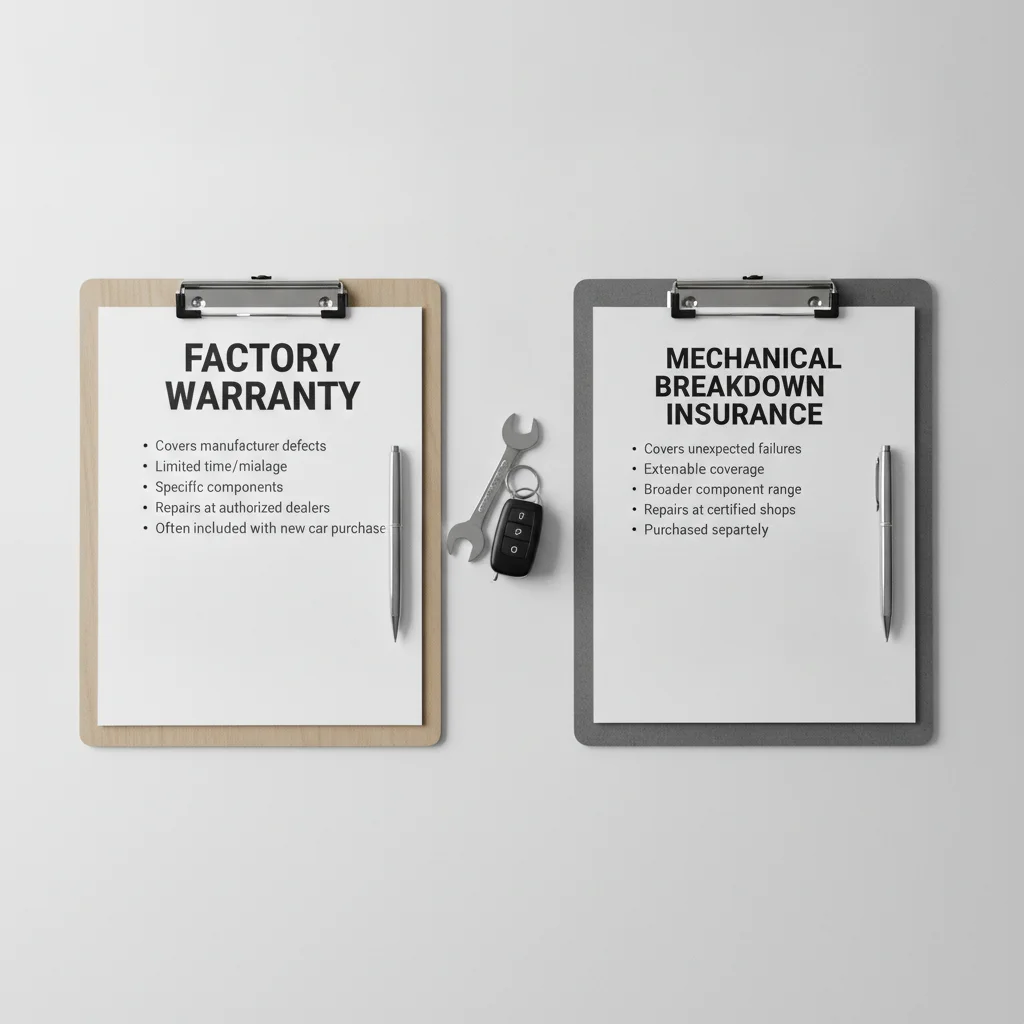
Your new car's factory warranty is the first line of defense against repair bills. Most new vehicles come with a bumper-to-bumper warranty covering roughly three years or 36,000 miles and a powertrain warranty covering five years or 60,000 miles — though some manufacturers now offer longer terms. For a full breakdown of what those warranties actually protect, see our guide on new car warranties.
The gap MBI fills is the period after the factory warranty expires but before you're ready to part with the vehicle. If you plan to keep a car for 10 years, you're looking at potentially five to seven years of unprotected mechanical exposure. That's when a single repair bill can exceed what you'd have paid in MBI premiums over the entire policy term.
$3,800
Average transmission repair cost
According to RepairPal data, transmission replacement on a mid-size vehicle commonly ranges from $2,800 to $5,000 depending on make and repair shop.
$1,200
Typical engine repair bill
RepairPal estimates average engine-related repairs (short of full replacement) frequently exceed $1,000, with major failures routinely reaching $4,000–$8,000.
30–50%
Dealer markup on service contracts
Industry analysts estimate dealerships mark up vehicle service contracts by 30 to 50 percent above the administrator's wholesale cost.
~$100/yr
Typical MBI annual premium range (low end)
GEICO's MBI premiums for new vehicles with low deductibles start in the range of $25–$30 per month, varying by vehicle type, deductible, and state.
MBI also differs from your factory warranty in one practical way: you choose the repair shop. Factory warranty repairs must be done at a franchised dealership. MBI claims, in most policies, can be fulfilled at any licensed repair facility — often including independent shops that charge lower labor rates than dealers. That flexibility can mean a lower out-of-pocket deductible experience even when the insurer pays the bulk of the bill.
MBI vs. Extended Warranty: The Real Comparison
The term "extended warranty" gets used loosely. Technically, only manufacturers can extend an actual warranty. What dealers sell in the finance office is a vehicle service contract — a private contract with a third-party administrator. Buyers often don't learn this until a claim is denied and they discover the administrator has gone out of business.
“The difference between a vehicle service contract and mechanical breakdown insurance isn't just semantic — it determines who regulates the product, what recourse you have when a claim is denied, and ultimately whether the coverage you paid for actually pays out when you need it.”
— J. Robert Hunter, Former Director of Insurance, Consumer Federation of America
For a deep-dive comparison of both products side by side, including which scenarios favor each option, read our article on mechanical breakdown insurance vs. extended warranty.
The most meaningful differences come down to four factors:
- Regulation: MBI is regulated by state insurance departments. Vehicle service contracts are regulated (less strictly) as service contracts, with fewer consumer protections.
- Price: MBI premiums are almost always lower than equivalent dealer-sold service contracts. Dealers typically mark up service contracts by 30–50% from administrator cost.
- Claims process: MBI claims go through your insurer. Service contract claims go through the administrator — a company you likely know nothing about at time of purchase.
- Portability: MBI stays with you as a policyholder. Service contracts are tied to the vehicle VIN and may or may not transfer if you sell.
Negotiate the Deductible Amount
MBI policies often give you a choice of deductible — commonly $0, $100, or $250 per claim. A higher deductible lowers your premium but increases your out-of-pocket cost when a claim occurs. If you're using MBI primarily to protect against large, infrequent failures (transmission, engine), a $250 deductible with a lower premium is usually the smarter tradeoff than paying for a $0 deductible you rarely benefit from.
Don't Confuse MBI With Add-Ons Sold at the Dealer
If a finance manager presents you with something called "mechanical breakdown protection" or "powertrain coverage" in the F&I office, that is almost certainly a vehicle service contract — not MBI. Ask directly: 'Is this regulated as insurance by the state insurance commissioner?' If the answer is no, you're looking at a service contract with different (and generally weaker) consumer protections. MBI is purchased directly from an insurance company, not through a dealership.
If you're evaluating a used car purchase, MBI eligibility may be limited by mileage. In that case, a third-party extended warranty may be your only option — but shop carefully. Our guide on extended warranties on used cars walks you through evaluating those contracts before signing.
Who Actually Benefits From MBI
Not every driver needs MBI. The math only works in your favor under certain conditions.
MBI Makes Strong Sense If You:
- Plan to keep your vehicle well past the 60,000-mile factory powertrain warranty
- Are financing a new or low-mileage used vehicle and carrying a loan for several years
- Drive a vehicle with average to above-average repair frequency (luxury brands, German engineering, high-tech electronics)
- Don't have $3,000–$6,000 in liquid savings available to absorb a major repair without financial stress
- Prefer predictable monthly costs over unpredictable repair bills
MBI Is Probably Not Worth It If You:
- Lease your vehicle — the factory warranty almost always covers the full lease term
- Trade in every three to four years before warranties expire
- Drive a brand known for exceptional reliability and low repair costs
- Have substantial savings and would rather self-insure against repair risk
- Own a high-mileage vehicle that no longer qualifies for MBI enrollment
The honest framing is this: MBI is risk management, not a guaranteed money-maker. You might pay premiums for years and never file a claim — that's a fine outcome, because the coverage gave you certainty. But for drivers who have faced a surprise $4,000 transmission replacement, the premium cost looks very different in hindsight.
How to Buy MBI and What to Watch For
The process of obtaining MBI is simpler than dealing with dealer finance products — which is part of its appeal.
Step 1: Check Eligibility First
Most insurers impose strict eligibility thresholds. GEICO's MBI, for example, requires the vehicle to have fewer than 15,000 miles at enrollment. Other carriers may use age (e.g., under one model year old) or a combination of both. Check eligibility requirements before assuming you can add this coverage at any point.
Step 2: Request a Quote From Your Current Insurer
Start with your existing auto insurance company. Adding MBI to an existing policy is typically straightforward, and bundling may simplify billing. If your current insurer doesn't offer MBI, compare at least two or three providers.
Step 3: Read the Declarations and Exclusions Page
Before signing, read — actually read — the list of covered components and the exclusions. Pay specific attention to: the deductible amount, coverage limits per claim, whether rental car reimbursement is included, and any waiting period before coverage takes effect.
Step 4: Understand the Claims Process
Ask specifically: Do I need pre-authorization before a repair begins? Which repair shops are accepted? How are claims reimbursed — directly to the shop, or to me after the fact? Getting these details upfront prevents surprises when you're sitting in a repair shop waiting room.
Negotiate the Deductible Amount
MBI policies often give you a choice of deductible — commonly $0, $100, or $250 per claim. A higher deductible lowers your premium but increases your out-of-pocket cost when a claim occurs. If you're using MBI primarily to protect against large, infrequent failures (transmission, engine), a $250 deductible with a lower premium is usually the smarter tradeoff than paying for a $0 deductible you rarely benefit from.
Don't Confuse MBI With Add-Ons Sold at the Dealer
If a finance manager presents you with something called "mechanical breakdown protection" or "powertrain coverage" in the F&I office, that is almost certainly a vehicle service contract — not MBI. Ask directly: 'Is this regulated as insurance by the state insurance commissioner?' If the answer is no, you're looking at a service contract with different (and generally weaker) consumer protections. MBI is purchased directly from an insurance company, not through a dealership.
MBI is one of the few optional auto coverages that doesn't involve a dealership at all. There's no negotiation theater, no finance manager presenting it as "just a few dollars a month." You buy it directly through an insurer, which keeps the process clean and the pricing honest.
Also worth noting: MBI is a separate consideration from gap insurance, which covers the difference between what you owe on a loan and what the car is worth after a total loss. Those are two distinct financial risks. If you're carrying a significant loan balance on a new or nearly new vehicle, both protections may be relevant. See our overview of gap insurance to understand when that coverage makes sense alongside MBI.

All claims are backed by peer-reviewed research. Sources on request.