
Key Takeaways
Why Your Deductible Choice Matters More Than Most Drivers Realize
Most drivers spend their time shopping for the lowest premium without giving much thought to the deductible attached to it. That's understandable — the premium is the number that shows up every month. But the deductible is the number that matters when something actually goes wrong.
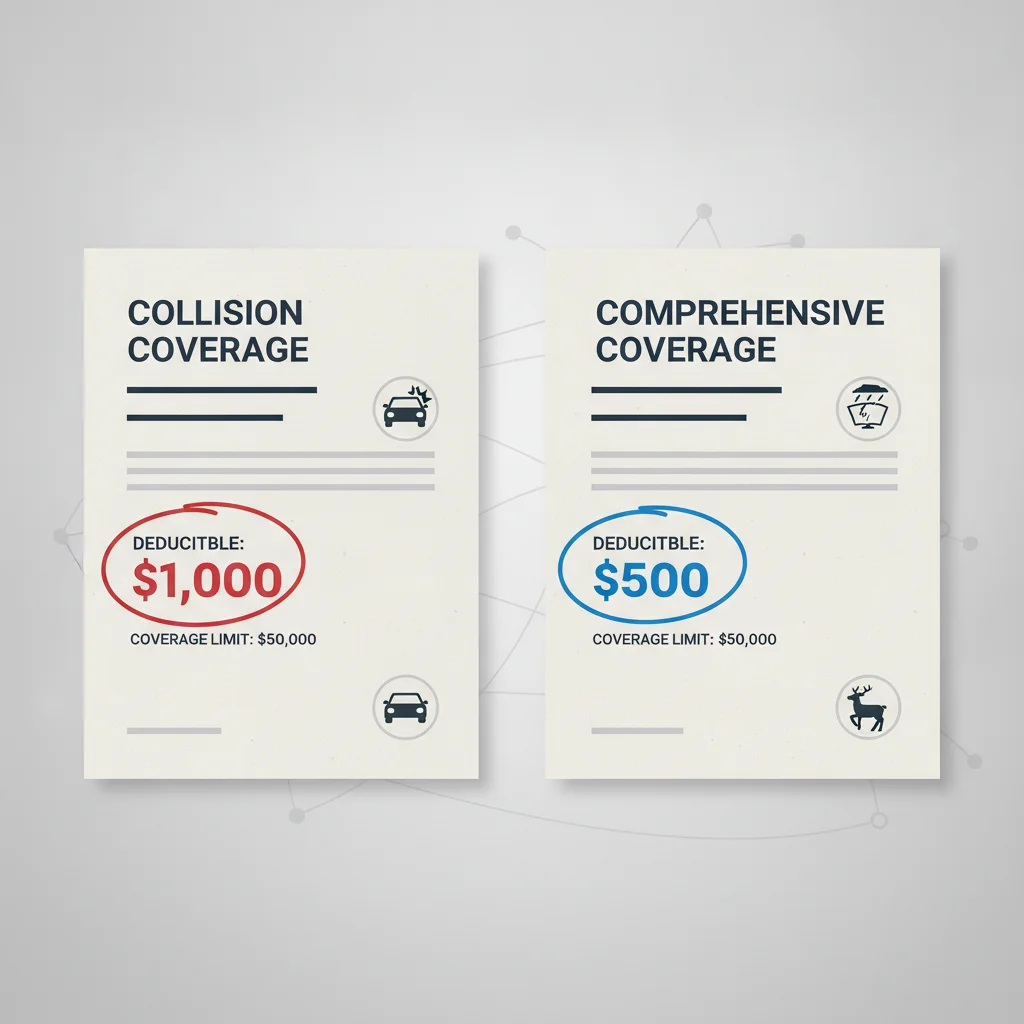
Your collision deductible applies when your vehicle is damaged in an accident involving another vehicle or a stationary object — a guardrail, a parking barrier, or another car. Your comprehensive deductible applies to losses outside of driving: theft, hail, flooding, a fallen tree, or a deer strike. For a full breakdown of what each coverage protects against, see our complete guide to collision and comprehensive insurance.

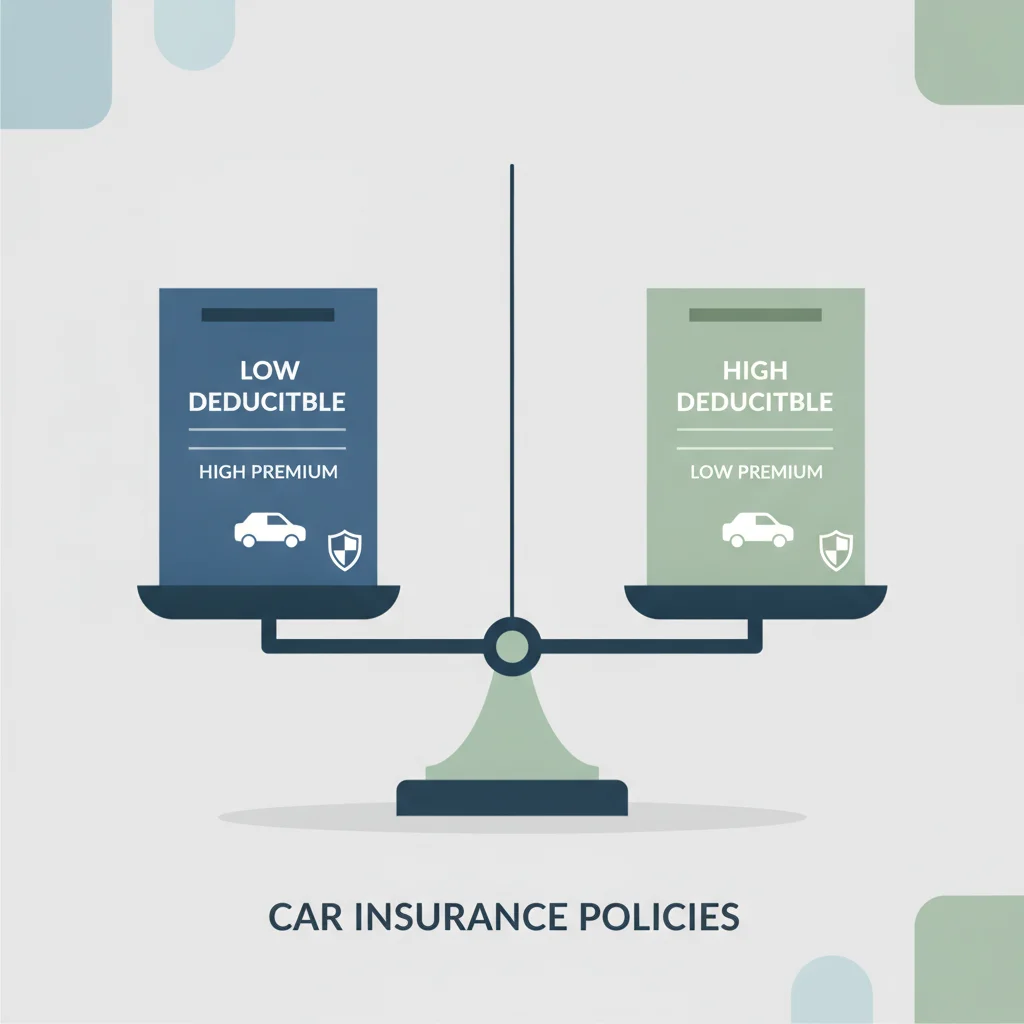
Here's the fundamental tradeoff: raise your deductible and your premium drops; lower your deductible and your premium rises. The insurer is essentially pricing based on how much risk you're willing to absorb yourself. Neither option is universally right — the correct answer depends on your vehicle's value, your financial cushion, your driving habits, and where you live.
Understanding how insurers weigh these factors in the first place can give you an edge when negotiating your policy. How insurers calculate physical damage premiums explains the variables — from your ZIP code to your vehicle's repair cost profile — that drive the number on your quote.
What you will need
What You'll Need Before You Start
Choosing the right deductible isn't a guessing game — it's a calculation. Before working through the steps below, gather the tools and information you'll need to make an informed comparison rather than an arbitrary one.
Kelley Blue Book (KBB) or NADA Guides
Look up your vehicle's current private-party or trade-in value to determine whether physical damage coverage is still cost-effective.
Insurance Declarations Page
Identifies your current deductible amounts and premium breakdown so you have a baseline for comparison.
Spreadsheet or Calculator App
Run the break-even calculation comparing premium savings against increased out-of-pocket risk at different deductible levels.
Your Insurer's Online Quote Tool
Instantly shows how adjusting your deductible amount changes your six-month or annual premium without committing to a change.
Loan or Lease Agreement
Confirms any lender-imposed deductible maximums you must respect on a financed or leased vehicle.
With these items in hand, you'll be able to move through each step efficiently and arrive at a deductible amount backed by your actual financial situation — not just a default the insurer pre-selected for you.
Step-by-Step: How to Choose Your Deductible
The following steps will walk you through evaluating your current deductibles, stress-testing alternatives, and making a change that fits both your budget and your risk profile. Work through them in order — each step builds on the last.
Confirm what your current deductibles are
Pull up your auto insurance declarations page — the one- or two-page summary your insurer sends at the start of each policy term. Under the physical damage section, look for two separate line items: collision deductible and comprehensive deductible. They may be the same amount, or they may differ.
If you don't have a declarations page handy, log in to your insurer's app or website. Most carriers display deductible amounts prominently on the coverage summary screen. Write down both figures before moving to the next step.
Look up your vehicle's current market value
Your car's actual cash value (ACV) is the maximum your insurer will pay on a total-loss claim, minus your deductible. If that ceiling is low, a high deductible can leave you with very little payout — or none at all.
Use Kelley Blue Book, NADA Guides, or a similar resource to find your vehicle's private-party value in your region with accurate mileage and condition. This figure, not the sticker price or what you originally paid, is what matters for coverage decisions.
As a general rule of thumb used by many financial advisors: if your annual premium for collision plus your deductible exceeds 10% of your car's market value, dropping or restructuring that coverage deserves serious consideration.
Assess your ability to pay the deductible out of pocket
A deductible is only useful if you can actually pay it when a claim occurs. Before choosing any deductible amount, ask yourself: Could I write a check for this amount today without derailing my finances?
Common deductible options include $250, $500, $1,000, $1,500, and $2,000. Some insurers offer $0 or even $2,500. Higher amounts reduce your premium but require more liquidity on your end.
- If your emergency fund is thin: A $250 or $500 deductible provides more predictable exposure.
- If you have 3–6 months of expenses saved: A $1,000 deductible is often manageable and delivers meaningful premium savings.
- If you rarely file claims and have strong savings: $1,500–$2,000 may make sense, as long as your vehicle's value justifies the coverage at all.
Run the break-even calculation
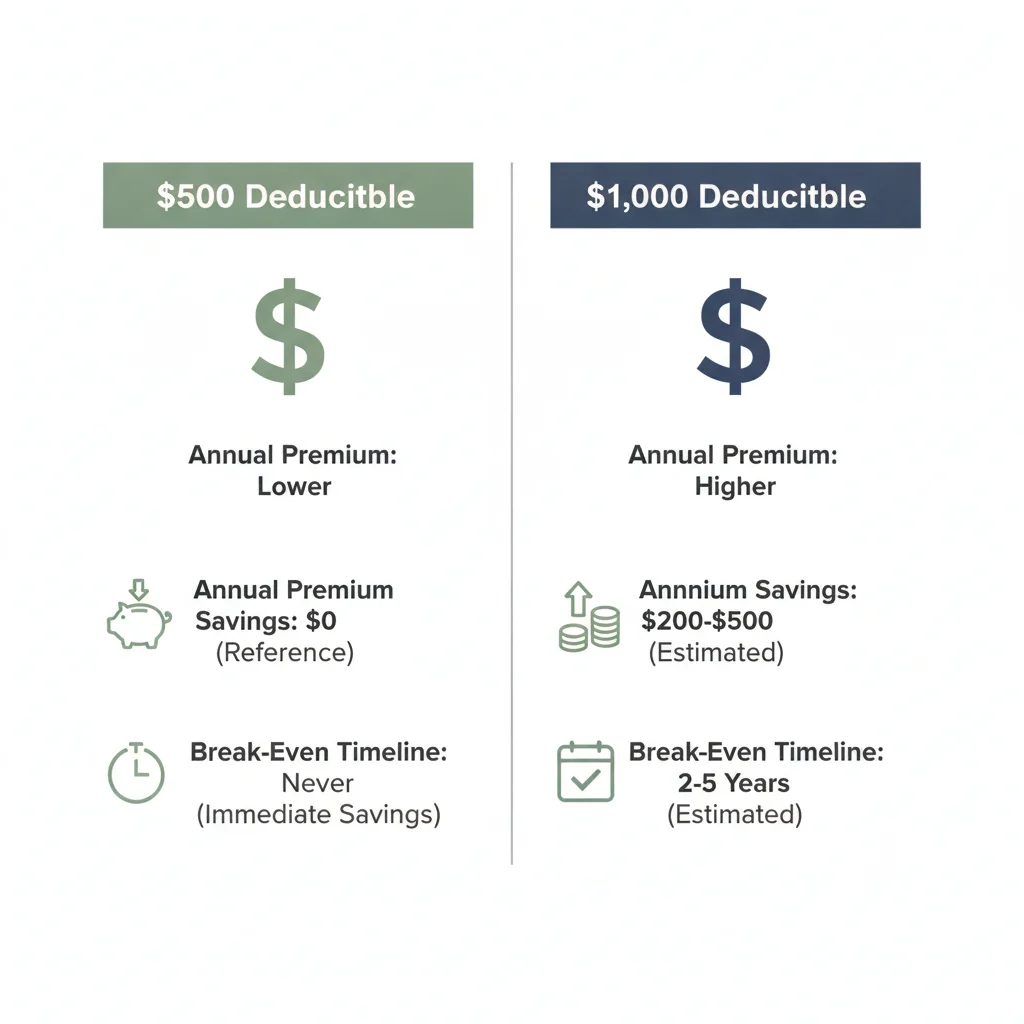
This is the core math behind any deductible decision. The break-even point tells you how many months of lower premiums it takes to recover the extra out-of-pocket cost you'd face at a higher deductible.
Formula:
Break-even months = (Deductible increase) ÷ (Monthly premium savings)
Example: Raising your collision deductible from $500 to $1,000 saves you $12/month. The deductible increase is $500.
$500 ÷ $12 = ~42 months (3.5 years)
If you expect to go more than 42 months without filing a collision claim — a reasonable assumption for many careful drivers — the higher deductible pays off. If you've filed multiple claims in recent years, the lower deductible may be safer.
Run this calculation separately for collision and comprehensive, since the risk profiles — and premium sensitivity — can differ significantly. Our deeper analysis of the deductible tradeoff walks through more advanced scenarios if you want to stress-test your numbers.
Evaluate your collision and comprehensive risk separately
Collision and comprehensive don't carry the same risk profile for every driver, and many insurers let you set different deductibles for each. This is worth thinking about strategically.
Collision risk is higher if you:
- Drive frequently or in heavy urban traffic
- Have a younger driver on the policy
- Have a prior at-fault accident history
Comprehensive risk is higher if you:
- Live in a region prone to hail, flooding, or severe weather
- Park on the street overnight in a higher-theft area
- Live in a state with high deer-collision frequency (Midwest, Mid-Atlantic)
If your comprehensive risk is relatively low — say, you garage the car in a low-crime suburb with mild weather — you might choose a higher comprehensive deductible to capture premium savings, while keeping your collision deductible lower given daily driving exposure. Learn more about setting mismatched deductibles to see if that strategy fits your situation.
Check lender or lessor requirements
If you're financing or leasing your vehicle, you don't have complete freedom on deductible levels. Most lenders and leasing companies cap the maximum deductible — typically at $500 or $1,000 — to protect their financial interest in the vehicle.
Review your loan or lease agreement for any language about insurance requirements. If you can't find it there, a quick call to your lender's customer service line will clarify the restriction. Setting a deductible above the allowed maximum could put you in breach of your financing agreement.
Make the change and document it
Once you've landed on the right deductible levels for both coverages, make the adjustment through your insurer's app, website, or by calling your agent. Most insurers allow mid-term deductible changes, though the premium adjustment will be prorated for the remaining policy period.
After making the change:
- Download or print the updated declarations page immediately.
- Confirm the new premium amount and the effective date of the change.
- If you raised your deductible, transfer the equivalent amount into a dedicated savings account so you're never caught short after a claim.
Review your deductible choices again at every policy renewal — your vehicle's value, financial situation, and risk exposure all shift over time.
Use Your Insurer's Tool Before Calling
Most major insurers — including GEICO, Progressive, and State Farm — let you adjust deductibles interactively on their websites or apps and see real-time premium changes. Run through several combinations before calling an agent. You'll enter the conversation with a much clearer sense of your options and won't be pressured into a quick decision.
Revisit Deductibles Every Renewal Cycle
A car that was worth $22,000 three years ago may now be worth $13,000. The deductible that made sense at purchase may no longer fit the vehicle's current value or your financial situation. Build a 10-minute deductible review into your annual renewal process — it consistently returns value for the time invested.
High Deductibles on Low-Value Vehicles
If your car is worth $5,000 and you carry a $2,000 deductible, a significant accident could yield a net insurance payout of just $3,000 — or nothing if the repair cost falls below your deductible. Before choosing a high deductible, make sure the remaining coverage is still worth the premium you're paying.
Don't Confuse Deductibles With Coverage Limits
Your deductible is not the same as your coverage limit. The deductible is what you pay first; the insurer covers the rest up to the vehicle's actual cash value. Conflating the two can lead to underinsurance or misplaced confidence in how much protection you actually have.
Common Mistakes Drivers Make With Deductibles
Even financially savvy drivers trip up on deductible decisions. Here are the most common errors worth avoiding:
- Setting the same deductible for collision and comprehensive by default. Most insurers allow independent deductibles, and there's often a financial case for mismatching them based on your actual risk exposure. Collision vs. comprehensive deductibles: do they have to match? explores exactly when that strategy makes sense.
- Ignoring the vehicle's depreciation curve. A $500 deductible on a car worth $4,000 means your maximum net insurance payout — in a total loss — is $3,500. At that point, the annual premium may not justify the coverage at all.
- Choosing a deductible based on what a neighbor or coworker uses. Deductible math is personal. Their risk profile, savings position, and vehicle value are almost certainly different from yours.
- Never revisiting the deductible after the initial policy purchase. As your car depreciates and your savings grow, the optimal deductible level changes. Treating it as a set-and-forget decision leaves money on the table.
The other common error is overcorrecting — dropping coverage entirely on a vehicle that still has meaningful value because the deductible feels too high. If the break-even math supports keeping coverage, a better solution is adjusting the deductible rather than eliminating the protection. For guidance on when filing a claim actually makes sense given your deductible, see which coverage applies to your situation.
Financed Vehicles Have Deductible Restrictions
If you're making car payments or leasing, your lender or lessor has a legal interest in the vehicle and typically limits your deductible to $500 or $1,000. Setting a higher deductible without lender approval may constitute a breach of your financing agreement. Always check your loan or lease documents before making deductible changes on a vehicle you don't own outright.
How Deductible Decisions Fit Into Your Broader Insurance Strategy
Your deductible doesn't exist in isolation — it's one lever in a larger policy structure. When you're comparing auto insurance policies, the deductible is one of the first places carriers compete on price, and it can obscure meaningful differences in coverage quality.
A policy with a $250 comprehensive deductible and a $1,000 collision deductible, for example, might cost nearly the same as one with both set at $500 — but carry meaningfully different risks depending on whether you're more likely to be in a fender bender or caught in a hailstorm. Running the break-even math on each combination, rather than comparing total premiums in isolation, gives you a clearer picture of actual value.
Think of the deductible decision as a form of self-insurance. Every dollar you agree to absorb yourself is a dollar the insurer no longer needs to price into your premium. The question is whether you're accepting that risk deliberately — with a savings buffer to back it up — or accidentally, because you selected a deductible without thinking through what you'd do if you had to pay it tomorrow.
Done thoughtfully, deductible optimization is one of the fastest ways to reduce your insurance costs without sacrificing meaningful protection. Done carelessly, it's how drivers end up unable to repair a car they're still paying off.

All claims are backed by peer-reviewed research. Sources on request.