
Key Takeaways
Policy Endorsement
A policy endorsement is a written amendment attached to your auto insurance policy that modifies the original terms of your coverage. It can add new protections, remove certain coverages, change limits, or adjust conditions. Endorsements are legally binding and take effect on a specified date, altering what your insurer will and won't pay for.
Insurers may also refer to endorsements as "riders" or "policy forms." Each endorsement is assigned a form number, which you can use to look up its exact language in your state's filed rate documents.
What an Endorsement Actually Is
Your base auto insurance policy is a standardized contract — it defines what's covered, what's excluded, the limits, and the conditions. But a standardized document can't account for every driver's situation. That's where endorsements come in.
An endorsement is a formal written modification attached to your policy. It overrides, expands, or restricts specific language in the base contract. When there's a conflict between the main policy document and an endorsement, the endorsement wins. That's worth understanding because it means endorsements carry real legal weight — they aren't footnotes or suggestions.
Drivers most commonly encounter endorsements when they're buying optional add-ons, when an insurer adjusts terms at renewal, or when a life change (new car, new driver, new job) requires the policy to be updated mid-term. For a broader look at the terminology that shows up in these documents, the auto insurance policy terms drivers reference most is a useful companion reference.
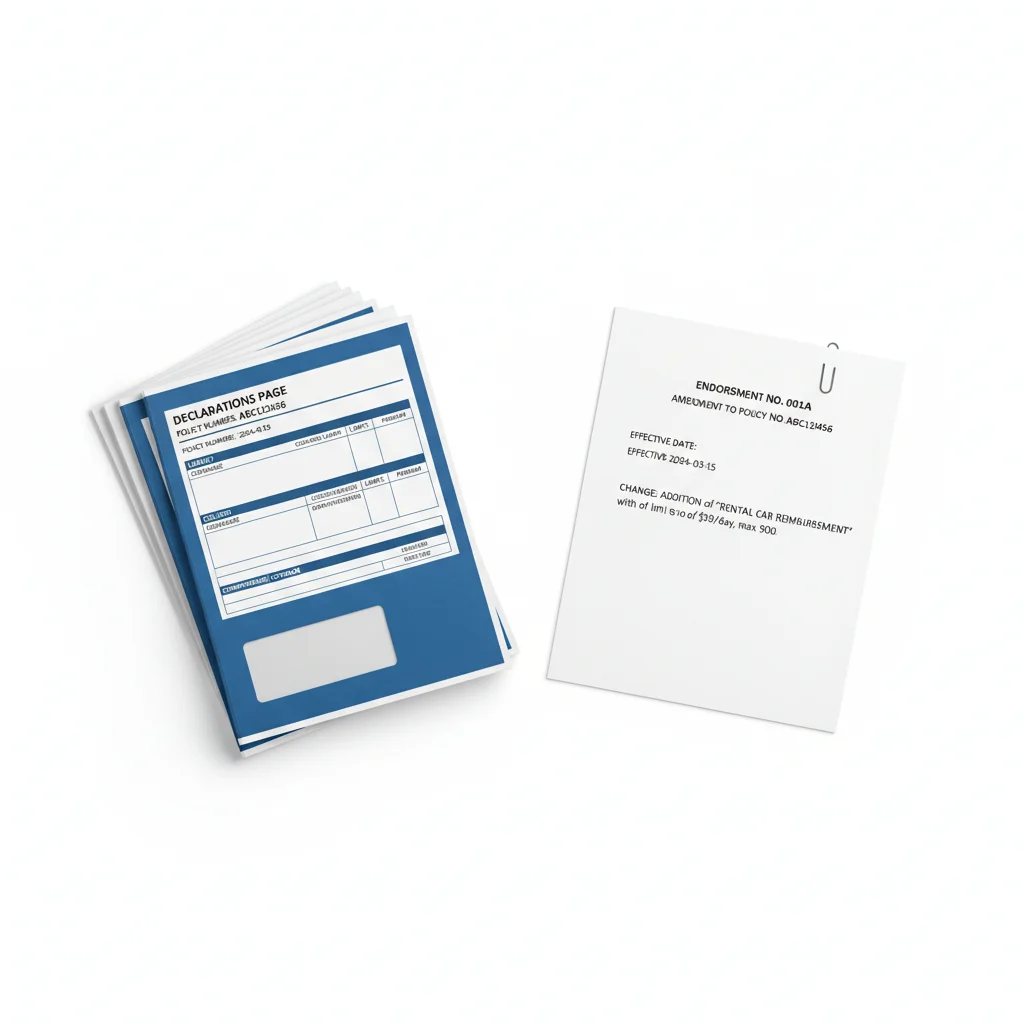
Endorsements show up on your declarations page by form number — something like "PP 03 34" or a company-specific identifier. The declarations page lists which endorsements are active, but the actual terms are in the endorsement documents themselves, which should be part of your full policy packet. If you've only been reading the declarations page, you may not have the full picture of your coverage.
The Two Directions Endorsements Can Go
Most drivers think of endorsements as upgrades — things you add for a fee. That's half the story. Endorsements move in two directions, and which direction matters enormously when you need to file a claim.
Coverage-Adding Endorsements
These expand what your policy covers beyond the base contract. Common examples include:
- Gap insurance endorsement: Covers the difference between your car's actual cash value and your remaining loan balance if the vehicle is totaled. Critical if you're underwater on a new or recent car loan.
- Rideshare endorsement: Fills the gap between your personal policy and the coverage your rideshare platform provides during the app-on, no-passenger phase — a window that base personal policies typically exclude.
- New car replacement endorsement: Instead of paying actual cash value after a total loss, the insurer pays to replace the vehicle with a comparable new model.
- Roadside assistance endorsement: Adds towing, lockout, flat tire, and fuel delivery services directly through your insurer.
- Custom parts and equipment endorsement: Extends coverage to aftermarket upgrades — wheels, audio systems, lift kits — that standard comprehensive and collision policies may cap or exclude entirely.
These endorsements belong to a broader category that the optional add-ons hub covers in depth. Not every add-on is worth the cost, so it's worth being selective — see which add-ons routinely pay off and which don't before deciding.
~40%
Drivers unaware of policy endorsements
Industry consumer research consistently finds that a large share of policyholders cannot identify the endorsements currently attached to their own policies.
$1,200+
Average gap between ACV and loan balance on new cars
According to Edmunds data, new car buyers frequently owe significantly more than their vehicle's actual cash value in the first two years of a loan, making gap endorsements financially material.
Up to 30%
Premium reduction from named driver exclusion
Excluding a high-risk driver from a household policy can reduce annual premiums by up to 30%, according to insurer rate filings, depending on the driver's record and the state.
Coverage-Restricting Endorsements
These are the endorsements drivers rarely read carefully — and the ones that create the most surprise at claim time.
- Named driver exclusion: Formally removes a specific person from coverage under your policy. If your excluded spouse is involved in an accident while driving your car, the insurer owes nothing.
- Business use exclusion: Restricts coverage for accidents that occur while using the vehicle for commercial purposes.
- Limited mileage endorsement: Caps coverage at a stated annual mileage — common in usage-based or low-mileage discount programs. Exceed the cap and you may find coverage limited or disputed.
Restricting endorsements usually come with a premium reduction, which makes them look attractive. Understand what you're giving up before accepting the discount.
When Insurers Add Endorsements Without You Asking
Not every endorsement on your policy got there because you requested it. Insurers can — and do — add endorsements unilaterally in certain situations. They're required to notify you, but that notification often arrives in the same envelope as your renewal documents, where it can get buried.
Common triggers for insurer-initiated endorsements include:
- Post-claim driver exclusions: After a serious at-fault accident or DUI, some insurers will exclude the at-fault driver from the policy rather than cancel the entire policy — particularly when other household members are covered.
- Regulatory or form updates: When a state insurance department approves revised policy language, your insurer may attach an endorsement to bring your in-force policy into compliance.
- Underwriting adjustments: If your insurer's underwriting review surfaces new risk information — a motor vehicle report showing an unreported violation, for example — they may amend your coverage terms mid-term or at renewal.
State Rules Govern Insurer Notification
Insurance is regulated at the state level, and notification requirements for mid-term endorsements vary by state. Most states require insurers to provide written notice 10 to 30 days before a material adverse change takes effect. However, favorable changes or corrections may take effect immediately with shorter or no required notice. Check your state's insurance department website if you're unsure of your rights.
The practical takeaway: don't assume your renewal is identical to your prior policy. Read the endorsement forms, not just the premium summary. If something looks unfamiliar, call your agent and ask for a plain-language explanation before the renewal date passes.
How Endorsements Interact With the Rest of Your Policy
An endorsement doesn't exist in isolation — it modifies a specific part of your base policy and can have downstream effects on other parts. Understanding that interaction is what separates a driver who thinks they have coverage from one who actually does.

Take the rideshare endorsement as a practical example. Your personal auto policy has a standard business-use exclusion buried in the conditions section. Without the rideshare endorsement, that exclusion could void coverage during the "app on, no passenger" phase. The endorsement overrides that exclusion for the specific circumstances it covers — but only those circumstances. Accidents that occur during a delivery (not a passenger ride) may still fall outside the endorsement's scope depending on the insurer.
Gap coverage endorsements interact with your collision and comprehensive coverages — they don't create a standalone protection; they sit on top of an existing payout and extend it. If you drop collision, the gap endorsement becomes worthless because there's no base payout to extend.
“The endorsement is where a policy gets real. The base contract sets the stage, but endorsements tell you what actually happens when something goes wrong in your specific situation.”
— J. Robert Hunter, Former Insurance Commissioner and Director of Insurance, Consumer Federation of America
The key question to ask with any endorsement: What specific policy language does this change, and what remains unchanged? If an agent or insurer can't answer that precisely, request the endorsement form number and read the document itself. For context on how endorsements compare to what policies explicitly won't cover, understanding exclusions is worth reading alongside this.
The features drivers most often overlook when comparing quotes covers how endorsement-driven benefits like rental reimbursement and roadside assistance factor into overall policy value — which matters when you're deciding between competing quotes.
Request an Endorsement Review Annually
Before every renewal, ask your agent to walk through your active endorsements and explain what each one does. This takes about ten minutes and frequently surfaces coverage you forgot you added — or coverage gaps you didn't know existed. It's also a useful moment to benchmark your policy against competitors.
Don't Wait for Renewal on High-Risk Changes
If you start driving for a rideshare platform, add a new driver, or take on a vehicle loan, call your insurer the same week. Mid-term endorsements are straightforward to add, and the pro-rated cost is typically small. The alternative — discovering a coverage gap at claim time — is far more expensive.
Reading Your Policy for Endorsements
Most drivers look at two things when they receive a policy: the premium and the declarations page. Both are important, but neither tells the full endorsement story.
Here's a practical process for reviewing endorsements:
- Pull your declarations page. Look for a section titled "Forms and Endorsements" or "Policy Forms." Every form listed there is part of your active policy.
- Locate the endorsement documents. Each listed form should have a corresponding document in your policy packet, either physical or in your insurer's digital portal. If any are missing, request them.
- Read the "Amendatory" language. Good endorsements state clearly which section of the base policy they're modifying and exactly what the replacement language is. Vague endorsements are a red flag.
- Note the effective date. Endorsements aren't retroactive. An endorsement added after an accident won't cover that accident.
- Check at every renewal. Your endorsement lineup can change at renewal without a separate notification beyond the renewal packet itself.
For a fuller vocabulary of the terms you'll encounter doing this review, the auto insurance terms you need to know lays out the landscape in plain language. And when you're comparing policies across insurers, the comparing policies hub is the right starting point for a structured evaluation.
When to Request an Endorsement Mid-Term
You don't have to wait for renewal to update your coverage. Mid-term endorsements take effect on a specified date — often the next day — and your premium adjusts on a pro-rated basis for the remaining policy period.
Life events that warrant an immediate call to your insurer or agent:
- You bought a new car. Your existing policy may extend coverage temporarily, but a formal endorsement or new declaration ensures you're properly covered, especially for loan or lease requirements.
- You started driving for Uber, Lyft, or a delivery platform. Your standard personal policy almost certainly has a business-use exclusion that applies. Add a rideshare endorsement before your first trip.
- You added a teen driver. Adding a new household driver is a material change that affects your risk profile and coverage scope. Don't rely on informal assumptions that they're covered.
- You financed or refinanced a vehicle. Lenders typically require comprehensive and collision coverage, and some require gap coverage. Verify your endorsements match your loan agreement's requirements.
- You installed significant aftermarket equipment. A lift kit, custom wheels, or upgraded audio may exceed your base policy's coverage cap for equipment. A custom parts endorsement protects that investment.
Request an Endorsement Review Annually
Before every renewal, ask your agent to walk through your active endorsements and explain what each one does. This takes about ten minutes and frequently surfaces coverage you forgot you added — or coverage gaps you didn't know existed. It's also a useful moment to benchmark your policy against competitors.
Don't Wait for Renewal on High-Risk Changes
If you start driving for a rideshare platform, add a new driver, or take on a vehicle loan, call your insurer the same week. Mid-term endorsements are straightforward to add, and the pro-rated cost is typically small. The alternative — discovering a coverage gap at claim time — is far more expensive.
The cost of a mid-term endorsement is almost always less than the coverage gap it closes. Don't let inertia leave you exposed between now and your next renewal date.

All claims are backed by peer-reviewed research. Sources on request.