Key Takeaways
As-Is Sale
An as-is sale means you're buying the vehicle in its current condition, with no promises from the seller about its mechanical state, history, or fitness for use. Whatever problems exist — known or unknown — become your responsibility the moment you sign. The seller is not obligated to fix anything before or after the sale, and you generally cannot return the vehicle if something breaks.
Under the Uniform Commercial Code (UCC), an as-is clause effectively disclaims all implied warranties, including the implied warranty of merchantability, which would otherwise guarantee the vehicle is fit for ordinary use.
What "As-Is" Actually Means in a Car Sale
Two words on a sticker or in a contract change the entire financial equation of a used car purchase. "As-is" is not a casual disclaimer — it's a legally operative phrase that strips away consumer protections most buyers assume they have.
When you buy a car as-is, you're agreeing that the vehicle's condition at the moment of sale is what you're getting. Full stop. The engine could fail on the drive home. The transmission could slip the next morning. Unless the seller committed outright fraud, those repair bills are yours. No returns, no refunds, no recourse against the seller for breakdowns.
This matters because used cars are the dominant context for as-is sales. The vast majority of private party transactions and a significant share of dealer sales involve some form of as-is language. Understanding what you're signing before you hand over a check is non-negotiable. See our paperwork and contracts guide for a broader look at the documents involved in any car purchase.
There are two ways an as-is sale happens: explicitly, through contract language or a signed disclosure, and implicitly, through default legal rules that govern private party transactions in most states. Either way, the legal effect is the same — you're taking the car as you found it.
The Legal Framework Behind As-Is Clauses
The legal weight of an as-is clause comes from the Uniform Commercial Code, which governs commercial transactions across the U.S. Under UCC § 2-316, sellers can disclaim implied warranties — specifically the implied warranty of merchantability and the implied warranty of fitness for a particular purpose — by clearly stating the item is sold "as is" or "with all faults."
In plain terms: without an as-is clause, the law implies a baseline promise that the vehicle is reasonably fit for normal use. Add an as-is clause, and that implied promise disappears.
Manufacturer Warranties Can Survive As-Is Sales
An as-is clause only affects what the seller warrants — it does not cancel transferable factory warranties. If the vehicle is still within the manufacturer's bumper-to-bumper or powertrain coverage window, that protection may transfer to you automatically. Always verify warranty status by VIN on the manufacturer's website before finalizing the deal.
State Law May Override As-Is Language
In several states, consumer protection statutes preserve minimum implied warranty rights for buyers of used vehicles from licensed dealers, regardless of what the contract says. Before assuming an as-is clause is absolute, check your state's specific used car lemon law and dealer warranty requirements. A consumer protection attorney can clarify your local rights at low or no cost.
Odometer Disclosure Is Not Optional
Federal law requires a signed odometer disclosure statement in every vehicle sale, separate from the bill of sale's as-is language. This disclosure is mandatory regardless of vehicle age (for most vehicles) and is a distinct legal obligation. Misrepresenting mileage is a federal crime that carries civil penalties of up to three times actual damages.
The critical distinction buyers miss is between seller warranties and manufacturer warranties. An as-is clause only disclaims what the seller is guaranteeing. If a factory powertrain warranty still has months or years remaining and is transferable, that coverage survives an as-is sale. Always check warranty status on the manufacturer's website using the VIN before you buy.
State law complicates this further. A handful of states — Massachusetts, Minnesota, Mississippi, West Virginia, and Kansas among them — limit or prohibit outright as-is disclaimers on consumer vehicle sales, preserving implied warranty protections for buyers regardless of what the contract says. If you're buying in one of these states, the seller has more limited ability to completely disclaim responsibility. See the full breakdown of as-is vs. implied warranty protections for state-by-state nuances.
~40%
Used dealer cars sold without any warranty
FTC data on Buyers Guide filings indicates a significant share of used dealer inventory is designated as-is, varying by vehicle age and condition tier.
$1,200+
Average first-year repair cost on as-is used car
Consumer Reports data suggests buyers of older used vehicles without warranty coverage spend over $1,200 in unplanned repairs in the first 12 months of ownership on average.
6 states
States limiting or prohibiting full as-is disclaimers
States including Massachusetts, Minnesota, and West Virginia have statutes that preserve minimum implied warranty protections for consumers even when as-is language appears in the contract.
$150
Typical pre-purchase inspection cost
Independent mechanic inspection fees generally range from $100–$200 depending on market and inspection depth, representing a small fraction of potential repair exposure.
Where As-Is Clauses Don't Protect Sellers
Here's what the as-is label does not cover, and where sellers remain legally exposed despite the contract language.
Active Fraud and Intentional Concealment
An as-is clause shields sellers from liability for defects they didn't know about. It does not protect them for defects they knew about and deliberately hid. If a seller fills an engine with heavy oil to quiet a knock, rolls back an odometer, or misrepresents accident history, courts will set aside the as-is clause entirely. Fraud is fraud — contract language doesn't change that.
Required Disclosures Under State and Federal Law
Most states have mandatory disclosure requirements that operate independently of any as-is agreement. Sellers must disclose known material defects, salvage titles, flood damage, and in many states, prior accident history exceeding certain damage thresholds. These obligations exist by statute and cannot be waived through contract. Violating them creates liability regardless of what the bill of sale says.
The seller disclosure law requirements vary significantly by state — what must be disclosed in California differs from what's required in Texas. As a buyer, you should understand what your state requires sellers to tell you.
FTC Buyers Guide Requirements at Dealerships
If you're buying from a licensed dealership, the Federal Trade Commission requires a Buyers Guide window sticker on every used vehicle. That sticker must clearly indicate whether the car is sold as-is or with a warranty. Dealers who fail to display it, or who contradict the Buyers Guide in the purchase contract, are in violation of federal rules. Importantly, the Buyers Guide terms take legal precedence over any conflicting language in the contract you sign.

Always Inspect Before You Sign Anything
Never agree to buy a car as-is based solely on a test drive and the seller's assurances. Hire an independent mechanic — not one the seller recommends — to inspect the car on a lift before you commit. If the seller won't allow an inspection, that refusal is itself a red flag worth taking seriously.
Negotiate Price Using Inspection Findings
An inspection report isn't just peace of mind — it's a negotiating tool. Document every defect with estimated repair costs and use that total to justify a lower offer. A seller who won't budge on price after documented problems are revealed is telling you something important about the transaction.
Private Party vs. Dealer As-Is Sales: Key Differences
The as-is dynamic plays out differently depending on who you're buying from.
Private Party Sales
In a private party transaction, as-is is the default. There's no implied dealer warranty, no FTC Buyers Guide requirement, and generally no dealer license at stake. What you see is what you get. Sellers are still bound by fraud law and state disclosure statutes, but the structural protections are minimal. This is where buyers are most exposed and where due diligence matters most.
Private party deals also tend to produce better prices — precisely because the buyer absorbs more risk. The trade-off can be worth it, but only when you've actually done the work to understand what you're buying. Learn more about what sellers are still liable for in as-is private sales.
Dealer Sales
Dealers operate under more regulatory scrutiny. The FTC Buyers Guide requirement is mandatory. Many states impose additional used car regulations on licensed dealers that don't apply to private sellers. Some states require dealers to offer a short "cooling off" period or minimum implied warranty even on as-is vehicles — though these vary widely.
That said, dealers also sell plenty of cars as-is legitimately — auction units, high-mileage trade-ins, or vehicles with known mechanical issues priced accordingly. "As-is" at a dealer doesn't automatically mean the car is a disaster; it means the dealer isn't standing behind it. Understand the difference between an as-is dealer sale and a Certified Pre-Owned vehicle — CPO programs come with inspections and warranties that significantly change the risk profile. The contrast with buying a new car is stark: new vehicles carry full factory warranties with no as-is ambiguity.
“The 'as-is' label doesn't mean the seller has no responsibility — it means you've agreed to accept the unknown. What it cannot do is immunize a seller who lied to your face about what the car is.”
— Remar Sutton, Consumer advocate and author on auto industry practices
How to Protect Yourself Before Signing As-Is
Buying as-is isn't inherently a bad decision — it's a risk calculation. The question is whether the price reflects the condition and whether you've done enough homework to know what you're taking on.
1. Get a Pre-Purchase Inspection
A qualified independent mechanic — not the seller's preferred shop — should inspect the vehicle before you commit. Expect to pay $100–$200 for a thorough inspection. That's cheap insurance against a $3,000 transmission repair you didn't see coming. A good PPI will catch fluid leaks, suspension wear, compression issues, brake condition, and body repair evidence that the seller may not have disclosed.
2. Pull a Vehicle History Report
Run a Carfax or AutoCheck report using the VIN. Look for salvage or rebuilt titles, flood damage flags, odometer rollback indicators, and accident history. A clean history report doesn't guarantee a clean car — not all incidents are reported — but it will surface obvious red flags before you invest time in an inspection.
3. Negotiate Price Based on Known Defects
If the inspection turns up problems, use them as negotiating leverage. Every documented defect should reduce the price by at least the estimated repair cost, and often more — because you're also absorbing the risk of discovering additional issues. Don't pay retail pricing for an as-is car; there should be a meaningful discount to compensate for the warranty you're not getting.
4. Get Verbal Representations in Writing
If the seller tells you the car "just had a new transmission" or "the AC was recharged last month," write it into the bill of sale. Verbal representations can sometimes create legal obligations, but proving them later is difficult. Put specifics on paper: what was replaced, when, by whom. This also has the effect of testing the seller's confidence in their own claims.
5. Understand the Full Cost Picture
Budget for immediate maintenance — fluids, filters, brakes, tires — regardless of what the seller says about the car's condition. On high-mileage vehicles especially, assume you're buying a car that needs some work. If you're financing the purchase, factor potential repair costs into whether you can actually afford to own this vehicle. Review what the finance contract commits you to before signing, because those payments don't stop if the car breaks down.

Always Inspect Before You Sign Anything
Never agree to buy a car as-is based solely on a test drive and the seller's assurances. Hire an independent mechanic — not one the seller recommends — to inspect the car on a lift before you commit. If the seller won't allow an inspection, that refusal is itself a red flag worth taking seriously.
Negotiate Price Using Inspection Findings
An inspection report isn't just peace of mind — it's a negotiating tool. Document every defect with estimated repair costs and use that total to justify a lower offer. A seller who won't budge on price after documented problems are revealed is telling you something important about the transaction.
What the Paperwork Will Actually Look Like
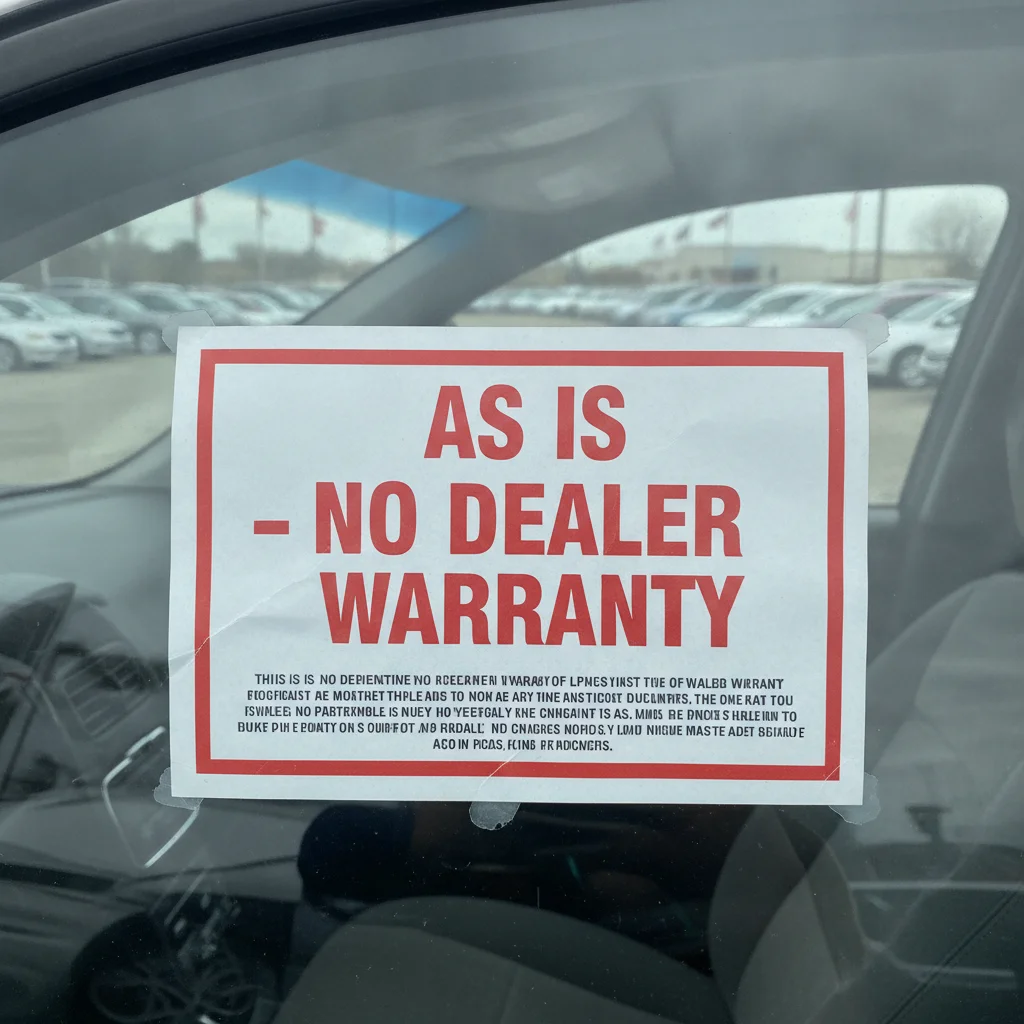
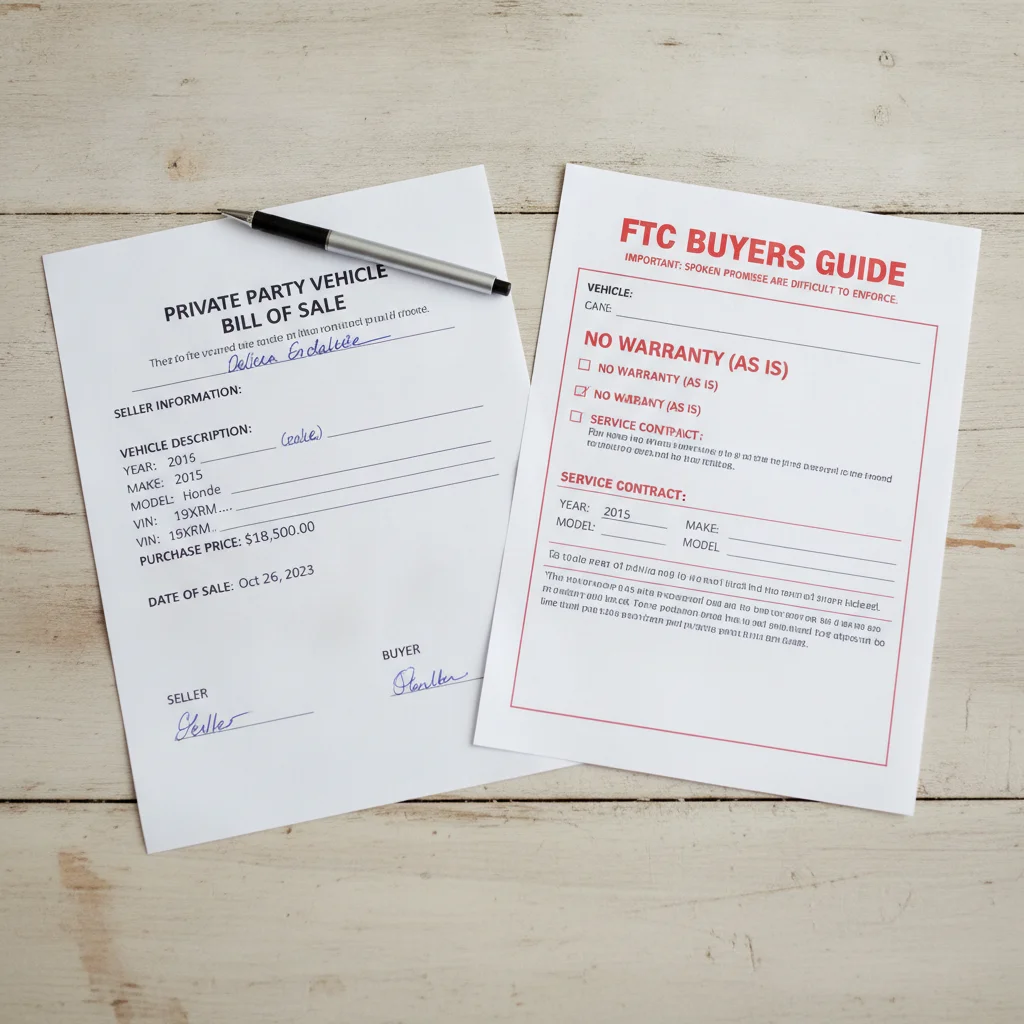
In a dealer transaction, as-is status appears in two places: the FTC Buyers Guide window sticker and typically within the purchase agreement itself. The Buyers Guide will have "AS IS – NO DEALER WARRANTY" checked in the top box. The purchase agreement may include a separate as-is acknowledgment clause requiring your signature or initials.
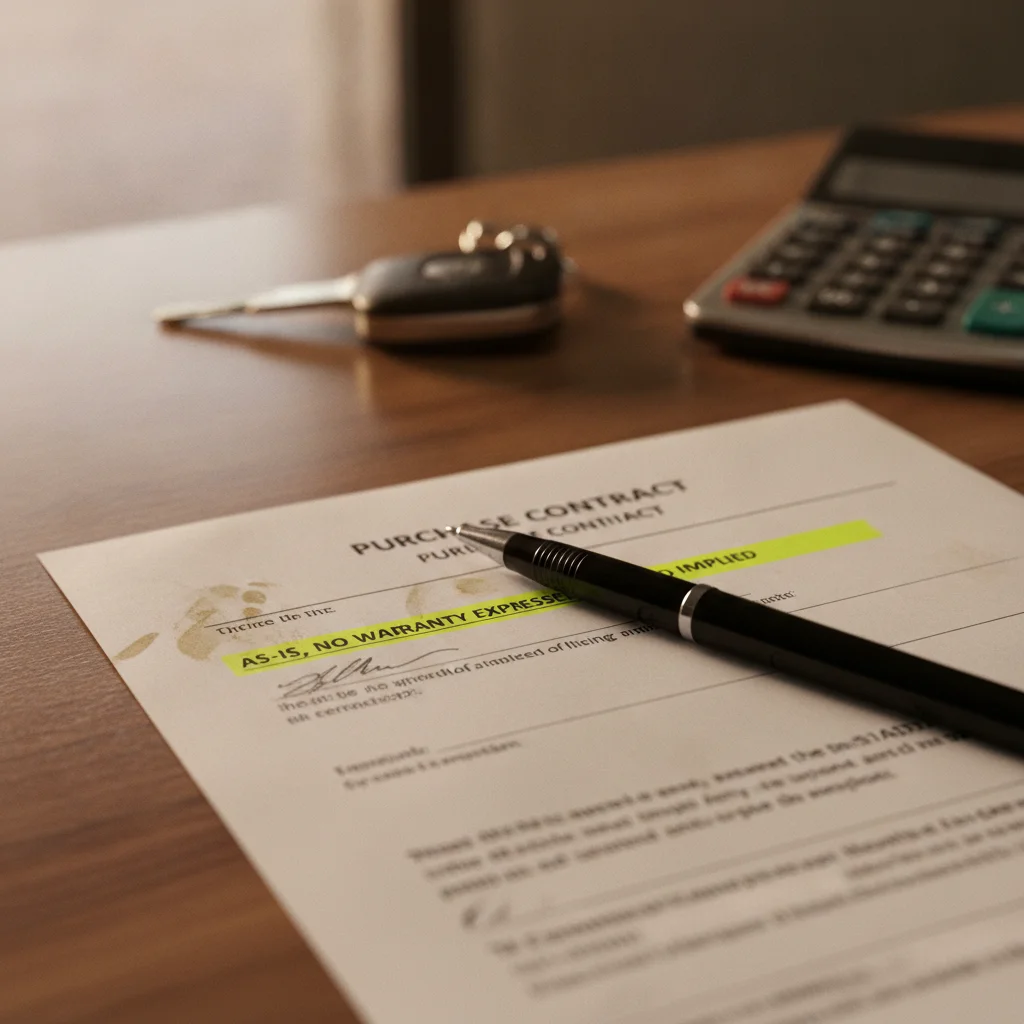
In a private party sale, the bill of sale is simpler — often a form downloaded from the state DMV's website. If the seller wants as-is protection explicit, they'll add language to the effect of "sold as-is with no warranties expressed or implied, buyer acknowledges acceptance of vehicle in present condition." Some states' standard bill of sale forms include this language by default.
One document often overlooked in this context: the odometer disclosure statement. Federal law requires sellers to disclose the actual mileage at the time of sale. This is a separate legal obligation from the as-is clause and applies regardless of whether the vehicle is sold with or without warranty. Misrepresenting mileage is a federal violation. See every document you'll sign at a dealership for a complete overview of what the paperwork stack looks like.
Manufacturer Warranties Can Survive As-Is Sales
An as-is clause only affects what the seller warrants — it does not cancel transferable factory warranties. If the vehicle is still within the manufacturer's bumper-to-bumper or powertrain coverage window, that protection may transfer to you automatically. Always verify warranty status by VIN on the manufacturer's website before finalizing the deal.
State Law May Override As-Is Language
In several states, consumer protection statutes preserve minimum implied warranty rights for buyers of used vehicles from licensed dealers, regardless of what the contract says. Before assuming an as-is clause is absolute, check your state's specific used car lemon law and dealer warranty requirements. A consumer protection attorney can clarify your local rights at low or no cost.
Odometer Disclosure Is Not Optional
Federal law requires a signed odometer disclosure statement in every vehicle sale, separate from the bill of sale's as-is language. This disclosure is mandatory regardless of vehicle age (for most vehicles) and is a distinct legal obligation. Misrepresenting mileage is a federal crime that carries civil penalties of up to three times actual damages.
For sellers weighing their options, the calculus between selling as-is and offering some form of limited warranty involves real trade-offs in liability and pricing. The seller's perspective on as-is vs. warranty disclosures covers that side of the transaction in detail.
The Bottom Line on As-Is Purchases
An as-is label is not a stop sign — it's a signal to do more work before buying. Plenty of solid used cars are sold as-is, priced accordingly, and run reliably for years afterward. The label becomes a trap only when buyers skip due diligence and assume the price alone justifies the risk.
The practical rules are simple: inspect before you sign, price in the risk, get key claims in writing, and understand that the contract you sign is the final word. No amount of buyer's remorse after the fact changes what that document says.
And remember — as-is protects honest sellers from liability for things they didn't know. It doesn't protect dishonest sellers who concealed what they did know. If you discover after the fact that the seller misrepresented something material, document everything and consult an attorney before assuming you have no options.

All claims are backed by peer-reviewed research. Sources on request.