
Key Takeaways
Out-the-Door Price
The out-the-door (OTD) price is the total amount you actually pay to drive a vehicle home — including the negotiated vehicle price, sales tax, title and registration fees, documentation fees, and any dealer-added charges. It's the only figure that reflects what will leave your bank account or appear on your loan. Everything else — the MSRP, the advertised price, the monthly payment — is derived from it or obscures it.
Lenders calculate your loan principal from the OTD price (minus your down payment and trade-in equity), meaning every dollar added in fees directly increases the amount on which interest accrues over the life of the loan.
Why the Advertised Price Sets a Trap
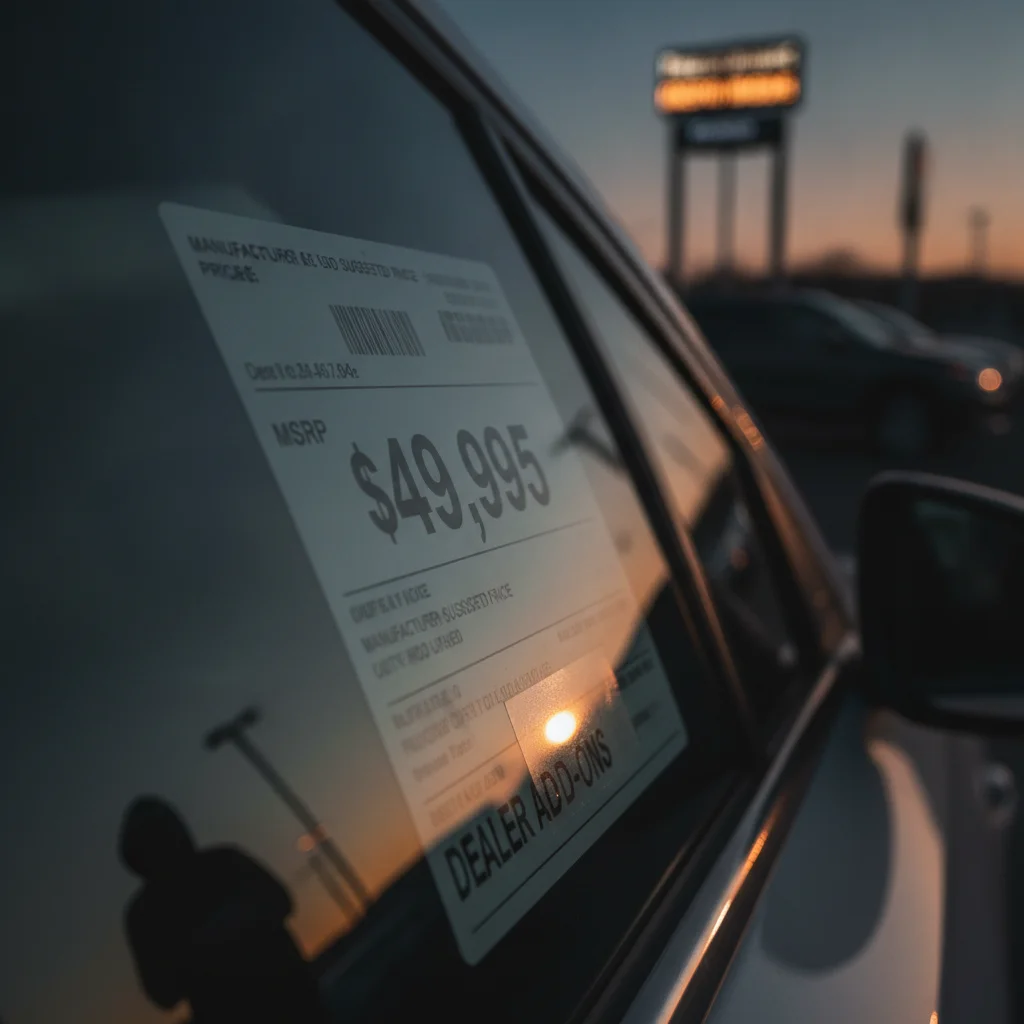
Walk into any dealership and point to a car priced at $29,995 on the window sticker. That number — the Manufacturer's Suggested Retail Price, or MSRP — is not what you're going to pay. It's a starting point, and in many cases, it's the most optimistic figure you'll see on any document you sign that day.
Dealers know this. Advertisements lean into it. "Drive home today for $369/month!" means nothing without knowing the loan term, the interest rate, the down payment required, and — most critically — what the vehicle actually costs when taxes and fees are included. The sticker price doesn't tell you about dealer-added accessories already installed on the car, market adjustments added on top of MSRP, or the documentation fee that appears quietly on the final contract.
The out-the-door price is the antidote to all of that noise. It is the one number that tells you exactly what leaves your pocket — or gets added to your loan balance — on the day you take delivery. Every other number in the deal is either a component of it or a distraction from it.
What Builds the Out-the-Door Price
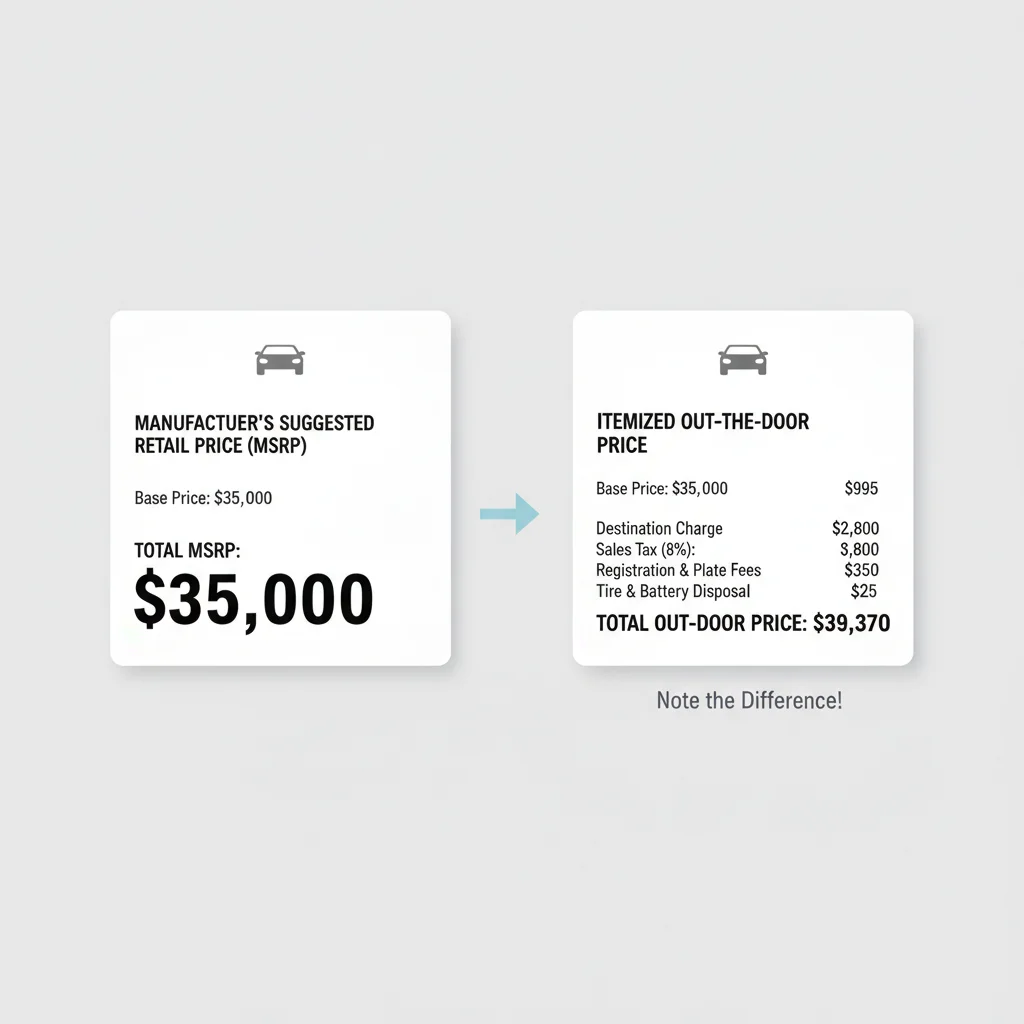
The OTD price is not a single charge — it's an addition problem with five to eight line items. Understanding each one lets you verify the math and catch inflated charges before they're buried in a loan.
1. Negotiated Vehicle Sale Price
This is the agreed-upon price of the car itself, separate from everything else. It should be the result of your negotiation, not the MSRP. On popular or scarce models, dealers may add a "market adjustment" above MSRP — a charge that is entirely negotiable and sometimes removable if you're willing to shop competing dealers. The sale price is the foundation of the OTD calculation. Every percentage point you shave here compounds favorably across the entire deal.
2. Sales Tax
Most states charge sales tax on vehicle purchases, and the rate varies significantly. California's combined state and local rate can exceed 10%. Texas charges 6.25%. States like Oregon, Montana, New Hampshire, and Delaware charge zero. If you live near a state border, understand that tax is typically owed in the state where you register the vehicle — not where you buy it. On a $35,000 car at 9% tax, that's $3,150 added before anything else.
$1,500–$4,500
Typical taxes and fees added to a $30K vehicle
Based on average state sales tax rates and typical dealer fees across U.S. markets in 2024; varies significantly by state.
$599–$999
Average dealer documentation fee range at non-capped dealerships
Edmunds and consumer advocacy surveys show doc fees at high-volume dealers averaging over $400 nationally, with outliers exceeding $900.
0%
Sales tax rate in Oregon, Montana, Delaware, New Hampshire, and Alaska
Buyers in these states pay no state sales tax on vehicle purchases, though local taxes or fees may still apply in some jurisdictions.
8–12%
Estimated OTD cost above negotiated price in most states
A practical budgeting benchmark for buyers in high-tax states factoring in sales tax, registration, title, and typical doc fees.
72–84 months
Loan terms increasingly used to obscure total vehicle cost
Experian's State of the Auto Finance Market reports show average new car loan terms have lengthened steadily, with 72-month loans now common.
3. Title and Registration Fees
These are government fees paid to your state's DMV to legally register the vehicle in your name and establish the title. They are non-negotiable — the dealer collects them on behalf of the state. Registration fees vary by state and sometimes by vehicle weight or value. State fees and registration costs differ enough that it's worth checking your state's DMV fee schedule before you sit down with a finance manager.
4. Documentation Fee
The doc fee — sometimes called a "processing fee" or "administrative fee" — is what the dealer charges to handle the paperwork. It has nothing to do with the government. It is pure dealer revenue, and it ranges from $85 in states that don't regulate it and have competitive markets, to over $900 at some dealers. A few states cap it by law. Everywhere else, it is negotiable. If a dealer refuses to budge on the fee, insist they reduce the vehicle price by the same amount.
5. Dealer-Installed Add-Ons
Walk around the new car on the lot and you may find a small sticker inside the window listing "dealer-installed accessories": paint sealant, fabric protection, wheel locks, nitrogen tire fill, window tinting. These are added by the dealer — not the manufacturer — and they almost always carry enormous profit margins. The cost to the dealer for paint sealant is typically under $50. They charge $299–$599. These are negotiable; many can be removed entirely. Negotiating the OTD price rather than the monthly payment is the single most effective way to eliminate these charges from the deal.
Dealer Add-Ons Already Installed
Some dealers install accessories on every vehicle before it hits the lot and insist you must pay for them because they're "already done." Legally, you typically cannot be compelled to pay for unsolicited add-ons. If they won't remove the charge, negotiate an equivalent reduction in the vehicle sale price. Document this in writing on the purchase agreement.
Monthly Payment Math: Always Reverse It
If a dealer quotes you a monthly payment before an OTD price, reverse-engineer the total. Multiply the monthly payment by the number of months in the loan. Subtract your down payment. If the result is significantly higher than the OTD you agreed on, there are hidden charges embedded in the loan. Ask the finance manager to walk through the contract line by line.
How to Calculate Your OTD Price Before You Walk In
You don't need to wait for a finance manager to hand you a contract to know your OTD. Here's how to estimate it yourself before the conversation starts.
- Start with the target sale price. Research the market value of the vehicle using tools like KBB and Edmunds valuation tools to establish a realistic target. For most non-scarce vehicles, that's somewhere between invoice price and MSRP.
- Add sales tax. Look up your state and county combined sales tax rate for vehicle purchases. Multiply your target sale price by the tax rate. On a $32,000 vehicle in a jurisdiction with 8.5% tax: $32,000 × 0.085 = $2,720.
- Add title and registration. Check your state DMV's published fee schedule. For most states this falls between $150 and $400, but some states with value-based registration fees can run higher on new vehicles.
- Add an estimated doc fee. Call the dealer ahead of your visit and ask directly: "What is your documentation fee?" Any dealer worth buying from will tell you. Budget for it and include it in your comparison across dealers.
- Add any confirmed add-ons you're actually keeping. If you want dealer-installed window tint, add it. If you don't want paint sealant, don't add it — and don't pay for it.
The result is your estimated OTD. When the dealer presents a contract, verify every line matches your estimate. Any new line item is a conversation, not an automatic obligation.
Call Ahead for the Doc Fee
Before visiting any dealer, call and ask specifically: "What is your documentation fee?" A dealer who won't give you a straight answer on a simple number is signaling how they'll handle every other part of the transaction. Use this single question to pre-screen dealers and set your negotiating baseline.
Always Ask for a Written OTD Quote
Request that the dealer provide a written OTD quote — sometimes called a "buyer's order" or "purchase agreement" — before you discuss financing. This document should itemize every charge. If anything appears in the finance office that wasn't on this document, stop and ask why. Don't let new charges slip by because you're excited to close the deal.

The Hidden Cost of Ignoring the OTD Price
Here's the thing most buyers don't feel until it's too late: when you finance a vehicle, every dollar added to the OTD price becomes a dollar you're paying interest on. That changes the math on "small" fees dramatically.
Say a dealer adds $895 in dealer add-ons you didn't notice and a $599 doc fee you didn't push back on. That's $1,494 in additional cost. Financed over 60 months at 7% APR, those fees don't cost you $1,494 — they cost you approximately $1,780 when interest is factored in. The difference between negotiating OTD price vs. monthly payment is where buyers consistently leave hundreds or thousands on the table.
“Buyers who focus on the monthly payment are essentially handing the dealer a blank check for the total price. The out-the-door figure is the only number that honest dealers and informed buyers agree on first.”
— Philip Reed, Senior Consumer Advice Editor, Edmunds
This compounding effect also explains why dealers sometimes want you focused on monthly payments. If they can convince you that $450/month is an acceptable payment, they can adjust the loan term and the purchase price independently to hit that number — while loading the OTD price with fees and add-ons that inflate the loan principal significantly. See how to calculate the total tax and fee cost before buying a car for a detailed state-by-state breakdown of what you should expect.
The OTD price is also directly relevant if you're comparing the true cost of buying new versus used. A used car with a lower sticker price can end up with a similar OTD figure once taxes, fees, and any required repairs are factored in — which is exactly the kind of calculation covered in the real cost of owning a used car beyond the sticker price.
Call Ahead for the Doc Fee
Before visiting any dealer, call and ask specifically: "What is your documentation fee?" A dealer who won't give you a straight answer on a simple number is signaling how they'll handle every other part of the transaction. Use this single question to pre-screen dealers and set your negotiating baseline.
Always Ask for a Written OTD Quote
Request that the dealer provide a written OTD quote — sometimes called a "buyer's order" or "purchase agreement" — before you discuss financing. This document should itemize every charge. If anything appears in the finance office that wasn't on this document, stop and ask why. Don't let new charges slip by because you're excited to close the deal.
How to Use the OTD Price at the Negotiating Table
The OTD price isn't just a concept — it's a tactical tool. Here's how to use it from the moment you sit down.
Lead with it, don't chase it
Before any discussion of trade-in, financing, or monthly payment, say this: "I'd like to start by agreeing on an out-the-door price for this vehicle before we get into financing options." This reframes the entire negotiation. Dealers are trained to anchor on monthly payments. You're redirecting to the number that actually matters.
Get it in writing before you go to the finance office
The finance office — the F&I (Finance and Insurance) room — is where dealers make a substantial portion of their profit. Extended warranties, GAP insurance, and service contracts are presented here, often bundled into the monthly payment to obscure their cost. If you have a signed, agreed-upon OTD price before you enter that room, any add-on is a separate, transparent decision — not something slipped into an already-agreed payment.
Compare dealers on OTD, not on MSRP
If you're shopping multiple dealers for the same model, the only apples-to-apples comparison is the OTD price. Dealer A may advertise $500 below MSRP but charge an $895 doc fee. Dealer B might be at MSRP but charge $150 in docs. The OTD tells you who's actually giving you the better deal.
Know which fees are fixed and which are negotiable
Sales tax: fixed. Title fee: fixed. Registration: fixed. Documentation fee: negotiable. Dealer add-ons: negotiable. Market adjustment above MSRP: negotiable. Understanding which charges are real and which are dealer-created gives you the confidence to push back only where pushing back makes sense — and to accept fixed charges without wasting energy arguing about them.

OTD Price vs. Monthly Payment: The Trap Explained
Consider a $30,000 vehicle negotiated down to $28,500 in a state with 7% sales tax, $350 in registration and title fees, and a $599 doc fee. The real OTD calculation looks like this:
| Line Item | Amount |
|---|---|
| Negotiated Sale Price | $28,500 |
| Sales Tax (7%) | $1,995 |
| Title & Registration | $350 |
| Documentation Fee | $599 |
| Out-the-Door Total | $31,444 |
Now imagine the dealer says: "We can do $449 a month." At 7% APR over 72 months, a $449/month payment corresponds to a loan principal of roughly $26,500 — which means either you're being asked for a $4,944 down payment, or the numbers don't actually add up and you need to ask them to show you the full contract math. Monthly payments without a defined loan term, rate, and OTD total are meaningless. Always do the reverse calculation.
The formula: Monthly Payment × Number of Payments = Total Paid. Subtract your down payment. That's your loan principal. Does it match the OTD price? If it's higher, find out why.
Dealer Add-Ons Already Installed
Some dealers install accessories on every vehicle before it hits the lot and insist you must pay for them because they're "already done." Legally, you typically cannot be compelled to pay for unsolicited add-ons. If they won't remove the charge, negotiate an equivalent reduction in the vehicle sale price. Document this in writing on the purchase agreement.
Monthly Payment Math: Always Reverse It
If a dealer quotes you a monthly payment before an OTD price, reverse-engineer the total. Multiply the monthly payment by the number of months in the loan. Subtract your down payment. If the result is significantly higher than the OTD you agreed on, there are hidden charges embedded in the loan. Ask the finance manager to walk through the contract line by line.
All claims are backed by peer-reviewed research. Sources on request.