

Key Takeaways
Why the Sticker Price Is Just the Beginning
Walk onto any dealer lot, spot a $32,000 sedan, and feel confident about your budget. Then sit down in the finance office and watch that number climb — sometimes by $3,000, sometimes by $5,000 or more — before a single optional add-on is mentioned. That gap between the sticker and your actual out-of-pocket cost isn't an accident. It's a combination of legitimate government charges, dealer-set fees, and, occasionally, outright padding.
The problem isn't that these costs exist. Most of them are real obligations tied to vehicle ownership. The problem is that they're routinely misrepresented, misunderstood, or deliberately obscured. Buyers confuse a dealer's documentation fee with a state tax. They assume every line on a contract is fixed by law when several are not. They finance fees they could have paid out-of-pocket, then pay interest on them for five years.
As our guide to the out-the-door price makes clear, the only number that truly matters in any car purchase is what you'll owe on the day you drive off. Everything else is a starting point for negotiation or a number to verify. This article focuses specifically on the tax and fee mythology that keeps buyers paying more than they should.

Common Myths About Car Taxes and Fees — Corrected
The misconceptions below come directly from what buyers say in dealership finance offices every day. Some cost people hundreds of dollars. Others cost thousands. All of them are correctable once you know the facts.
Myth
All the fees on a car contract are required by law — the dealer has no control over them.
Fact
Government fees like sales tax, title, and registration are mandated by law. Documentation fees, dealer prep charges, and electronic filing fees are set entirely by the dealer.
This is the single most costly misconception in car buying. A finance manager presenting a contract will often read through every line — sales tax, title, registration, doc fee, dealer prep — in the same flat tone, implying they're all equally fixed. They are not.
Government fees are pass-through costs. The dealer collects them and remits them to the state. They don't profit from them and genuinely cannot change them. But a documentation fee of $799? That number was chosen by the dealer's management team, not by any government agency. In states without a cap on doc fees, it's a profit line. The distinction between dealer and government fees is the most important thing to understand before entering a finance office.
Think of it like a restaurant adding a "kitchen maintenance fee" to your bill alongside the sales tax. The tax is real. The kitchen fee is a choice. Knowing which is which is the only way to push back intelligently.
Myth
The sales tax rate on a car is always your state's standard sales tax rate.
Fact
Vehicle sales tax can differ from your state's general sales tax rate, and local county or city taxes may layer on top, making the effective rate significantly higher than the headline number.
Most buyers know roughly what their state's sales tax rate is from everyday retail purchases. They apply that mental number to the car purchase and feel confident. But vehicle sales tax is governed by its own rules in many states.
Some states apply a different rate to vehicle sales than to general merchandise. Others allow counties or municipalities to add local vehicle taxes on top of the state rate. In states like Tennessee and Arkansas, combined state-and-local vehicle tax rates can reach 9–10%. A buyer expecting 7% on a $35,000 vehicle might owe $700 more in tax than anticipated.
Additionally, some states calculate sales tax on the purchase price after the value of a trade-in is deducted — a meaningful benefit called a trade-in tax credit. Others tax the full sale price regardless of trade. If you're trading in a vehicle worth $8,000 in a state with a 9% vehicle tax, the trade-in credit saves you $720 in taxes. That's a factor worth calculating when deciding whether to trade in versus sell privately. Estimating your total tax and fee cost before you negotiate will prevent this kind of surprise.
Myth
You only pay taxes and fees once — at the time of purchase.
Fact
Vehicle ownership triggers recurring government costs: annual registration fees, personal property taxes in many states, and periodic inspection fees that continue for as long as you own the car.
The tax clock on a vehicle doesn't stop when you leave the dealer. It resets every year. Annual registration renewals are mandatory in every state and typically run $50–$250+ depending on your state, vehicle age, and vehicle value. In states that use vehicle value to calculate registration, a new luxury vehicle can cost $500 or more per year just to keep the plates current.
Then there's the personal property tax issue. Roughly a dozen states impose an annual tax on vehicle ownership as personal property. Virginia is perhaps the most notable example — residents pay an annual car tax to their county that, on a new $45,000 vehicle, can exceed $1,500 in the first year. Buyers moving from a non-property-tax state to Virginia frequently discover this obligation only when the first bill arrives.
The financial implication is significant. Over a five-year ownership period, recurring registration and property taxes on a new mid-size SUV can easily total $2,000–$5,000 depending on where you live. None of that appears in the purchase price, the monthly payment, or most dealership conversations. It's a cost of ownership, not a cost of buying — but it's just as real, and it should factor into which vehicle and which trim level you choose.
Myth
A higher documentation fee means the dealer is doing more paperwork — it reflects actual cost.
Fact
Documentation fees are almost entirely profit. The cost of processing paperwork is roughly the same regardless of whether the fee is $150 or $799; the spread is dealer margin, not labor cost.
The paperwork required to transfer a vehicle title and complete a sale is largely standardized. A dealership's administrative team processes dozens of these transactions per month. The cost per transaction in staff time and materials is relatively fixed — and doesn't vary meaningfully based on whether the vehicle costs $20,000 or $70,000, or whether the dealer charges $200 or $900 for the privilege.
States that cap documentation fees — California at roughly $85, for example — haven't caused their dealers to drown in uncompensated paperwork. They've simply eliminated a profit line. States with no cap, like Florida or Texas, see average doc fees that are five to ten times higher, not because the paperwork is more complex, but because there's no regulation preventing it.
What you can do: In states without a cap, negotiate the doc fee directly, or ask the dealer to reduce the vehicle price by an equivalent amount. You will rarely get a dealer to waive the fee entirely, but reducing it by $200–$400 in a competitive negotiation is very achievable. The dealer negotiation strategies that work on vehicle price apply equally to dealer-set fees.
Myth
Rolling taxes and fees into your car loan is essentially free — you're just spreading out the cost.
Fact
Every dollar of taxes and fees financed into your loan accrues interest for the full loan term, increasing your total payment and potentially leaving you underwater on the vehicle.
This myth is financially costly and very common. On a $2,500 tax-and-fee bundle rolled into a 72-month loan at 7.5% APR, you'll pay roughly $3,060 by payoff — a $560 premium for the convenience of not writing a check at closing. On a higher-fee state transaction with $4,000 in rolled-in costs, the interest premium exceeds $900.
There's a second problem: financing fees reduces your equity position immediately. If you drive off the lot having financed a $35,000 vehicle plus $3,000 in fees, your loan balance is $38,000. The car is immediately worth less than that on the open market. This negative equity position — being "underwater" on the loan — can become a serious problem if you need to sell or trade before the loan is substantially paid down.
The practical advice is straightforward: pay government taxes and fees in cash at closing whenever possible. If you can't cover the full amount, at least pay the fees and finance only the vehicle price. And before signing anything, understand your loan's true APR and how it interacts with every dollar you borrow.
Myth
The dealer is required to show you an itemized breakdown of all fees — what you see on the contract is everything.
Fact
While truth-in-lending laws require disclosure of finance charges, dealers are not always required to separately itemize every fee, and some charges may be bundled under vague line items.
The Retail Installment Sales Contract (RISC) you sign at a dealership is a regulated document, and certain disclosures are federally mandated — particularly around finance charges and APR. But state laws vary considerably on how granular fee itemization must be at the point of sale.
Some states require dealers to separate every government fee on the contract. Others permit bundling. This means a line item labeled "title, registration and government fees" could contain a legitimate $400 in state charges and an additional $150 in dealer administrative padding — and you'd have no way to know without independently calculating the actual government fees.
This is not a hypothetical. Contract structuring practices are well-documented, and fee bundling is a common tactic. The defense: calculate your state's actual title and registration fees from the DMV website before you sit down. If the government fee line on the contract exceeds that number, ask for an itemized explanation of every component.
8–12%
Typical taxes and fees as a share of purchase price
Industry estimates consistently show taxes, title, registration, and dealer fees add 8–12% to a vehicle's transaction price, varying by state and dealer practices.
$1,200+
Average first-year registration cost in high-tax states
In states like Virginia and California, first-year registration and associated fees on a new vehicle priced above $40,000 can exceed $1,200.
$799
Common documentation fee in uncapped states
In states without regulatory caps on doc fees, charges of $699–$999 are routine at volume dealerships, compared to $85–$150 in capped states like California.
$560+
Extra cost of financing $2,500 in fees over 72 months
At a 7.5% APR over 72 months, rolling $2,500 in taxes and fees into a car loan adds approximately $560 in interest charges by payoff.
12
U.S. states with annual vehicle personal property tax
Approximately a dozen states assess an annual personal property tax on vehicles, a recurring ownership cost that surprises buyers who relocate from non-taxing states.
The Fees That Are Truly Non-Negotiable
Not everything on a car contract is up for debate, and it's important to know which charges fall into that category so you don't waste energy fighting a fixed cost — and so you can quickly identify when a dealer is calling something non-negotiable when it isn't.
State Sales Tax
This is calculated as a percentage of the vehicle's sale price (or sometimes the taxable value after a trade-in credit) and remitted directly to your state. The rate is set by law. Five states — Alaska, Delaware, Montana, New Hampshire, and Oregon — have no general state sales tax on vehicles. Every other state does, and some localities layer additional taxes on top. You cannot negotiate this down. You can, however, choose to take delivery in a different county if local tax rates vary significantly — though that's a tactic worth calculating carefully.
Title and Registration Fees
These go to your state's DMV to record you as the legal owner and to register the vehicle for road use. Title fees are typically flat ($15–$100 depending on state). Registration fees often incorporate a vehicle valuation component, meaning a more expensive car costs more to register — sometimes significantly more. Calculating these costs before you buy is straightforward and takes about ten minutes online using your state's DMV fee estimator.
Emissions and Safety Inspection Fees
Some states require a new or used vehicle to pass an emissions or safety inspection before it can be registered. The associated fee is small but fixed. This is one of the smallest line items on a contract but one dealers occasionally inflate — something to watch for.
Don't Finance Taxes and Fees If You Can Avoid It
Rolling taxes and fees into your auto loan means paying interest on every dollar of those charges for the full loan term. On a 60–72 month loan, this can add hundreds to thousands of dollars in unnecessary interest. Pay government fees and dealer fees out-of-pocket at closing if your budget allows. If you must finance some amount, prioritize keeping the vehicle price financed as low as possible.
Personal Property Tax Can Be a Costly Surprise
If you're buying a vehicle and plan to register it in a state that levies annual personal property tax — including Virginia, Missouri, Arkansas, Connecticut, and others — research the expected annual tax bill before committing to a vehicle price. On a $45,000 vehicle in a high-rate county, the first-year tax bill can exceed $1,500. This recurring cost should factor into your budget calculation before, not after, you sign.

The Fees That Look Fixed But Aren't
This is where buyers lose the most money. A confident finance manager will present these charges with the same body language used for government taxes — implying they're fixed requirements. They are not.
Documentation Fee (Doc Fee)
This is a dealer charge for processing the paperwork associated with your sale. The actual work involved — preparing contracts, submitting title applications, coordinating with the DMV — takes a trained clerk about an hour. Yet doc fees range from $100 in states that cap them to $799 or more in states with no cap. California caps doc fees at around $85. Florida has no cap, and $999 doc fees are not uncommon there.
The fee is real in the sense that dealers do incur administrative costs. But the amount is set by the dealer, not the state. In competitive markets, it's negotiable. At minimum, you can often ask for the doc fee to be offset against other line items. See the dealer fees glossary for a full breakdown of every common fee type.
Dealer Prep and Destination Charges
Destination charges — what it cost the manufacturer to ship the vehicle from the factory to the dealership — are listed on the Monroney label and are non-negotiable on new vehicles. But dealer prep fees (removing plastic wrap, topping off fluids, a quick wash) are a dealer convenience charge, not a government mandate. They're often $200–$500 and should be questioned. Dealer add-ons like these are among the easiest costs to push back on before the negotiation is done.
Electronic Filing or E-Government Fees
Some dealers charge a separate line item for electronically submitting title and registration paperwork — even though this saves them time and money versus paper filing. This charge is a profit center, not a pass-through cost. Challenge it.
Never Confuse a Doc Fee with a Government Fee
When a finance manager presents your contract, documentation fees and government taxes will often appear in the same section, listed in the same format. They are fundamentally different charges. Government fees — sales tax, title, registration — are fixed by law and non-negotiable. Documentation fees are set by the dealer and are negotiable in most states. Treating a $700 doc fee as though it were a state mandate is a costly mistake. Always ask the dealer to separate dealer-set fees from actual government pass-throughs on any quote you receive.
The Lifetime Tax Burden Most Buyers Never Calculate
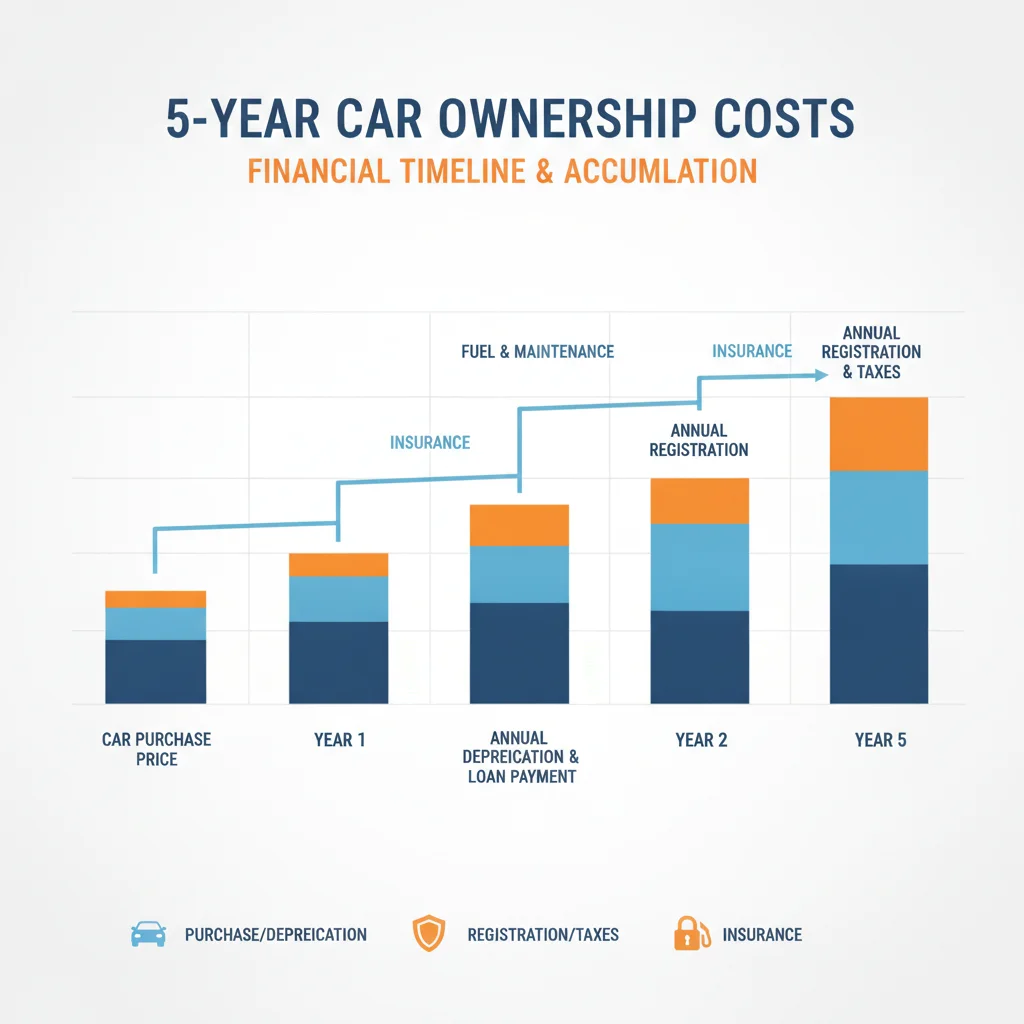
The fees at purchase are only the first installment. Government-mandated costs continue across the entire life of vehicle ownership — and they compound in ways most buyers never think through at the point of purchase.
Annual Registration Renewal
In many states, registration fees decline as the vehicle ages and depreciates. But in the first few years, especially on a new vehicle, annual registration can run $200–$600 or more depending on your state and the car's value. Over a five-year ownership period, that's a real four-figure cost that never appears in a monthly payment calculation.
Personal Property Tax
Several states — Virginia, Missouri, Arkansas, and others — assess an annual personal property tax on vehicles. This is separate from registration fees and is based on the vehicle's assessed value. A new $40,000 SUV in Virginia can generate a personal property tax bill of $1,200–$1,500 in its first year. Buyers who relocate from non-property-tax states are routinely blindsided by this.
Sales Tax on Insurance Premiums
Some states apply a tax or surcharge to auto insurance premiums. It's small per payment but adds up over time and is almost never factored into total cost-of-ownership discussions at the dealership.
Understanding how all of these costs layer on top of your purchase price — and how financing them into a loan at 6–8% APR turns a $500 fee into a $600+ obligation — is why understanding your loan's APR matters as much as the sticker price itself.
How to Protect Yourself Before You Sign
The best defense against overpaying on taxes and fees is preparation. Here's a practical sequence that works:
- Get the out-the-door price in writing before you visit the dealer. Most dealers will provide a full itemized quote by email. Any dealer who refuses is a red flag. Use the out-the-door price framework to know exactly what you should be asking for.
- Look up your state's actual DMV fees before the appointment. Your state DMV website will tell you exactly what title, registration, and any other government fees will cost for your specific vehicle. Write that number down. If the contract shows a higher number under a government fee label, ask why.
- Separate the doc fee from government fees on the contract. They are not the same thing. The difference between dealer fees and government fees is the single most valuable distinction you can understand going into a finance office.
- Decline to finance fees you can pay in cash. Every dollar of fees you roll into your loan is a dollar that accrues interest for the life of the loan. On a 60-month loan at 7%, a $1,000 fee costs you roughly $1,200 by payoff.
- Read the contract before signing, line by line. This sounds obvious, but finance offices create time pressure deliberately. Take the contract home if needed — you are legally entitled to do so in most states before final signing. How dealerships structure contracts is a pattern worth recognizing before you're in the room.
None of this requires confrontation. It requires preparation. A buyer who walks in knowing the difference between a title fee and a doc fee, and who has already looked up the state's registration costs, is a buyer a finance manager cannot confuse. That alone is worth hundreds of dollars at the average dealership.


All claims are backed by peer-reviewed research. Sources on request.