| Law requiring the label | Automobile Information Disclosure Act (1958) |
| Removing the sticker before sale | Federal offense — only buyer can remove it post-sale |
| Typical destination charge | $1,000 – $1,800 (Varies by manufacturer and vehicle class, recent model years) |
| MSRP stands for | Manufacturer's Suggested Retail Price |
| Fuel economy estimates source | EPA standardized test conditions (U.S. Environmental Protection Agency) |
| Safety ratings on the sticker | NHTSA (1–5 stars) and/or IIHS designation |
| Dealer addendum sticker | Separate from Monroney — dealer-set, fully negotiable |
| Doc fee range by state | Under $100 to over $800 (Varies by state; some states cap the fee) |
What the Monroney Label Is (and Why It Exists)
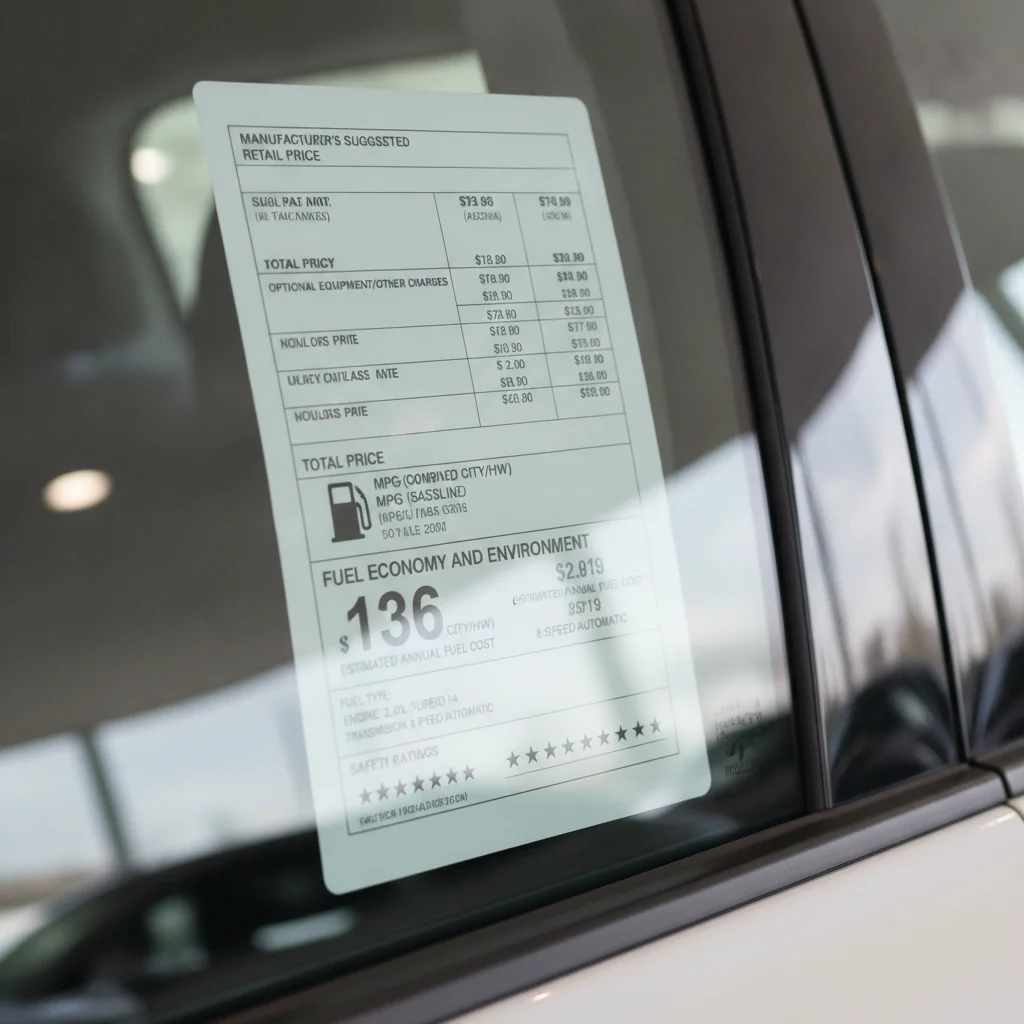
Every new car on a U.S. dealer lot is required by federal law to display a window sticker — formally called the Monroney label, named after the Oklahoma senator who sponsored the Automobile Information Disclosure Act of 1958. Strip away the history, and the purpose is simple: manufacturers must disclose the vehicle's price and key specifications before you buy.
Before this law, dealers could charge anything they wanted with no itemization required. The Monroney label fixed that — at least partially. It forces transparency on the manufacturer's side. What the dealer layers on top is a different story, and we'll get to that.
One thing worth understanding upfront: the Monroney label is a disclosure document, not a contract. It tells you what the manufacturer is charging. It does not lock the dealer into any price. For the legal weight the sticker actually carries, see what the window sticker does — and doesn't — guarantee.
| Law requiring the label | Automobile Information Disclosure Act (1958) |
| Removing the sticker before sale | Federal offense — only buyer can remove it post-sale |
| Typical destination charge | $1,000 – $1,800 (Varies by manufacturer and vehicle class, recent model years) |
| MSRP stands for | Manufacturer's Suggested Retail Price |
| Fuel economy estimates source | EPA standardized test conditions (U.S. Environmental Protection Agency) |
| Safety ratings on the sticker | NHTSA (1–5 stars) and/or IIHS designation |
| Dealer addendum sticker | Separate from Monroney — dealer-set, fully negotiable |
| Doc fee range by state | Under $100 to over $800 (Varies by state; some states cap the fee) |
Removing the Monroney label before sale is a federal offense — that's why you see it prominently displayed on every new vehicle. Once you buy the car, you can remove it yourself. The dealer cannot remove it before the sale.
The Seven Sections of a Monroney Label
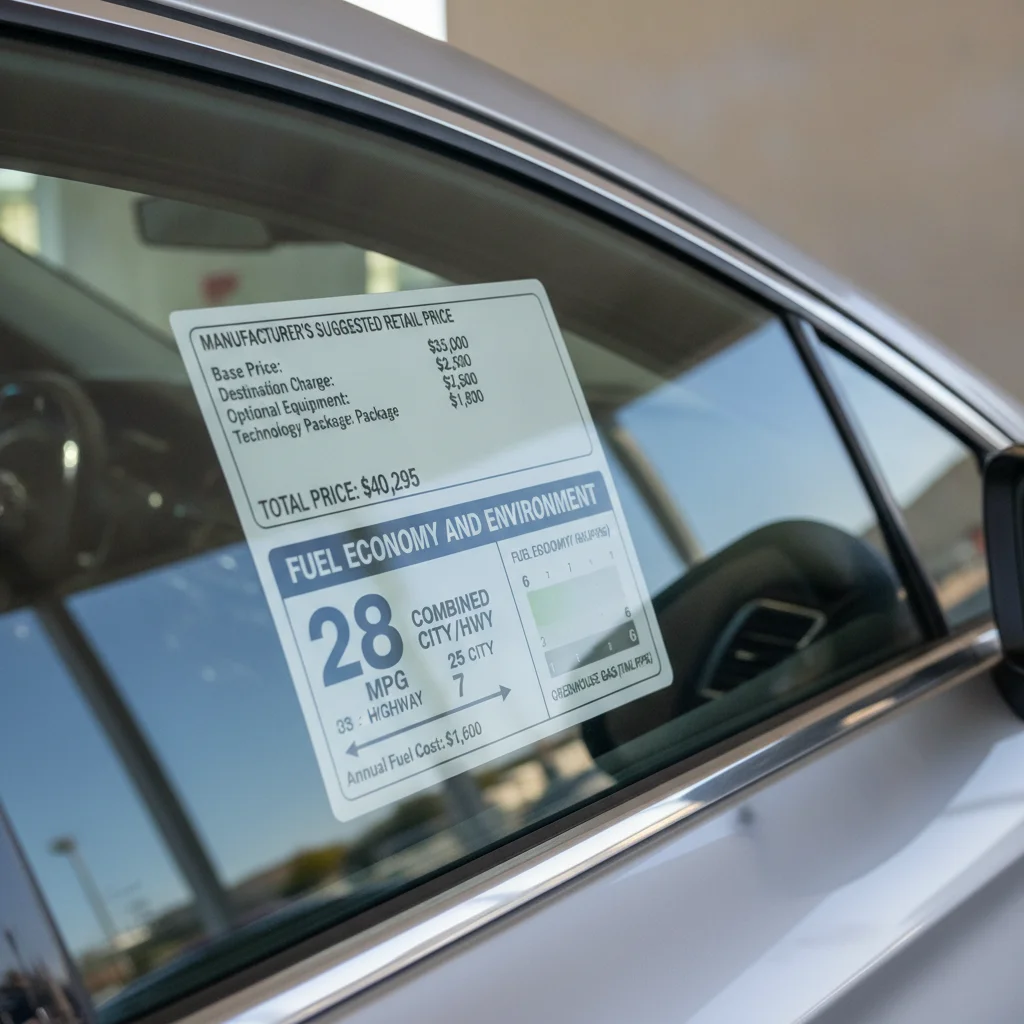
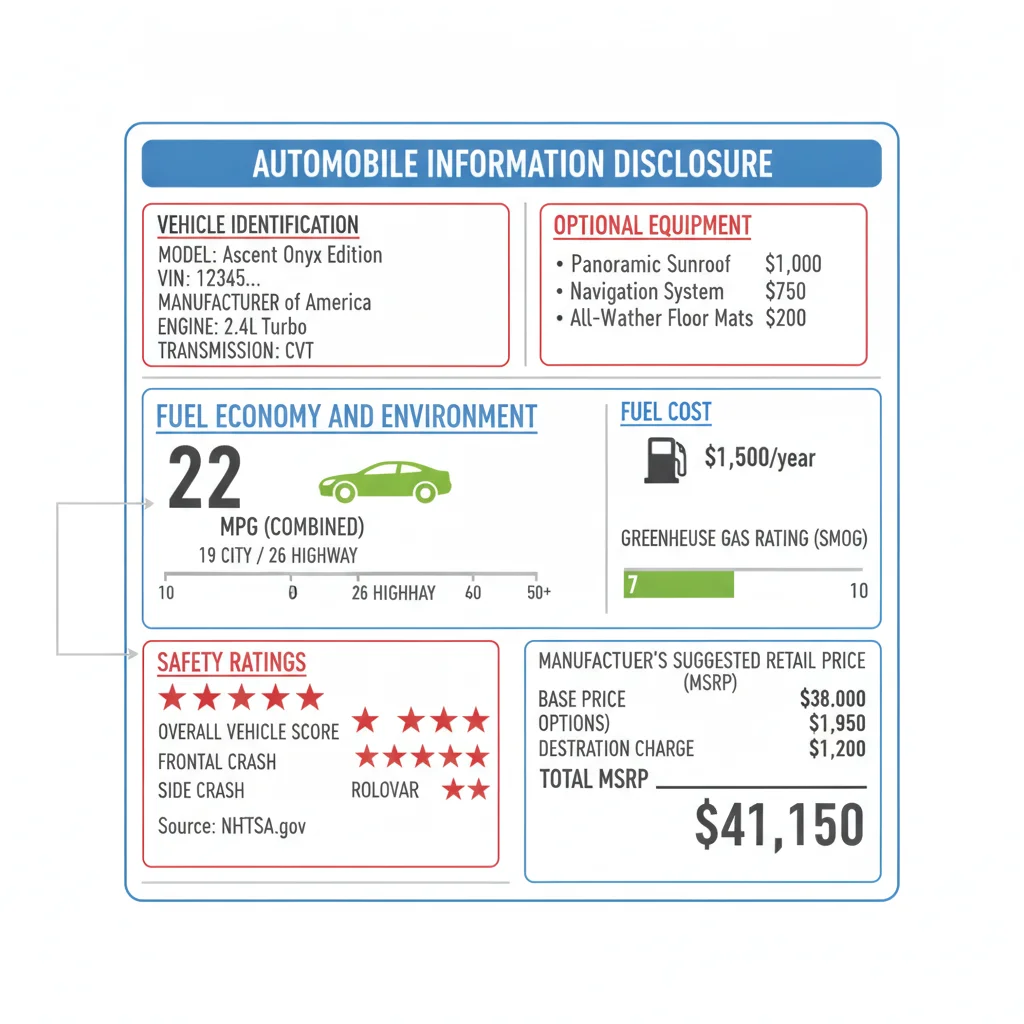
A standard Monroney label is divided into distinct sections. Most buyers glance at the total price and move on. Here's what each section actually contains — and which numbers deserve your attention.
1. Vehicle Identification
At the top: make, model, trim level, model year, and the 17-character VIN (Vehicle Identification Number). Cross-check the VIN on the sticker against the VIN stamped on the dashboard and the door jamb. They should match. If they don't, stop and ask why.
2. Standard Equipment
A list of features that come on every vehicle at this trim level — safety systems, infotainment, powertrain specs, seating material. This section sets the baseline. If a dealer later claims a feature is an add-on, check this list first; you may already be paying for it.
3. Optional Equipment and Packages
Every factory-installed option that was added above the base trim, listed individually with its price. This is where you can see exactly what you're paying extra for — heated seats, a sunroof, a towing package. Each line item should have a dollar figure. Add these up and verify they match what's reflected in the total.
4. Destination and Delivery Charge
A fixed fee charged by the manufacturer — not the dealer — to ship the vehicle from the factory to the dealership. It is non-negotiable because it's set by the manufacturer, not the dealer. As of recent model years, this fee typically runs $1,000–$1,800 depending on the brand and vehicle size. It's legitimate and should already be included in the MSRP total at the bottom.
5. Fuel Economy Estimates
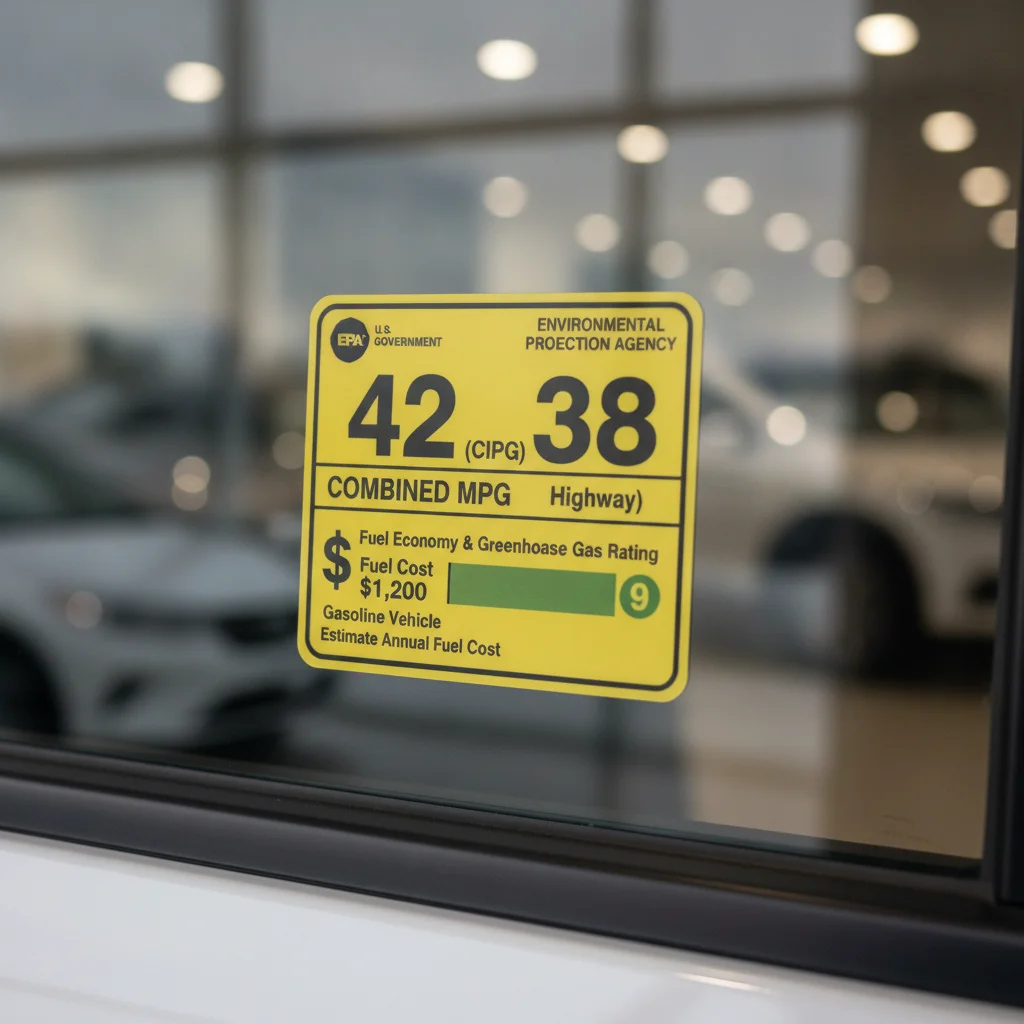
EPA city and highway mpg ratings, an annual fuel cost estimate, and a fuel economy comparison against similar vehicles in the same class. These are estimates under controlled test conditions — your real-world mileage will vary. The full fuel economy label breakdown covers every figure on this panel in depth.
6. Safety Ratings
If the vehicle has been tested, you'll see NHTSA crash test ratings (1–5 stars) and/or an IIHS designation. Not all new vehicles have been rated yet — a blank here doesn't mean unsafe, but it means no independent test data exists yet for that model year.
7. MSRP Summary
The bottom line: base price, options total, destination charge, and the total Manufacturer's Suggested Retail Price. "Suggested" is the operative word. This is a starting point for negotiation, not a fixed price — and it has nothing to do with what you'll actually pay once dealer fees, taxes, and financing enter the picture.
What the Sticker Does Not Show You
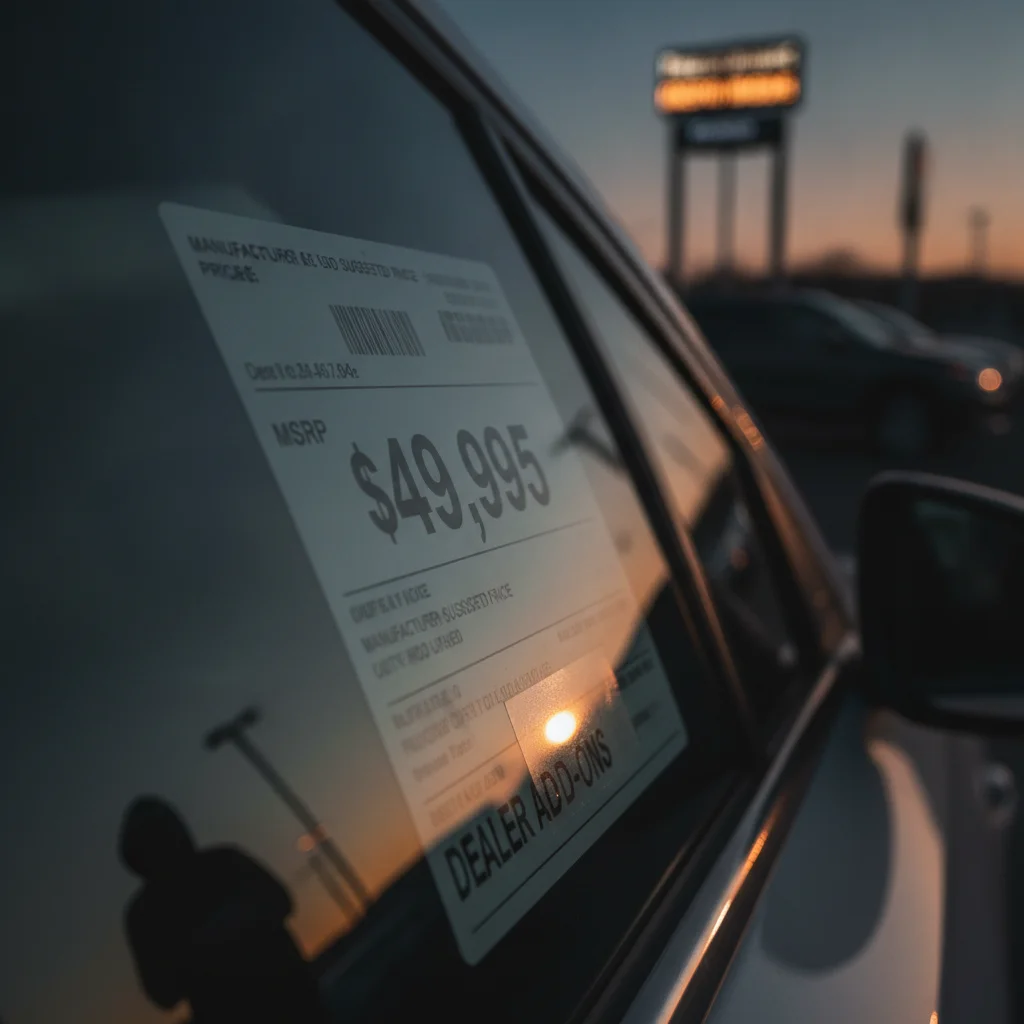
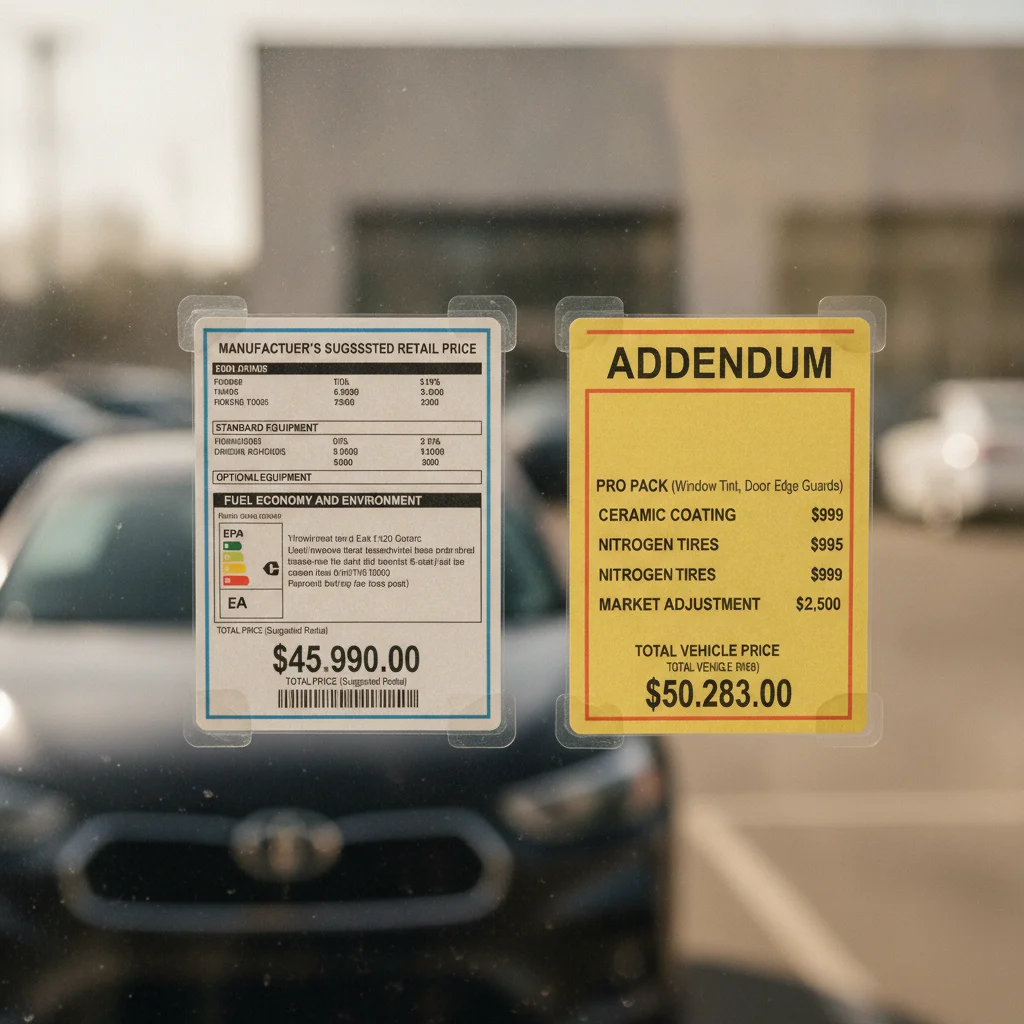
This is where most buyers get surprised. The Monroney label is a manufacturer document. It ends at the dealer's door. Everything the dealer adds — and dealers add a lot — lives on a separate sticker, usually attached adjacent to the Monroney label on the same window.
$2,000–$10,000+
Typical dealer market adjustment markup on high-demand models
ADM amounts spiked during the 2021–2023 inventory shortage and persist on popular trucks and SUVs in constrained markets.
500–1,000%
Markup on dealer-installed accessories like paint protection or nitrogen fills
Industry insiders routinely report that low-cost add-ons like fabric sealant or nitrogen tire fills are marked up dramatically over actual cost.
$3,200
Sales tax alone on a $40,000 vehicle at 8% state rate
Taxes are not included in the Monroney MSRP and are often excluded from advertised prices — they add up fast.
1958
Year the Monroney label became federally required
The Automobile Information Disclosure Act was passed after dealers routinely charged undisclosed markups with no itemized pricing.
The Dealer Addendum Sticker
Look for a second sticker, often with the dealer's logo. This is where you'll find:
- Market Adjustment / ADM (Additional Dealer Markup): Pure profit added on top of MSRP. In high-demand markets or during inventory shortages, this can run $2,000–$10,000+ on popular models. It has no cost basis — it's whatever the dealer thinks the market will bear.
- Dealer-Installed Accessories: Paint protection film, nitrogen in tires, fabric protection spray, window tinting. These are often low-cost items marked up 500–1,000%. They're frequently presented as already-installed and non-removable from the deal.
- Documentation Fee (Doc Fee): A paperwork processing charge that varies wildly by state — from under $100 to over $800. Some states cap it; many don't. It's technically negotiable at many dealers, though they'll push back hard.
None of these charges appear on the Monroney label. None of them are manufacturer-mandated. For a full breakdown of what's hiding in the price beyond the sticker, read our guide on what the sticker price doesn't tell you.
The Sticker Isn't the Same as the Out-the-Door Price
The Monroney total does not reflect what you'll actually pay at signing. Sales tax, title, registration, documentation fees, and any dealer add-ons are all added after the fact. Always ask for the full out-the-door price — in writing — before agreeing to any deal. This is the number that matters, not the MSRP at the bottom of the sticker.
Online Monroney Labels Are Available Before You Visit
Most manufacturers publish Monroney data online through their build-and-price tools or VIN lookup pages. If a dealer shares a specific VIN with you, you can often pull the official sticker data before you set foot on the lot. This gives you time to research without the pressure of a showroom environment.
Taxes, Title, and Registration
The Monroney label doesn't include state sales tax, title fees, or registration costs — because these vary by location and aren't known until the deal is finalized. On a $40,000 vehicle in a state with 8% sales tax, that's $3,200 in tax alone, not counting registration. These costs are real, they're unavoidable, and they're often buried in the payment quote rather than disclosed upfront. Learn which charges are legitimate and which aren't.
How to Use the Sticker Before You Negotiate
The Monroney label is most useful as a research tool before you walk into the dealership — not just as something you glance at on the lot. Here's how to put it to work.
Verify the Build Against What Was Advertised
Dealers sometimes advertise a vehicle at one price and then show you a fully loaded version. Compare the options section of the sticker against what was advertised online. Every option is a line item with a price — if you didn't ask for it, you don't have to pay for it (unless it's already installed and the dealer won't remove it, in which case you negotiate on price).
Separate Manufacturer Cost from Dealer Cost
Anything on the Monroney label = manufacturer-set. Anything on the addendum sticker = dealer-set and negotiable. This distinction alone gives you a cleaner starting point for negotiation. Your goal is to pay as close to the Monroney total as possible, ideally without the addendum items stacked on top.
Use the Fuel Economy Data for Real Cost Math
The annual fuel cost estimate on the sticker uses EPA assumptions about miles driven and a national average gas price. Plug in your own numbers. If you drive 18,000 miles per year in a market with higher gas prices, your actual fuel cost will be meaningfully different from what the sticker shows. This matters when comparing two vehicles at similar price points.
Check the Safety Ratings Before You Negotiate
If the vehicle has no NHTSA or IIHS ratings yet, check those agency websites directly before you commit. Safety ratings sometimes change significantly between model years and can affect insurance premiums — which connects back to your total ownership cost, not just the purchase price.
Monroney Label
The federally mandated window sticker on every new vehicle, disclosing the manufacturer's suggested retail price, standard and optional equipment, fuel economy estimates, and safety ratings. Named after Senator A.S. Mike Monroney.
MSRP
Manufacturer's Suggested Retail Price — the price the manufacturer recommends the dealer charge. It is a starting point for negotiation, not a fixed sale price.
Destination Charge
A fixed fee set by the manufacturer to cover shipping the vehicle from the factory to the dealership. It is non-negotiable because it's a manufacturer cost, not a dealer markup.
ADM (Additional Dealer Markup)
An above-MSRP price increase set by the dealer, also called a market adjustment. It reflects local demand, not any added cost or value to the vehicle.
Dealer Addendum Sticker
A second sticker placed by the dealer, separate from the Monroney label, listing dealer-installed accessories, market adjustments, and other charges. Everything on this sticker is negotiable.
VIN
Vehicle Identification Number — a unique 17-character code that identifies a specific vehicle. It appears on the Monroney label, the dashboard, and the door jamb, and should match across all three.
EPA Fuel Economy Estimate
Miles-per-gallon ratings generated by the U.S. Environmental Protection Agency under standardized test conditions. Real-world fuel economy varies based on driving habits, climate, and load.
Doc Fee
A documentation or processing fee charged by the dealer for handling paperwork. Amounts vary widely by state — some states cap it, others don't — and it is often negotiable.
Once you've agreed on a vehicle price, the next document that demands this level of scrutiny is the loan disclosure. The numbers there determine how much that car actually costs you over time. Read our walkthrough of every number in an auto loan disclosure before you sign anything in the finance office.
FuelEconomy.gov Vehicle Comparison Tool
The EPA's official site lets you compare fuel economy ratings, annual fuel costs, and emissions across makes and models. Use it to pressure-test the estimates on the sticker before you buy.
NHTSA SaferCar Safety Ratings
Look up crash test ratings for any new vehicle by make, model, and year. Cross-reference with what's printed on the Monroney label to ensure the data is current for the model year you're buying.
IIHS Vehicle Ratings Database
The Insurance Institute for Highway Safety publishes its own independent crash test results and Top Safety Pick designations, which are separate from NHTSA ratings and often more rigorous.
VIN Decoder (NHTSA)
Enter any 17-character VIN on the NHTSA website to pull official vehicle specifications and check for open recalls — a smart step before signing anything.
State DMV Fee Estimator
Many state DMV websites offer registration and title fee calculators. Use your state's tool to estimate the government fees that won't appear on the Monroney sticker but will appear on your final bill.
All claims are backed by peer-reviewed research. Sources on request.