Key Takeaways
Monroney Label (Window Sticker)
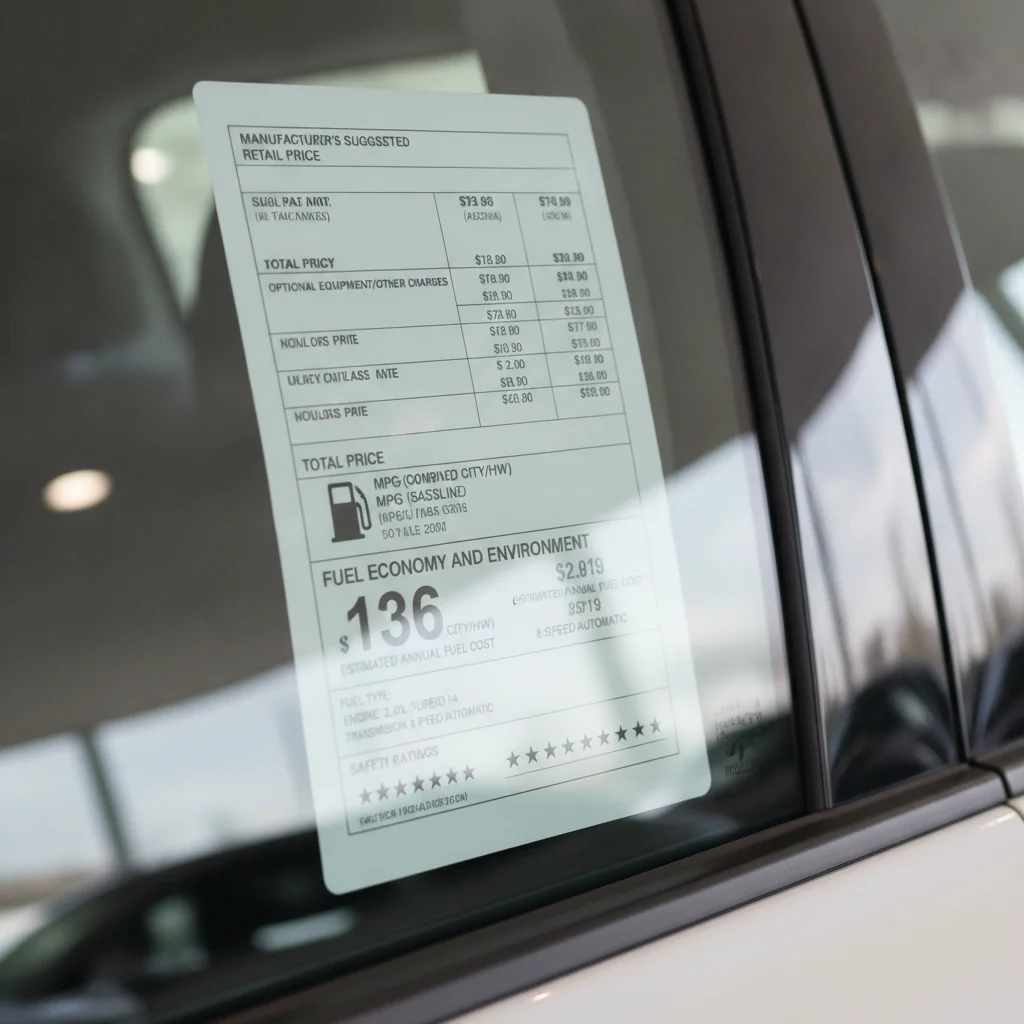
The Monroney label is the federally required price and specification sticker displayed on every new vehicle sold in the United States. It lists the manufacturer's suggested retail price (MSRP), standard and optional equipment, EPA fuel economy estimates, and safety ratings. Federal law — specifically the Automobile Information Disclosure Act of 1958 — mandates that dealers keep it on the vehicle until the buyer removes it. It is a disclosure document, not a contract.
The label is named after Senator A.S. 'Mike' Monroney of Oklahoma, who sponsored the original legislation. Dealers who remove it before sale are subject to federal fines, but the sticker's pricing information is not legally binding as a purchase agreement.
What the Monroney Label Actually Is
Walk onto any new-car lot in America and you'll find a rectangular sticker plastered to the side window of every vehicle on display. Most buyers glance at the big price number, maybe check the fuel economy, and move on. That's a mistake — because understanding what this document is, and what it isn't, is one of the most useful pieces of knowledge you can walk into a dealership with.
The Monroney label is a federally mandated disclosure document created under the Automobile Information Disclosure Act of 1958. Congress passed it specifically to stop dealers from hiding pricing information from buyers. Before the law, dealers could — and routinely did — refuse to show customers what manufacturers actually charged for vehicles, leaving buyers with no reference point to negotiate from.
The label is produced by the vehicle's manufacturer, not the dealer. That distinction matters. It means the information on it — base price, option costs, destination charge, and fuel economy data — comes directly from the company that built the car, and the dealer is required to display it unchanged.
What the law does not do is set a binding sale price. The 'S' in MSRP stands for 'suggested.' Federal law requires the label to be displayed; it does not require the dealer to sell at that price. That legal gap is where a lot of buyer confusion — and dealer opportunity — lives.
What the Sticker Discloses (Line by Line)
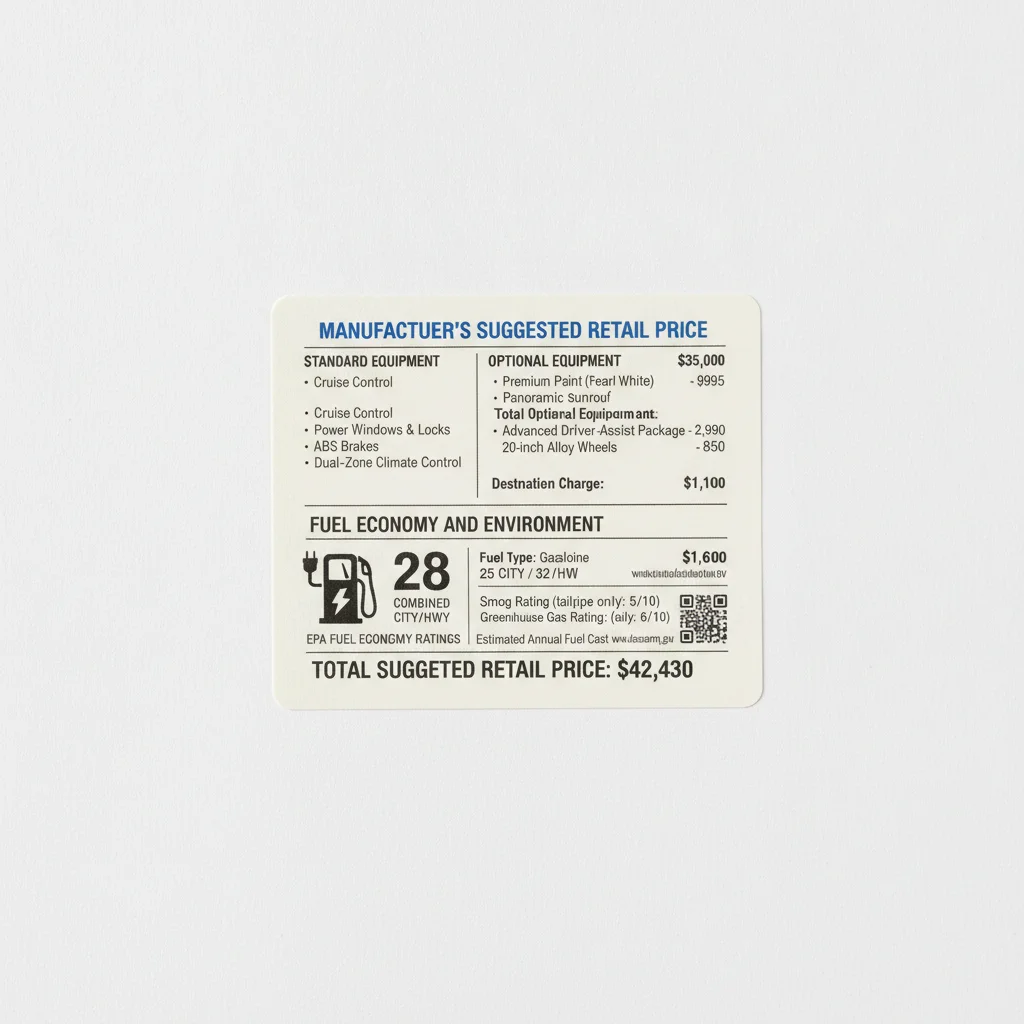
The Monroney label has more information on it than most buyers stop to read. Here's what each section is actually telling you:
Base Price
This is the cost of the vehicle in its standard configuration — no optional add-ons. It's the floor, not the ceiling. Very few vehicles on a dealer's lot are sold in base trim without any packages.
Optional Equipment and Packages
Each factory-installed option or package is listed individually with its cost. This section is worth reading carefully. If a dealer tells you a vehicle has a certain feature included, you should be able to find it here. If it's not on the Monroney, it wasn't installed at the factory.
Destination and Delivery Charge
This is the manufacturer's set fee for shipping the vehicle from the factory to the dealership. It is non-negotiable — it's the same for every buyer nationwide for that model — but it is a real cost that gets added to the base price. See our breakdown of fees buried in car pricing for context on which charges are fixed and which aren't.
Total MSRP
The sum of the base price, all options, and the destination charge. This is the headline number buyers focus on. Remember: it is a starting point for negotiation, not a locked price.
Fuel Economy Estimates
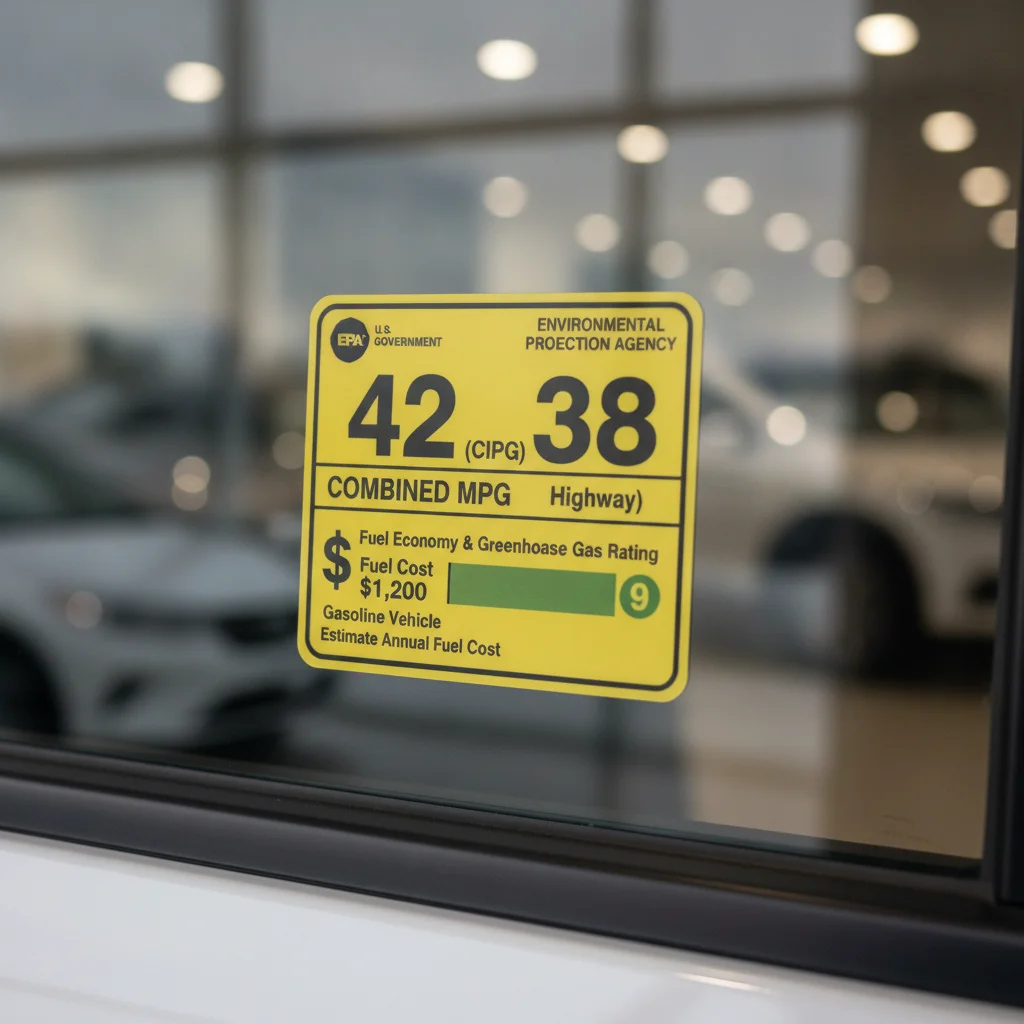
EPA city, highway, and combined mpg (or MPGe for hybrids and EVs) are displayed prominently. These numbers come from the EPA's standardized test cycles and carry a government-mandated disclosure that actual results will vary. See our full guide to reading fuel economy labels for a field-by-field breakdown of what every number on that section means.
Safety Ratings
If the vehicle has been tested by NHTSA (National Highway Traffic Safety Administration) or IIHS (Insurance Institute for Highway Safety), those ratings may appear on the sticker. Note that not every vehicle will have ratings at the time of sale — some models are sold before testing is complete.
1958
Year the Monroney label became federal law
The Automobile Information Disclosure Act was passed by Congress and signed into law, requiring manufacturer-produced price stickers on all new vehicles sold in the U.S.
$1,000+
Typical dealer addendum markup per vehicle
Consumer advocacy groups estimate dealer-installed accessory and protection packages routinely add $500–$2,500 to transaction prices beyond the Monroney MSRP.
~20%
Real-world EV range shortfall vs. EPA estimate
Independent testing by organizations such as Recurrent and AAA has found that EVs often deliver 10–25% less range than EPA sticker estimates under real driving conditions.
$1,000
Maximum federal fine for removing a Monroney early
Under the Automobile Information Disclosure Act, dealers face up to $1,000 per violation for removing or altering the Monroney label before the buyer takes possession of the vehicle.
What the Sticker Does NOT Guarantee
This is the section most buyers wish someone had explained to them before they signed. The Monroney label is a disclosure document — not a contract, not a price lock, and not a guarantee of vehicle condition or feature accuracy.
The Sticker and the Contract Are Different Documents
Many buyers assume that agreeing to pay the sticker price means the deal is done. It isn't. The purchase agreement you sign in the finance office is the legally binding document. The Monroney is a pre-sale disclosure. Always compare the signed contract against both the sticker and your negotiated terms before you leave the dealership.
State Laws Can Add More Protections
Federal law sets the minimum standard for Monroney disclosure requirements, but some states have enacted additional consumer protection rules around dealer fees, addendum stickers, and price disclosure. California, for example, has some of the strictest dealer fee disclosure rules in the country. Check your state's DMV or consumer protection agency website if you suspect a dealer is violating local regulations.
The Price Is Not Binding
The MSRP is advisory. Dealers operating in high-demand environments — think popular trucks during a supply shortage, or a just-released performance model — routinely add market adjustment fees above MSRP. These adjustments are legal. The only number that is legally binding is the one on your signed purchase agreement. Our article on what the sticker price doesn't tell you goes deeper on the hidden costs that don't appear anywhere on the Monroney.
Fuel Economy Estimates Are Approximations
The EPA numbers are derived from controlled laboratory tests, not real roads. Factors like aggressive driving, cold weather, highway speeds above 65 mph, heavy cargo, and roof accessories can all reduce real-world efficiency below the sticker estimate. For electric vehicles, the gap can be especially significant — EPA range ratings for EVs are tested under conditions that rarely match daily driving in practice.
The Sticker Doesn't Cover Dealer Add-Ons
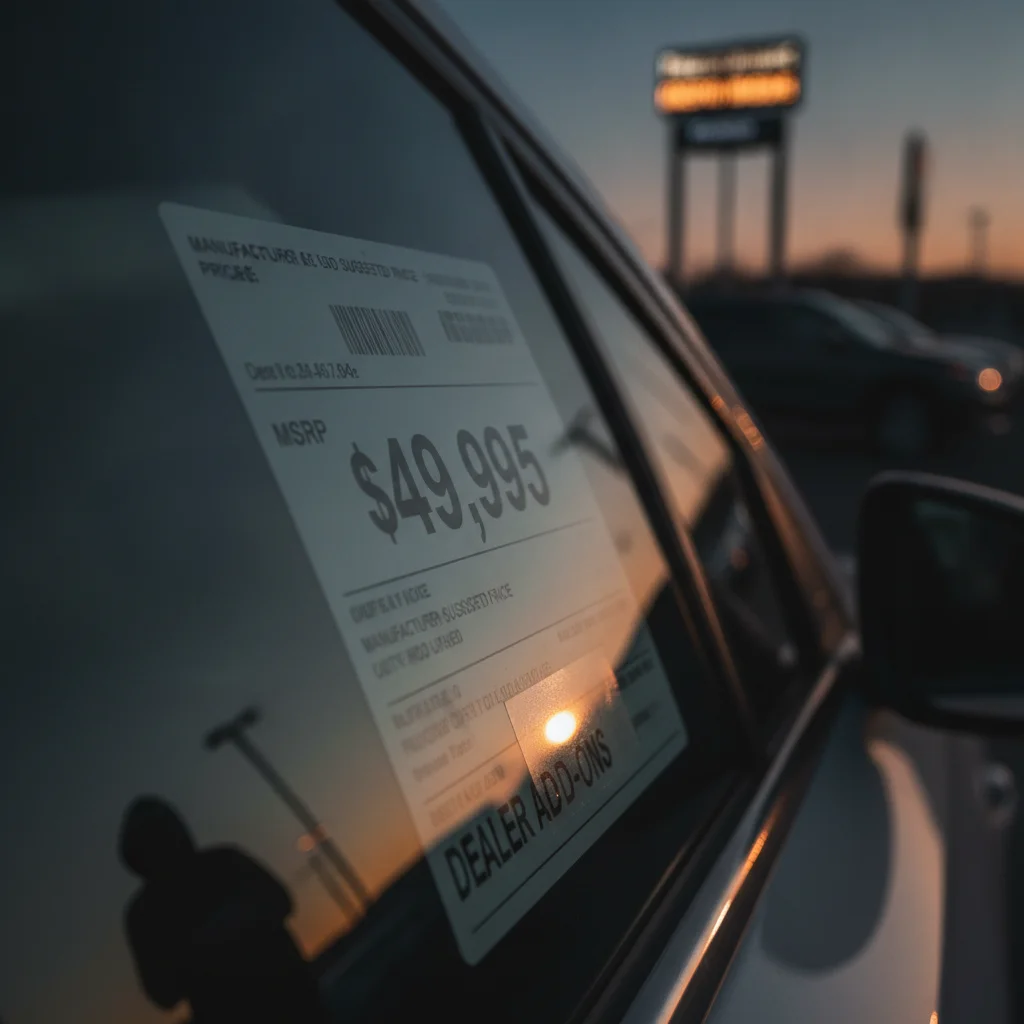
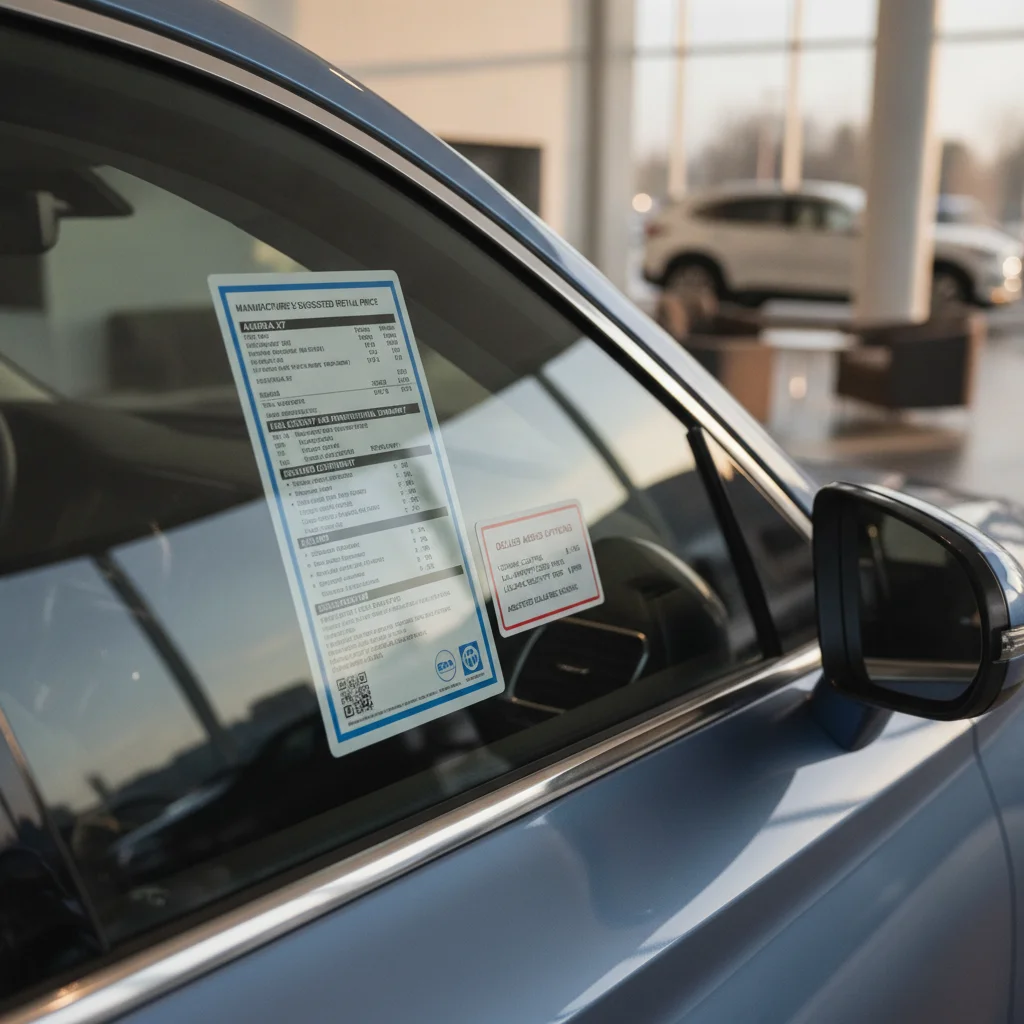
Watch for a second sticker — often placed directly next to or over part of the Monroney. This is the dealer-installed addendum sticker. It lists items like paint protection film, nitrogen-filled tires, window tinting, or LoJack tracking — often at significant markups. These charges are not mandated by federal law, are not part of the Monroney, and are almost always negotiable or removable from the deal.
Options Listed Are Not Always Present
In rare cases, vehicles can be mislabeled or arrive at a dealership with features listed on the sticker that weren't actually installed due to production changes. Always physically verify key options — especially technology packages, driver assistance features, and interior upgrades — before signing.
“The window sticker was designed to give buyers information, not power. Turning that information into negotiating leverage is the buyer's job — and it starts with understanding what the document legally commits no one to.”
— Rosemary Shahan, President, Consumers for Auto Reliability and Safety (CARS)
The Addendum Sticker: A Dealer's Tool You Need to Recognize
Once you know what the Monroney looks like — manufacturer-produced, printed on a standard format, covering standard sections — you'll immediately recognize when a dealer has added their own sticker alongside it. This addendum sticker is where buyers often quietly absorb hundreds or thousands of dollars in additional charges without realizing they're negotiable.
Common addendum line items include:
- Dealer-installed accessories (floor mats, cargo nets, wheel locks) — often marked up significantly over their retail value
- Paint sealant or fabric protection packages — frequently applied whether you want them or not, then billed on the sticker
- Market adjustment fees — a direct above-MSRP markup with no justification beyond demand
- Documentation or dealer prep fees — administrative charges that vary by state and dealer
- Warranty or protection plan bundles — sometimes listed here before being pitched again in the finance office
The key question to ask when you see an addendum sticker: Which of these items were installed before I arrived, and can they be removed from the vehicle or removed from the purchase price? Items already physically installed are harder to remove, but their dollar cost can often still be negotiated down or out of a deal.
Photograph Everything Before You Negotiate
Before sitting down with a sales rep, photograph both the Monroney label and any addendum sticker in their entirety. If numbers shift during the negotiation or finance process, you'll have a timestamped reference. This simple step has helped many buyers catch pricing discrepancies that would otherwise have been easy to miss in the pressure of a dealership closing room.
Ask for an Itemized Out-the-Door Quote in Writing
Never negotiate based on the MSRP alone. Ask the dealer to give you a complete, itemized out-the-door price in writing — including all taxes, fees, and dealer charges — before you discuss monthly payments. This prevents the common tactic of agreeing on a sticker price only to have unannounced fees added at the finance office.
How to Use the Monroney Label as a Buying Tool
Rather than treating the window sticker as a passive information sheet, use it as an active verification tool during your purchase process. Here's how to apply it step by step.
Step 1: Photograph It Before You Negotiate
Take a clear photo of the full Monroney label — both columns, the fuel economy section, and the total MSRP — before you sit down to talk numbers. This gives you a reference point if pricing figures shift during negotiation.
Step 2: Compare the Sticker to the Vehicle
Walk around the car and verify that every option listed on the Monroney is actually present. Check trim levels, technology packages, safety features, and interior options. If something is listed and missing, that's a problem to raise before any money changes hands.
Step 3: Identify Any Addendum Sticker
Locate any dealer-added sticker and itemize every charge on it. Ask specifically which items were already physically installed and which are just printed charges. Document which ones you want removed from the deal.
Step 4: Cross-Reference the Out-the-Door Price
The Monroney total MSRP is not your out-the-door price. Add taxes, title, registration, and any dealer fees to understand what you'll actually pay. Ask the dealer for a full itemized out-the-door figure in writing before agreeing to anything. Our article on what a new car's window sticker tells you and what it hides covers additional hidden data points that experienced buyers check.
Step 5: Confirm the Purchase Agreement Matches
When the finance office produces your purchase agreement, compare every line to what you negotiated. The Monroney is a reference document; the purchase agreement is the legal contract. Any discrepancy between what was discussed and what appears on the contract needs to be resolved before you sign.
When the Sticker Actually Protects You
Despite its limitations, the Monroney label does give buyers meaningful legal protections in specific situations.
Protection Against Undisclosed Price Changes
Because the label must be manufacturer-produced and dealer-intact, it prevents dealers from simply making up prices or withholding pricing entirely — a practice that was widespread before 1958. You always have a documented reference price from the manufacturer.
Verification of Included Equipment
If a dealer advertises a vehicle with a specific package and you purchase it based on that representation, the Monroney serves as documentary evidence of what was or wasn't on the car at the time of sale. If you later discover a listed feature is missing and the dealer misrepresented the vehicle, this document supports any claim you might make.
Federal Enforcement of Display Requirements
Dealers who remove stickers before sale or who sell vehicles with materially altered Monroney labels can face federal penalties. While enforcement is complaint-driven, the law provides a baseline level of accountability that protects buyers from the most blatant forms of pricing concealment.
The Sticker and the Contract Are Different Documents
Many buyers assume that agreeing to pay the sticker price means the deal is done. It isn't. The purchase agreement you sign in the finance office is the legally binding document. The Monroney is a pre-sale disclosure. Always compare the signed contract against both the sticker and your negotiated terms before you leave the dealership.
State Laws Can Add More Protections
Federal law sets the minimum standard for Monroney disclosure requirements, but some states have enacted additional consumer protection rules around dealer fees, addendum stickers, and price disclosure. California, for example, has some of the strictest dealer fee disclosure rules in the country. Check your state's DMV or consumer protection agency website if you suspect a dealer is violating local regulations.
The bottom line: the Monroney label is most valuable when you treat it as a baseline — a starting document that tells you what the manufacturer says the car is and what it costs, against which you measure everything the dealer says and does. It won't close a deal for you, but it will tell you when something is off.

All claims are backed by peer-reviewed research. Sources on request.