
Key Takeaways
Why Competing Quotes Actually Change the Dealer's Math
Here's something most buyers don't realize: the price a dealership quotes you on day one is almost never their best price. It's an opening position — a number designed to anchor your expectations high so that any concession they make feels like a win for you. The question isn't whether there's room to negotiate. There almost always is. The question is how to prove it.
Competing quotes from other dealers do exactly that. When you walk in with a written offer from a competing store — same make, same model, same trim, same color — you've replaced the dealer's subjective pricing power with an objective market data point. At that moment, the conversation stops being about what you want and starts being about what the market will bear. That's a fundamentally different negotiation, and it tilts in your favor.
I spent years on the finance side of dealerships, and I can tell you that nothing makes a sales manager move faster than a buyer who says, "Dealer X is $800 lower on the same car. Can you match it?" The response tells you everything. If they match it immediately, you had leverage and didn't know it. If they hesitate, probe a bit, and then meet you halfway, you've found the real floor. And if they refuse entirely, you now know either the competitor's quote was genuinely lower than their cost — unlikely — or this particular store isn't the right place to buy.

This process works even better for new cars than used cars, because new cars are fungible. A 2025 Honda CR-V EX-L in Sonic Gray Pearl is the same vehicle regardless of which Honda dealer sells it. The only variable is what they're willing to accept. Competing quotes make that variable visible. For a deeper look at how to hold your ground throughout the full negotiation, see our guide on negotiating a new car price without feeling outmatched.
What You Need Before You Start
Getting competing quotes isn't complicated, but doing it sloppily produces quotes that aren't actually comparable — and a dealer will spot that immediately. Before you contact a single store, get the following in order.
What you will need
Manufacturer's Build-and-Price Tool
Locks in the exact vehicle configuration and MSRP breakdown so all quotes are based on identical specifications.
Email Account
Used to request and receive written dealer quotes that can be printed, compared, and presented as documentation.
Spreadsheet (Google Sheets or Excel)
Tracks each dealer's out-the-door quote line-by-line so you can identify genuine price differences versus fee manipulation.
Printer or Phone with Clear Screenshots
Produces a physical or clearly readable copy of competing quotes to show a sales manager in the showroom.
CarGurus or TrueCar
Provides market pricing context and identifies whether a quote is above, at, or below typical transaction prices in your area.
CarMax / Carvana Appraisal (if trading in)
Establishes an independent trade-in baseline so dealers cannot quietly recoup margin through a lowball trade offer.
Your vehicle configuration needs to be locked down to the trim level and key packages before you start reaching out. A quote on a base model and a quote on a mid-trim are not competing quotes — they're two different products. Dealers will exploit any ambiguity to argue the prices aren't apples-to-apples. Know the exact MSRP breakdown from the manufacturer's website before you make your first call or send your first email.
How to Collect and Present Competing Quotes Effectively
The mechanics of this process matter a lot. Follow the steps below in sequence. Skipping steps — especially the ones around written documentation and out-the-door pricing — will undermine the leverage you're trying to build.
Lock in your vehicle specification before contacting anyone
Go to the manufacturer's website and use the build-and-price tool to configure exactly what you want: trim level, exterior color, interior color, and every option package. Write down the full MSRP line-by-line — base price plus each package. Screenshot or print this page. This is your specification sheet. Every dealer you contact will receive this exact configuration. Do not let any dealer substitute a "similar" vehicle unless you've consciously decided to change your target.
Identify at least four dealerships to contact
Search for authorized dealers within 100–150 miles. You want a minimum of four, ideally five or six. More quotes give you a wider spread and make your best offer harder to dismiss. Include at least one dealer you'd realistically buy from and at least one you'd never actually visit — the latter often produces the most aggressive pricing because they have nothing to lose.
Check each dealer's inventory online first. If they have your exact configuration in stock, note the stock number — it makes your email more credible and specific.
Send a direct, specific email requesting an out-the-door quote
Do not call. Do not visit. Email only. Phone conversations produce verbal quotes that evaporate; in-person visits trigger high-pressure sales environments before you have any data. Send the same email to all dealers simultaneously. Here is a template that works:
"I'm in the market for a [Year] [Make] [Model] [Trim] in [Color] with [Package Name(s)]. MSRP on the build I've configured is $[X]. I'm contacting several dealers and will be making a decision within the next 5–7 days based on out-the-door pricing. Please send me your best out-the-door price for this exact configuration — vehicle price plus all dealer fees, taxes, and documentation charges. No monthly payment breakdowns, please — I need the total cash price."
That last line matters enormously. Monthly payment framing is how dealers obscure real cost by stretching loan terms. Insist on a total out-the-door number every time.
Record every quote in a comparison spreadsheet
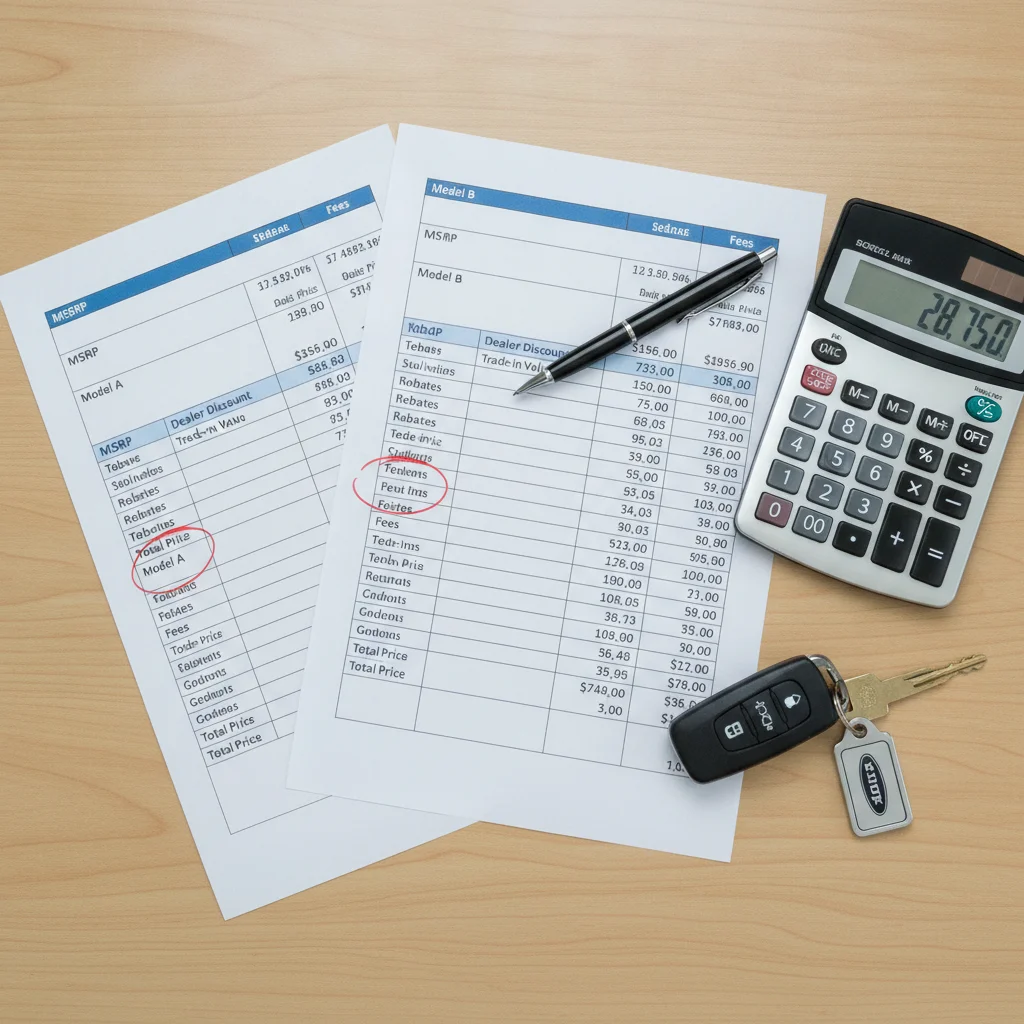
Create a simple table with these columns: Dealer Name, Vehicle Price, Documentation Fee, Other Dealer Fees, Estimated Tax, Total Out-the-Door. Fill in each response you receive. If a dealer gives you only a vehicle price without fees, email back asking for the complete breakdown. Fees vary dramatically — doc fees alone range from $85 to $999 depending on state and dealer. A lower sticker price can be completely wiped out by a $700 doc fee versus a competitor's $150 doc fee.
Once you have three or more comparable responses, identify the lowest legitimate out-the-door number. That's your primary negotiating instrument.
Visit your preferred dealer armed with your best competing quote
Choose the dealer you'd most like to buy from — maybe they're closest, have the best service department, or you simply liked how they communicated. Bring a printed copy of your lowest out-the-door quote. When you sit down with a salesperson, be direct from the start: "I've gotten quotes from several dealers. I'd like to buy from you if you can match or beat this number. Here's the offer I'm working with."
Hand over the printed quote. Let them take it to their manager. The silence that follows is not awkward — it's the sales manager doing math. Be comfortable with it.
Evaluate the counter-offer and know when to walk
The dealer will come back with one of three responses: they match the quote, they beat it, or they make a partial concession. If they match or beat it, you're done negotiating price — move to reviewing fees line-by-line in the finance office. If they make a partial concession, you can accept it if it's within $200–$300 of your competing quote (at that point, you're likely near the real floor) or push back once more: "I appreciate the movement. I'm still $X away from the offer I have in writing. Is there anything else you can do?"
If they won't move meaningfully, thank them and leave. Then call or email the dealer who gave you the best written quote and tell them you're ready to buy today at their quoted price. In most cases, they'll confirm it.
Once you've completed this process, you'll typically land within $200–$500 of the market floor on a new vehicle. Beyond that point, most dealers genuinely cannot go further without selling below cost, which they won't do. When you've exhausted your quote leverage on the vehicle price, shift your attention to add-ons and fees — extended warranties, paint protection packages, and document fees are all negotiable and represent another $300–$1,000 of savings in many deals.
Timing Your Outreach for Maximum Response
Send your quote request emails mid-week, ideally Tuesday through Thursday. Dealerships are less busy and sales staff have more time to engage seriously with your inquiry. End-of-month timing also works in your favor — sales managers are more willing to move on margin when they're chasing monthly targets. A quote request that arrives on the 28th of the month often generates a better response than the same request on the 5th.
Use the Internet Sales Department, Not the Floor
Most dealerships have a dedicated internet or fleet sales team that handles quote requests. These reps are typically paid differently than floor salespeople — often on volume rather than gross profit — and are more likely to give you a direct, competitive number without the traditional back-and-forth. Address your email to the internet sales manager by name if you can find it on the dealer's website.
Document Fees Are Partly Negotiable
Many buyers accept the documentation fee as fixed, but it often isn't. In states where doc fees aren't capped by law, dealers set them internally. A $699 doc fee at one dealer versus $199 at another is $500 of pure margin. Ask for the doc fee to be reduced or waived as part of the overall deal. Some dealers will split the difference rather than lose the sale.
Don't Let Dealers Combine the Trade-In and Purchase Price
One of the most common ways dealers neutralize your competing quote leverage is by bundling the trade-in into the vehicle price negotiation. They'll say something like, "We'll give you $18,000 for your trade and $500 over the other dealer's price on the new car." On paper that looks like a win. But they may have just lowballed your trade by $1,200. Always negotiate the vehicle purchase price to finalization before introducing your trade-in. Keep the transactions separate until both numbers are settled.
Beware the Finance Office Rate Markup
A dealer who matches your competing quote on vehicle price can recapture that margin in the finance office by inflating your interest rate. If the lender approves you at 6.5% APR and the dealer quotes you 8.0%, that spread — called dealer reserve — goes straight to the dealership. On a $35,000 loan over 60 months, that 1.5% markup costs you roughly $1,400. Always secure a pre-approval from your own bank or credit union before visiting the dealer, so you have an interest rate to compare against their offer.
If your deal also involves a trade-in, keep that conversation completely separate from your vehicle price negotiation. Dealers routinely use the trade-in to quietly recover margin they "gave up" on the car price. Before your dealership visit, get independent appraisals from CarMax, Carvana, and at least one other buyer. See how that process works in our guide on getting multiple trade-in offers before you buy. And if you want to understand the specific tactics dealers use to shrink what you net on a trade, read about dealer tactics that eat into your trade-in value.
Your Competing Quote Must Be Written and Out-the-Door
A verbal quote from another dealer is worthless as negotiating leverage. Sales managers dismiss them instantly — and they're right to, because verbal quotes are unverifiable and frequently misremembered. Your competing quote must be a written email or printed document that shows the complete out-the-door total: vehicle price, all dealer fees, documentation fee, and estimated taxes. Anything less gives the dealer an easy exit from the conversation.
Never Reveal Your Target Monthly Payment
If you tell a dealer your maximum monthly payment, you've handed them control of the entire deal. They can hit your payment number while still overcharging you on the vehicle by extending the loan term or building in a higher interest rate. Focus exclusively on out-the-door price and, separately, the APR on your financing. The monthly payment is a result of those two numbers — not a negotiating starting point.
When the Quote Strategy Doesn't Work — and What to Do
There are situations where the competing quote approach stalls. Understanding why prevents you from walking away from a good deal or getting stuck at a bad one.
The Dealer Claims the Competing Quote Is Fake
This happens. A sales manager will sometimes look at your printed email and say something like, "That dealer must have made a mistake" or "They'll add that back in fees when you get there." Your response is simple: "I have their out-the-door number in writing, including all fees. Can you match that total?" Shift the burden back to them. If they can't match a verified out-the-door number, that tells you something real.
The Model You Want Has Low Inventory
On high-demand vehicles — hybrids, certain trucks, newly redesigned models — dealers have little reason to compete. If every store within 200 miles has a two-month waiting list, your competing quotes lose most of their force. In this situation, your better leverage is negotiating a used car price using comparable market data, or simply widening your geographic search and being willing to travel for the right deal.
The Quotes Are All the Same
If three dealers within your market are all quoting within $100 of each other, you may have found the actual market floor. This isn't a failure — it's information. At that point, negotiate on financing terms, fee waivers, and accessories rather than vehicle price. Consider whether a slightly different trim or color might have more movement. And always verify that their finance department isn't recouping margin through a marked-up interest rate. A dealer who sells you a car at invoice can still make $1,500 in finance reserve if they bump your APR by a point and a half.

You're Buying Used
Used car quotes are harder to compare because no two used vehicles are identical. However, the principle still applies: gather at least three written offers on comparable vehicles using sites like CarGurus, AutoTrader, or Dealer.com, filter by similar mileage and condition ratings, and use the lower comps to push back on price. The same strategy of using competing offers applies when you're on the selling side of a trade-in, too.
All claims are backed by peer-reviewed research. Sources on request.