
Key Takeaways
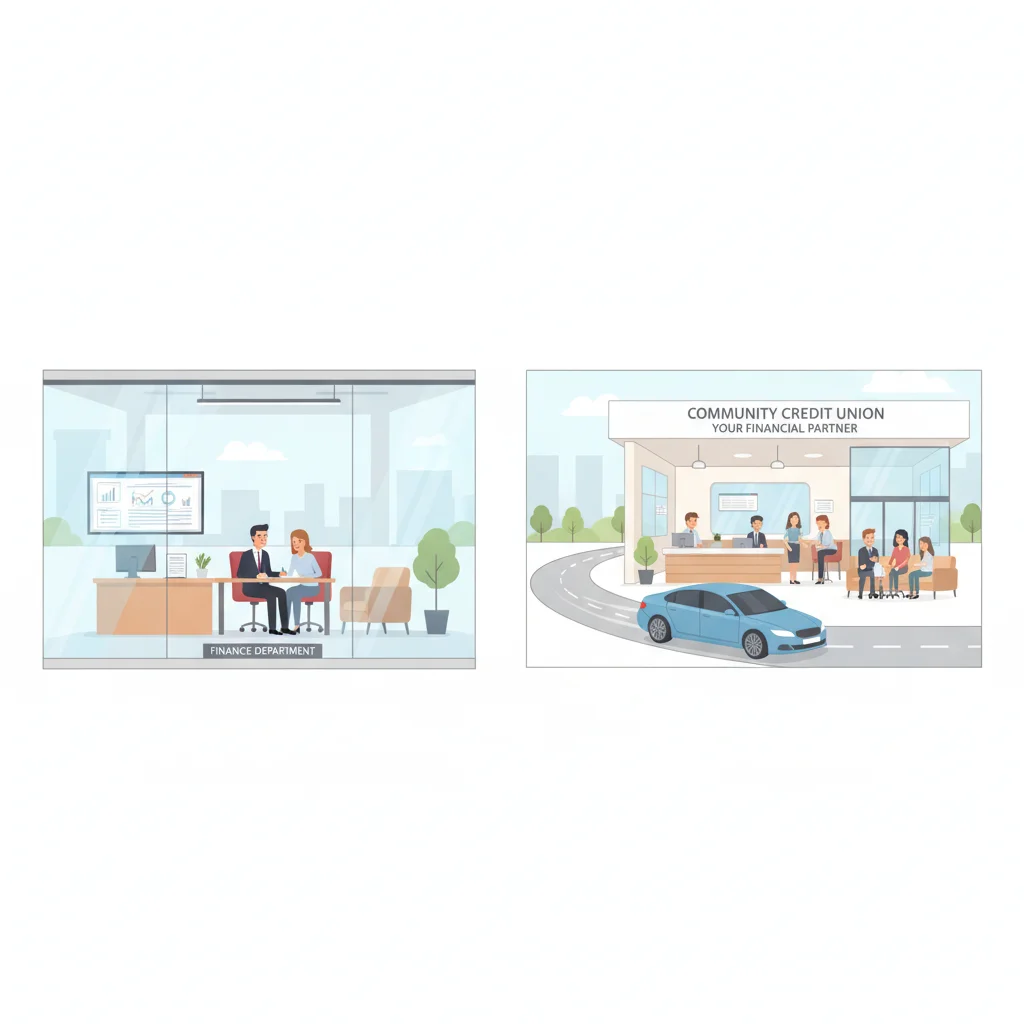
Option A
Dealer Financing
The one-stop-shop option built right into the purchase process.
Best for: Buyers who want speed and convenience, or who qualify for manufacturer-subsidized promotional rates.
Option B
Bank or Credit Union Financing
The independent route that gives you negotiating leverage and often a lower rate.
Best for: Buyers who want the strongest possible rate and the upper hand at the dealership finance desk.
If you qualify for a manufacturer promotional APR (0%–2.9%)
Dealer Financing
Subsidized rates through the manufacturer's captive lender are almost never matched by outside banks. Take the deal — just don't let the finance office load the contract with extras.
If you have good credit and want the lowest total cost
Bank or Credit Union Financing
With strong credit you'll qualify for competitive rates at a credit union or bank, and having a preapproval letter lets you negotiate the car price independently of the financing.
If your credit is below 640 and you need quick approval
Dealer Financing
Dealers work with a network of subprime lenders and can often find an approval that a single direct lender would decline — though you'll pay for that access in rate markup.
If you already have a loan from the dealership and feel the rate was too high
Bank or Credit Union Financing
Refinancing with a credit union or bank shortly after purchase can significantly reduce your rate if your credit has improved or market rates have shifted.
If you want to streamline the buying process in a single visit
Dealer Financing
When time is the priority and you've verified the dealer's rate is within a reasonable range of outside offers, dealer financing saves the extra legwork of a separate loan application.
How Each Financing Path Actually Works
Before comparing numbers, it helps to understand the mechanics behind each option — because they operate in fundamentally different ways.
Dealer Financing: You're Borrowing Through a Middleman
When you finance through a dealership, the dealer doesn't lend you money directly. Instead, the finance manager submits your application to a network of partner lenders — banks, credit unions, and the manufacturer's own captive finance company (think Ford Motor Credit or Toyota Financial Services). Each lender responds with a buy rate: the lowest rate they're willing to accept for your loan.
Here's the part most buyers don't realize: the dealer is legally permitted to mark up that buy rate before presenting it to you. That markup — often called the dealer reserve — is split between the lender and the dealership. In practice, markups of 1 to 3 percentage points above the buy rate are common. On a $35,000 loan over 60 months, a 2-point markup costs you roughly $1,900 in additional interest.
Direct Lending: You Negotiate as a Cash Buyer
When you secure financing through your own bank or credit union before you shop, you're essentially walking onto the lot with a blank check up to a set limit. You negotiate the vehicle price on its own merits, then hand over the lender's check at signing.
This separation matters. Dealers are skilled at bundling the price, trade-in, and financing into one moving target — adjusting monthly payments to obscure what you're actually paying. With outside financing already in hand, that tactic disappears. See our dealer negotiation hub for more on keeping these negotiations clean and separate.

Comparing the Two Side by Side
The table below cuts through the noise and shows where each option stands on the factors that most affect your wallet and your experience.
| Criterion | Dealer Financing | Bank / Credit Union |
|---|---|---|
| Typical APR advantage | 0% if promotional; otherwise higher | Usually 0.5–3% lower than dealer markup |
| Rate transparency | Buy rate hidden; markup not disclosed | Rate quoted directly — no middleman |
| Speed to approval | Same-day, in-dealership | 1–3 days; preapproval possible before shopping |
| Negotiating position | Weakens price negotiation (bundled deal) | Strengthens it (price and financing separated) |
| Credit flexibility | Works with subprime lenders for low scores | Best rates require 680+ credit score |
| Promotional offers | Access to 0%–2.9% manufacturer deals | No access to manufacturer subsidies |
| Add-on pressure | High — F&I office upsells aggressively | None — loan is finalized before the lot |
| Best for | Promo rates or urgent purchases | Most buyers who plan ahead |
1–3%
Typical dealer interest rate markup above buy rate
Industry data from the Consumer Financial Protection Bureau indicates dealers commonly mark up buy rates by 1 to 3 percentage points, capturing that spread as dealer reserve income.
$1,900+
Extra interest on a 2-point markup, $32K / 60 months
Calculated on a $32,000 loan at 60 months comparing 6.5% APR (direct lender) to 8.5% APR (marked-up dealer rate), illustrating the real-dollar cost of the spread.
700+
Typical credit score needed for manufacturer 0% deals
Manufacturer captive lenders such as Ford Motor Credit and Toyota Financial Services generally require a credit score of 700 or above to qualify for promotional zero-percent financing offers.
14 days
Rate-shopping window for minimal credit score impact
FICO and VantageScore models treat multiple auto loan hard inquiries within a 14-day window as a single inquiry, allowing buyers to shop multiple lenders without compounding score damage.
One factor the table doesn't fully capture: the shopping dynamic. When you have a preapproval in hand, the dealer's finance office has to compete for your business rather than simply present a rate and wait for you to sign. That competitive pressure alone often results in the dealer beating your outside rate — or at least matching it. See a deeper breakdown in our article on the pros and cons of dealer-arranged financing.
The Rate Markup: What It Costs You in Real Numbers
Abstract percentage points are easy to dismiss. Dollar amounts are harder to ignore.
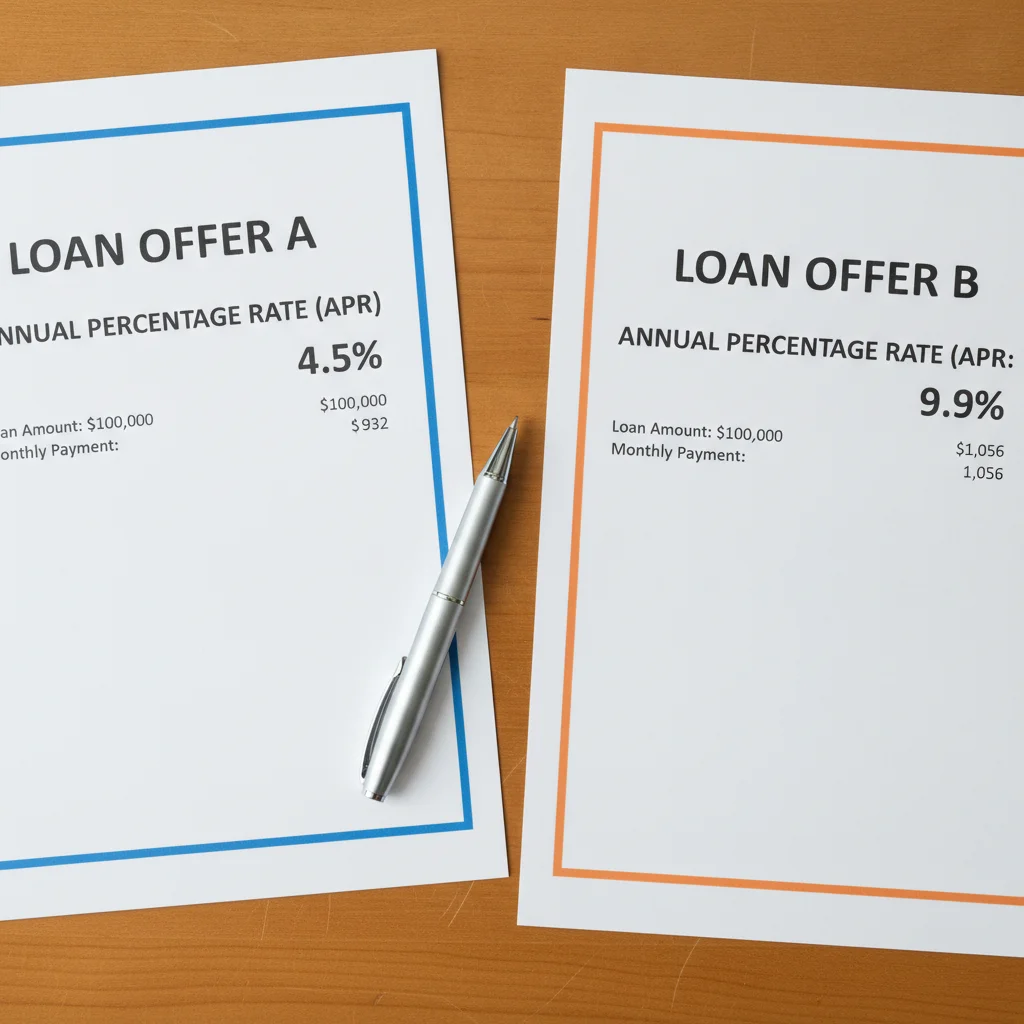
Assume you're financing $32,000 for 60 months. Your credit union offers you 6.5% APR. The dealer's finance office presents 8.5% APR — which might look close enough to accept if you're focused on negotiating the vehicle price.
- At 6.5% APR: Monthly payment = $624 | Total interest paid = $5,440
- At 8.5% APR: Monthly payment = $656 | Total interest paid = $7,360
- Difference: $1,920 over the life of the loan — for the same car, same lender network, same credit profile
That gap widens with larger loan amounts and longer terms. On a $50,000 truck financed over 72 months at a 2-point markup (say, 7% vs. 9%), the difference approaches $3,800. The 30 minutes it takes to get a credit union preapproval can pay well over $100 per hour in interest savings.
Monthly Payment Framing Is a Sales Tactic
Dealers are trained to anchor your attention to the monthly payment rather than the total cost of the loan. A finance manager can make a higher-rate loan appear affordable simply by stretching the term from 60 to 72 or even 84 months. Always ask for the APR, the loan term, and the total interest paid — then do your own comparison. Never agree to a payment without knowing all three numbers.
If your dealership experience involves a finance manager who focuses almost entirely on monthly payment rather than total cost, that's a signal to slow down. Always ask for the total amount financed, the APR, and the total interest paid over the loan term before signing anything. For a detailed look at scenarios where dealer financing actually does come out ahead, read our piece on when dealer financing beats your bank.
When Dealer Financing Is Genuinely the Better Deal
Dealer financing isn't always the worse option — and being fair about this matters. There are three scenarios where it can legitimately win.
1. Manufacturer Promotional Rates
When a manufacturer wants to move inventory, it subsidizes loans through its captive finance arm. These promotional rates — 0%, 1.9%, 2.9% APR — represent real money that no outside lender can match. If you qualify (typically requires a credit score of 700+), a 0% loan is a pure win: you're effectively borrowing the money free while your own cash stays invested.
The catch: manufacturers often offer either a low APR or a cash rebate, not both. Do the math to see which saves more before committing.
2. Thin or Damaged Credit Profiles
If your credit score is below 620, many banks and credit unions will decline your application outright or offer rates that aren't meaningfully better than what the dealer arranges. Dealers work with a broader range of lenders, including subprime specialists. That access has value when options are limited. For a specific comparison in this situation, see our guide on dealer financing vs. direct lending for poor credit.
3. Speed and Simplicity
If you're replacing a totaled vehicle on short notice and need to close quickly, dealer financing can fund in a single visit. The time cost of getting a preapproval — even if only a day or two — isn't always practical. Just go in knowing the approximate market rate for your credit tier so you can spot an unreasonable offer.
How to Use Both Options to Your Advantage
The best move isn't always to pick one option and ignore the other — it's to use them together as a negotiating strategy.
- Get preapproved first. Apply at your bank and at least one credit union before you set foot in a dealership. You're looking for a real rate commitment, not a soft estimate. This typically involves a hard credit pull, but multiple auto loan inquiries within a 14-day window are usually treated as a single inquiry by the major scoring models.
- Negotiate the vehicle price independently. With financing already sorted, you can focus the negotiation on the out-the-door price. Don't reveal your monthly payment target — that hands the dealer a tool to manipulate the deal structure. For practical tactics, the dealer negotiation guide covers this in detail.
- Let the dealer's finance office try to beat it. After agreeing on price, tell the finance manager you have a preapproval at X% APR and ask if they can improve it. Sometimes they can — dealers earn a flat fee for placing loans even without a markup, so it's worth their time to compete.
- Compare total cost, not monthly payment. Whichever offer wins, verify the total interest paid, not just the monthly figure. A longer term can make a higher-rate loan look cheaper per month while costing significantly more overall.
- Don't forget refinancing as a safety net. If you end up in dealer financing at a rate you later regret, refinancing through a bank or credit union is often straightforward within the first year — especially if your credit has improved. Our article on dealership financing vs. refinancing covers when that switch makes sense.

The goal is to make the dealer's finance office compete — not to reflexively reject whatever they offer. If they beat your preapproval by half a point, take it. If they add two points of markup and dress it up with a lower monthly payment on a longer term, walk away from their financing while keeping the car deal you negotiated. For a side-by-side look at preapprovals against dealer rates in real scenarios, see dealer financing vs. outside preapproval.
The Bottom Line: Convenience Has a Price Tag
Dealer financing wins on convenience. It's right there, it's fast, and when manufacturer rates are in play, it can be genuinely unbeatable. But outside those situations, the default dealership loan typically costs more than what a bank or credit union will offer — because the dealer's business model depends on that margin.
The practical approach is straightforward: spend 30–60 minutes getting preapproved before you shop. That one step turns you from a financing customer into a buyer with leverage. You've already separated the loan decision from the car decision, and you've given yourself a credible number to use as a benchmark at the finance desk.
If the dealer beats it, great — take their rate. If they don't, you close with your preapproval and drive home knowing you didn't leave money on the table. Either way, you win.
Rates cited are illustrative examples based on typical market conditions and may not reflect current lender offers. Always obtain personalized rate quotes before making a financing decision.
All claims are backed by peer-reviewed research. Sources on request.