

Key Takeaways
The Payment Game: What's Really Happening at the Finance Desk
Walk into almost any dealership and within five minutes a salesperson will ask you: "What are you comfortable paying every month?" It sounds like a reasonable, even helpful question. It is not. It is the opening move in one of the most effective negotiation strategies the retail auto industry has ever developed.
Here's why it works so well. A monthly payment is a single variable. But that single number is secretly the output of at least four moving parts: vehicle price, trade-in value, interest rate (APR), and loan term. By collapsing all four into one figure, the dealer can adjust any of the others without you noticing. Lower your payment by $30? They just stretched your term from 60 to 72 months. Hit your exact number? They may have quietly bumped the APR by 1.5 points or rolled in a $900 protection package you didn't ask for.
Understanding the four-square structure dealers use is the foundation of seeing through this tactic. Once you know that dealers track each profit center independently, you understand why merging them into a payment conversation always benefits the house.

This isn't speculation. As someone who spent years on the finance side of dealerships, I can tell you the monthly payment question is trained, scripted, and used because it works. The buyers who avoided getting burned were almost always the ones who refused to answer it.
Common Mistakes Buyers Make When Payments Dominate the Conversation
Most buyers don't walk in planning to be manipulated. They make predictable, understandable errors — errors the dealership's entire sales process is designed to encourage. Below are the most costly ones.
Volunteering your target monthly payment when asked.
Why it happens: It feels like a practical way to communicate your budget. Buyers assume transparency speeds up the process and builds goodwill with the salesperson.
Treating the monthly payment as the primary measure of affordability.
Why it happens: Monthly payments are how most people budget household expenses, so applying that same lens to a car purchase feels intuitive and familiar.
Accepting a loan term extension without recognizing the total cost increase.
Why it happens: When a salesperson says "we can get you into that for just $30 less a month," the mechanism — a longer term — is rarely explained. Buyers hear the lower payment and nod.
Negotiating price, trade, rate, and term simultaneously in one bundled conversation.
Why it happens: Dealers present all four elements together by design. Most buyers don't realize they can — and should — negotiate each one sequentially and independently.
Failing to get pre-approved financing before visiting the dealership.
Why it happens: Many buyers assume the dealership will find them the best rate, or they don't want the hassle of a separate bank application before they know which car they want.
Allowing add-on products to be rolled into the loan during the payment conversation.
Why it happens: When a $1,200 warranty is framed as "only $18 more per month," it feels trivial. Buyers often agree to multiple small additions without tracking the cumulative financed amount.
72%
New-car buyers who negotiated monthly payment
According to a Consumer Financial Protection Bureau study, nearly three-quarters of auto loan borrowers focused on monthly payments rather than total loan cost during negotiation.
$5,000+
Extra cost from payment-focused deals
The CFPB estimates that buyers who negotiate on monthly payments rather than total price can overpay by more than $5,000 over the life of a loan compared to price-first negotiators.
84 months
Maximum loan term now offered by major lenders
Experian's State of the Automotive Finance Market report (2024 Q1) found 84-month new-car loans are now offered by multiple lenders, up from a fringe product just a decade ago.
38%
New-car buyers with loan terms over 60 months
Experian's Q1 2024 data shows more than a third of new-vehicle buyers are now taking loans longer than 60 months, significantly increasing total interest exposure.
Notice that nearly every mistake in the list above has one thing in common: the buyer ceded control of the information. In a negotiation, whoever sets the terms wins. When you answer the monthly payment question, you've handed the dealer the pen.
Why out-the-door price is the only number that protects you — and how to use it — is worth reading before you ever step on a lot.
How Dealers Manipulate Four Variables Inside One Payment
Let's make this concrete with real numbers. Say you're financing a $36,000 vehicle and your pre-approved rate from your credit union is 6.9% over 60 months. That puts your payment at roughly $711/month and your total interest paid at around $6,660.
Now suppose the dealer's finance manager targets a $680 payment — $31 less — because you mentioned that's your ceiling. Here are three ways they can hit that number while increasing what you actually pay:
- Stretch the term to 72 months: At the same 6.9% APR over 72 months, your payment drops to $604. But total interest climbs to $7,488 — $828 more. And if they nudge it back up to $680 by raising the vehicle price or adding a product, you pay even more.
- Raise the APR: At 60 months, bumping the rate to 9.9% produces a payment of $763 on the same $36,000. If they shorten the term to 48 months, the payment rises — so they might instead lower the stated vehicle price slightly to obscure the rate increase.
- Roll in add-ons: A $1,500 extended warranty and a $600 paint sealant package add $2,100 to the financed amount. At 6.9%/60 months, that alone costs you roughly $2,540 in total — but the monthly difference is only about $42, which is easy to hide in rounding.
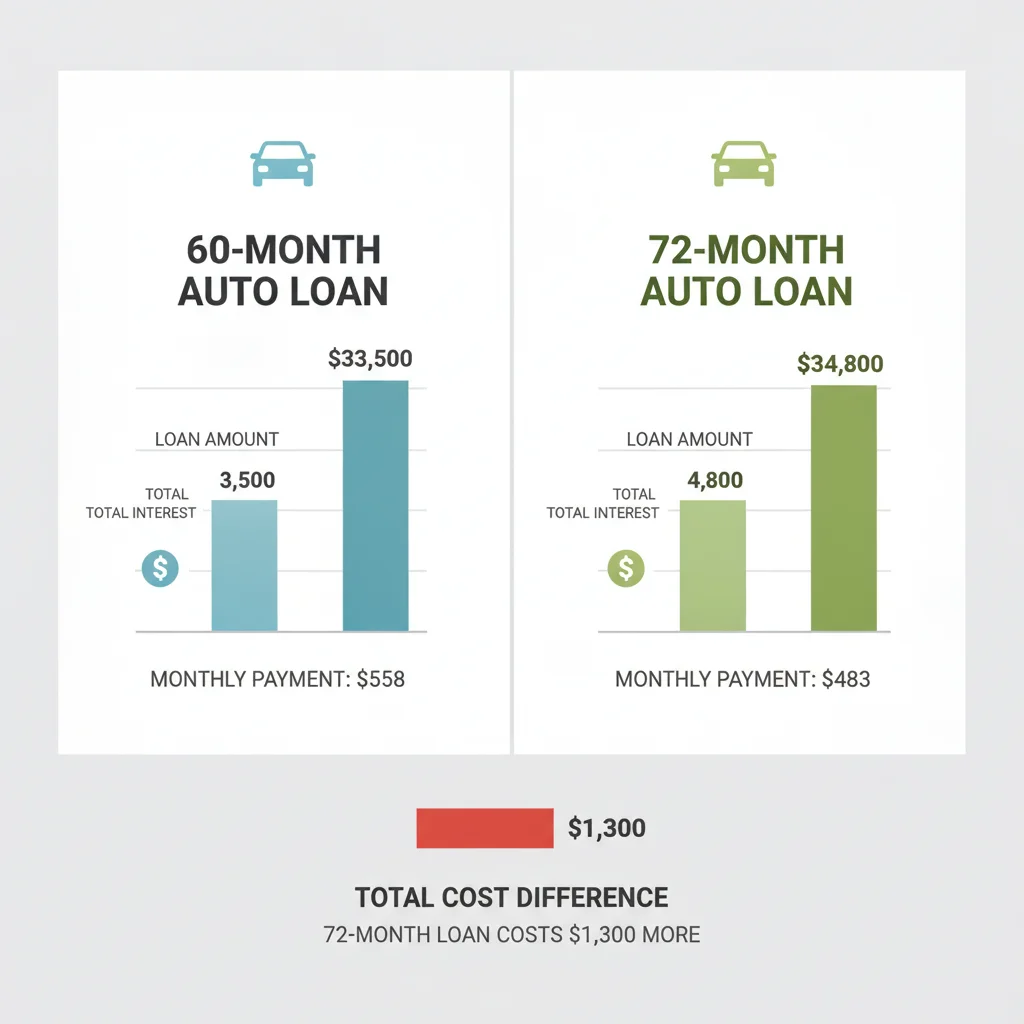
This is why the true cost of monthly-payment thinking is so severe. The number on the page looks fine. The deal underneath it doesn't.
Term Stretching Is the Invisible Fee
Unlike a documentary fee or destination charge, a longer loan term never appears as a line item on your contract. It's embedded in the payment math. A 72-month term at 6.9% on a $36,000 loan costs you roughly $1,700 more in interest than a 60-month term — yet the monthly payment looks almost identical. Always verify the loan term in months before you agree to any payment figure.
Manufacturer Incentive Rates Come with Conditions
Subsidized APR offers (0%, 1.9%, etc.) frequently require you to forgo cash-back rebates. On a $5,000 rebate versus 0% financing, the break-even depends entirely on your alternative rate. Run both scenarios with real numbers before assuming the low rate is the better deal.
Your Trade-In Can Be Used Against You
When the deal is bundled around a monthly payment, a low trade-in appraisal can be absorbed into the math invisibly. If the salesperson knows your target payment, they can offer you $2,000 less on your trade while still hitting that number by extending the term. Get an independent appraisal from CarMax, Carvana, or a similar service before you negotiate a trade.
How to Redirect the Conversation — Exact Language to Use
Redirecting doesn't require being rude or combative. It requires having a clear, rehearsed script of your own. Here's language that works:
When they ask about your target payment:
"I'm focused on the out-the-door price today. Can you walk me through the purchase price, all fees, and taxes? We can talk about financing after we agree on the vehicle price."
When they pivot back to payments:
"I appreciate that, but I want to make sure we're looking at the same number. What's the total out-the-door price on this vehicle?"
When they try to bundle financing early:
"I have pre-approved financing from . I'm happy to see if you can beat their rate — but let's settle the price first."
These aren't magic words. They work because they force the negotiation back onto a single, transparent variable — price — where your due diligence actually applies. You researched market value. You know what competing dealers are charging. That knowledge only matters if the conversation stays on price.
Never Reveal Your Monthly Budget Ceiling
Telling a dealer your maximum monthly payment is equivalent to handing them your negotiating limit in writing. Every subsequent adjustment to price, rate, term, or add-ons will be calibrated to land just at or below that number — maximizing their profit while technically meeting your stated requirement. Keep that number to yourself, always.
Price First — Always
No financing conversation should begin before you have a firm, agreed, written out-the-door price. This isn't a preference — it's the structural requirement for any fair negotiation. Once a price is locked in writing, the dealer cannot retroactively inflate it through financing. Until it's locked, every payment quote is hypothetical and exploitable. Get the price on paper before you walk into the finance office.
Full negotiation strategy for new car buyers covers how to prepare your counter-offer anchors before you walk in — which pairs directly with the language above.
One practical note: in states with high-tax environments or dealer doc fees above $500, the out-the-door number can be $1,500–$2,500 higher than the sticker price. Always ask for a complete itemized breakdown of fees before you agree to anything.
Pre-Approval: Your Most Powerful Redirect Tool
Nothing changes the dynamic at the finance desk faster than walking in with a pre-approval letter in hand. Here's why it works mechanically, not just psychologically.
When you have a pre-approved rate — say, 6.4% from your bank — the dealer can still try to beat it through their lending partners. If they do, great: you've created competition and driven your rate down. If they can't, you walk into the finance office already knowing your maximum rate, your maximum payment at a given price, and your loan ceiling. None of those numbers are negotiable anymore. The only variable left is the vehicle price itself.
Getting pre-approved also reveals your real budget ceiling to you, not the dealer. Many buyers don't know what they're actually approved for until a lender tells them. Dealers know this and exploit it — they'll often qualify buyers for larger amounts than they need, then work backward to fill that capacity with add-ons.

For context on what loan terms actually mean for your total repayment, our loan terms explainer breaks down how length, rate, and principal interact — including why a 72-month loan at a low rate can still cost more than a 48-month loan at a higher one.
The pre-approval process takes 15–30 minutes online with most banks and credit unions. Do it before you visit any dealership. It's the single highest-ROI step in the entire car-buying process.
When the Dealer Isn't Wrong — and When to Let Them Finance You
To be fair: dealer financing isn't always bad. Manufacturers run subsidized financing campaigns — 0% APR, 1.9% for 60 months — that your bank genuinely cannot match. When those deals are legitimate and clearly disclosed, taking them makes sense. But even then, the right sequence is price first, financing second.
The problem isn't financing through the dealer. The problem is letting financing become the lens through which the entire deal is negotiated. Those are different things.
Also worth noting: if you have a trade-in, that's a separate conversation too. How dealer trade-in appraisals work — and how to negotiate them independently — matters because dealers can absorb a lower vehicle price by shortchanging your trade, especially when everything is bundled into one payment discussion.

Finally, timing matters more than most buyers realize. Quarterly sales pressure creates real negotiating leverage — particularly at month-end and quarter-end when dealers need to move units. Walking in on the right day with the right preparation amplifies everything else in this article.
Never Reveal Your Monthly Budget Ceiling
Telling a dealer your maximum monthly payment is equivalent to handing them your negotiating limit in writing. Every subsequent adjustment to price, rate, term, or add-ons will be calibrated to land just at or below that number — maximizing their profit while technically meeting your stated requirement. Keep that number to yourself, always.
Price First — Always
No financing conversation should begin before you have a firm, agreed, written out-the-door price. This isn't a preference — it's the structural requirement for any fair negotiation. Once a price is locked in writing, the dealer cannot retroactively inflate it through financing. Until it's locked, every payment quote is hypothetical and exploitable. Get the price on paper before you walk into the finance office.
The bottom line: dealers prefer payment negotiations because they profit from complexity. Your counter-strategy is radical simplicity — one price, one conversation at a time. That's it. It's not adversarial; it's just math. And math doesn't care about what's comfortable.
For a deeper look at how contract language is used to bury costs even after the price is agreed, see how dealerships structure contracts to obscure total cost — required reading before you sign anything.
All claims are backed by peer-reviewed research. Sources on request.