
Key Takeaways
What 'Fixed Price' Actually Means on These Platforms
When Carvana, Vroom, CarMax, or a dealer-backed online storefront advertises a fixed price, what they're really saying is: we won't negotiate the sticker on the vehicle itself. That's a narrower promise than most buyers realize. The total transaction — the money that actually leaves your pocket — includes trade-in value, document fees, delivery charges, optional protection plans, and the interest rate on your loan. Fixed-price platforms control the vehicle price. They don't control all of those other numbers.
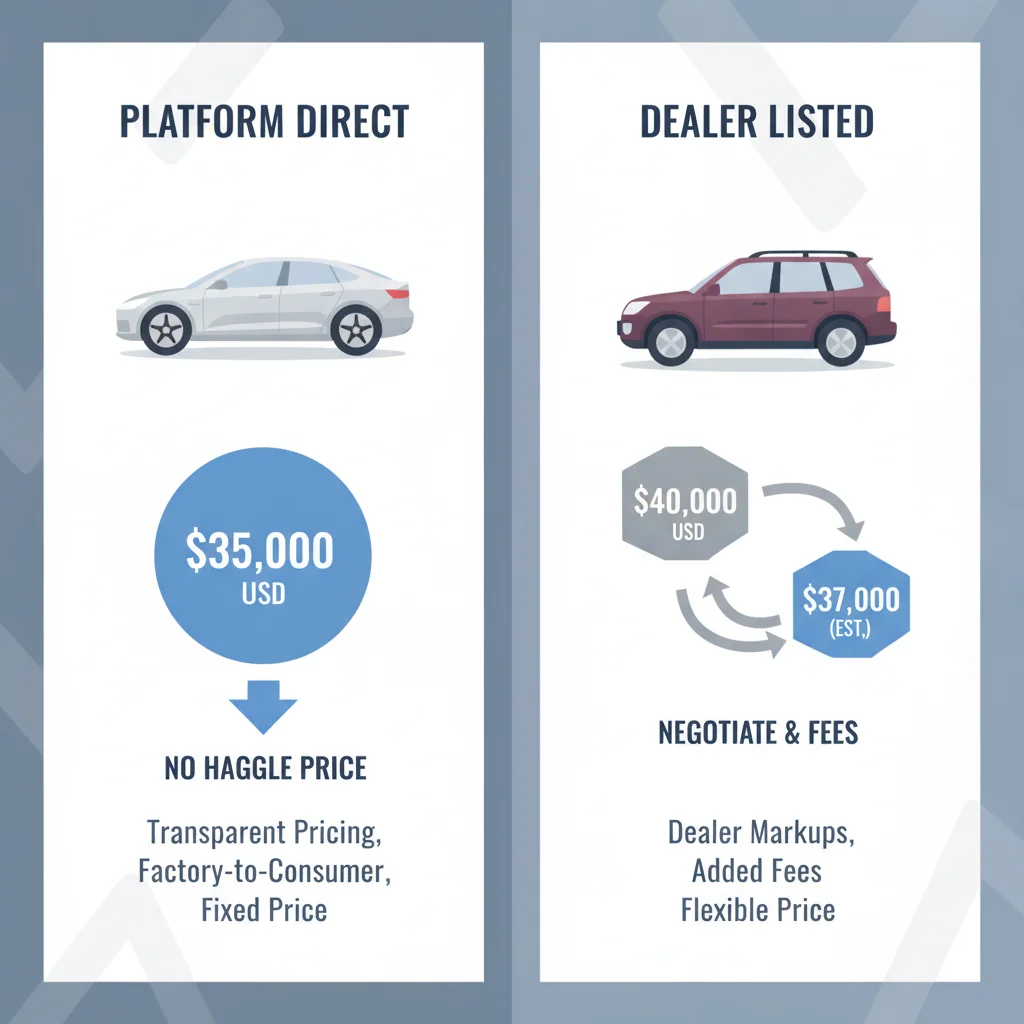
There are also two distinct business models hiding under the 'fixed-price' label, and they behave very differently under pressure:
- Platform-direct inventory: The platform owns the car. Carvana and Vroom operate this way. Their pricing algorithms are centralized, and individual sales agents have little authority to deviate. The vehicle price is genuinely rigid.
- Dealer-listed inventory on aggregator platforms: Sites like CarGurus, AutoTrader, and Cars.com let dealers post listings with a 'no-haggle' or 'great price' badge. The dealer still owns the car and still has a finance manager with a deal structure in mind. These listings are far more pliable than they appear.
Understanding which model you're dealing with changes your entire approach. For platform-direct cars, your leverage lives outside the vehicle price. For dealer-listed 'fixed-price' cars, the sticker is often the starting point, not the endpoint — regardless of the badge. See our full breakdown of no-haggle pricing if you want to understand how these platforms set their numbers in the first place.
What You Need Before You Start Negotiating
Walking into any fixed-price negotiation without preparation means leaving money on the table from the first conversation. Here's what you need assembled before you contact anyone:
What you will need
Edmunds True Market Value (TMV)
Provides real transaction price data for the specific vehicle you're buying, showing what others have actually paid.
CarMax Instant Offer
Generates a competitive trade-in floor price you can use as documented leverage with any selling platform.
Carvana Trade-In Tool
A second competing trade-in offer that, combined with CarMax, anchors your trade-in negotiation.
KBB Instant Cash Offer
A third trade-in benchmark that rounds out your market data and strengthens your negotiating position.
Credit Union Preapproval
Establishes an independent financing benchmark that protects you from inflated platform or dealer loan rates.
TrueCar Price Report
Shows the price range dealers in your area have accepted for the target vehicle, giving you a documented market ceiling.
CarGurus Deal Rating
Flags whether the platform's fixed price is rated 'good,' 'fair,' or 'overpriced' relative to current local inventory.
The most critical piece of preparation is competing offers. Run your trade-in through at least three platforms — CarMax, Carvana, and KBB Instant Cash Offer are the standard trio. Print or screenshot those offers. Then pull Edmunds and TrueCar pricing on the exact vehicle you're buying. If the platform's fixed price is already at or below market, your argument evaporates. If it's above market, that gap is your opening.
On financing: get preapproved through your bank or credit union before you touch the platform's financing application. Platforms make significant margin on loan origination — sometimes $500 to $1,500 per deal. When you arrive with your own rate, they either beat it to earn the business or lose the finance income. Either way, you win. The dealer negotiation hub has detailed guidance on using preapproval as leverage in any purchase scenario.
Step-by-Step: Finding and Using Leverage on a Fixed-Price Platform
Follow these steps in order. Each one builds on the last. Skipping steps — especially the research steps — is how buyers end up paying more than they should on a platform that told them there was nothing to discuss.
Identify Which Type of Fixed-Price Listing You're Dealing With
Before anything else, determine if you're looking at platform-owned inventory (Carvana, Vroom, CarMax retail) or a dealer listing on an aggregator (CarGurus, AutoTrader, Cars.com). Check the listing carefully — it will identify the selling entity. Platform-direct listings typically show the platform's name as seller; dealer listings show the dealership name with a platform 'badge.'
This single distinction determines your entire strategy. Platform-direct = focus on trade-in, fees, and financing. Dealer-listed = all of the above plus the vehicle price itself may be movable.
Pull Market Comps on the Specific Vehicle
Go to Edmunds, TrueCar, and CarGurus and search for the identical year, make, model, trim, and mileage band within a 250-mile radius. Screenshot or save the price distribution. Note the median, the low end, and whether the platform's fixed price is above or below median.
If the price is below median, acknowledge it internally and shift your energy entirely to fees, trade-in, and financing — you won't move the price and you shouldn't try. If it's above median, that gap is documented leverage you'll use in a later step.
Get Your Trade-In Appraised by at Least Three Competing Sources
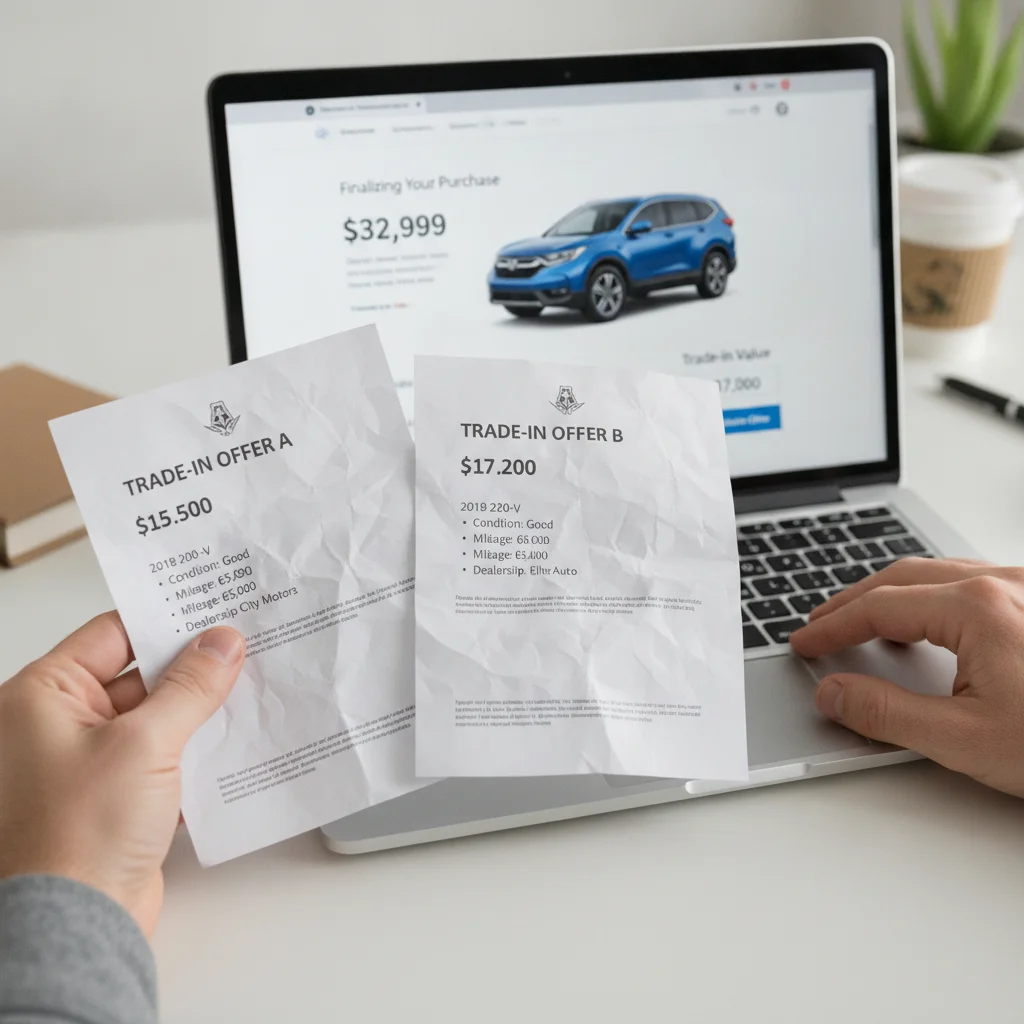
Run your current vehicle through CarMax (in-person or online), Carvana, and KBB Instant Cash Offer before you engage with any selling platform. These offers are valid for seven days and serve as floor-price anchors. Screenshot each offer with the date visible.
This step is non-negotiable if you're trading in. The difference between a platform's opening trade offer and what a competitor will pay can easily be $1,500–$3,000. You need that number in your hand before the conversation starts. The instant offer platform hub has current comparisons of which platforms consistently offer strongest trade values.
Get Preapproved for Financing Independently
Apply for auto loan preapproval through your bank or a credit union before initiating any purchase conversation. Credit unions consistently offer lower rates than dealer-arranged or platform-arranged financing. Bring your preapproval rate to the table as your benchmark.
When the platform presents financing, ask for the buy rate (the actual lender rate) and the rate they're quoting you. The spread between those two numbers is your negotiating target — in a traditional dealership that spread might be 1–2 percentage points and is often negotiable down. Platform financing markup varies but exists at most dealer-connected platforms.
Request a Full Out-the-Door Quote in Writing
Before negotiating a single line item, get the complete transaction cost in writing: vehicle price, documentation fee, registration fee, any dealer add-ons, delivery fee (for online platforms), and the trade-in credit applied. Many platforms charge documentation fees of $300–$700 that aren't visible in the listed price.
This number — the OTD total — is what you're actually negotiating. Breaking it into components lets you attack each piece separately rather than being anchored to the vehicle price alone.
Make Your Ask — Target Fees, Trade, and Rate Simultaneously
Present your position clearly and without apology: 'I have competing trade-in offers at $X from CarMax and $Y from Carvana. I have a preapproval at Z% from my credit union. I've also found comparable vehicles priced $[gap] lower in my area. To make this transaction work, I need [specific ask]: a trade-in credit matching my best competing offer, your documentation fee reduced to [reasonable number], and financing at or below my preapproval rate.'
Being specific forces a specific response. Vague asks get vague rejections. Concrete numbers with documented support get real responses — sometimes a counter, sometimes a concession, sometimes both.
Evaluate the Final Package Against Your Walk-Away Number
Before any negotiation begins, you should have calculated your walk-away OTD number — the maximum you're willing to pay for this specific vehicle given available alternatives. If the platform's final offer lands below that number, take the deal. If it doesn't, execute a clean exit as described in the final section below.
Don't let anchoring bias trap you into paying more than you should simply because you've invested time in the conversation. Time spent researching is a sunk cost. The only number that matters is whether this deal — right now — beats your alternatives.
Don't Conflate 'Market-Adjusted' With 'Fair'
Platforms frequently use the phrase 'market-adjusted pricing' to imply their price is already a deal. This means they've priced relative to current market data — it does not mean the price is below market or even at market. Always verify with independent comp data before accepting that framing.
Financing Add-Ons Can Erase Every Concession You Won
GAP insurance, extended warranties, paint protection, and credit insurance sold through the platform's finance process can add $2,000–$4,000 to a transaction. Decline all of them by default in the F&I stage. Price any product you actually want independently before agreeing to a bundled version from the platform.
Specific Tactics for Dealer-Listed 'Fixed-Price' Vehicles
If the listing is through a dealer — even one advertising a no-haggle price on an aggregator platform — you have more room than you think. Dealers use the 'fixed-price' badge as a psychological anchor, not a legal commitment. Here's how to work past it:
Request an Out-the-Door Quote First
Never negotiate off the sticker. Ask for a complete out-the-door (OTD) number that includes all fees. Dealer doc fees range from $85 to over $1,000 depending on the state, and they're often inflated on 'no-haggle' deals because the dealer knows buyers won't push back on price. Once you have the OTD number, that's the figure you negotiate — not the vehicle price.
Use the Trade-In as a Separate Transaction
Always negotiate the trade-in independently of the vehicle purchase. Dealers routinely subsidize a 'fixed' vehicle price by undervaluing your trade-in, then tell you they gave you a deal on the car. Get your competing offers from CarMax and Carvana first. Tell the dealer you have a $14,200 offer from CarMax — watch how quickly their trade appraisal improves. Our guide on negotiating a trade-in when the dealer says the price is final walks through this in detail.
Attack the Financing Spread
Dealers mark up the interest rate on loans they originate. If your bank preapproved you at 6.4%, the dealer might quote you 7.9% and pocket the difference as 'dealer reserve.' Show your preapproval. Ask them to beat it. If they can't beat it, use your own financing and close the deal. This single step saves the average buyer $800–$1,400 over the life of a 60-month loan.
Strip or Negotiate Add-Ons
Extended warranties, paint protection, nitrogen in the tires, key fob insurance — these are profit centers, not features. On a 'fixed-price' deal, this is often where the dealer makes the margin they gave up on the vehicle. Decline everything in the F&I office as a default. If you want an extended warranty, price it independently through Endurance or CARCHEX first, then compare.
End-of-Month Is Your Best Friend
Salespeople and finance managers at dealer-affiliated platforms are chasing monthly quota targets just like traditional dealerships. Contact platforms in the last four business days of the month and you'll find 'fixed' pricing gets considerably more flexible. Even platform-direct sites may run end-of-month promotions on delivery fees or financing rates — ask directly.
Document Every Concession Before Moving Forward
When a platform rep agrees to match your trade-in offer or reduce a fee, get it confirmed in a written summary email or chat transcript before discussing the next item. Verbal agreements in car transactions have a way of evaporating between the phone call and the final paperwork.
Condition Documentation Boosts Trade-In Offers
Platform trade-in algorithms often default to conservative condition ratings to protect against inspection surprises. If your vehicle is in better-than-typical condition, submit recent service records, a clean Carfax, and high-quality photos when requesting the appraisal. Some platforms allow a condition appeal that can add hundreds to the offer.

When to Walk Away — and How to Do It Productively
The most underused negotiating tool on any platform is a credible exit. Fixed-price platforms, especially dealer-sourced ones, have holding costs on every vehicle that increase daily. A car sitting on a lot for 45 days costs real money. When you signal genuine readiness to walk, the dynamic shifts.
The productive walk looks like this: after your final ask is declined, say something direct — 'I appreciate your time. I'm going to move forward with the CarMax offer on my trade-in and look at the similar vehicle I saw listed at . If anything changes on your end, please reach out.' Then actually leave — end the chat, close the tab, or leave the lot. Don't hover.
In my experience working the finance desk, roughly 30% of buyers who executed a genuine walk received a follow-up call within 48 hours with a better number. The percentage climbed significantly on vehicles that had been in inventory more than 30 days. Timing matters: end-of-month is when salespeople and finance managers are chasing quota — that's when the 'fixed' price gets a lot more flexible.
For platform-direct vehicles (Carvana, Vroom), the vehicle price won't change via a follow-up call. But if you walked over a trade-in valuation dispute, a resubmission with updated condition documentation sometimes yields a revised offer. See the nuances on what's actually negotiable with instant offer platforms before you give up on a platform-direct deal.
Never Disclose Your Maximum Budget
If a platform representative asks what monthly payment you're comfortable with, decline to answer. This redirects the negotiation from total transaction cost to a monthly figure — and it's how dealers stretch loan terms to inflate total cost while making the deal feel affordable. Negotiate the OTD price exclusively. Monthly payment is a derivative of that number, not a substitute for it.
Platform 'No-Haggle' Policies Do Not Apply to All Fees
Platforms enforce no-haggle policies on vehicle price — they rarely have a stated policy on documentation fees, add-on products, or financing rates. Buyers who assume the entire transaction is fixed leave significant money on the table. Always ask what each fee covers and whether it can be reduced or waived before signing anything.

Troubleshooting: Common Objections and How to Counter Them
Fixed-price platforms train their representatives to hold the line with specific language. Here's what you'll hear — and what to say back.
| What They Say | What It Means | Your Counter |
|---|---|---|
| 'Our prices are already market-adjusted.' | They've priced to current data, which may or may not favor you. | 'I've pulled Edmunds and TrueCar comps — here's where I'm seeing similar vehicles priced. Can we talk about closing the gap with fees or financing?' |
| 'We don't negotiate on vehicle price — it's our policy.' | The vehicle price is off the table, but they've said nothing about fees or rate. | 'Understood. Let's talk about the out-the-door number and your best available rate against my preapproval.' |
| 'That CarMax offer on your trade will expire.' | They're creating urgency to reduce your leverage window. | 'I can get a new one in 10 minutes online. My priority is getting the full transaction to work — where can we improve the trade number?' |
| 'Our inspection certified this vehicle — that justifies the premium.' | Certification programs vary widely in what they actually cover. | 'I've reviewed the inspection report. Can you walk me through what's covered by the certification warranty and for how long?' |
The pattern is consistent: fixed-price language almost always refers narrowly to the vehicle price. Redirect every conversation toward the total transaction cost. That's where your money actually lives.
If you're evaluating multiple platforms and want to understand why identical vehicles can be priced thousands of dollars apart, this breakdown of platform pricing algorithms explains the mechanics. And if you're deciding between platform buying and private-party, compare the dynamics covered in negotiating with private buyers — the leverage structure is completely different but equally learnable.
Fixed-price platforms are a legitimate innovation that removes some friction from car buying. But friction isn't always the enemy — sometimes it's the buyer's friend. Know what's truly fixed, find what isn't, and negotiate everything within reach. That's how digital-savvy buyers close smarter deals.

All claims are backed by peer-reviewed research. Sources on request.