

Key Takeaways
Why Market Value Research Is Different for Online Purchases
Walking onto a dealership lot, you can read the room — a salesperson's hesitation when you mention a competing price, the age of inventory gathering dust in the back row. Online, those cues disappear. You're looking at professionally staged photos, optimized listing copy, and a price that may have been calculated with the assumption that you won't do your homework.
That asymmetry is exactly what makes market value research non-negotiable when buying online. Sellers on platforms like CarGurus, Autotrader, Cars.com, Carvana, and Vroom understand pricing psychology. Some list vehicles at the high end of fair market range and wait for less-informed buyers. Others use "great deal" badges generated by their own algorithms to create urgency. Without independent data, you have no way to separate genuine value from clever positioning.
This guide walks you through a repeatable, systematic process for establishing what a vehicle is actually worth before you make contact with a seller — whether that seller is a franchise dealer, an independent lot, or a private party. If you want to pair this with a broader buying strategy, see our pre-purchase checklist for buying a car online for everything else you should verify before clicking buy.
What You'll Need Before You Start
Before running valuations, gather the specifics of the vehicle you're researching. Garbage in, garbage out — entering the wrong trim or an approximate mileage figure will skew every number you pull. Here's what to collect from the listing:
- Year, make, model, and trim level (e.g., 2021 Honda Accord EX-L, not just "2021 Honda Accord")
- Exact mileage as listed
- VIN — always pull this from the listing; it unlocks history data and confirms the actual trim and option codes
- Listed options and packages — sunroof, navigation, towing package, premium audio, etc.
- Seller's ZIP code and your own ZIP code if they differ significantly
- Number of previous owners if disclosed
- Accident or damage history if disclosed
Once you have these details, you're ready to build a price range using multiple independent sources.
What you will need
Kelley Blue Book (KBB)
Pull retail, private-party, and trade-in value benchmarks for the specific trim and condition of the vehicle.
Edmunds True Market Value
Access transaction-based pricing that reflects what buyers are actually paying rather than just asking prices.
NADA Guides
Check lender-facing valuations, which determine how much financing a bank will extend against the vehicle.
CarGurus or Autotrader
Search active comparable listings in the seller's local market to establish a real-world price anchor.
CarFax or AutoCheck
Pull a full vehicle history report using the VIN to uncover accidents, title brands, and ownership history.
Manufacturer VIN Decoder
Verify the vehicle's factory-installed options and trim code directly from the OEM to confirm listing accuracy.
CARCHEX, Lemon Squad, or local mechanic
Conduct a third-party pre-purchase inspection on the physical vehicle, especially critical for remote purchases.
Bank or credit union preapproval
Establish a baseline financing rate so you can evaluate dealer financing offers independently of the vehicle price negotiation.
Step-by-Step: Building Your Market Value Baseline
The goal here isn't to find one magic number. It's to build a defensible price range — a floor, a ceiling, and a target — using data from multiple sources and local market context. Work through these steps in order.
Pull Valuations from Multiple Pricing Tools
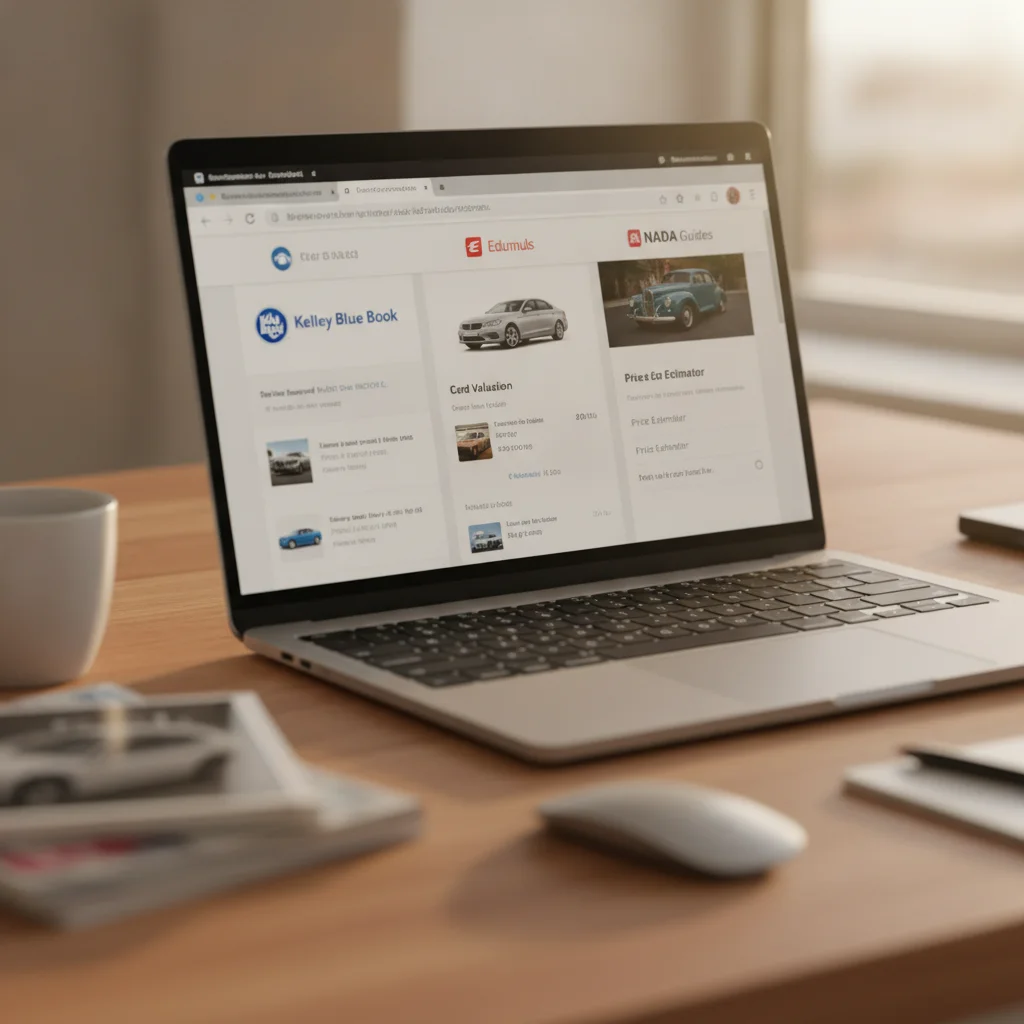
Start with the three most widely used valuation databases: Kelley Blue Book (KBB), Edmunds True Market Value (TMV), and NADA Guides. Each uses a different methodology and data set, which is exactly why you need all three.
- KBB tends to reflect retail and private-party asking prices; it's what most consumers reference, which makes it what many dealers use to justify their pricing.
- Edmunds TMV is transaction-based — it reflects what people are actually paying, not just asking — which makes it the most useful for determining a realistic purchase target.
- NADA is heavily used by banks and lenders to establish loan-to-value limits; it's more conservative and skews toward dealer retail.
For each tool, enter the exact trim level and all listed options. Record the private party value, dealer retail value, and trade-in value for each source. You'll use all three numbers: dealer retail tells you the ceiling, private party tells you the floor, and trade-in tells you what the car is worth in a distressed sale. You can also explore how these tools work in more depth via our valuation tools hub.
Check Active Comparable Listings in the Local Market
Book values are national averages. Your purchase is local. A 2020 Toyota Tacoma in Phoenix may command a $2,000 premium over the national average simply because truck inventory is tight in that market. Conversely, the same truck in a market with abundant inventory might sit below book value.
Go to CarGurus, Autotrader, or Cars.com and search for the same year, make, model, and trim within 100 miles of the listing's ZIP code. Filter to the same mileage band — within 15,000 miles either direction is usually close enough. Note the following for at least 5–8 comparable vehicles:
- Listed price
- Mileage
- Number of days on market (CarGurus shows this — longer days on market often signal an overpriced listing)
- Any disclosed accidents or issues
Calculate the median listed price across your comparables. This is your local market anchor — more reliable than any national book value for determining what a buyer in this specific geography is actually paying.
[in_content_images:1]Pull the Vehicle History Report
Use the VIN to pull a CarFax or AutoCheck report before you do anything else. This single step can save you from spending $20,000 on a vehicle that's been in a major accident, had a title brand applied, or been used as a rental or commercial fleet vehicle.
The key things to look for on the report:
- Accident and damage records: Minor fender-benders disclosed and repaired professionally have minimal price impact. Structural damage, airbag deployment, or flood damage are deal-changers — discount accordingly or walk away.
- Title history: Salvage, rebuilt, lemon law buyback, or odometer rollback brands dramatically reduce a vehicle's value and your ability to resell it later. Never pay retail for a branded-title vehicle.
- Number of owners and usage type: Rental, fleet, and lease returns have different maintenance profiles than single-owner personal vehicles.
- Service records: Consistent oil changes and manufacturer-recommended service intervals add confidence and can justify paying closer to retail. Gaps in service history should lower your offer.
- Odometer consistency: Every entry on the report should show increasing mileage. Any decrease — even small — is a serious red flag for odometer fraud.
If the seller hasn't provided a report, you can purchase one directly at carfax.com or autocheck.com for $40–$50. Some platforms include reports in the listing — always verify the report is tied to the actual VIN, not a generic document.
Adjust Your Price Range for Condition and Features
Book values assume a specific condition tier — typically "good" or "clean retail." The actual vehicle you're looking at may be above or below that baseline, which means you need to apply adjustments before you have a usable number.
Condition Adjustments
| Condition Factor | Typical Price Adjustment |
|---|---|
| Excellent condition, low mileage for year | +3–5% above book |
| Good condition, average mileage | At book value |
| High mileage for year (25%+ above average) | −5–10% below book |
| Minor cosmetic damage (dents, scratches) | −$300–$800 depending on severity |
| Needs tires or brakes soon | −$400–$900 (cost of parts + labor) |
| Single reported accident, professionally repaired | −5–8% below comparable clean vehicle |
| Structural damage or airbag deployment | −15–25% or walk away |
Options and Package Adjustments
Premium trims with desirable options — panoramic sunroof, premium sound, towing package, advanced safety suite — can legitimately command $500–$2,000 above base trim pricing. Verify these options are actually present by cross-referencing the VIN with the manufacturer's window sticker lookup (most OEMs provide this free on their websites). Dealers sometimes list lower trims as if they're higher trims by mentioning features present only on the upgraded package. The VIN decoder doesn't lie.
Get a Pre-Purchase Inspection Quote for Remote Purchases
If you're buying remotely and cannot personally inspect the vehicle, budget for a third-party pre-purchase inspection (PPI). Services like CARCHEX, Lemon Squad, or a local independent mechanic near the seller can physically inspect the car and report back before you commit.
A PPI typically costs $100–$200 and covers the mechanical condition, frame and body inspection, tire condition, and a basic road test. If the inspection reveals issues not disclosed in the listing — deferred maintenance, hidden rust, mismatched paint suggesting an undisclosed repair — you have documented grounds to renegotiate or withdraw your offer.
Factor the PPI cost into your total budget, and treat the inspection report as a final validation of your price range. A clean PPI on a car that already cleared your valuation research is the closest you'll get to confidence in an online purchase. This due diligence is also a cornerstone of the broader process covered in our pre-purchase checklist for buying a car online.
Document Everything in a Single Reference Sheet
Before you make contact with the seller, consolidate your research into a single reference document. This keeps you grounded during a negotiation — it's easy to get emotionally attached to a car and let that attachment erode your data-driven position. Your reference sheet should include:
- KBB, Edmunds, and NADA values (private party, dealer retail, trade-in)
- Local comparable median price and range
- CarFax or AutoCheck summary of relevant findings
- Your condition and feature adjustments
- Your floor, target, and ceiling prices
- Listing price and how many days it's been listed
- Any open questions you need the seller to answer
When you're looking at multiple vehicles simultaneously — which is the smart move in an online buying environment — this documentation prevents you from confusing details across listings and helps you compare apples to apples. Sellers count on buyer fatigue and confusion to push marginal deals through. A clear data sheet keeps you sharp.
Interpreting Your Data and Making an Offer
Once you've completed all the research steps, you should have a documented price range with context. Here's how to use it.
Build Your Three-Number Framework
- Floor (your walk-away price): The highest you'll pay given what you know. Usually the midpoint of your valuation range, adjusted downward for any negative history findings.
- Target (your opening counter): Start 5–8% below the listing price for dealer listings; closer to 3–5% for private party.
- Ceiling (fair maximum): What you'd pay if every other factor checked out perfectly and the vehicle is genuinely in excellent condition.
What to Say When You Make Contact
Lead with data, not emotion. Something like: "I've pulled valuations from KBB, Edmunds, and NADA and looked at comparable active listings in your area. Based on the mileage and trim, the market data puts this vehicle in the $X–$Y range. Is there flexibility near $Z?" That framing signals you've done your homework and aren't a soft target.
Use Price Drop History as Leverage
CarGurus tracks listing price history and shows you how many times a price has been dropped and by how much. A car that started at $28,000 and has been reduced twice to $24,500 tells you the seller has already demonstrated flexibility. Reference that history in your offer: it signals you've been watching the listing and aren't an uninformed buyer.
Timing Your Offer Can Move the Price
Dealerships face monthly sales targets and are more motivated to move inventory in the final week of the month. If you're not in a rush, timing your offer for the last three to five business days of the month can yield an extra $300–$800 in flexibility — especially on vehicles that have already been sitting for several weeks.
Red Flags That Should Change Your Number
Certain findings from your research justify walking away or demanding a significant discount — not just a token reduction. Structural damage on a CarFax, a branded title (salvage, rebuilt, lemon law buyback), more than two previous owners in under five years, or a listing price that's outlying high even after accounting for options — these all change the calculus. For a deeper look at listing-level warning signs, check our guide on red flags to watch for when browsing online car listings.

Platform "Deal Ratings" Are Not Independent
Badges like "Great Deal" or "Good Price" on CarGurus and similar platforms are generated by the platform's own algorithm — not by an independent appraiser. They are useful as a rough directional signal but should never substitute for your own valuation research. A car can carry a "Good Deal" badge and still be $1,500 above Edmunds TMV in a soft local market.
Beware of Artificially Low Out-the-Door Prices
Some online dealers advertise attractive purchase prices but then add substantial documentation fees, dealer-installed accessories, or bundled service contracts that inflate the real cost. Always ask for the full out-the-door price — including all fees and taxes — before comparing against your valuation research.
Never Skip the VIN Verification Step
Online listings can contain errors — intentional or otherwise — about trim level, options, or even the vehicle itself. The VIN is the only source of truth. Before you invest time researching a vehicle's value, confirm the VIN is visible in the listing photos (typically on the driver's side dashboard) and matches what the seller provides. If a seller refuses to provide the VIN prior to purchase, treat that as an automatic disqualifier — no exceptions.
Don't Let Financing Cloud Your Price Judgment
Online dealers and platforms love to shift the conversation from purchase price to monthly payment. A dealer can offer you a "great" $399/month payment on a car that's $3,000 overpriced by stretching the loan term to 72 or 84 months. Always negotiate the out-the-door price first — financing is a separate conversation. Come in with a preapproval from your bank or credit union so you have a benchmark rate before the dealer presents their financing options. When you know the purchase price is fair and the rate is competitive, the payment will follow.
If you're also considering selling your current vehicle through a private listing, be aware that the same valuation tools apply from the other side. Our article on setting the right asking price for a private car sale walks through how sellers use this data — which means you'll understand exactly what a motivated seller already knows about their car's worth.
Verifying the Seller Before You Commit
Market value research tells you whether the price is right. It doesn't tell you whether the seller is trustworthy or the listing is legitimate. Those are separate but equally important questions, especially in an all-digital transaction where you may never see the vehicle in person before money changes hands.
Cross-check everything: Does the VIN in the listing match the VIN in the vehicle history report? Does the seller's stated mileage match the odometer reading in the CarFax service records? Is the seller's platform account established, with reviews, or brand new? For a full vetting framework, see our guide on how to spot a legitimate online car seller.

If you're buying through a major platform like Carvana or Vroom, legitimacy risk is lower but not zero — check their return policy windows carefully and understand what "reconditioned" means on their specific platform. If you're buying from a private seller through Facebook Marketplace or Craigslist, the verification burden is entirely on you. Never wire money, use gift cards, or pay through non-reversible channels for any online vehicle purchase.
Finally, remember that online car buying is evolving fast. The platforms and tools available today — from remote inspection services to digital title transfers — are dramatically better than they were five years ago, but the fundamentals haven't changed: know the car's value, verify the vehicle's history, and trust data over a seller's word. That's how you buy smart in any market.

All claims are backed by peer-reviewed research. Sources on request.