
| Number of core documents in a financed online purchase | 5–8 standard documents |
| Optional F&I products often bundled in signing flow | GAP, extended warranty, tire/wheel, credit life |
| Return window offered by major online retailers | 7 days (varies by retailer) |
| Federal odometer disclosure required by | 49 U.S.C. § 32705 (Truth in Mileage Act) |
| TILA disclosure required for all financed deals | Yes — federal Regulation Z |
| Dealer GAP insurance average cost | $400–$900 (Industry average, varies by dealer) |
| GAP through auto insurer average annual cost | $20–$40/year (Consumer Reports, 2023) |
| States requiring doc fee disclosure | Varies — some cap fees, most do not |
Why Digital Paperwork Isn't Just a Convenience Feature
Buying a car online used to mean browsing inventory on your phone and then finishing the deal in a finance office. Today, the entire transaction — from price negotiation to title transfer — can happen without you setting foot in a dealership. That's genuinely useful. But it also means you're signing legally binding contracts on a screen, often under time pressure, without anyone walking you through what you're agreeing to.
The documents themselves haven't changed much. What's changed is the delivery method and the pace. When everything is digital, it's easy to click through a stack of e-signature requests without stopping to read what's in each one. I've watched that happen countless times from the dealer side — buyers who would have read a paper contract carefully will blast through the same document when it's formatted as a DocuSign envelope.
This guide breaks down every document you're likely to encounter in a fully online car purchase, explains what each one actually does, and flags the specific fields and clauses that deserve a second look before you sign. For a broader walkthrough of the entire process, see the complete online car buying guide.
| Number of core documents in a financed online purchase | 5–8 standard documents |
| Optional F&I products often bundled in signing flow | GAP, extended warranty, tire/wheel, credit life |
| Return window offered by major online retailers | 7 days (varies by retailer) |
| Federal odometer disclosure required by | 49 U.S.C. § 32705 (Truth in Mileage Act) |
| TILA disclosure required for all financed deals | Yes — federal Regulation Z |
| Dealer GAP insurance average cost | $400–$900 (Industry average, varies by dealer) |
| GAP through auto insurer average annual cost | $20–$40/year (Consumer Reports, 2023) |
| States requiring doc fee disclosure | Varies — some cap fees, most do not |
The Core Documents: What You Will Almost Always Sign
Regardless of whether you're buying from a franchise dealer, an online-only retailer like Carvana or Vroom, or a private seller facilitated through a marketplace, a handful of documents are nearly universal. Here's what each one is and what to check.
Buyer's Order (Purchase Agreement)
This is the first contract and, for many buyers, the most important one to read carefully. The buyer's order itemizes the vehicle price, trade-in credit, fees, taxes, and any add-ons. It commits you to specific numbers before financing paperwork is generated. In an online deal, this document is often emailed to you as a PDF or presented through the retailer's portal for e-signature.
What to check: Confirm the out-the-door price matches what was quoted. Look for destination fees, documentation fees (which vary wildly by state and dealer), and any pre-installed add-ons you didn't agree to — things like paint protection film, window tinting, or a GPS tracking device that appears as a dealer-installed option at $400–$1,200. These are almost always negotiable or removable before signing. The buyer's order deserves a full read — it's not a quote, it's a commitment.
Retail Installment Sales Contract (RISC)
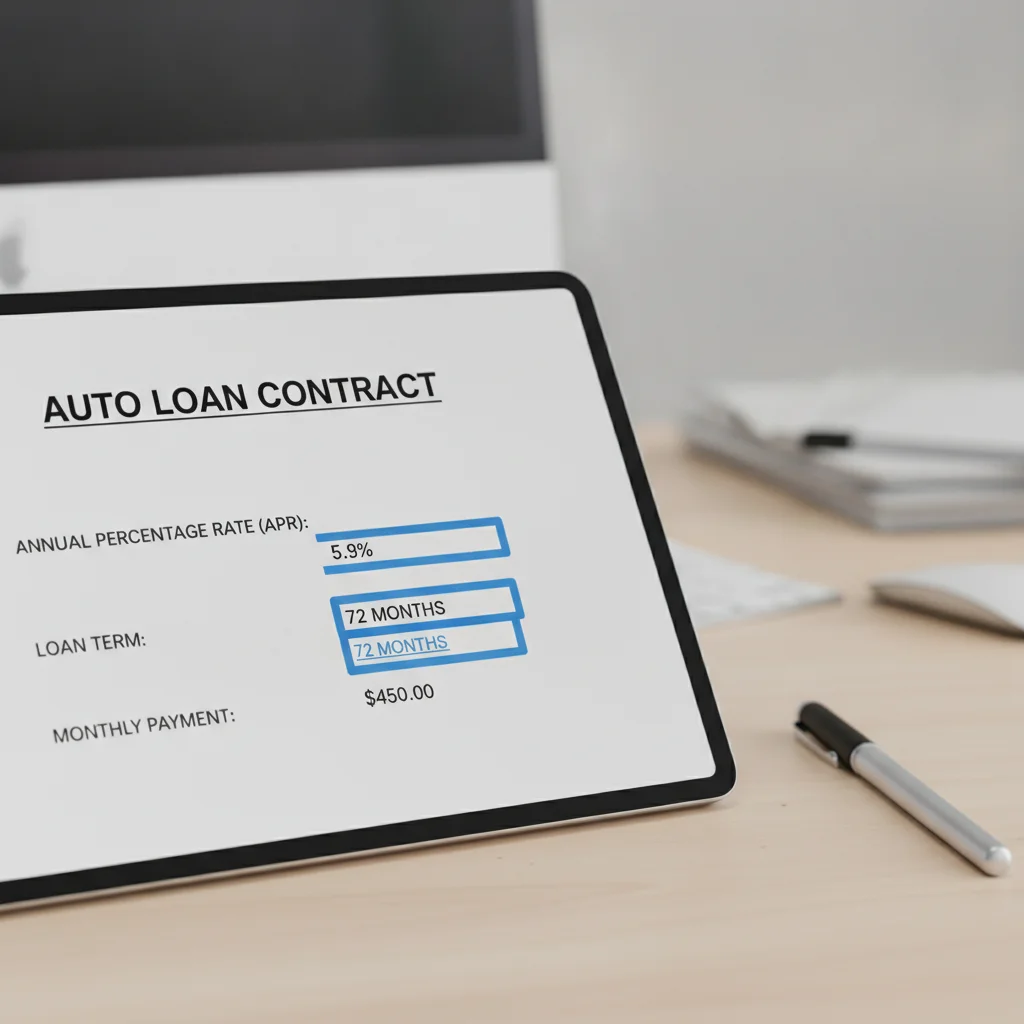
If you're financing through the dealer, the RISC is the most legally significant document in your stack. It defines the annual percentage rate (APR), the total amount financed, the number of payments, the monthly payment amount, and the total cost of the loan over its life. It also contains provisions around default, repossession, and prepayment penalties (rare, but they exist).
What to check: The APR must match what was quoted to you — not just the monthly payment. Dealers can manipulate the payment figure by stretching the term while keeping the rate higher than what you qualified for. Confirm the term (number of months), the exact rate, and whether there's a prepayment penalty clause. The fine print in a RISC is where buyers lose the most money without realizing it.
Odometer Disclosure Statement
Federal law requires sellers to disclose the vehicle's mileage at the time of sale. In an online deal, this is typically embedded in the title transfer paperwork or presented as a standalone digital form. For vehicles over 10 years old or above 16,000 lbs., the federal requirement doesn't apply — but many states still require disclosure.
What to check: Confirm the mileage on the disclosure matches the listing and the physical odometer if you had the car inspected. A discrepancy is a serious red flag for odometer fraud.
Title Transfer Documents
The signed title (or title application) transfers legal ownership from seller to buyer. In dealer transactions, the dealer typically handles title paperwork on your behalf and submits it to the state DMV. In a private-party online purchase, you may need to handle this yourself or through a third-party title service.
What to check: Verify the VIN on the title matches the car exactly. Ensure the seller's name on the title matches who you're buying from — a mismatch can indicate a title-jumping situation, which creates legal exposure for you. Understand your state's timeline for title delivery; some states allow 30–45 days, and online dealers sometimes operate from out of state, which can complicate the process. See the related resource on paperwork and title transfers for state-specific context.
Financing and Credit Documents
If you're not paying cash, you'll encounter a second layer of documents tied specifically to your loan. These often arrive separately from the purchase contract, either through the dealer's finance portal or directly from your lender if you brought pre-approved financing.
Credit Application
When you apply for dealer-arranged financing online, you submit a credit application that authorizes the dealer to pull your credit and shop your loan to lenders (often called the dealer's lending network or "tier system"). Online, this is typically a digital form collecting your SSN, income, employment, and housing information.
What to watch: Applying for financing through a dealer triggers hard credit inquiries. Multiple applications to different lenders within a short window (14–45 days depending on the scoring model) typically count as a single inquiry for rate-shopping purposes. But if a dealer submits your application to a dozen lenders over several weeks, that window can be exceeded. Ask how many lenders they plan to submit to and in what timeframe.
Truth in Lending Disclosure (TILA)
Required by federal law, the TILA disclosure presents four key numbers in a standardized box: the APR, the finance charge (total interest over the loan life), the amount financed, and the total of payments. This is the clearest apples-to-apples document for evaluating your loan cost.
What to check: Compare the APR in the TILA box to any rate you were quoted verbally or in a promotional offer. The TILA must be accurate — if it doesn't match, that's a compliance violation, and you should not sign until it's corrected.
GAP Waiver or GAP Insurance Agreement
Guaranteed Asset Protection (GAP) covers the difference between what you owe on a loan and what your car is worth if it's totaled or stolen. Dealers frequently bundle this into online deals and present it as a standard document in the signing stack. It is not required by law.
What to check: If GAP is included, confirm you actually agreed to it and verify the price — dealer-sold GAP typically runs $400–$900, while the same coverage from your auto insurer often costs $20–$40 per year. If you didn't specifically opt in, remove it from the deal before signing.

GAP Coverage: Dealer vs. Insurer
Before agreeing to dealer-sold GAP insurance, check with your auto insurer first. Most major insurers offer GAP or loan/lease payoff coverage as a policy add-on for a fraction of the dealer price. If you've already purchased dealer GAP and later find a better option, most states require dealers to refund a pro-rated amount if you cancel within the loan period.
Extended Warranty or Service Contract
These are separate contracts sold alongside the vehicle, often presented in the same e-signature envelope as required paperwork. They are entirely optional and are one of the highest-margin products in a dealer's F&I (finance and insurance) office.
What to check: Read the coverage exclusions carefully — many "bumper-to-bumper" plans exclude far more than buyers expect. Confirm the deductible, whether coverage is transferable if you sell, whether you can cancel for a pro-rated refund (most states require this), and whether the administrator is the dealer, manufacturer, or a third-party company. Third-party administrators carry more counterparty risk. See the full dealership document breakdown for more on F&I products in the signing stack.
Documents Specific to Online and Remote Purchases
Beyond the standard purchase and financing paperwork, fully remote deals add a category of documents you won't see in a traditional dealership transaction. These are worth understanding because they define rights you may or may not have after delivery.
Remote Purchase Agreement or E-Commerce Terms
Online-only retailers typically have their own digital purchase agreement that supplements or replaces the standard buyer's order. This document often includes delivery terms, cancellation policies, and liability language about vehicle condition upon delivery. Read it before the purchase order — it sets the framework for everything else.
Return Policy or "Love It or Return It" Agreement
Some retailers (Carvana, CarMax, and others) offer a return window — typically 7 days or a set mileage limit — after vehicle delivery. This policy is only enforceable if it's in writing in a signed document. Do not rely on what a salesperson told you verbally or what you read on a marketing page.
What to check: The exact return window (calendar days vs. business days), any mileage cap, who pays for return shipping or pickup, whether a restocking fee applies, and what condition the car must be in to qualify. If any of these terms have changed from what was advertised, get it corrected before you sign.
Power of Attorney (Limited)
In some remote title and registration scenarios, a dealer will ask you to sign a limited power of attorney authorizing them to complete paperwork on your behalf — particularly for title transfers in states that require a wet signature. This is common and generally legitimate, but it should be narrowly scoped.
What to check: The document should specify exactly what the POA covers (title filing, temp tag registration, etc.) and should not grant broad authority. If the language is vague or expansive, ask the dealer to clarify or provide a more limited version.
Delivery Inspection Acknowledgment
When the car is delivered, you'll often be asked to sign a delivery acknowledgment or condition acceptance form — sometimes digitally, via a tablet presented by the delivery driver. This document typically states you received the vehicle and it was in the condition described.
What to strong>strongly avoid: Signing this before you inspect the car. Walk around the vehicle, check for damage, test the electronics, confirm the VIN matches your paperwork, and verify the mileage. If anything is wrong, document it in writing on the form before signing — or refuse to sign until the issue is resolved. A signed delivery acknowledgment can undermine your ability to dispute condition issues afterward.

Before clicking through any of these documents, run through the pre-purchase checklist for online car buyers to make sure you've verified the vehicle, the financing terms, and the delivery logistics upfront.
How to Review Digital Documents Without Getting Rushed
The biggest risk in online car buying isn't a specific clause — it's the pace. Digital signing platforms make it easy for dealers and retailers to queue up 12 documents in a row and present them as a "just sign here" flow. Here's how to slow that down to your advantage.
Request the Documents in Advance
Before your scheduled signing session, ask the dealer or retailer to send all documents for your review at least 24 hours ahead. This is a completely reasonable request and any legitimate seller will accommodate it. If they resist, that's a signal to proceed cautiously.
Use the Checklist Approach
Before signing anything, cross-reference these five numbers across every financial document: (1) vehicle selling price, (2) trade-in credit, (3) APR, (4) loan term in months, (5) total amount financed. These numbers must be consistent across the buyer's order, the RISC, and the TILA disclosure. Discrepancies are not "paperwork errors" — they are how buyers get overcharged. Use the pre-signing checklist to work through each line systematically.
Download and Save Every Document
E-signature platforms typically allow you to download a completed copy of every signed document. Do this immediately after signing and save copies in at least two places. Some online retailers make it cumbersome to retrieve documents after the fact, and you may need them for insurance claims, title disputes, or warranty service.
Know What's Optional
In a well-structured digital signing flow, required documents and optional add-ons should be clearly separated. In practice, they're often mixed together. Any document that isn't the purchase agreement, RISC, TILA disclosure, odometer statement, or title paperwork is likely optional. That includes GAP, extended warranties, paint protection plans, tire and wheel coverage, and credit life insurance. Declining all of these doesn't affect the core transaction.
Retail Installment Sales Contract (RISC)
The primary financing contract between a buyer and the dealer, which is then assigned to a lender. It defines the APR, loan term, monthly payment, total finance charge, and conditions of default.
Truth in Lending Act (TILA)
A federal law requiring lenders to disclose the true cost of credit, including the APR and total finance charge, in a standardized format before the borrower signs.
GAP (Guaranteed Asset Protection)
An optional add-on product that covers the difference between the remaining loan balance and the vehicle's actual cash value in the event of a total loss or theft.
Buyer's Order
A binding purchase agreement that itemizes the vehicle price, fees, taxes, trade-in credit, and optional add-ons. It is the first contract generated in a car deal and must match subsequent financing documents.
Limited Power of Attorney
A legal authorization allowing a designated party (often the dealer) to complete specific paperwork on your behalf, typically limited to title and registration filing in remote transactions.
Odometer Disclosure Statement
A federally mandated document in which the seller certifies the vehicle's mileage at the point of sale. Falsifying this information is a federal crime.
F&I (Finance and Insurance)
The department within a dealership responsible for arranging financing and selling optional protection products. In online deals, F&I products are typically presented during the digital signing flow.
E-Signature
A legally valid digital signature executed through platforms like DocuSign or Adobe Sign. Under the ESIGN Act and UETA, e-signatures carry the same legal weight as handwritten signatures in most U.S. states.
For a side-by-side view of how online paperwork differs from a traditional dealership experience, the full car buying paperwork map walks through every document from first quote to final title. And if you want to understand how to protect yourself during the payment phase specifically, see the guide on protecting yourself when paying for a car online.
30%
U.S. car buyers who completed part of the transaction online in 2023
According to Cox Automotive's 2023 Car Buyer Journey Study, nearly one-third of buyers completed at least one major step of their purchase digitally.
$1,300+
Average F&I product revenue per vehicle at franchise dealers
NADA 2023 annual data shows finance and insurance remains the highest per-unit profit center at most franchise dealerships.
7 days
Standard online return window offered by major used-car retailers
Carvana, Vroom, and CarMax all offer return windows ranging from 7 to 30 days, subject to mileage and condition limits.
65%
Buyers who did not negotiate or review add-ons in the F&I office
A 2022 Consumer Reports survey found most buyers accepted F&I products without comparing prices or realizing they were optional.
Consumer Financial Protection Bureau: Auto Loans
The CFPB's auto loan resource center explains your rights as a borrower, how to compare loan offers, and what to do if you experience a financing problem. Especially useful for verifying TILA disclosures.
NHTSA VIN Lookup Tool
Before signing title documents, use the National Highway Traffic Safety Administration's free VIN decoder to confirm recall status and verify vehicle details match your paperwork.
DocuSign Document Review Guide
DocuSign's buyer resource explains how to navigate e-signature envelopes, download completed documents, and identify when a document has been modified after initial presentation.
Federal Trade Commission: Auto Financing
The FTC's vehicle financing guidance covers dealer markup, spot delivery risks, and your right to cancel optional add-ons — directly applicable to online purchase agreements.
Pre-Signing Contract Checklist
A printable checklist for verifying price, APR, term, and add-ons across your buyer's order, RISC, and TILA disclosure before committing to any financed car purchase.

All claims are backed by peer-reviewed research. Sources on request.