Key Takeaways
Why Myths Cost Borrowers More Than Bad Rates Do
Most borrowers who overpay on their auto loan don't do so because they couldn't get a better rate. They do so because they talked themselves out of trying. A collection of persistent myths — about credit scores, lender loyalty, savings minimums, and timing — keeps millions of Americans in loans that no longer serve them.
The frustrating part is that many of these myths feel logical on the surface. Of course checking your credit hurts it. Of course you should wait until rates drop significantly. Of course your original lender deserves first right of refusal. Except none of those things are really true — and believing them has a measurable dollar cost.
This article walks through the most damaging refinancing misconceptions, corrects them with evidence, and explains exactly what the math looks like in the real world. If you've been on the fence about refinancing, there's a good chance one of these myths is the reason why.

Before diving in, it's also worth understanding how refinancing myths overlap with broader credit misconceptions. Many of the same borrowers who hesitate to refinance also misunderstand how their credit score works in the loan process — see our piece on credit score myths that trip up car buyers for a deeper look at that side of the equation.
The Core Myths — Debunked
Below are the most common misconceptions that cause borrowers to delay or avoid refinancing altogether. Each one is paired with the accurate correction and a plain-English explanation of what's actually happening.
Myth
Applying to refinance will hurt my credit score significantly and take months to recover.
Fact
A single auto loan inquiry typically lowers your score by fewer than 5 points, and the effect is temporary — usually gone within three to six months.
This is one of the most stubborn myths in consumer lending, and it keeps creditworthy borrowers locked into high-rate loans for years. The fear is understandable: you've worked hard to build your score, and you don't want to watch it drop because of a lender check.
Here's the reality. When you apply for refinancing, a lender performs a hard inquiry on your credit report. According to FICO's own published data, a hard inquiry reduces most people's scores by fewer than 5 points — and only temporarily. The impact fades quickly, typically within three to six months, and the inquiry disappears entirely from your report after two years.
Even better: if you shop multiple lenders within a focused window — generally 14 to 45 days depending on the scoring model — all those inquiries are grouped together and counted as a single event. FICO does this intentionally to encourage rate comparison without penalizing consumers for being thorough. So applying to four lenders in two weeks is not four hits to your score; it's one.
Compare that to the ongoing cost of a high interest rate. If refinancing would save you $80 per month over 30 remaining months, that's $2,400. A temporary 4-point dip in your credit score is not a reasonable reason to forego that kind of savings.
Myth
I need to wait until rates drop by at least 2% before refinancing makes financial sense.
Fact
There is no universal rate threshold for refinancing — even a 1% rate reduction can generate meaningful savings depending on your balance and remaining term.
The "2% rule" is a rule of thumb that was popularized in the mortgage industry, where loan balances are enormous and closing costs are substantial. It doesn't translate to auto lending, where balances are smaller, fees are minimal, and the math looks quite different.
Consider a borrower with $22,000 remaining at 10.5% APR and 42 months left on the loan. Refinancing to 9% — just 1.5% lower — saves approximately $740 in total interest over the life of the loan. With typical refinancing fees of $100–$200, the break-even point is roughly 2–3 months. That's a strong outcome by any measure.
The correct way to evaluate whether to refinance isn't to compare rates in isolation — it's to calculate what the new rate actually saves you in total interest and divide the cost of refinancing by your monthly savings to find the break-even point. If the numbers pencil out within a timeframe that fits your plans for the car, the rate difference is almost irrelevant as a standalone figure.
Smaller rate improvements matter more early in the loan when your balance is highest and you still have many interest-accruing months ahead. A 1% improvement in month three of a 60-month loan saves far more than the same improvement in month 48.
Myth
My original dealership or lender has some claim on my loyalty, and shopping around is somehow disloyal or inappropriate.
Fact
Your original lender has no loyalty claim on your refinancing decision. You are free to take your business anywhere, and doing so is financially prudent.
This myth often surfaces as a vague sense of obligation — the feeling that because the dealer or original lender gave you a loan when you needed it, you owe them the first opportunity to keep it. Some dealers even encourage this framing explicitly, suggesting you should come back to them before going elsewhere.
To be clear: this is not a legal or contractual obligation in standard loan agreements. Your auto loan is a financial product. You agreed to specific terms, and both parties are bound to those terms. There is no clause requiring you to offer your lender a right of first refusal on a refinance.
More importantly, your original dealer almost certainly wasn't working in your pure financial interest when they arranged financing. Dealer-arranged loans often carry a markup above the rate the lender actually offered — known as the dealer reserve — which the dealer keeps as profit. You were, in many cases, paying more than necessary from day one. Seeking a competitive refinancing offer isn't disloyalty; it's correcting an imbalance that may have existed from the start.
If you feel conflicted, run the numbers: if a credit union offers you a rate that saves $1,500 over the remaining loan term, staying with your original lender out of loyalty costs you $1,500 in cash. That reframes the decision clearly.
Myth
If my credit score is bad or subprime, I won't qualify for a better rate so there's no point in trying.
Fact
Consistent on-time payments over 12–18 months after your original loan can meaningfully improve your score, making you eligible for better refinancing rates even from a subprime start.
This myth is particularly costly because it traps the borrowers who need savings the most. Subprime auto loans often carry rates between 14% and 25% — sometimes higher. Staying in one of those loans for five years because you assume you can't do better is an extremely expensive assumption.
Here's what actually happens: payment history is the single largest factor in your FICO score, accounting for 35% of the calculation. If you took out a high-rate loan when your score was poor and have since made 12–18 months of on-time payments, your score has very likely improved — sometimes by 40 to 80 points. That improvement can move you from a subprime tier to a near-prime or even prime tier with many lenders.
[in_content_images:2]At that point, refinancing could drop your rate by 4, 6, or even 8 percentage points. On a $15,000 balance with 36 months remaining, the difference between 19% APR and 11% APR is approximately $2,100 in total interest. That's not a trivial number for most households.
Even if your score hasn't improved dramatically, some lenders specialize in refinancing subprime borrowers who have demonstrated consistent repayment behavior. The key is to actually apply and find out — not to assume the answer is no. See our bad credit auto loan hub for lenders and strategies suited to this situation.
Myth
Refinancing always extends my loan and means I'll be paying longer than I originally planned.
Fact
You can refinance to the same or a shorter term than your current loan, reducing total interest paid while keeping or accelerating your payoff timeline.
This myth confuses a feature with a requirement. Term extension is an option when refinancing — not a built-in outcome. If your goal is to reduce your interest rate without pushing back your payoff date, you can simply refinance to a term that matches your current remaining balance.
For example, if you have 32 months left on your loan, you can refinance to a 30- or 32-month term at a lower rate. Your monthly payment stays roughly the same (or may even drop slightly), but more of each payment goes to principal instead of interest. You pay off the loan on nearly the same schedule and spend less total.
Alternatively, if your cash flow has improved since you took out the original loan, refinancing to a shorter term at a lower rate is a powerful move. Your monthly payment might rise slightly, but you'd eliminate months of interest accrual entirely.
The only scenario where term extension makes sense is if you genuinely need to reduce your monthly payment for cash flow reasons — and you're doing so with full awareness that total interest paid will likely increase. That's a legitimate trade-off, but it should be a conscious choice, not something you stumble into because you assumed refinancing always meant a longer loan.
Myth
It's too early in my loan to refinance — I should wait until I've built more equity.
Fact
The best time to refinance is often in the first half of your loan term, when your outstanding balance is highest and the potential interest savings are greatest.
Auto loans use simple interest and an amortization schedule that front-loads interest payments. In the early months of your loan, the vast majority of each payment goes toward interest rather than principal. That's the exact window where a rate reduction saves the most money.
Waiting until you've built equity or paid down a significant portion of the balance actually reduces the benefit of refinancing, because there's less remaining interest to save. The math is unambiguous: a lower rate applied to a larger balance for more months saves more than a lower rate applied to a smaller balance for fewer months.
There is one legitimate caveat: most lenders won't refinance a loan that's less than 60–90 days old, and you'll want to make sure you're not upside down on the vehicle (owing more than it's worth) to the point where no lender will approve the refinance. But outside of those constraints, acting earlier in the loan term is generally better than waiting.
If you're already in the final stretch of repayment, it's worth reading Refinancing Too Late before proceeding — the calculus shifts considerably when you're within 12 months of payoff.
Don't Wait Until the Loan Is Nearly Paid Off
Refinancing delivers its greatest benefit when your balance is still high and you have substantial months remaining. If you're within 12–15 months of payoff, the interest savings may not cover even minimal fees, and the administrative effort may not be worth it. Use a loan amortization calculator to verify your remaining interest before applying.
Watch Out for Prepayment Penalties on Your Current Loan
Some lenders — particularly buy-here-pay-here dealerships and certain subprime lenders — include prepayment penalties in loan agreements. Before refinancing, read your original contract or call your lender to confirm there is no penalty for paying off the loan early. A prepayment fee of $500 or more can erode or eliminate your projected savings.
When the Numbers Actually Work in Your Favor
Once you've cleared the mental hurdles, the practical question becomes: how do you know if a refinance makes financial sense right now? The answer usually comes down to two calculations: your break-even point and your total interest savings.
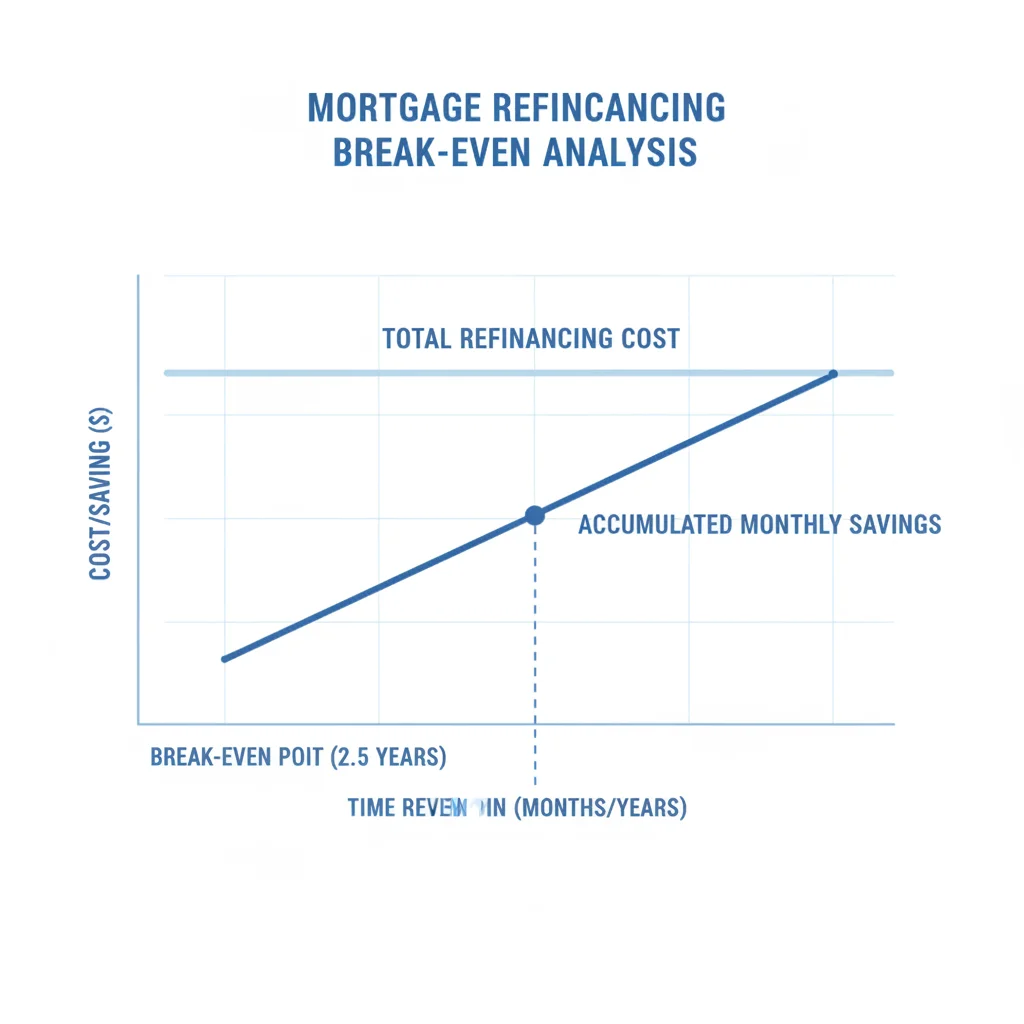
The Break-Even Calculation
Your break-even point is the number of months it takes for your monthly savings to cover the cost of refinancing. Most auto refinances involve minimal fees — typically between $0 and $300, depending on your state and lender. Unlike mortgage refinancing, there are usually no appraisals or closing cost packages.
Here's a simple example: Suppose refinancing saves you $55 per month and costs $150 in fees. Your break-even point is roughly three months ($150 ÷ $55). If you have more than three months left on your loan, the refinance pays for itself. In most cases, if you break even within 12 months, refinancing is worth doing.
Total Interest Savings
Monthly savings alone don't tell the full story, especially if you're considering extending your loan term. A lower monthly payment sounds appealing, but if it comes with a longer repayment timeline, you may pay more total interest even at a lower rate. Always compare the total cost of the loan — not just the monthly figure.
For example, suppose you owe $18,000 at 11% with 36 months remaining. Refinancing to 7% over the same 36 months would save roughly $1,200 in total interest. Refinancing to 7% but extending to 48 months might drop your payment more but increase total interest paid. Run both scenarios before deciding.
<5 pts
Typical credit score impact from a hard inquiry
FICO's published guidelines indicate that most consumers see fewer than 5 points shaved off their score from a single hard inquiry, with the effect fading within months.
14–45 days
Rate-shopping window treated as one inquiry
Both FICO and VantageScore models consolidate multiple auto loan inquiries made within a short window into a single credit event to encourage comparison shopping.
35%
Share of FICO score determined by payment history
Consistent on-time payments are the fastest legitimate way to improve your credit profile and qualify for better refinancing rates after a subprime start.
$1,200+
Potential interest savings from a 4-point rate drop
On an $18,000 balance with 36 months remaining, dropping from 11% to 7% APR eliminates roughly $1,200 in total interest according to standard amortization calculations.
For borrowers who are also navigating damaged credit, the refinancing window matters even more. Our bad credit auto loan resource hub covers the strategies available when your credit history makes lenders hesitant.
And if you've already been making payments for a while, timing matters — refinancing in the back half of your loan is rarely as beneficial as refinancing in the first half. We explain why in detail in Refinancing Too Late: Why the Last Year of a Loan Is Rarely Worth It.
Steps to Take Before You Apply
Knowing that refinancing is worth considering is only the first step. Walking into the process prepared means you'll get better offers and make a smarter decision faster.
- Pull your credit report first. Check for errors, recent derogatory marks, or accounts that might drag your score down unexpectedly. You can get a free report at AnnualCreditReport.com. Dispute any errors before applying — even a 10-point improvement can shift your rate tier.
- Know your payoff amount. This is different from your remaining balance. Contact your current lender and request a 10-day payoff figure. This is the exact amount a new lender would need to send to close out your loan.
- Get multiple quotes within a 14-day window. As discussed in the myth section, rate-shopping within a short window is treated as a single inquiry by scoring models. Don't be afraid to contact four or five lenders — credit unions, banks, and online lenders — and compare the actual APR, not just the monthly payment.
- Get preapproved before committing. Preapproval gives you a real rate offer without finalizing the loan. It lets you compare apples to apples. Our loan preapproval guide walks through what to expect from this process and how to use an offer as leverage.
- Read the new loan terms carefully. Look for prepayment penalties, whether your loan is simple interest or precomputed, and what the total payback amount is over the life of the loan.
Total Cost of the Loan, Not Just Monthly Payment
Always compare the total amount you'll pay over the life of the new loan against the total remaining on your current loan — not just the monthly payment figures. A lower monthly payment achieved by extending your term can actually cost you more money overall. Any lender should be able to provide you a full amortization schedule on request.
Finally, be aware of the mistakes that can turn even a smart refinance into a bad deal. Skipping the break-even math, ignoring fees, or extending your term without realizing it can all undercut the savings. Our article on common mistakes that undercut an otherwise good refinancing decision covers the specific errors to watch for.
The Bottom Line: Hesitation Has a Price Tag
Every month you stay in a loan that could be refinanced at a lower rate is a month you're paying more than necessary. That's not a judgment — it's arithmetic. And the myths covered in this article are largely responsible for that unnecessary cost.
Refinancing isn't a dramatic financial move. It doesn't require perfect credit, a huge rate drop, or lender permission. It requires a payoff quote, 30 minutes of comparison shopping, and the willingness to act when the numbers make sense.
If you've been waiting for the perfect moment, chances are the perfect moment already passed — or is available to you right now. Run the break-even math, get a few quotes within a two-week window, and let the actual numbers guide the decision rather than the myths.
Borrowers who feel like they have little leverage — especially those with subprime credit histories — should also read the myths keeping subprime borrowers from negotiating better terms. The same pattern of false assumptions that delays refinancing also stops many borrowers from negotiating the terms they deserve in the first place.

All claims are backed by peer-reviewed research. Sources on request.