

Key Takeaways
Why Good Intentions Aren't Enough
Refinancing an auto loan is one of the most straightforward ways to cut your monthly payment or reduce the total interest you pay over the life of a loan. The math is often compelling: rates drop, your credit improves, and a lower APR looks like easy money. But the gap between a refinance that genuinely helps you and one that merely feels like it does comes down to the details most borrowers skip.
This isn't about whether refinancing is a good idea in principle — for many borrowers, it absolutely is. The trouble is that the excitement of a lower rate can cause you to rush past the questions that determine whether the move actually works in your favor. Before you submit an application, it's worth understanding the most common mistakes that turn a promising refinance into a wash — or worse, a loss.
If you're still weighing whether refinancing is the right call at all, start with these key self-assessment questions before reading on. What follows assumes you've decided to move forward — and focuses on where people go wrong in execution.

The Mistakes That Quietly Undermine Your Refinance
Each of the errors below has a common thread: they're usually the result of moving too fast, trusting the surface numbers, or not knowing what questions to ask. Recognizing them before you apply puts you in a much stronger position to capture the savings you're after.
Skipping the break-even calculation entirely and focusing only on the monthly payment difference.
Why it happens: A lower monthly payment is immediately visible and emotionally satisfying — the fees and total interest cost are less obvious and require more effort to calculate.
Ignoring prepayment penalties on the existing loan before agreeing to refinance.
Why it happens: Many borrowers don't know their original loan included a prepayment clause, or assume the penalty is small enough not to matter.
Applying to only one lender and accepting the first rate offered.
Why it happens: Borrowers often assume all lenders use the same pricing, or worry that multiple applications will hurt their credit score significantly.
Extending the loan term significantly in order to lower the monthly payment, without accounting for increased total interest.
Why it happens: Lenders often advertise the payment reduction without highlighting how much more interest a longer term generates. The lower payment feels like a win without the full context.
Not checking your credit report for errors before applying.
Why it happens: Borrowers assume their credit score is accurate, or don't realize how common reporting errors are across major bureaus.
Rolling all fees into the new loan balance rather than paying them upfront.
Why it happens: Paying fees out of pocket at closing feels painful in the moment, so rolling them in seems like the easier path.
Applying during a period of financial instability — such as after a job change, a new major loan, or recent missed payments.
Why it happens: Borrowers sometimes assume their overall credit history is strong enough to offset recent turbulence, or don't realize how recently opened accounts and employment gaps affect lender risk assessments.
1–2%
Typical rate spread between lenders
Industry data consistently shows that auto loan rates can vary by one to two percentage points or more between competing lenders for the same borrower profile.
43%
Borrowers who shop only one lender
According to the Consumer Financial Protection Bureau, a significant portion of auto loan borrowers accept the first financing offer without comparing alternatives.
$1,000+
Average prepayment penalty on some contracts
Prepayment penalties structured under the Rule of 78s method can result in fees exceeding $1,000 on mid-size auto loans, per lender contract analysis data.
14 days
Rate-shopping window for bundled credit inquiries
FICO and VantageScore both allow multiple auto loan inquiries within a 14-day window to count as a single hard inquiry, minimizing the score impact of comparison shopping.
The Break-Even Point: Why the Math Has to Come First
One of the most underused tools in refinancing is the break-even calculation. Simply put, your break-even point is how many months it takes for your cumulative savings to exceed the total costs of refinancing. If you plan to pay off the car before you hit that point, the refinance costs you money rather than saves it.
Here's a concrete example. Suppose refinancing saves you $45 per month but costs $600 in fees rolled into the new loan. Your break-even point is 600 ÷ 45 = roughly 13 months. If you only have 14 months left on the loan, you'd barely come out ahead — and that's before accounting for the fact that rolling fees into the loan means you're paying interest on those fees too.

The full break-even calculation also needs to account for prepayment penalties on your existing loan, origination fees on the new one, and any difference in total interest paid when your term changes. These variables compound quickly, which is why doing the math in advance — not after you've signed — is non-negotiable.
Rolling Fees Into the Loan Costs More Than You Think
When refinancing fees are added to your new loan balance rather than paid at closing, you don't just pay the fee — you pay interest on that fee for the entire loan term. On a $600 origination fee at 6.5% APR over 48 months, the real cost is closer to $685. Always factor this into your break-even calculation before deciding whether to roll in fees or pay them upfront.
A Lower Rate Doesn't Guarantee You'll Save Money
The rate is only one variable. If you extend the loan term, carry a prepayment penalty, or refinance too late in the loan when most interest has already been paid, the new rate can be significantly lower and you can still come out behind. Always compare the total interest cost across both loans, not just the monthly payment or the rate percentage.
Refinancing Late in Your Loan Rarely Makes Sense
Auto loans are front-loaded with interest — you pay the most interest in the early months and less as the loan matures. If you're within the last 12–18 months of repayment, most of the interest you owe has already been paid. Refinancing at this stage restarts the interest cycle on a new loan, and you're unlikely to recover the costs. Refinancing is most powerful in the early-to-middle portion of a loan.
Loan Term Traps and the Total Cost Perspective
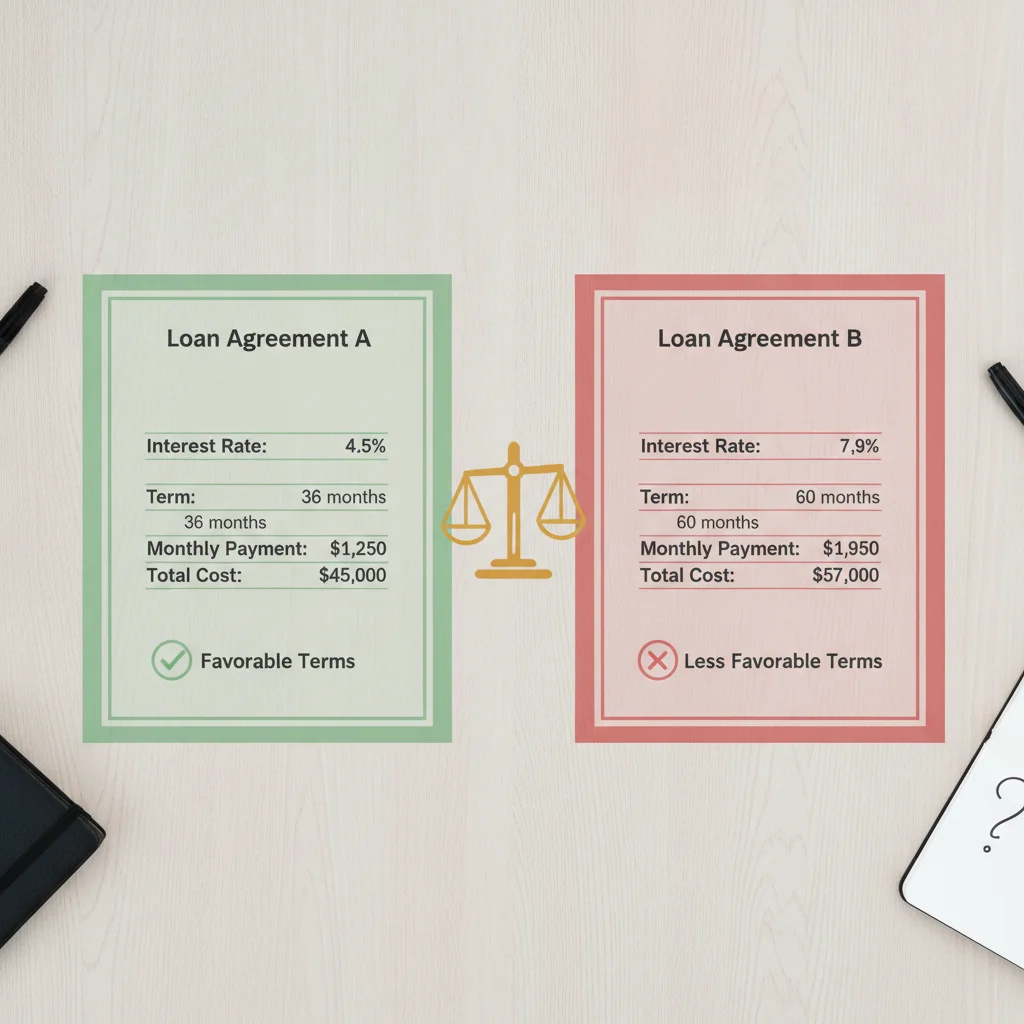
A lower monthly payment feels like an obvious win, but it's one of the most reliable ways a refinance can cost you more in the end. When you extend your loan term — say, from 36 remaining months to a new 60-month loan — you're spreading what's left of your principal over a longer period. Lenders collect more interest as a result, even if the rate is lower.
Consider this: you have 30 months left on a loan at 9% APR with a $350 monthly payment. Refinancing to a new 60-month loan at 6.5% APR drops your payment to around $215 — a $135 monthly savings that looks great on paper. But you've doubled the repayment timeline, and the total interest over those 60 months can exceed what you'd have paid finishing the original loan in 30.
This doesn't mean extending the term is always wrong. If cash flow is genuinely tight and you need the breathing room, the tradeoff may be worth it. But go in knowing the real cost, not just the payment reduction. Run the numbers on total interest paid under both scenarios before deciding.
If this is your first time navigating these tradeoffs, this first-timer's guide to refinancing walks through the concepts lenders often don't explain upfront.
Credit, Timing, and the Lender Shopping Problem
Two more mistakes deserve direct attention because they involve decisions made before you ever fill out an application: not checking your credit first, and not shopping multiple lenders.
Not Checking Your Credit Before Applying
Your credit score determines what rate you'll actually be offered — not the teaser rates advertised. Applying without knowing your score means you may be surprised by a higher rate than expected, which changes whether the refinance makes sense at all. Worse, if your score has dipped since you took out the original loan, you might qualify for a rate that's barely better — or even higher — than what you have now.
Pull your credit report and check for errors before applying. A single misreported account can suppress your score by 20–40 points, which can mean the difference between two entirely different rate tiers. Dispute errors first, let your score recover, then apply.
Applying to Only One Lender
Lenders price loans differently based on their own risk models, funding costs, and target customer profiles. The rate you're quoted at your current bank may be meaningfully different from what a credit union or online lender would offer. Shopping at least three to five lenders — ideally within a 14-day window so the credit inquiries are bundled into one — is one of the simplest ways to ensure you're getting competitive terms.
Borrowers with credit challenges face this problem acutely. If you're working through a difficult credit history, understanding your options through resources like bad credit auto loan strategies can help you identify which lenders are most likely to offer workable rates for your profile.

Finally, don't overlook timing. Applying right after a job change, a major new credit inquiry, or a period of missed payments puts you in a weaker negotiating position. Stability signals to lenders that you're a lower-risk borrower, and that translates directly to better rates. If your situation is in flux, waiting even 60–90 days can materially improve your outcome.
If you're second-guessing yourself on timing, the common refinancing myths article is a useful gut-check — it separates legitimate reasons to wait from unfounded hesitation that costs you money.
Credit Inquiries Alone Won't Ruin Your Score
One of the most persistent myths that keeps borrowers from shopping lenders is fear of credit score damage. In reality, multiple auto loan inquiries made within a 14-day window are treated as a single inquiry by major scoring models. Your score may dip by 5–10 points temporarily, but the savings from finding a better rate will vastly outweigh that small, short-term impact. Don't let this fear push you into accepting a suboptimal rate from the first lender you talk to.
Making the Call with Confidence
The through-line across every mistake above is the same: acting on the surface numbers rather than the full picture. A lower rate is not automatically a better deal. A lower payment is not automatically savings. And a lender's first offer is rarely their best one.
What protects you is doing the work upfront: calculating your break-even point, understanding your total cost across both scenarios, checking your credit before applying, and shopping enough lenders to know what a genuinely competitive offer looks like for your profile. That process takes a few extra hours — and can save you hundreds or thousands of dollars over the remainder of your loan.
Before you submit anything, consider walking through this pre-application checklist one more time. And if your existing loan includes a prepayment clause, make sure you've read through how prepayment penalties can affect your savings before signing anything new. Small due-diligence steps like these are what separate a refinance that genuinely improves your financial position from one that just feels like it does.

All claims are backed by peer-reviewed research. Sources on request.