
Key Takeaways
Credit Union Auto Loan Refinancing
Refinancing an auto loan through a credit union means replacing your existing car loan with a new one issued by a member-owned financial cooperative. Because credit unions are not-for-profit institutions, they typically return earnings to members in the form of lower interest rates and reduced fees. The process works similarly to refinancing with a bank, but eligibility requires joining the credit union first.
Credit unions are regulated by the National Credit Union Administration (NCUA) rather than the OCC or FDIC, and deposits are insured up to $250,000 through the National Credit Union Share Insurance Fund (NCUSIF).
Why the Lender Type Matters When You Refinance
When most people think about refinancing a car loan, they focus on two numbers: the new interest rate and the new monthly payment. What they often overlook is how much the type of lender shapes both of those numbers before a single application is submitted.
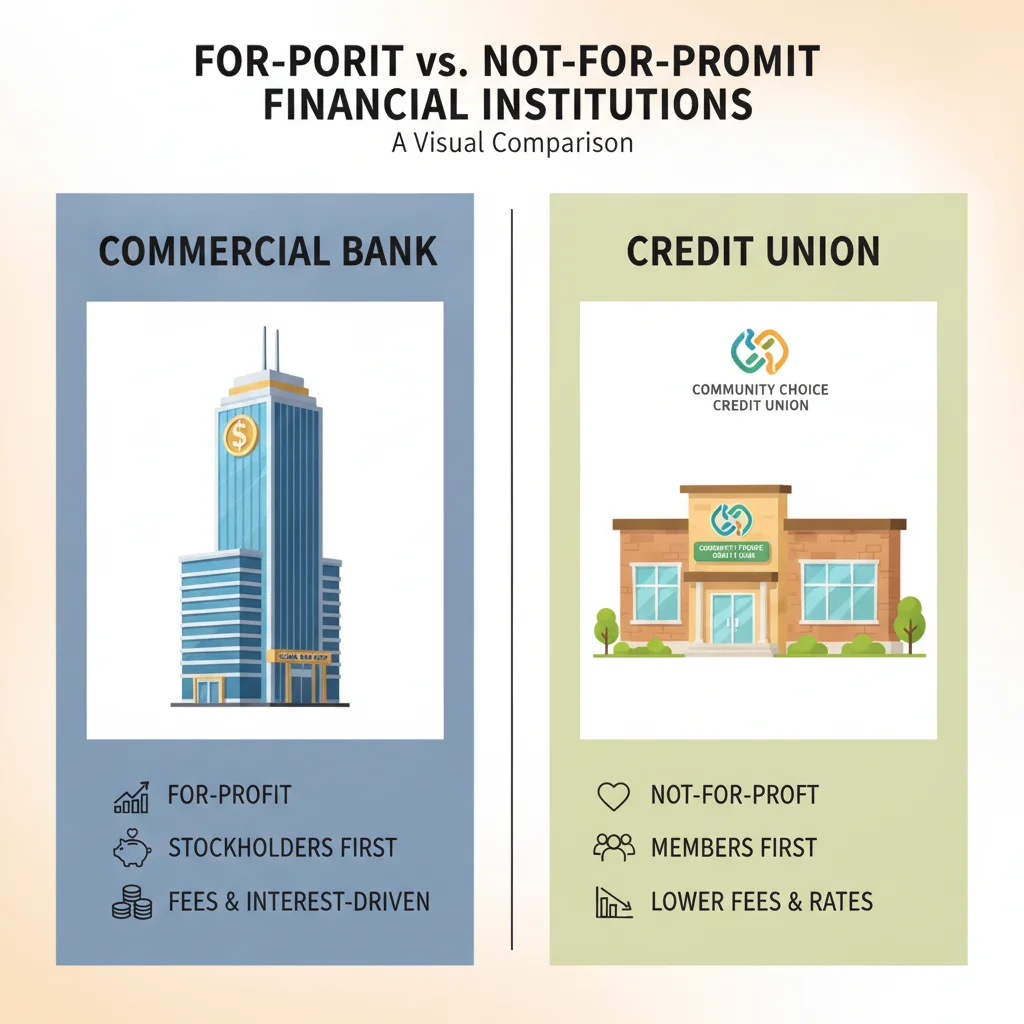
Banks, online lenders, and credit unions all offer auto loan refinancing — but they operate under fundamentally different business models. A commercial bank answers to shareholders and must generate profit from the interest spread between what it pays depositors and what it charges borrowers. An online lender typically operates with lower overhead but also works within investor-driven margins. A credit union, by contrast, is a member-owned cooperative. Any profit it earns above operating costs is returned to members, usually through better rates, lower fees, and fewer penalties.
That structural difference is not a marketing slogan. It shows up in the data. The NCUA consistently reports that credit union rates on used car loans run one to two percentage points lower than those from commercial banks for comparable loan terms. On a $20,000 loan over 60 months, a two-percentage-point rate difference equals roughly $1,100 in interest savings — real money that stays in your pocket instead of going to a lender's bottom line.
To understand how rate-setting actually differs across lenders in detail, see our comparison of car loan interest rates from credit unions, banks, and dealerships. But before you compare numbers, it helps to understand what makes credit unions structurally unique — and how that affects your refinance.
How Credit Unions Are Structured — and Why It Benefits Borrowers
A credit union is chartered as a cooperative, which means its members collectively own it. When you open an account and become a member, you are not a customer — you are a part-owner. That ownership structure drives every major policy decision, from the rates set on loans to the fees charged on checking accounts.
Because there are no outside shareholders demanding a return on equity, credit unions can price their loans closer to their actual cost of funds. They still need to cover operating expenses, maintain capital reserves, and comply with regulatory requirements set by the NCUA — but the margin they need to earn on each loan is structurally smaller than what a commercial bank requires.
This plays out in three specific ways that are directly relevant to auto loan refinancing:
- Lower APRs: The not-for-profit structure allows credit unions to offer rates that commercial lenders typically cannot match without losing money.
- Fewer or no origination fees: Many credit unions charge little or nothing to process a refinance application, compared to some banks that charge $200–$500 or more.
- More flexible underwriting: Credit unions are more likely to look at the full picture of your financial life — your history as a member, your income stability, your debt-to-income ratio — rather than relying solely on a credit score cutoff.
Credit Union Loan Decisions Vary by Institution
Not all credit unions operate the same way. Larger credit unions with national footprints tend to use more standardized, automated underwriting — similar to banks. Smaller, community-based credit unions are more likely to use manual review processes with greater loan officer discretion. If flexible underwriting is important to you, a local or regional credit union may serve your needs better than a large national one.
Rate Shopping Does Not Significantly Harm Your Score
A common concern is that applying to multiple lenders will damage your credit score. In reality, both FICO and VantageScore treat multiple auto loan inquiries within a short window (typically 14–45 days depending on the version) as a single inquiry. This rate-shopping protection was specifically designed to encourage borrowers to compare offers — so use it.
This flexibility in underwriting does not mean credit unions will approve anyone. It means the decision-making process is often more human and context-aware. A loan officer at a local credit union has more discretion than an automated system at a large national bank.
For a full breakdown of what all lenders evaluate when reviewing a refinance application, see what lenders look at before approving an auto refinance.
The Membership Requirement: What It Actually Involves
The one barrier that distinguishes credit unions from other lenders is membership. You cannot walk in off the street and refinance without first joining. For some borrowers, this sounds like a significant hurdle — but in practice, it rarely is.
Historically, credit unions were formed around specific groups: employees of a particular company, members of a profession, residents of a neighborhood. Those affiliation ties still exist, but over the past two decades, the field of membership for many credit unions has expanded dramatically. Today, many federal and state-chartered credit unions offer membership to:
- Anyone who lives, works, or attends school in a specific geographic area (often a county, metro region, or entire state)
- Members of certain professional associations or alumni groups
- Family members of existing credit union members
- Anyone willing to make a small one-time donation to an affiliated nonprofit organization — sometimes as little as $5 to $25
Large nationally accessible credit unions — such as PenFed Credit Union or Alliant Credit Union — have essentially open membership, making geography irrelevant for many borrowers.
Apply to More Than One Credit Union
Do not limit yourself to a single credit union application. Joining two or three credit unions and comparing their refinance offers costs you almost nothing — membership fees are minimal — and can reveal meaningful rate differences. If you submit all applications within a 14-day window, most credit scoring models will count the hard inquiries as a single event, protecting your score.
Ask Specifically About Rate Discounts
Many credit unions offer a small APR discount — typically 0.25% — for setting up automatic payments from a credit union checking or savings account. This discount is not always advertised upfront. Ask the loan officer directly before you finalize the loan agreement, since even a quarter point adds up over a multi-year loan term.
Once you join and are approved for a refinance, account membership typically requires maintaining a small savings account (often called a share account) with a minimum balance of $5 to $25. That modest requirement is the only ongoing cost of maintaining membership.
The practical implication: before ruling out a credit union because you assume you do not qualify, take 10 minutes to check their membership eligibility page. Most have eligibility wizards on their websites. You may be surprised how easily you qualify.

Rate Comparison: What the Numbers Actually Show
Abstract claims about lower rates are only meaningful when you attach real numbers. Here is what the data has consistently shown in recent years.
1–2%
Average APR advantage of credit unions over banks
The NCUA's quarterly credit union data consistently shows credit union used car loan rates running one to two percentage points below commercial bank averages for comparable loan terms.
$1,100+
Potential interest savings on a $20,000 loan
A two-percentage-point rate reduction on a $20,000, 60-month loan translates to approximately $1,100 in total interest savings — based on standard amortization calculations.
135M+
Americans currently belong to a credit union
According to NCUA 2023 data, more than 135 million Americans are credit union members, reflecting how broadly accessible membership has become.
5,400+
Federally insured credit unions in the U.S.
The NCUA reports over 5,400 federally insured credit unions operating across the country, giving most borrowers multiple local and national options to consider.
$5–$25
Typical minimum to open a share account
Most credit unions require only a small initial deposit to establish membership — often between $5 and $25 — making the barrier to joining extremely low for most borrowers.
These averages are instructive, but your specific rate will depend on your credit score, loan term, vehicle age, and remaining balance. Two points worth emphasizing:
Credit score bands still matter at credit unions. A borrower with a 760 FICO score will get a meaningfully better rate than one with a 640, at any lender. The difference is that at a credit union, the rate at every credit tier tends to be lower than the equivalent rate at a bank.
Loan term affects total cost, not just monthly payment. Extending a loan from 48 months to 72 months lowers the monthly payment but increases the total interest paid — sometimes by more than the rate improvement saves. Always compare total interest cost, not just the monthly figure. Our hub on loan terms explained breaks down how term length affects your total borrowing cost.
“Credit unions were literally designed to serve their members first. That's not a philosophy — it's baked into the legal structure. When a credit union sets a loan rate, the question they're answering is different from the one a bank asks.”
— Mike Schenk, Chief Economist, Credit Union National Association (CUNA)
When Credit Union Refinancing Makes the Most Sense
Credit unions are not automatically the right choice for every refinance. They make the most sense under specific conditions — and understanding those conditions helps you allocate your application effort wisely.
You originally financed through a dealership
Dealership financing — especially loans arranged at the point of sale — frequently carries higher rates than what the market would otherwise offer. Dealers earn a markup (called a "dealer reserve") by adding basis points to the rate the lender quotes them. If your current loan came from dealership financing, there is a statistically high likelihood that a credit union can beat it.
For a direct comparison of dealership financing versus refinancing alternatives, see dealership financing vs. refinancing with a bank or credit union.
Your credit score has improved since you took out the loan
If your credit score has risen by 40 or more points since you financed the car, you likely qualify for a substantially better rate today. Credit unions tend to have multiple rate tiers, and moving from one tier to the next can produce significant savings. Your credit score impact directly translates to the APR a lender will offer.
You want a more personal lending relationship
Credit unions — particularly smaller, regional ones — often allow you to speak directly with a loan officer who has the authority to consider context that an automated system would ignore. If you have had a temporary income disruption, a medical event, or other extenuating circumstances reflected in your credit file, a credit union loan officer may be able to interpret those factors in your favor.
Your current loan has a high APR and significant remaining balance
Refinancing is most impactful when there is substantial interest left to save. If you are in the first two years of a five-year loan, refinancing a high-rate loan can cut thousands of dollars in future interest. If you are in the final year of a loan, the savings are smaller and the transaction costs may outweigh the benefit.
How to Apply: A Step-by-Step Overview
The refinancing process at a credit union closely mirrors what you would experience at a bank, with the added step of joining first. Here is how it typically flows:
- Identify credit unions you are eligible to join. Use the NCUA's credit union locator or each institution's eligibility tool. Cast a wide net — apply to two or three institutions to compare offers.
- Join the credit union. Open a share (savings) account and fund it with the minimum balance, typically $5–$25. This usually takes less than 15 minutes online.
- Gather your documents. You will need your current loan account number and payoff amount (call your current lender), vehicle information (VIN, current mileage, year, make, model), proof of income, and a government-issued ID.
- Submit your refinance application. Most credit unions now offer fully online applications. Some smaller institutions may require you to visit a branch.
- Review the offer carefully. When an approval comes back, read the full loan disclosure. Confirm the APR (not just the interest rate), the loan term, the total interest you will pay, and whether there is a prepayment penalty.
- Accept and authorize payoff. Once you accept the new loan, the credit union pays off your existing lender directly. You then begin making payments to the credit union.
Apply to More Than One Credit Union
Do not limit yourself to a single credit union application. Joining two or three credit unions and comparing their refinance offers costs you almost nothing — membership fees are minimal — and can reveal meaningful rate differences. If you submit all applications within a 14-day window, most credit scoring models will count the hard inquiries as a single event, protecting your score.
Ask Specifically About Rate Discounts
Many credit unions offer a small APR discount — typically 0.25% — for setting up automatic payments from a credit union checking or savings account. This discount is not always advertised upfront. Ask the loan officer directly before you finalize the loan agreement, since even a quarter point adds up over a multi-year loan term.
To understand the full mechanics of what happens when you refinance — including how lenders evaluate your application — see our foundational explainer on auto loan refinancing: what it actually means and how it works.

Credit Unions vs. Online Lenders: A Quick Honest Comparison
Online lenders have become a popular refinancing option in recent years, and they offer real advantages — particularly speed and convenience. It is worth being clear-eyed about how they stack up against credit unions so you can make an informed choice rather than a default one.
| Factor | Credit Union | Online Lender |
|---|---|---|
| Average APR | Generally lower | Competitive, but variable |
| Underwriting flexibility | Higher (human review common) | Lower (often algorithm-driven) |
| Speed | 2–7 business days | Often same-day or next-day |
| Membership required | Yes | No |
| Fee structure | Often minimal fees | Variable; some charge origination fees |
| Accessibility for fair credit | Good, especially for members | Depends heavily on the platform |
The honest conclusion: if speed is your priority and your credit is strong, a competitive online lender may serve you well. If you want the best available rate and are willing to invest the modest time that membership requires, a credit union is often the stronger long-term financial choice.
For borrowers with lower credit scores considering both options, our comparison of subprime auto lenders vs. credit unions walks through the tradeoffs in detail.
Credit Union Loan Decisions Vary by Institution
Not all credit unions operate the same way. Larger credit unions with national footprints tend to use more standardized, automated underwriting — similar to banks. Smaller, community-based credit unions are more likely to use manual review processes with greater loan officer discretion. If flexible underwriting is important to you, a local or regional credit union may serve your needs better than a large national one.
Rate Shopping Does Not Significantly Harm Your Score
A common concern is that applying to multiple lenders will damage your credit score. In reality, both FICO and VantageScore treat multiple auto loan inquiries within a short window (typically 14–45 days depending on the version) as a single inquiry. This rate-shopping protection was specifically designed to encourage borrowers to compare offers — so use it.
Making the Decision: Key Questions to Ask Yourself
Before submitting any refinance application — to a credit union or anyone else — ground your decision in these practical questions:
- What is my current APR? If you do not know it, find your original loan agreement or call your lender. This is your baseline.
- What rate can I realistically qualify for today? Check your credit score for free through your bank or a service like Credit Karma, then look at published rate tiers from two or three credit unions to estimate where you fall.
- How much time is left on my loan? The earlier in the loan you refinance, the more interest you can save. If you are past the halfway point of the loan term, run the math carefully before committing.
- What are the transaction costs? Some states charge a fee to retitle the vehicle when the lender changes. Some lenders charge prepayment penalties on the loan you are paying off. Subtract these from your projected savings.
- Am I eligible to join a credit union with competitive rates? Spend 15 minutes confirming eligibility before assuming you cannot access this option.
The goal of refinancing is not simply to lower your monthly payment — it is to reduce the total cost of the loan over its remaining life. A credit union's structural advantages make it one of the strongest tools available to accomplish that goal. Whether or not one is right for your specific situation depends on the numbers — and now you know how to evaluate them.


All claims are backed by peer-reviewed research. Sources on request.