Key Takeaways
Vehicle Eligibility for Refinancing
When you apply to refinance your auto loan, lenders don't just look at your credit score — they also evaluate the car itself as collateral. Most lenders set hard limits on how old a vehicle can be and how many miles it can have before they'll agree to refinance the loan. If your car is too old or has too many miles, lenders may consider it too risky to back with a new loan.
These restrictions stem from collateral risk management: a high-mileage or older vehicle depreciates faster and is more likely to lose value below the outstanding loan balance, increasing the lender's exposure in the event of default.
Why Your Car Is Part of the Refinancing Equation
Most people think of refinancing as a purely personal finance decision — one driven by their credit score, income, and the interest rate environment. And those factors do matter a great deal. But there's a second party to every auto loan that often gets overlooked: the car itself.
When you refinance, a new lender is essentially buying your existing loan and replacing it with a fresh one. To do that, they need to be comfortable with the collateral backing that loan — your vehicle. If the car is worth significantly less than what you owe, or if its age and mileage signal that it could break down or depreciate rapidly, lenders view it as a risky bet.
That's why nearly every lender who offers auto refinancing sets firm eligibility requirements around vehicle age and mileage. These aren't arbitrary hurdles — they're calculated risk controls. Understanding them puts you in a much better position to time your refinance application and pick the right lender for your situation.
For a broader look at how lenders evaluate your full application, see what lenders look at before approving an auto refinance.

Typical Age and Mileage Limits Set by Lenders
Lender requirements vary, but there are general patterns you can use as a starting framework when evaluating your eligibility.
Vehicle Age Limits
The majority of traditional lenders — banks, auto finance companies, and many credit unions — cap refinancing at vehicles that are 7 to 10 model years old. So if you're applying in 2025, that generally means your car must be a 2015 model year or newer to meet the most common cutoffs.
Some credit unions are more flexible and may refinance vehicles up to 12 years old, especially for existing members with strong payment histories. On the stricter end, certain national banks won't refinance anything older than 5 or 6 years. The range is wide, which is why shopping lenders matters enormously when your vehicle is on the older side.
Mileage Limits
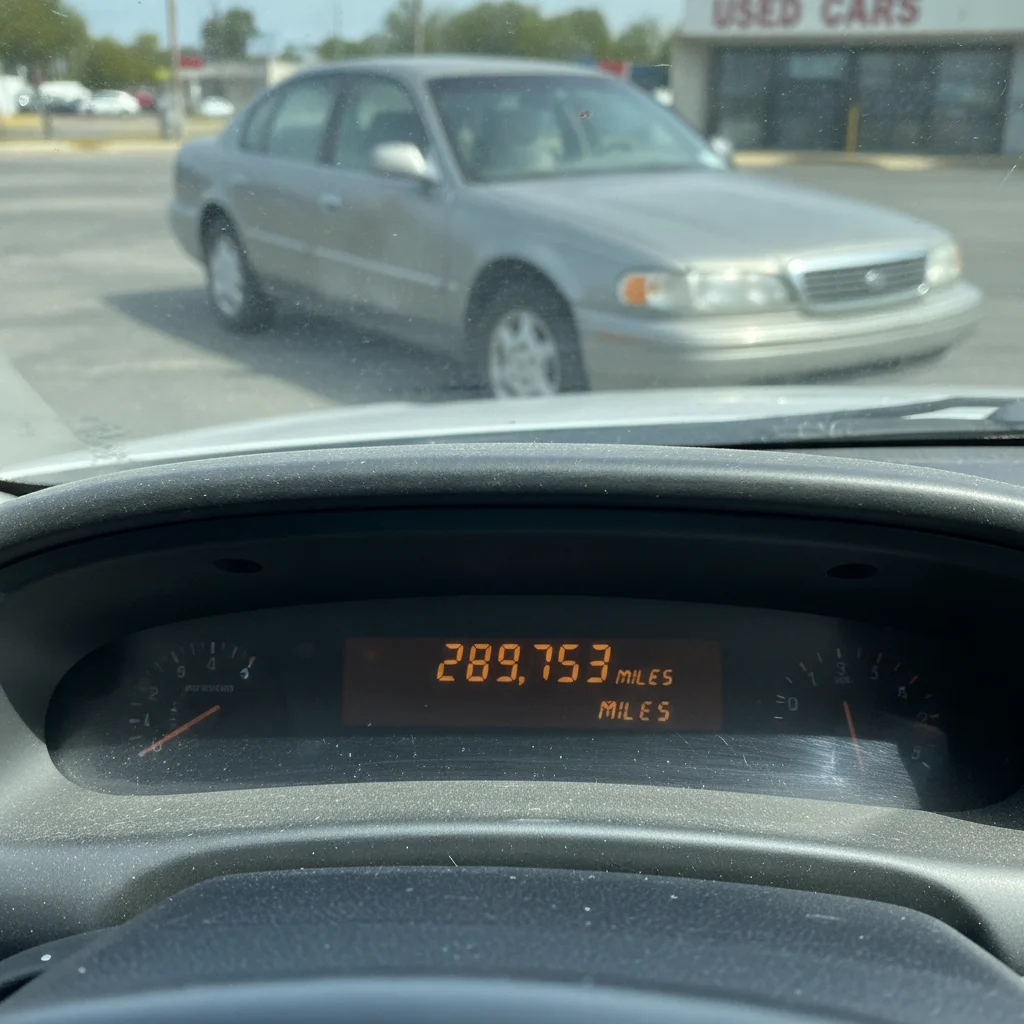
Mileage cutoffs follow a similar pattern but are somewhat more consistent across lenders. The most common ceiling is 100,000 to 150,000 miles. Vehicles with fewer than 75,000 miles are generally viewed as low-risk and attract the most competitive rates. Once you cross 100,000 miles, your lender pool starts to shrink, and those who do approve the loan often apply a risk premium to your rate.
7–10 years
Typical maximum vehicle age for refinancing
Most banks and auto finance companies set age cutoffs in this range; credit unions may extend to 12 years for eligible members.
100,000–150,000 mi
Common mileage ceiling for refinance eligibility
Lender surveys and policy disclosures show this is the most widely applied mileage limit range across major refinancing institutions.
125%
Maximum LTV ratio many lenders will refinance
Some lenders set their LTV ceiling as low as 100–110%, meaning any negative equity can immediately disqualify a refinance application.
1–2%
Typical rate premium for high-mileage vehicles
Borrowers with vehicles over 100,000 miles often pay 1–2 percentage points higher than comparable borrowers with lower-mileage cars, even with similar credit profiles.
Combined Limits
Here's the nuance that trips up a lot of borrowers: lenders often apply both age and mileage limits simultaneously. A 6-year-old vehicle with 130,000 miles might fail the mileage cutoff even if it clears the age requirement. Conversely, a 9-year-old car with only 60,000 miles might clear the mileage requirement but be disqualified by age. You need to clear both thresholds — not just one.
Model Year vs. Calendar Year
Lenders typically measure vehicle age by model year, not the calendar year you purchased it. A 2018 model year vehicle purchased new in late 2017 is still considered a 2018 for underwriting purposes. This distinction can work in your favor — always confirm which year your lender uses when evaluating age cutoffs.
Mileage at Time of Application Matters
Lenders assess your vehicle's mileage at the time you submit the refinance application — not at origination or some future date. If you're close to a mileage threshold, submitting your application sooner rather than later is a straightforward way to preserve your eligibility before you cross the line.
Insurance Costs Shift With Age Too
Vehicle age doesn't only affect loan refinancing — it also influences your auto insurance premiums and discount eligibility. Older vehicles may lose access to certain coverage discounts tied to newer safety technology. See <a href="/car-insurance/rates-and-savings/discounts-and-deals/new-car-vs-older-vehicle-how-age-and-safety-ratings-shape-your-discount-eligibility">how vehicle age shapes your insurance discount eligibility</a> for the full picture.
How Age and Mileage Affect Your Interest Rate — Even When You Qualify
Clearing the eligibility threshold doesn't mean you're getting the same rate as someone with a brand-new car. Lenders price risk into every loan, and an older or higher-mileage vehicle represents more risk — even after it's approved.
Here's how that plays out in practice:
- Higher base rates for older vehicles: A lender might offer a borrower with excellent credit 5.5% on a 2021 vehicle but quote 7.2% on a 2017 vehicle, simply because of depreciation risk.
- Shorter maximum loan terms: To limit their exposure, lenders sometimes cap the repayment term on older vehicles. This keeps monthly payments higher but reduces the window during which the car could break down or become worthless.
- Stricter loan-to-value requirements: If your car has depreciated significantly, the lender may require that you owe less than a certain percentage of the car's current value before they'll approve the refinance.
Your credit score still plays the largest single role in your rate. But understand that the vehicle adds a second layer of risk pricing on top of your personal creditworthiness. For more on how credit affects the rates lenders will offer you, explore the Credit Score Impact hub.
“The vehicle is just as much a part of the underwriting decision as the borrower. When the collateral deteriorates faster than the loan pays down, the lender's risk compounds — and that's what these age and mileage restrictions are designed to control.”
— Melinda Oaks, Senior Auto Lending Officer at a regional credit union

The Loan-to-Value Problem With Aging Vehicles
One of the most important — and least discussed — ways that vehicle age and mileage affect refinancing is through the loan-to-value (LTV) ratio.
LTV is simply the ratio of what you owe on the loan to what the car is currently worth. If you owe $12,000 and the car is worth $15,000, your LTV is 80% — generally considered acceptable. If that same car has depreciated to $10,000 but you still owe $12,000, you're now at 120% LTV, which most lenders will refuse to refinance.
Older vehicles and those with high mileage depreciate faster. That means the gap between your remaining loan balance and the car's actual market value can close — or flip — more quickly than you might expect. By the time you decide to refinance, you could find yourself upside-down on the loan without realizing it.
Check Your Car's Value Before Applying
Before submitting any refinance application, look up your car's current market value on Kelley Blue Book (kbb.com) or Edmunds. Compare that figure against your remaining loan balance to calculate your LTV ratio. If you're close to — or above — 100% LTV, address that first by making extra principal payments or simply waiting until your balance drops enough to show positive equity.
Refinance Sooner, Not Later
If your credit has improved or interest rates have dropped, don't delay refinancing simply because your car is still running fine. Vehicles age and accumulate mileage whether you're paying attention or not, and every year you wait narrows your lender options. The best refinancing outcomes tend to happen earlier in the loan — before age and mileage chip away at your eligibility.
Get Pre-Qualified Without Hurting Your Credit
Many lenders offer soft-inquiry pre-qualification for auto refinancing, which lets you see estimated rates and confirm vehicle eligibility before submitting a full application. Use this to test the waters if your vehicle is close to age or mileage limits — you'll learn quickly whether you're in range without adding a hard inquiry to your credit report.
This is one of the key reasons why timing matters so much when refinancing an auto loan. If you wait too long, two things work against you simultaneously: the car ages and loses value, and your loan balance hasn't dropped fast enough to keep pace. Refinancing earlier in your loan term — when you still have meaningful equity — typically gives you more options and better terms.
To understand what auto loan refinancing actually involves, including how lenders calculate your new terms, it helps to review the mechanics before you apply.
Real-World Examples: When Age and Mileage Work For and Against You
Abstract rules are easier to understand when you apply them to realistic situations. Here are two common borrower scenarios that illustrate how vehicle age and mileage intersect with refinancing outcomes.
These examples highlight a central truth: the same credit profile can lead to very different refinancing outcomes depending entirely on the vehicle. It's not just about you — it's about the car you're driving.
Strategies If Your Vehicle Is Approaching the Limits
If your vehicle is getting close to — or has already hit — a lender's age or mileage threshold, you're not necessarily out of options. Here's what you can do.
1. Act Before You Cross the Threshold
This is the most effective strategy. If your car is 7 years old and you've been thinking about refinancing, don't wait another year. Every month adds mileage and another month of age. Refinancing now — while you still clear the limits — gives you access to more lenders and better rates.
2. Target Credit Unions First
Credit unions tend to have more flexibility on vehicle age and mileage than traditional banks. Many are willing to refinance vehicles up to 12 years old or with up to 150,000 miles, especially if you're an existing member in good standing. Membership requirements vary, but many are open to people who live in a certain area or work in a specific industry.
3. Compare Online Lenders
Several online auto lenders specialize in refinancing for borrowers who don't fit the standard bank profile. Their eligibility requirements sometimes extend to older or higher-mileage vehicles, though you should compare APRs carefully since their rates can also run higher.
4. Pay Down the Balance First
If your LTV ratio is too high, making a lump-sum payment to reduce your loan balance might bring you within an acceptable range for refinancing. This is particularly useful if you have a small amount of savings you could apply strategically.
5. Know When It's Not Worth It
If your car has 140,000 miles, is 9 years old, and you only owe $4,000 — the math on refinancing may not work in your favor. The fees, hard credit inquiry, and limited rate improvement might cost more than you'd save. Run through the key questions before submitting a refinance application to make sure the timing actually works for your situation.

Check Your Car's Value Before Applying
Before submitting any refinance application, look up your car's current market value on Kelley Blue Book (kbb.com) or Edmunds. Compare that figure against your remaining loan balance to calculate your LTV ratio. If you're close to — or above — 100% LTV, address that first by making extra principal payments or simply waiting until your balance drops enough to show positive equity.
Refinance Sooner, Not Later
If your credit has improved or interest rates have dropped, don't delay refinancing simply because your car is still running fine. Vehicles age and accumulate mileage whether you're paying attention or not, and every year you wait narrows your lender options. The best refinancing outcomes tend to happen earlier in the loan — before age and mileage chip away at your eligibility.
Get Pre-Qualified Without Hurting Your Credit
Many lenders offer soft-inquiry pre-qualification for auto refinancing, which lets you see estimated rates and confirm vehicle eligibility before submitting a full application. Use this to test the waters if your vehicle is close to age or mileage limits — you'll learn quickly whether you're in range without adding a hard inquiry to your credit report.
How This Differs From Bad-Credit Loan Restrictions
It's worth clarifying that the vehicle restrictions discussed in this article apply to refinancing — replacing an existing loan on a car you already own. These restrictions have a different character than the vehicle limits you'd encounter when applying for a new bad-credit purchase loan.
When subprime lenders evaluate a first-time loan on a used car purchase, they often apply even stricter collateral requirements — sometimes capping vehicles at 5–7 years old or 100,000 miles — because the lender has no payment history to reference. With refinancing, your existing payment track record is actually a data point in your favor, which can soften the vehicle-related concerns somewhat.
That said, the underlying logic is the same: the car is collateral, and lenders want to minimize the chance that the collateral becomes worthless before the loan is paid off. For a deeper look at how these restrictions work in the purchase context, see vehicle age and mileage limits that block bad-credit loan approvals.
Model Year vs. Calendar Year
Lenders typically measure vehicle age by model year, not the calendar year you purchased it. A 2018 model year vehicle purchased new in late 2017 is still considered a 2018 for underwriting purposes. This distinction can work in your favor — always confirm which year your lender uses when evaluating age cutoffs.
Mileage at Time of Application Matters
Lenders assess your vehicle's mileage at the time you submit the refinance application — not at origination or some future date. If you're close to a mileage threshold, submitting your application sooner rather than later is a straightforward way to preserve your eligibility before you cross the line.
Insurance Costs Shift With Age Too
Vehicle age doesn't only affect loan refinancing — it also influences your auto insurance premiums and discount eligibility. Older vehicles may lose access to certain coverage discounts tied to newer safety technology. See <a href="/car-insurance/rates-and-savings/discounts-and-deals/new-car-vs-older-vehicle-how-age-and-safety-ratings-shape-your-discount-eligibility">how vehicle age shapes your insurance discount eligibility</a> for the full picture.
Making the Most of Your Refinancing Window
Your car's clock is ticking in two directions at once — years passing and miles accumulating. The window during which refinancing makes both practical and financial sense is real, and it closes faster than most borrowers expect.
The smartest approach is to treat refinancing as a timed decision, not an open-ended option. Check your car's current market value using tools like Kelley Blue Book or Edmunds. Calculate your current LTV. Look up your lender's specific age and mileage cutoffs before you invest time in an application.
If the numbers work now, don't assume they'll work just as well in 18 months. And if they don't work yet — because your credit score needs improvement or rates haven't moved favorably — then build a timeline and revisit the question with those variables in mind.
Refinancing is one of the most actionable ways to reduce your cost of car ownership, but only when the conditions — personal and vehicle-related — are aligned. Understanding the role your car's age and mileage play gives you the full picture, not just half of it.

All claims are backed by peer-reviewed research. Sources on request.