Key Takeaways
Why Loan Calculators Are So Easy to Misread
Auto loan calculators are genuinely useful tools. They let you test scenarios in seconds — what if you put more money down, or chose a 48-month term instead of 72? The problem isn't the calculator. The problem is that most people use them to find one number — the monthly payment — and then treat that number as the full story.
It isn't. The monthly payment is a useful data point, but it's only one output of several, and it's arguably not the most important one. If you focus exclusively on whether a payment fits your monthly budget, you can easily end up committing to a loan that costs you thousands more than a slightly higher-payment alternative would have.
This guide walks through each step of using a loan calculator correctly: what to enter, which outputs to look at, what the calculator can't tell you, and how to use the results to make a better borrowing decision — not just a more comfortable-looking monthly commitment.

Understanding what the calculator is actually computing is also important. Every standard auto loan calculator uses a relatively simple formula based on three inputs: the loan amount (principal), the interest rate, and the loan term. It assumes equal monthly payments that each cover a portion of principal plus interest — this structure is called an amortizing loan. For a deeper look at how those payments break down over time, see our guide on reading an auto loan amortization schedule.
What You Need Before You Open a Calculator
Running a loan calculator with rough, guessed inputs produces rough, unreliable outputs. Before you start, gather as much real information as you can. Here's what you'll need — and where to get each number.
What you will need
If you're not sure what interest rate to enter, that's one of the most common stumbling points. The rate a lender will offer you depends on your credit score, the loan term, the vehicle's age, and several other factors. Our article on how lenders determine your auto loan interest rate explains exactly which inputs drive your rate and which ones you can improve before applying.
Online Auto Loan Calculator
Computes monthly payment, total interest, and total cost based on your principal, rate, and term inputs.
Credit Score Report
Helps you identify the rate tier you qualify for before entering an APR estimate.
State Tax Rate Reference
Used to calculate the correct financed amount by adding sales tax to the vehicle purchase price.
Spreadsheet (Excel or Google Sheets)
Lets you build a comparison table of multiple loan scenarios side by side for easier decision-making.
Amortization Schedule Generator
Shows you how each payment splits between principal and interest across the full loan term.
Step-by-Step: Using the Calculator Correctly
Follow each step below in order. Skipping steps — especially the scenario-comparison step — is where most readers go wrong and end up with a misleading picture of their loan.
Calculate the true loan amount — not just the sticker price
Most people enter the vehicle's asking price as the loan amount. That's usually wrong. The actual principal you'll finance is the purchase price, minus your down payment, minus any trade-in equity, plus sales tax and any fees being rolled into the loan.
Use this formula:
Loan Amount = (Purchase Price + Tax + Fees) − Down Payment − Trade-In Value
If you're purchasing a $28,000 vehicle, rolling in $1,200 in fees, paying $3,000 down, and trading in a car worth $5,000, your loan amount is $21,200 — not $28,000. Entering the sticker price alone will overstate your payment and your interest cost in ways that make comparisons less meaningful.
Enter APR — not the interest rate
Many calculators have a field labeled simply "interest rate." If the lender quoted you an APR, use that number. If the calculator gives you a choice between "interest rate" and "APR," always use APR. APR incorporates the interest rate plus certain lender fees, which makes it a more accurate representation of your actual annual cost of borrowing.
If you don't have a real rate yet, use a rate from our guide on how lenders determine your auto loan interest rate to find a realistic estimate for your credit tier and loan term.
Choose your first loan term and record all three outputs
Select a term length — start with 60 months as a common baseline. Record three numbers: the monthly payment, total interest paid, and total amount paid over the life of the loan. Most calculators show all three, but if yours only shows the monthly payment, multiply it by the number of months and subtract the loan principal to get total interest.
Don't make any decisions yet. This is scenario one of at least three you'll need to run.
Run at least two more scenarios with different term lengths
Keep the loan amount and APR identical. Change only the term length. Run scenarios at 36 months, 48 months, and 72 months in addition to your 60-month baseline. Record the same three outputs for each. You now have a comparison table showing exactly how each additional year of repayment affects both your monthly burden and your total cost.
This is where the real insight lives. The monthly payment differences may look modest — $50 to $80 per month — but the differences in total interest paid can easily exceed $2,000 to $4,000 depending on the loan size.
Test the impact of a larger down payment
Once you have your term comparison, go back to your preferred term scenario and increase the down payment by $1,000 to $2,000 increments. Watch how the monthly payment and total interest change. In most cases, an extra $1,000 down will save you more in total interest than the same $1,000 would in monthly payment reductions from a rate negotiation.
This step often reveals that stretching slightly to make a larger down payment at purchase can be more financially efficient than optimizing the loan term or hunting for a marginally lower rate.
Identify which scenario fits your budget without locking you into unnecessary interest
With your comparison table complete, find the shortest loan term whose monthly payment you can comfortably sustain. "Comfortably" means the payment leaves your monthly budget intact after housing, insurance, utilities, savings contributions, and an emergency buffer. It doesn't mean the lowest payment you can technically make while cutting everything else close.
If the 48-month payment is feasible, choosing 60 months to give yourself a $75 monthly cushion will cost you an extra $1,200 to $2,000 in interest over the loan's life. That's real money. Build a modest payment cushion into your budget instead, and opt for the shorter term.
Verify your inputs match the actual loan offer before signing
When you receive a formal loan offer — from a bank, credit union, or dealership — reopen the calculator and enter the exact numbers from the offer document: financed amount, APR, and term. The monthly payment the calculator produces should match the offer within a dollar or two (minor rounding differences are normal). If it doesn't match, something in the offer has changed from what you discussed — and you need to find out what before signing.
For a full breakdown of how to cross-reference a loan offer with the actual paperwork, see the right way to read an auto loan contract.
What the Calculator Cannot Tell You
Even a perfectly filled-out calculator has hard limits. Being clear on what those limits are will keep you from trusting the output more than you should.
Sales Tax and Registration Fees
Unless the calculator has a dedicated field for these, they're not included in the payment shown. In most states, sales tax is rolled into the financed amount (not paid separately at signing), which means it's quietly adding to your principal and generating interest charges over the life of the loan. Look up your state's auto sales tax rate and add it to the vehicle price before entering the loan amount.
Dealer Add-Ons and Finance Office Products
Extended warranties, GAP insurance, paint protection packages, and similar products are often rolled into the loan at the dealership's finance office. If you agree to any of these, the actual financed amount will be higher than the vehicle's purchase price — sometimes by $1,500 to $3,000 or more. Run the calculator again with the updated total if you accept any add-ons.
Prepayment Penalties
Some loan agreements penalize you for paying off early. If you plan to pay ahead of schedule, verify first that your contract allows it. A calculator assumes you'll make the minimum payment every month for the full term.
Insurance and Ongoing Ownership Costs
The monthly payment the calculator shows covers principal and interest only. Your actual monthly outlay will also include insurance, registration renewal, fuel, and maintenance. For a complete accounting of what you'll truly spend each month, see our guide on calculating your true monthly auto loan cost.
Don't Let a Low Payment Mask a Long Term
A $450 monthly payment sounds reasonable until you realize it's attached to an 84-month loan at a high APR. Always confirm the term length alongside any payment you're quoted. Dealers sometimes extend the term to make a payment fit without disclosing the change explicitly. If the term you're being offered is longer than what you calculated, the total cost has gone up — not down.
Rolled-In Fees Increase Your Interest Cost
Every dollar of fees or add-ons rolled into your loan principal generates interest charges for the full term of the loan. A $1,500 extended warranty financed at 7% over 60 months doesn't cost $1,500 — it costs roughly $1,782 by the time the loan is paid off. Whenever possible, pay dealer fees and optional products out of pocket rather than financing them.
How Loan Term Length Changes Everything
Term length is the input most buyers underestimate. It's also the one dealers and lenders know how to use most effectively against your budget intuition. Here's a concrete example that shows why it matters so much.
Suppose you're financing $30,000 at a 7% APR. Here's how the numbers shift across four common term lengths:
| Term | Monthly Payment | Total Interest Paid | Total Cost |
|---|---|---|---|
| 36 months | $927 | $3,375 | $33,375 |
| 48 months | $718 | $4,459 | $34,459 |
| 60 months | $594 | $5,640 | $35,640 |
| 72 months | $513 | $6,924 | $36,924 |
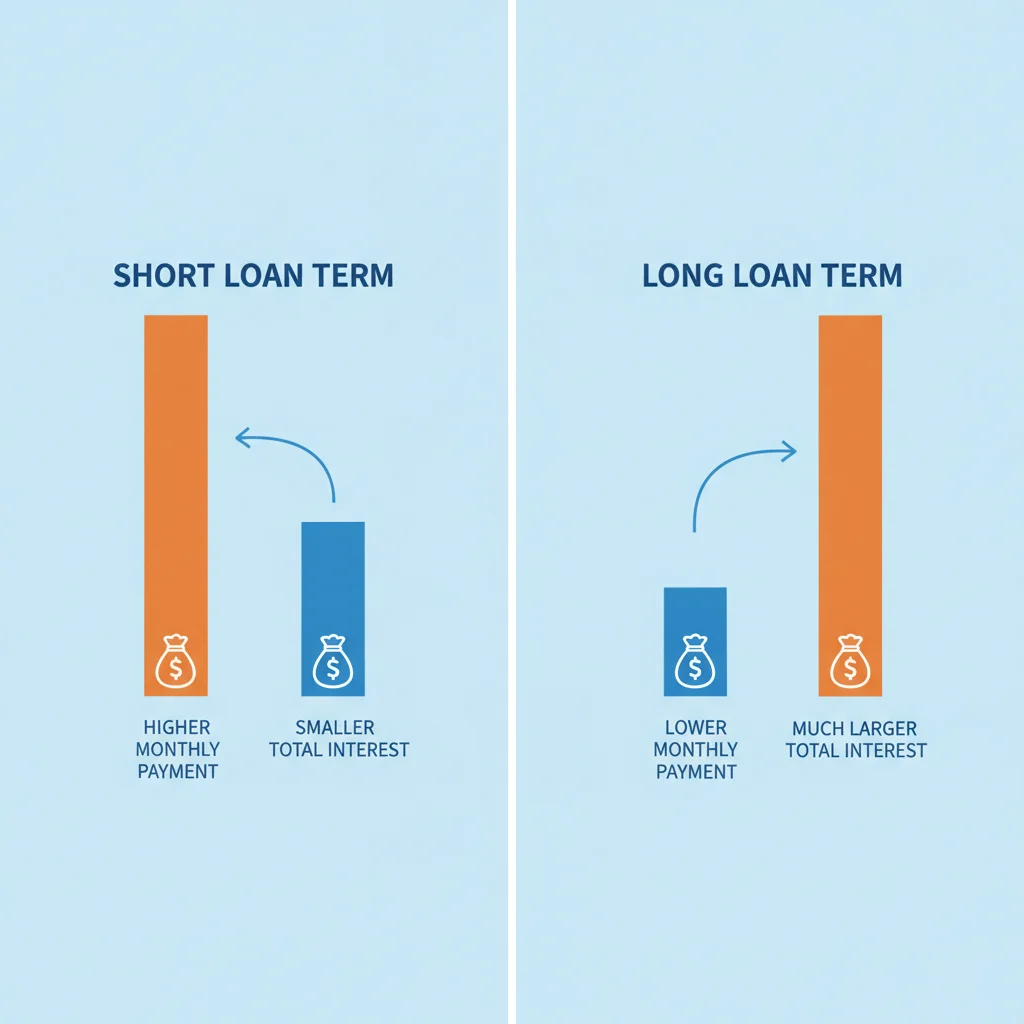
Moving from a 36-month loan to a 72-month loan cuts the monthly payment nearly in half — from $927 to $513. That looks like a massive win. But it costs you an extra $3,549 in total interest. You're also making payments for twice as long, meaning the vehicle depreciates significantly while you're still paying for it. That creates a real risk of being upside-down on the loan — owing more than the car is worth — especially in the early years.
Use Total Interest as Your Primary Comparison Metric
When comparing loan scenarios, lead with total interest paid — not monthly payment. Monthly payment is a cash-flow consideration; total interest is a true-cost consideration. They answer different questions, and the most budget-friendly monthly payment is almost never the lowest-cost loan overall. Train yourself to look at the total interest line first every time you run a new scenario.
Get Pre-Approved Before Running Scenarios
Calculator results are only as accurate as the APR you enter. If you're guessing at your rate, your output is a rough estimate at best. Spend 30 minutes getting pre-approved through a bank or credit union before your dealership visit — this gives you a real APR to plug in, and it becomes a negotiation anchor when the finance office presents their own financing options.
Run the Calculator Again After the Finance Office
It's common for the loan amount to change in the finance office — dealer fees, add-on products, and last-minute adjustments can all shift the financed principal. Don't assume the payment quoted to you matches what you calculated earlier. Pull out your phone, open the calculator, and verify on the spot. You have every right to do this and to ask for time if the numbers don't line up.
This is exactly why the interest and APR hub frames APR as a more honest comparison metric than the monthly payment. Two loans with identical monthly payments can carry very different APRs — and the one with the higher APR will always cost you more in total, even if the monthly number is the same.
A Low Monthly Payment Is Not a Good Deal
The monthly payment is the single most commonly manipulated figure in auto finance. It can be made to look nearly any size by adjusting the loan term, down payment, or by burying fees in the principal. A payment that fits your budget is a necessary condition for taking a loan — it is not sufficient evidence that the loan is fairly priced or financially sound. Always anchor your final decision on total interest paid and APR, not on the monthly number alone.
Negative Equity Starts With Long Loan Terms
Vehicles depreciate fastest in their first two to three years. On a 72- or 84-month loan, your loan balance decreases slowly in the early years because most of each payment goes toward interest. The result is that you can easily owe more than the car is worth for the first 36–48 months of a long-term loan. If you need to sell, trade in, or the car is totaled during that window, you may owe money out of pocket. This risk is real and common, and it starts with choosing a term that's longer than necessary to manage a monthly payment.
Turning Calculator Results Into a Real Decision
Once you've run several scenarios and understand the trade-offs, use the output to anchor your negotiation — not just your budget planning.
When you walk into a dealership knowing that a $30,000 loan at 7% APR over 60 months produces a $594 monthly payment, you can immediately recognize if a finance manager quotes you $630 for the same purchase. That $36-per-month difference adds up to $2,160 over the loan term — which usually means a higher rate was quietly applied, or an add-on product was folded in without explicit discussion.
Calculator literacy is negotiation leverage. Dealers frequently present payments in isolation, without showing the loan term or rate that generated them. If you know how the math works, you can reverse-engineer any payment you're quoted to check whether the underlying terms are what you agreed to.
Before you sign anything, use your calculator results alongside the actual loan paperwork. Our step-by-step guide on reading an auto loan contract before agreeing to anything walks you through the exact numbers to locate and verify in the contract itself. And if your lender provides a full loan disclosure, cross-reference it using the walkthrough in reading an auto loan disclosure.

One final note: a loan calculator tells you nothing about what the car is actually worth. Vehicle valuation and loan math are separate exercises. If you want to understand how the purchase price you're entering compares to the car's fair market value, valuation tools like KBB and Edmunds can give you a baseline before you ever open the loan calculator.

All claims are backed by peer-reviewed research. Sources on request.