
Key Takeaways
Summary
24 items · 20–40 minutes
Why the Loan Term Deserves More Scrutiny Than the Monthly Payment
When you sit down in the finance office, the conversation almost always gravitates to one number: your monthly payment. That's intentional. A monthly payment is easy to compare to your rent or grocery bill. A loan term is abstract — 60 months doesn't feel like money leaving your account the way $487/month does.
But the loan term is the multiplier. It determines how long interest compounds, how long you're exposed to negative equity, and ultimately how much the vehicle actually costs you. A $35,000 car financed over 84 months at 7% APR costs about $46,700 by the time the final payment clears. The same car over 48 months at the same rate costs around $40,300. That's a $6,400 difference — just from choosing a shorter term.
This checklist is designed to help you audit your auto loan term agreement before you sign it. The items here aren't bureaucratic formalities. Each one corresponds to a specific place where buyers have been surprised — by a rate that changed after negotiation, a term that was quietly extended, or a prepayment clause that made paying off early pointless. Work through this list methodically, in the finance office or before you walk in the door.
If you want a broader overview of how auto loans are structured, the complete auto loan guide is worth reading before your appointment. And if specific terms in your contract are confusing you, the auto loan glossary explains the 25 most important ones in plain language.
What You'll Need Before You Start
Bring these into the finance office — or have them open on your phone — before you review any paperwork.
Auto Loan Calculator
Run side-by-side payment and total cost comparisons for different loan terms and interest rates before signing.
Amortization Schedule Generator
Produce a month-by-month breakdown of principal and interest payments so you can see exactly how your loan unwinds over time.
Lender Preapproval Letter
Use your preapproval as a benchmark to catch any rate or term changes the dealer may have introduced.
Notepad or Checklist Printout
Bring a physical or digital copy of this checklist into the finance office so you can verify items in real time.
Credit Report (recent copy)
Confirm your credit score tier so you can challenge a rate that doesn't match your creditworthiness.
Competing Lender Quote
Having a second financing offer in hand gives you leverage and a clear benchmark for the dealer's rate.
The most powerful item on that list is your preapproval letter. If you secured financing from a bank or credit union before walking into the dealership, every number on the dealer's contract should be compared to that benchmark. Dealers often offer competitive rates through their captive lenders, but the only way to know is to have a competing offer in hand. See our overview of loan preapproval if you haven't gone through that process yet.
The Finance Office Has a Time Advantage — You Don't Have to Accept It
Finance managers work fast by design. A rushed environment makes it easy to miss a rate change, a swapped term, or an add-on product you didn't request. You have the legal right to read every page before signing. If you feel pressured to hurry, say: 'I need a few minutes to review this fully.' Any dealer who refuses that request is telling you something important about how they operate.
Never Negotiate on Monthly Payment Alone
Dealers can make almost any loan 'fit your budget' by extending the term. A $450/month payment over 84 months costs dramatically more than a $550/month payment over 60 months on the same vehicle. Always anchor your negotiations to the total vehicle price and the APR — then let the payment follow from those numbers, not the other way around.
The Pre-Signing Checklist
Work through each group below in order. The groups are sequenced to mirror how you'll encounter the information in a typical loan contract — term and rate appear near the top, payment schedule in the middle, and fine-print clauses toward the end. Use the priority labels to triage: must items are non-negotiable, should items are strongly recommended, and nice-to-have items are worth addressing if time permits.
Loan Term Length
Interest Rate and APR
Total Cost and Fees
Prepayment and Early Payoff Terms
Payment Structure and Schedule
Final Verification Before Signing
Once you've confirmed the numbers at the checklist level, use the rate and APR verification checklist to go deeper on the interest calculations specifically — it covers fee inclusions in APR, dealer markup scenarios, and how to interpret the finance charge disclosure.
Longer Terms Feel Affordable — Until They're Not
An 84-month loan might drop your payment by $100 a month compared to a 60-month loan, but it can add $3,000–$6,000 in total interest on a typical vehicle. You'll also be underwater on the loan — owing more than the car is worth — for a longer period, which creates serious problems if the car is totaled or you need to sell. Don't let the payment number alone guide your decision.
Blank Fields Are a Red Flag — Stop There
Signing a contract with any blank fields gives the finance office the ability to fill them in after you leave. This is not hypothetical — it happens. Before signing anything, verify that every field contains a number, a checkmark, or a deliberate crossed-out line. If you're told 'we'll fill that in later,' that is the moment to pause and push back firmly.
Precomputed Interest Is Not the Same as Simple Interest
Some auto loans — particularly from buy-here-pay-here dealers — use precomputed (rule-of-78s) interest, where most of the interest is front-loaded and locked in from day one. Paying early saves you almost nothing with this structure. The loan type should be identified in your contract; if it isn't clear, ask directly and get the answer in writing.
How Term Length Changes the Math
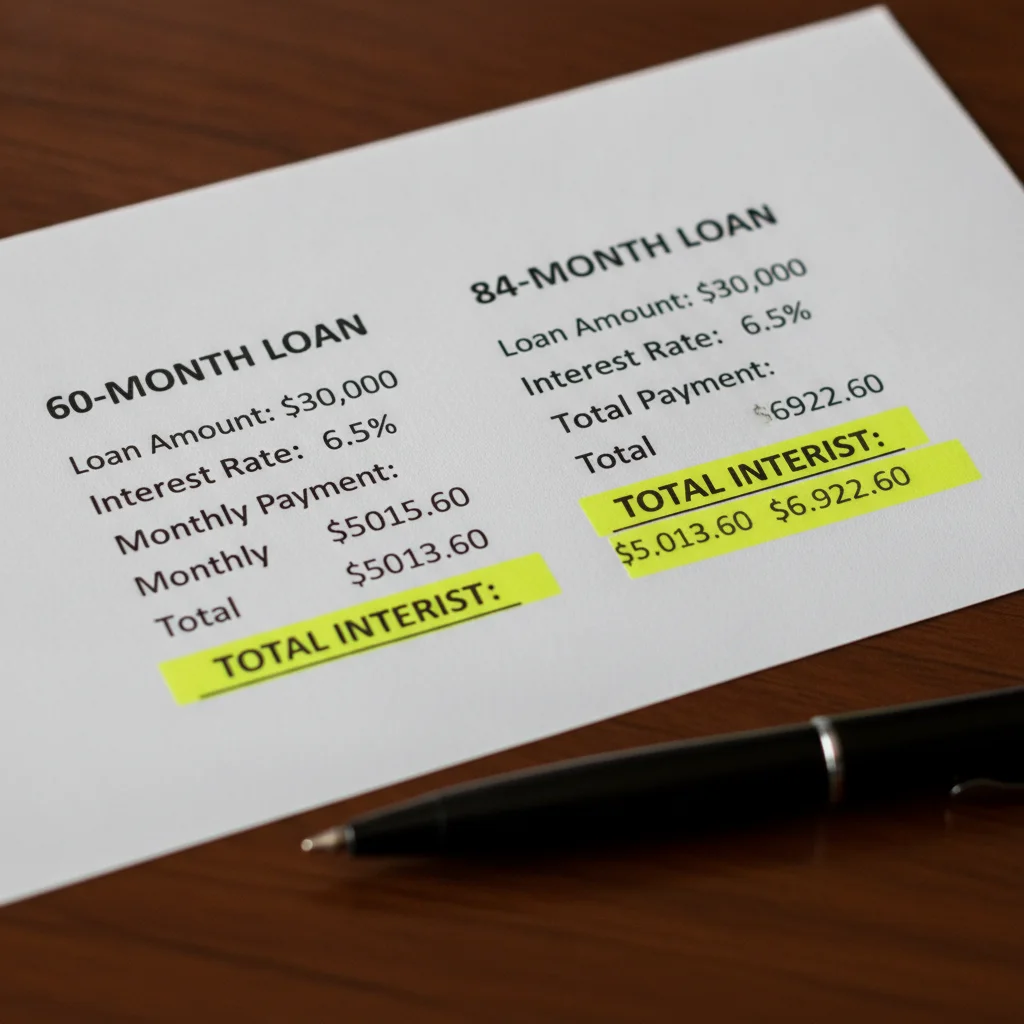
The relationship between loan term, monthly payment, and total interest is arithmetic — but it surprises people every time they see it laid out explicitly. Here's a simplified example using a $30,000 loan at 7% APR:
| Term | Monthly Payment | Total Paid | Total Interest |
|---|---|---|---|
| 36 months | $926 | $33,336 | $3,336 |
| 48 months | $718 | $34,464 | $4,464 |
| 60 months | $594 | $35,640 | $5,640 |
| 72 months | $513 | $36,936 | $6,936 |
| 84 months | $453 | $38,052 | $8,052 |
The 84-month loan looks affordable. The $453 payment is reasonable. But you're paying $4,716 more in interest than the 60-month borrower and $8,052 more than if you'd paid cash — for a car that may be worth $12,000 by the time you make the last payment.
Longer terms also keep you in negative equity longer. Negative equity — owing more than the car is worth — is a problem if you have an accident, need to sell the car, or want to trade it in. GAP insurance can cover the difference in a total-loss scenario, but it doesn't help if you simply want to exit the loan early.
This doesn't mean a 72- or 84-month loan is always wrong. For buyers with tight monthly budgets, the lower payment may be necessary. But it should be a deliberate trade-off, not a default choice made because the payment sounded manageable. Run the numbers first.
After You Sign: What to Watch For
Signing doesn't end your responsibility for understanding the loan. The first 90 days after closing are particularly important.
- Confirm your first payment date and amount. Some buyers assume auto-pay is set up when it isn't, missing the first payment and triggering a late fee or credit report entry.
- Verify the loan was assigned correctly. When a dealer arranges financing, they sell your loan to a lender. You'll receive a welcome letter from that lender. Make sure the terms on that letter match what you signed.
- Test your extra-payment process. If you plan to make extra payments toward principal, send a small one early and confirm it was applied correctly. Some servicers require a written or online instruction to apply extra funds to principal rather than crediting the next payment.
- Set a reminder to revisit refinancing. If your credit score has improved since closing — or if market rates have dropped — refinancing could lower your rate and reduce your total cost. Check out signs your original loan wasn't your best deal to know what red flags to look for.
Finally, store your complete loan contract somewhere retrievable — not in the glove compartment. A digital scan stored in cloud storage gives you access if a dispute arises months or years later.
If you're also reviewing the broader purchase contract (not just the financing), use the pre-signing car purchase contract checklist to cover vehicle price, add-ons, and trade-in documentation. And if you want a step-by-step method for reading the loan contract itself, the right way to read an auto loan contract walks through each clause in sequence so nothing slips past you.

All claims are backed by peer-reviewed research. Sources on request.