

Key Takeaways
Summary
22 items · 20–45 minutes
Why Rate vs. APR Confusion Costs Buyers Real Money
Most buyers focus on one number when shopping for a car loan: the interest rate. That's exactly what dealers and lenders count on. The interest rate tells you the cost of borrowing the principal — it doesn't tell you what the loan actually costs when you factor in origination fees, dealer markups, and other finance charges rolled into the deal.
The Annual Percentage Rate (APR) includes those costs. It's the standardized number that allows you to compare loans on equal footing. A loan advertised at 5.9% interest with $1,200 in fees can easily carry a 6.8% APR — and if you're comparing it to a competing offer at 6.4% APR with no fees, you might be walking into the more expensive option without knowing it.
I spent years on the finance side of dealerships. I've watched buyers celebrate a "low rate" while I calculated how much money we made on the back end through finance reserve — the markup between what the lender approved and what the dealer quoted. This checklist exists to close that information gap. If you want a solid grounding in how these numbers work before you run through the checklist, start with this guide to auto loan interest and APR — it covers the mechanics in plain English.
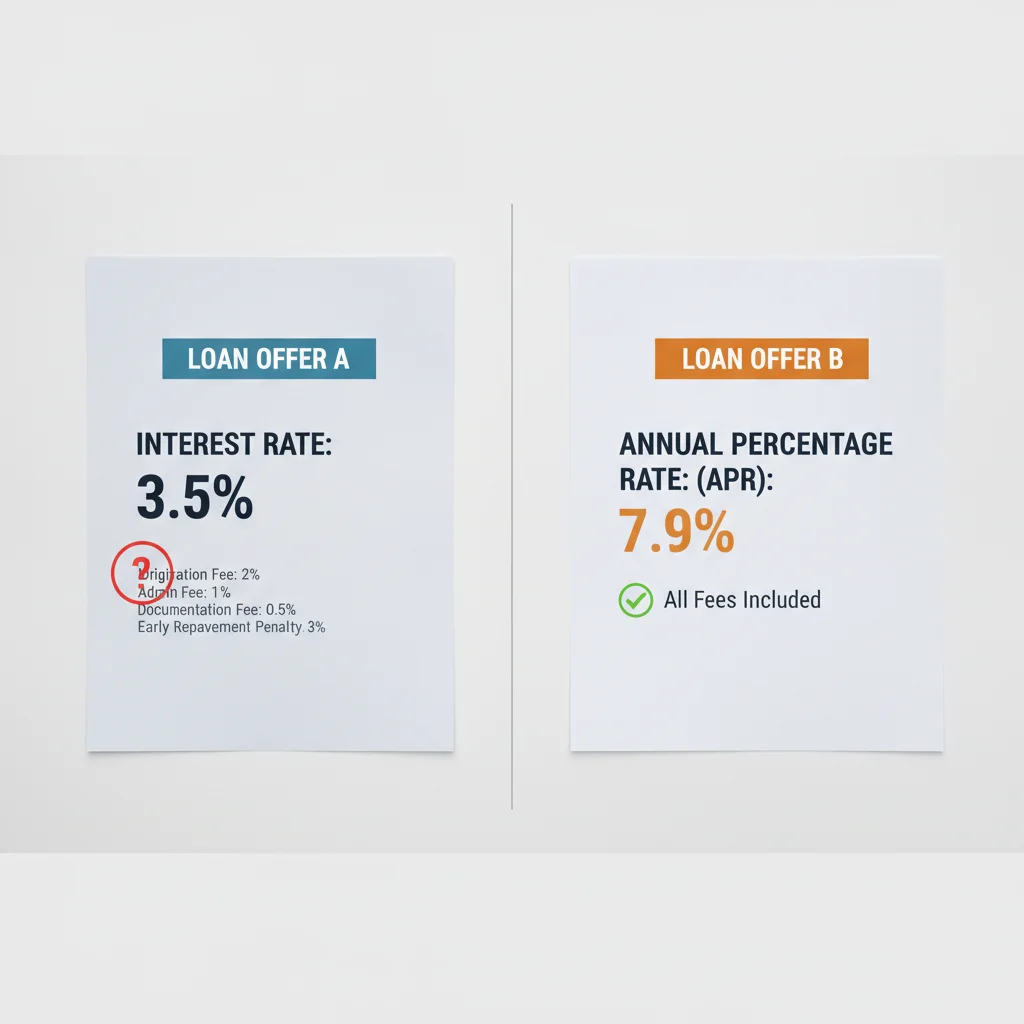
The checklist below walks you through every number you need to verify before you sign. Work through it at the dealership, at your bank, or at your kitchen table — anywhere you're reviewing a loan offer. Print it, screenshot it, or pull it up on your phone. The goal is simple: no surprises after you drive off the lot.
Tools You'll Need
You don't need anything exotic to run through this checklist. The items below cover what you should have in hand before you sit down with a finance manager or finalize an online loan application.
Preapproval letter from your bank or credit union
Provides a benchmark rate to compare against dealer financing — the single most effective defense against rate markups.
Online auto loan calculator (e.g., Bankrate, NerdWallet)
Lets you independently verify that the quoted monthly payment and total cost match the loan terms on the contract.
Your credit report and score
Tells you which rate tier you realistically qualify for so you can spot if you're being quoted a rate that doesn't match your creditworthiness.
Federal Truth in Lending (TILA) disclosure
The legally required document that summarizes APR, total finance charge, amount financed, and total of payments in standardized format.
Loan comparison spreadsheet or notepad
Allows you to place competing loan offers side by side and compare APR, term, monthly payment, and total cost at a glance.
APR verification calculator
Calculates the true APR from principal, fees, and payment schedule so you can cross-check the lender's disclosed figure.
One tool worth emphasizing: your preapproval offer. Walking in with a rate already approved by your own bank or credit union is the single most effective way to neutralize dealer rate markups. The loan preapproval hub explains how to get one and why it changes the negotiation entirely.
The Full Verification Checklist
Work through these items in order. The groups are sequenced deliberately — you need to confirm the loan basics before you can verify the math, and the math before you can catch hidden fees. Don't skip ahead.
Before You Walk In
Confirming the Interest Rate
Verifying the APR
Checking Loan Terms and Principal
Validating the Payment Math
Final Document Review
Watch Out for Payment-Focused Negotiation
Finance managers are trained to shift the conversation from total cost to monthly payment. "What can you afford per month?" is a setup — it allows them to extend the loan term while keeping the payment comfortable, dramatically increasing what you pay in total interest. Always negotiate rate and total cost, not monthly payment. A $450/month payment on a 72-month loan costs far more than $530/month on a 48-month loan at the same rate.
Spot-Delivery Risk on Same-Day Purchases
If a dealer allows you to drive the car home the same day the loan is signed, the financing may not be fully approved yet — a practice called spot delivery or "yo-yo financing." Days later, you could be called back and told the rate changed or the deal fell through. Confirm that financing is fully approved and funded before you take delivery.
Add-On Products Inflate Your Principal
GAP insurance, extended warranties, and paint sealant packages are frequently rolled into the loan principal without buyers realizing it. This means you pay interest on the cost of these products for the life of the loan. If you want any of these products, negotiate their price separately and consider paying for them outside the loan.
Once you've worked through the checklist items, you're ready to cross-reference what you've found against the actual contract language. For that next step, see how to read an auto loan contract — it walks through the document section by section so nothing gets past you.
The Numbers That Matter Most — and Where to Find Them
Every auto loan boils down to five numbers. Get these right and everything else falls into place.
| Number | Where to Find It | What to Watch For |
|---|---|---|
| Principal (amount financed) | Loan disclosure, Truth in Lending box | Includes add-ons you didn't agree to |
| Interest rate | Loan contract, rate disclosure section | Higher than your preapproval rate |
| APR | Truth in Lending disclosure (federal requirement) | Significantly higher than the stated rate |
| Loan term | Top of loan agreement | Extended beyond what you negotiated |
| Total of payments | Truth in Lending box | Doesn't match your own payment × month calculation |
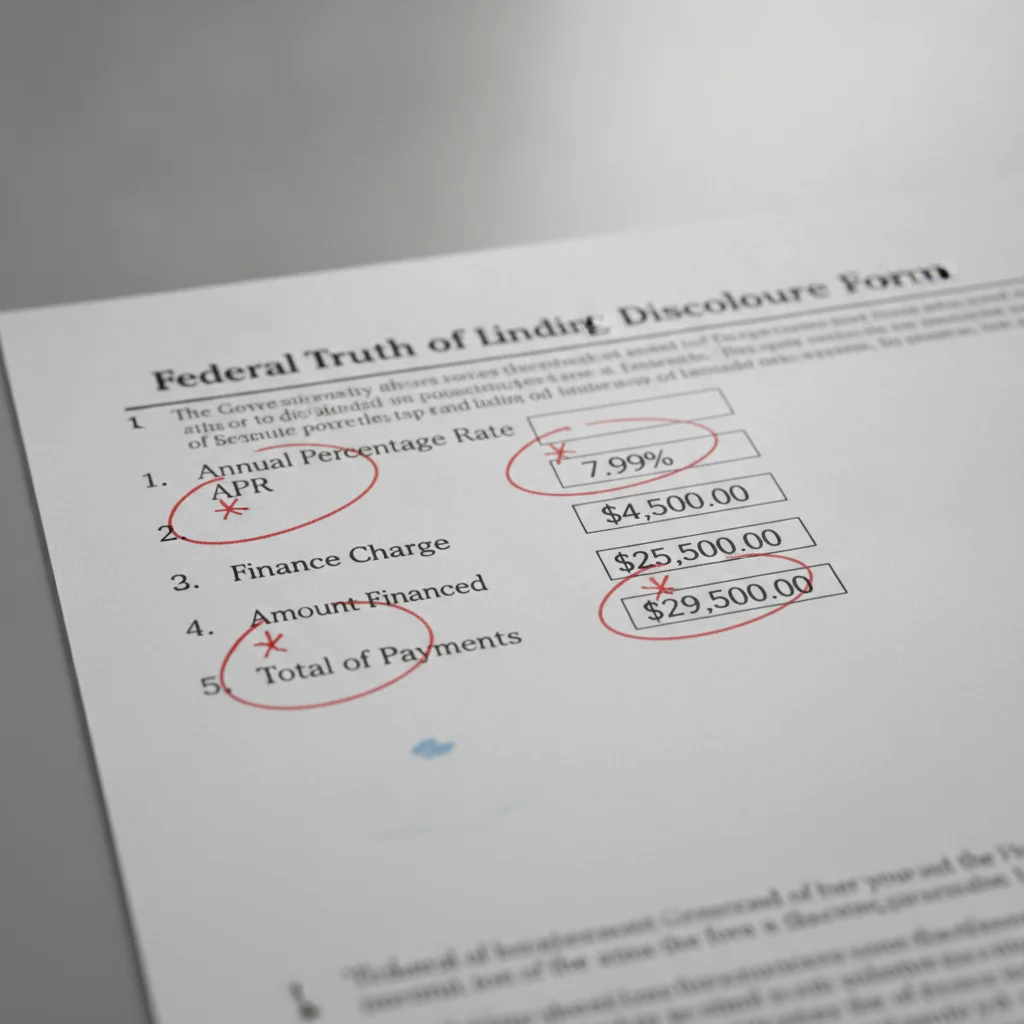
The gap between interest rate and APR is your clearest signal of how much you're paying in fees. A gap of less than 0.5 percentage points on a standard loan is generally reasonable. A gap of 1 point or more deserves a line-by-line explanation of what's creating it.
The Dealer Rate Is Not Always the Lender's Rate
When you finance through a dealership, the dealer submits your application to one or more lenders who respond with a buy rate — the lowest rate they'll accept for your credit profile. The dealer is legally permitted to mark that rate up and keep the difference as profit, often called "dealer reserve" or "finance reserve." On a $30,000 loan over 60 months, a 2-point markup can add more than $1,600 to your total cost. Your preapproval letter is the only reliable way to know whether the dealer is passing through a fair rate or padding it.
You Can Walk Away at Any Time Before Signing
No matter how far along you are in the process — test drive, trade-in appraisal, agreed price — you are under zero legal obligation to sign a loan you're not comfortable with. Finance offices use time pressure and social momentum to close deals quickly. If you need to take the contract home overnight to review it, ask. If they refuse that request or pressure you heavily, treat it as a serious warning sign about how they do business.
If you're working with a dealer finance office, ask for the Federal Truth in Lending disclosure before you sign anything. Lenders are legally required to provide it, and it summarizes APR, total finance charge, amount financed, and total of payments in one place. If the finance manager resists giving it to you early, that's a red flag worth noting.
Before You Leave the Table
Two things happen when buyers feel rushed: they skip verification steps, and they sign documents they regret. Finance offices are designed to create a sense of momentum — you've already picked the car, negotiated the price, maybe traded in a vehicle. Signing the loan feels like the finish line. It isn't.
The loan is where margin gets made. Take the time you need. Here's a short pre-departure check to run before you finalize anything:
- Confirm the APR on the contract matches (or beats) your preapproval APR.
- Verify the loan term in months matches what you agreed to verbally.
- Confirm no add-on products (GAP insurance, extended warranty, paint protection) were added without your explicit approval.
- Run the monthly payment math yourself: principal ÷ term doesn't equal your payment, but an online loan calculator should produce the same payment ± $1 of what's quoted.
- Ask for copies of every document you sign, before you leave the building.
If you want a broader pre-signing framework covering vehicle price, add-ons, and trade-in value — not just the loan — this pre-signing checklist for car purchase contracts covers the full picture. And if you're also reviewing loan term length and prepayment conditions, this loan term review checklist is a natural companion to what you've just worked through.
One last point: if your credit is challenged and you're looking at subprime offers, the stakes on rate verification are even higher. Rates in the 15–25% range are common in that market, and the difference between a well-positioned application and a poorly timed one can be several percentage points. This checklist for bad credit car loan applicants helps you verify you're in the strongest position before you apply.
All claims are backed by peer-reviewed research. Sources on request.