Key Takeaways
Credit Score & Auto Loan APR
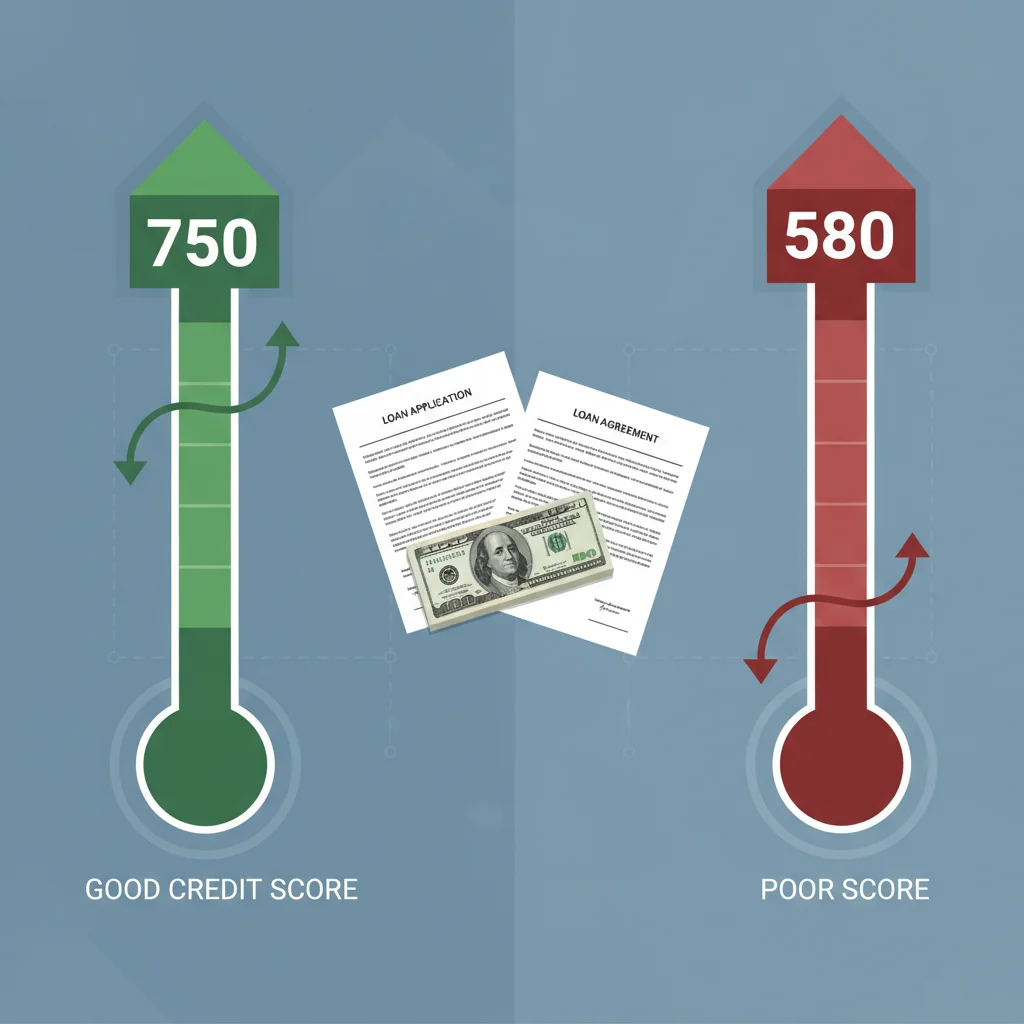
Your credit score is a three-digit number that summarizes how reliably you've repaid debt in the past. Lenders use it as a shortcut for risk: the lower your score, the higher the APR they charge to offset the chance you might default. On a car loan, even a 50-point score difference can shift your APR by two or more percentage points — enough to add hundreds or thousands of dollars to the total cost of the loan.
Auto lenders typically use FICO Auto Score 8 or FICO Auto Score 9, which weight auto-loan repayment history more heavily than the generic FICO 8 score you see on consumer credit monitoring apps — so the score a lender sees may differ from what you're used to checking.
Rate vs. APR: The Confusion That Costs Buyers Money
Walk into any dealership finance office and you'll hear the word "rate" thrown around constantly. What you rarely hear clearly explained is the difference between the interest rate and the Annual Percentage Rate (APR) — and that gap in understanding is where buyers routinely lose money.
The interest rate is the base percentage the lender charges on the principal balance of your loan. It does not account for fees. The APR wraps those fees — origination charges, documentation fees, any cost baked into the loan structure — into a single annualized figure. On many auto loans, the two numbers are close or identical because lenders structure their profit through the rate itself rather than upfront fees. But they are never guaranteed to be the same, and when they diverge, the APR is always the number that tells you what the loan actually costs.
Here's the practical rule: always ask for both numbers in writing and compare loans using APR. A dealer who quotes a 6.9% rate but rolls in a $500 origination fee is offering a loan with a higher effective APR than 6.9%. The difference may feel small on a monthly basis but compounds into real dollars over a 60- or 72-month term.
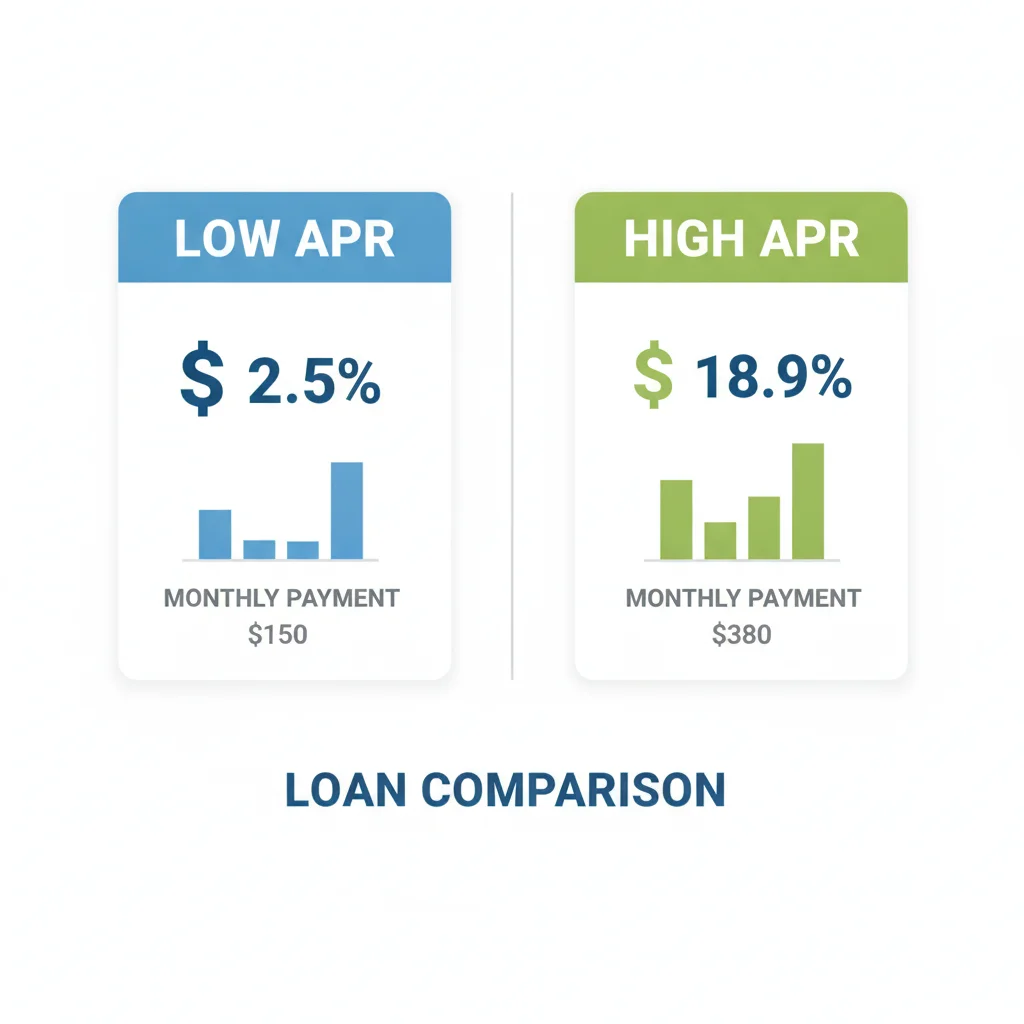
Your credit score is the primary engine driving both the rate and the APR a lender is willing to offer. Everything else — loan term, down payment, vehicle type — adjusts the math around the rate, but the rate itself starts with your credit score.
How Lenders Translate Your Score Into a Rate Tier
Lenders don't look at a 712 and think "this is a 712 borrower." They look at a 712 and think "this is a Tier 2 borrower" — or whatever internal label maps to that score range in their underwriting model. Risk-based pricing works through tiers, not a sliding scale. Cross a threshold and your rate drops. Stay just below it and you're stuck in the next tier up.
A typical lender might structure tiers roughly like this:
| Credit Score Range | Lender Risk Tier | Approximate APR Range (New Car) |
|---|---|---|
| 750+ | Tier 1 (Super Prime) | 4.5% – 6.5% |
| 700–749 | Tier 2 (Prime) | 6.5% – 9.0% |
| 660–699 | Tier 3 (Near Prime) | 9.0% – 12.5% |
| 620–659 | Tier 4 (Subprime) | 12.5% – 17.0% |
| Below 620 | Tier 5 (Deep Subprime) | 17.0% – 25%+ |
Figures are representative averages. Actual tiers and rates vary by lender, loan term, vehicle age, and market conditions.
The jump between Tier 2 and Tier 3 alone — often just 40 or 50 points on your score — can mean a 3.5 to 4 percentage point swing in APR. On a $35,000 loan over 60 months, that's roughly $3,500 in extra interest paid over the life of the loan. This is why borrowers who sit right at a tier boundary should seriously consider delaying purchase long enough to push across the line.
~5–6%
APR gap between prime and deep subprime auto loans
According to Experian's State of the Automotive Finance Market reports, the spread between Tier 1 and deep subprime new-car APRs has consistently ranged from 5 to 9 percentage points in recent years.
$8,000+
Extra interest paid by subprime borrowers on a $30K loan
On a $30,000, 60-month loan, the difference between a 6% APR and a 16% APR amounts to more than $8,000 in additional interest charges over the life of the loan.
43%
Share of auto loans originated to subprime or deep subprime borrowers
Experian's 2023 automotive finance data showed that roughly 43% of used-car loan originations went to borrowers with scores below 661, illustrating how common higher-rate lending is in practice.
14–45 days
Rate-shopping window with minimal credit score impact
FICO scoring models treat multiple auto loan hard inquiries within a 14- to 45-day window as a single inquiry, giving borrowers room to comparison-shop without compounding score damage.
Lenders interpret your score differently than you might expect — beyond the tier, they also look at the pattern of your credit history, not just the number itself.
Lenders Use Different Credit Score Versions
The score your bank or credit monitoring app shows you is often a generic FICO 8 or VantageScore 3.0 — not the FICO Auto Score most car lenders pull. FICO Auto Score versions weight your history with auto loans more heavily than other types of credit. Your auto-specific score can be higher or lower than your consumer score by up to 20–30 points. If you want to see the score a lender is likely to use, you can purchase FICO Auto Scores directly through myfico.com.
Rate Shopping Doesn't Hurt Your Score the Way You Think
Many buyers avoid getting multiple loan quotes because they're afraid of damaging their credit with multiple hard inquiries. In practice, FICO and VantageScore models deduplicate auto loan inquiries made within a short window — typically 14 to 45 days — counting them as a single inquiry. This means shopping three or four lenders in a focused two-week period costs you almost nothing in score points and can save you thousands in interest.
The Dealer Markup Layer: Where Your Score Stops Being the Only Variable
Here's what most borrowers don't know: the rate a lender gives the dealer — called the buy rate — is not always the rate the dealer gives you. Dealers who arrange financing through lenders have the contractual right to mark up the buy rate, typically by 1–2.5 percentage points. That markup is called the reserve, and the dealer keeps it as additional profit.
So your credit score sets the floor — the lowest rate the lender would accept for your risk profile. But the dealer's markup determines where you actually land above that floor. A borrower with a 730 score might qualify for a 6.8% buy rate but get quoted 8.5% at the desk if the dealer marks it up to the allowed ceiling.
This matters for one key reason: you can negotiate the markup, not just the rate. If you walk in with a pre-approval letter from your bank or credit union showing 7.2% APR, the dealer either has to beat it or match it — they can't simply quote you 8.5% and hope you don't notice.
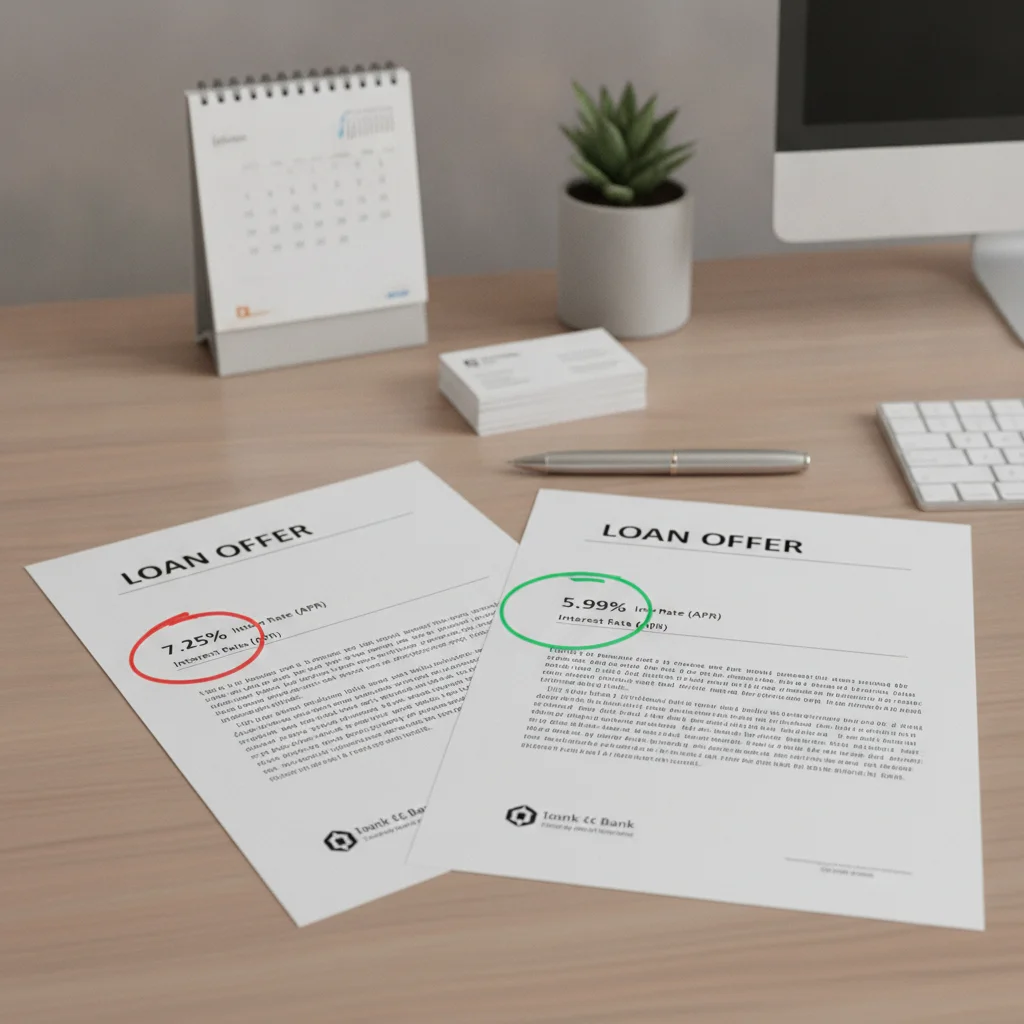
See how lenders price auto loans from the ground up to understand the full picture of what goes into your buy rate before the dealer touches it.
Always Get Your APR in Writing Before Signing
A verbal rate quote means nothing. Before you sit down to sign loan documents, ask the finance manager for the Truth in Lending Act (TILA) disclosure, which must show the APR, total interest charged, and total payment over the loan term. Review this document against the deal you agreed to — discrepancies happen, and they're almost never in your favor.
Target 30 Days Before Shopping to Pull Your Reports
Pull your credit reports from all three bureaus about 30 days before you plan to apply. That gives you enough time to dispute errors and see results before a lender runs their own inquiry. Errors on auto-related tradelines or incorrect derogatory marks are surprisingly common and can depress your score by 20–40 points unnecessarily.
The Math: What a 100-Point Score Gap Actually Costs You
Abstract percentages don't stick — concrete dollar amounts do. Let's run the numbers on a common real-world scenario: a buyer financing $28,000 on a new car over 60 months.
| Credit Score | Estimated APR | Monthly Payment | Total Interest Paid |
|---|---|---|---|
| 760 | 5.9% | $540 | $4,400 |
| 700 | 8.5% | $574 | $6,440 |
| 660 | 11.5% | $615 | $8,900 |
| 620 | 15.5% | $671 | $12,260 |
Calculations are illustrative. APRs are approximate and vary by lender and market conditions.
The borrower at 760 pays $4,400 in total interest. The borrower at 620 pays $12,260 — on the same car, from the same dealer. That $7,860 difference is entirely the cost of credit risk in the lender's eyes.
More pointedly: the 620-score borrower pays $131 more per month. Over five years that's $7,860 that could have gone to retirement savings, an emergency fund, or literally anything else.
For a deeper breakdown of these cost differences, see the exact dollar cost of a low credit score on a car loan. And if you want a side-by-side look at a real score gap, compare borrowing at 720 vs. 620 in detail.
The Levers You Can Pull Before You Walk Into a Dealership
Your credit score on the day you apply is the one that counts. Here are the highest-impact actions to take in the 30–90 days before you shop:
- Pay down revolving balances aggressively. Credit utilization — how much of your available revolving credit you're using — is the fastest-moving factor in your score. Getting balances below 30% of each card's limit can bump a score 20–40 points in a single billing cycle.
- Dispute errors on your credit report. Pull your reports from all three bureaus at AnnualCreditReport.com. Errors — wrong account statuses, duplicate derogatory marks, fraudulent accounts — appear on roughly 1 in 5 reports. A successful dispute can yield a meaningful score improvement within 30 days.
- Avoid opening new credit accounts. Each hard inquiry from a new card or loan application shaves a few points temporarily. In the months before an auto loan application, don't open anything new.
- Don't close old accounts. Closing an old card reduces your available credit and can raise your utilization ratio. Leave dormant accounts open unless they carry an annual fee that isn't worth it.
- Get pre-approved before you shop. Pre-approval from a bank or credit union locks in an APR offer you can use as a negotiating benchmark. Multiple auto loan inquiries within a 14–45 day window (depending on the scoring model) are typically treated as a single inquiry, so shopping around doesn't hurt your score as much as it used to.
Always Get Your APR in Writing Before Signing
A verbal rate quote means nothing. Before you sit down to sign loan documents, ask the finance manager for the Truth in Lending Act (TILA) disclosure, which must show the APR, total interest charged, and total payment over the loan term. Review this document against the deal you agreed to — discrepancies happen, and they're almost never in your favor.
Target 30 Days Before Shopping to Pull Your Reports
Pull your credit reports from all three bureaus about 30 days before you plan to apply. That gives you enough time to dispute errors and see results before a lender runs their own inquiry. Errors on auto-related tradelines or incorrect derogatory marks are surprisingly common and can depress your score by 20–40 points unnecessarily.
Your credit score doesn't just affect your auto loan — it also shapes your car insurance premiums in most states, compounding the financial impact of a lower score beyond just the loan itself.
Why Down Payment and Loan Term Don't Override Your Score
A common misconception is that putting more money down or choosing a shorter loan term will offset a weak credit score enough to get a better rate. They help at the margins, but they don't move you between tiers.
A larger down payment reduces the loan-to-value (LTV) ratio, which lenders see as a positive signal — it lowers their exposure if you default and the car gets repossessed. Some lenders will shave a fraction of a point off your rate for a strong down payment. But they won't move a 620-score borrower into the Tier 2 rate band because they put 20% down. The tier is set by credit risk, not collateral alone.
Similarly, a shorter loan term (48 months vs. 72 months) means less total interest paid and less default risk exposure for the lender, so rates on shorter terms are slightly lower. But again, a shorter term doesn't reclassify your credit tier.
“A down payment reduces the lender's loss-given-default, but it doesn't change your probability of default — and probability of default is what your credit score measures. Lenders price these two dimensions separately.”
— Melinda Zabritski, Senior Director of Automotive Financial Solutions, Experian
The bottom line: down payment and term are variables you should optimize after you've done what you can to improve your credit score. They're refinements, not substitutes.
For the full picture of what goes into a lender's pricing decision — beyond just your score — read how lenders determine your auto loan interest rate. Understanding all the variables puts you in a much stronger negotiating position.
All claims are backed by peer-reviewed research. Sources on request.