Key Takeaways
Credit Score Impact on Loan Cost
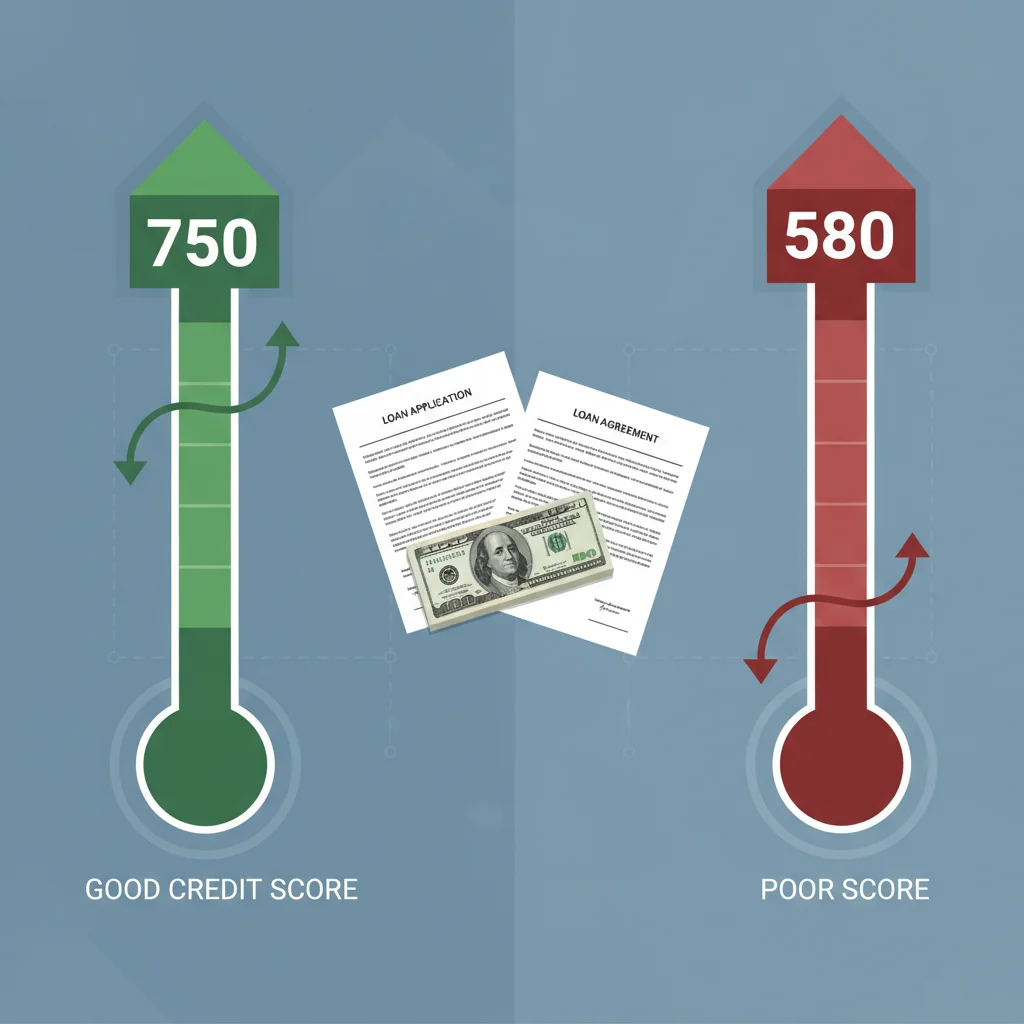
Your credit score determines the interest rate a lender charges you on an auto loan. The lower your score, the higher your rate — and even a small rate difference compounds into thousands of extra dollars paid over the life of the loan. On a $30,000 car financed for 60 months, the gap between a prime and subprime rate can cost you more than an entire extra car payment every single month.
Lenders use risk-based pricing models that tier borrowers by credit score bands (typically: deep subprime <580, subprime 580–619, near-prime 620–659, prime 660–719, superprime 720+). Each tier carries a distinct APR floor and ceiling set by the lender's internal credit policy.
Why Your Credit Score Is the Most Expensive Number in the Deal
Most car buyers obsess over the sticker price. They'll spend three weekends negotiating $800 off the MSRP, then sign a finance contract at 17.9% APR without blinking. That's backwards. On a typical financed vehicle, the interest rate determines more of your total cost than almost any other variable — and your credit score is the single biggest lever lenders pull when setting that rate.
Here's the simple mechanics: lenders use your credit score to assess the probability that you'll default. The higher the perceived risk, the higher the rate they charge to compensate. This isn't arbitrary — it's actuarial math. And the system is tiered, which means there are specific score thresholds where the rate jumps significantly, not a smooth curve.
Understanding those thresholds — and calculating exactly what each tier costs you — is the difference between walking into a dealership informed and walking out overcharged. For a full picture of how rates shift across every score band, see our auto loan rates by credit score breakdown.
Rates Vary by Lender and Market Conditions
The APR ranges in this article reflect typical market conditions as of 2024 and are based on data from Experian, Edmunds, and lender disclosures. Individual lenders set their own rate floors and ceilings, and rates shift with Federal Reserve policy. Your actual offer may differ — always get at least three quotes before accepting a rate.
New vs. Used Car Rates Are Different
All dollar examples in this article use new car loan APRs. Used car loans carry higher rates — typically 2–4 percentage points above new car rates within the same credit tier. If you're financing a used vehicle with a subprime score, your total interest costs will be even higher than the figures shown here.
The Credit Score Tiers Lenders Actually Use
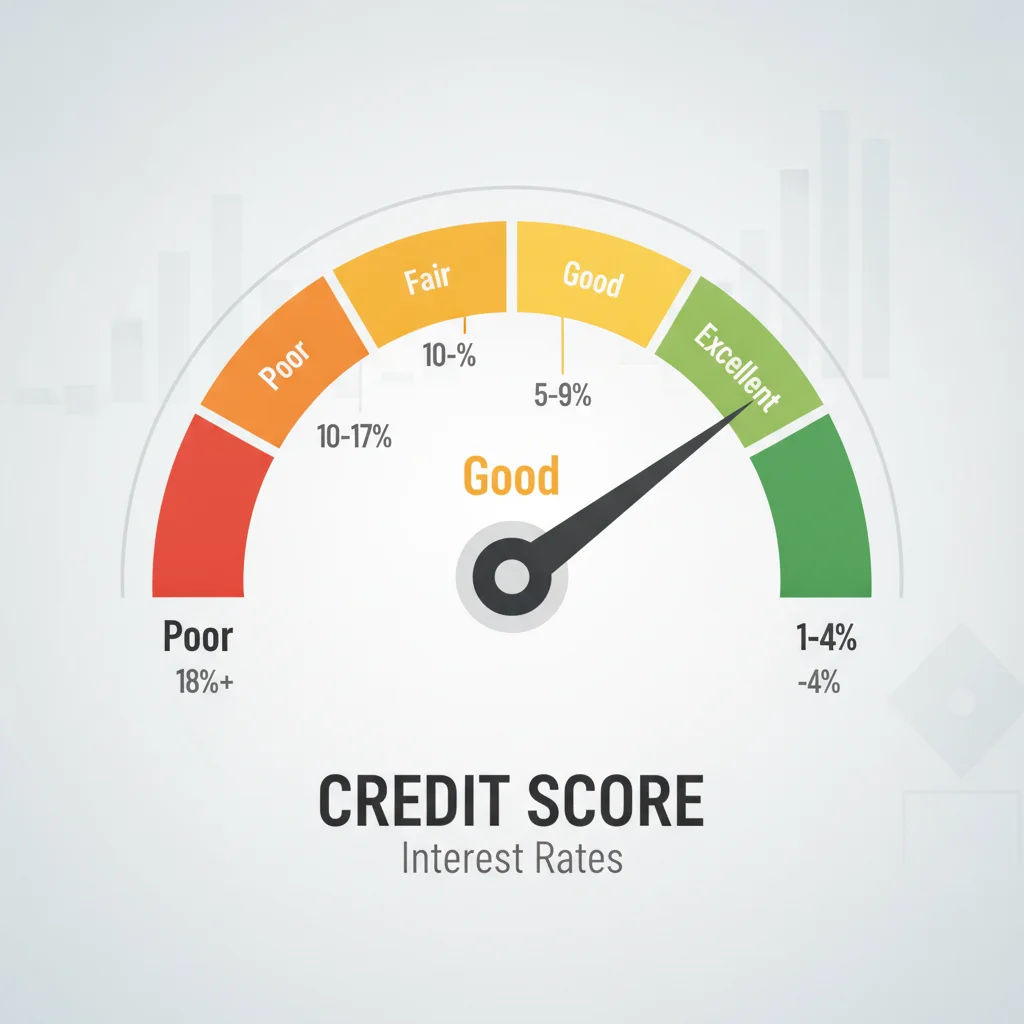
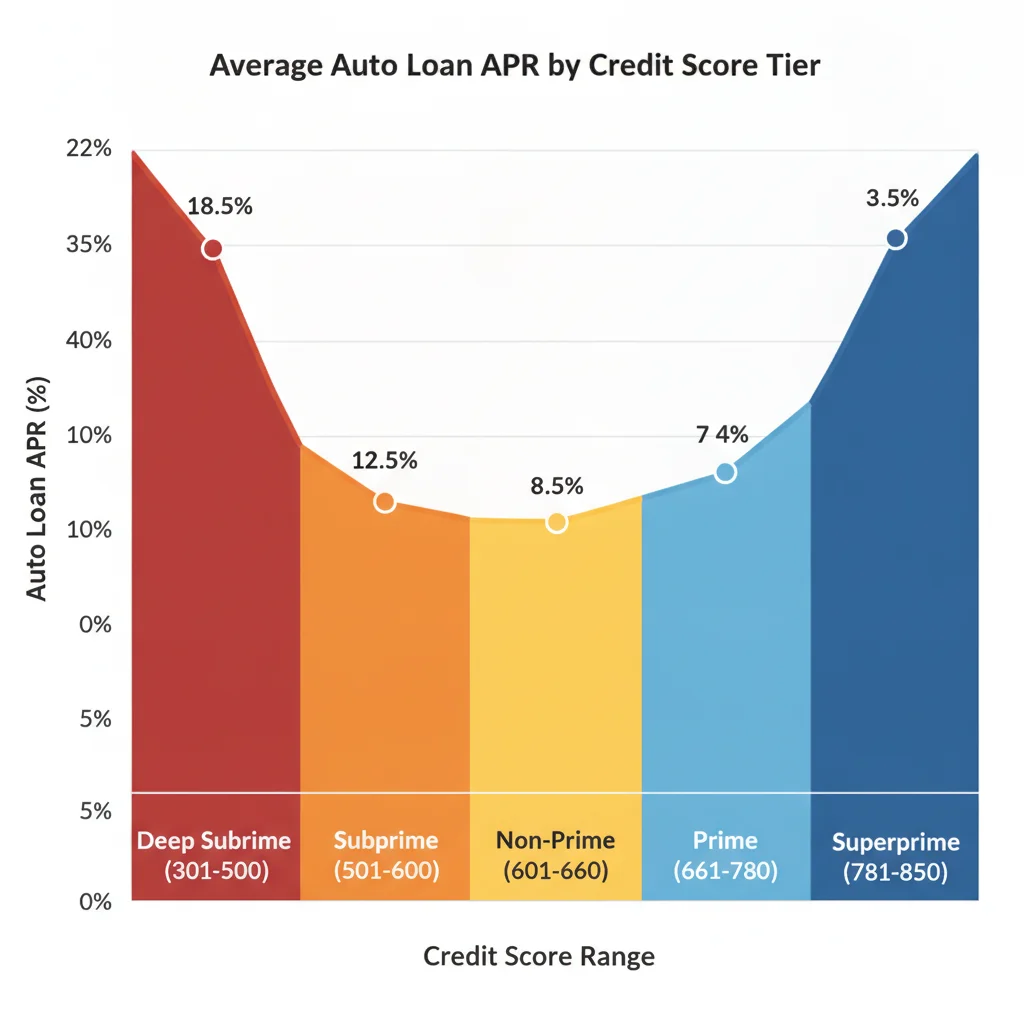
Lenders don't see your credit score as a number from 300 to 850. They see a tier. Here's how most auto lenders bucket borrowers, along with typical new-car APR ranges as of 2024:
| Tier | Score Range | Typical New Car APR |
|---|---|---|
| Superprime | 720 and above | 5.0% – 7.0% |
| Prime | 660 – 719 | 7.0% – 9.5% |
| Near-Prime | 620 – 659 | 9.5% – 13.5% |
| Subprime | 580 – 619 | 13.5% – 18.0% |
| Deep Subprime | Below 580 | 18.0% – 25%+ |
These ranges vary by lender and market conditions, but the structure is consistent. Notice what happens at the 660 and 620 thresholds — those are the cliff edges. A borrower at 658 might get 13% while a borrower at 663 gets 9%. Five points on your credit score, four percentage points on your rate. That's real money.
$8,749
Extra interest paid by subprime vs. superprime borrower
Based on a $30,000 new car loan at 60 months, comparing 16.5% APR (subprime) to 6.0% APR (superprime).
14–21%
Typical APR range for deep subprime borrowers
According to Experian's State of the Automotive Finance Market report, Q4 2023 data for borrowers below 580.
3.8x
Interest cost multiplier — deep subprime vs. superprime
A deep subprime borrower at 21% APR pays nearly four times the total interest of a superprime borrower at 6% on the same 60-month, $30,000 loan.
~40 points
Score gap between near-prime and prime threshold
The near-prime/prime boundary (typically around 660) represents a rate break of 3–4 percentage points at many major auto lenders.
$210/mo
Monthly payment difference, deep subprime vs. superprime
On a $30,000, 60-month loan, the difference between 6% APR ($580/mo) and 21% APR ($790/mo) is $210 every single month.
Used car rates run 2–4 points higher within each tier because used vehicles carry more collateral risk for lenders — they depreciate faster and are harder to resell in a default scenario. If you're shopping used with a low credit score, those two penalties stack.
The Dollar Math: What Each Tier Actually Costs You
Let's stop talking in percentages and talk in dollars, because that's what actually leaves your bank account. I'll use a $30,000 loan on a 60-month term — close to the average financed new car purchase — and run the numbers across tiers.
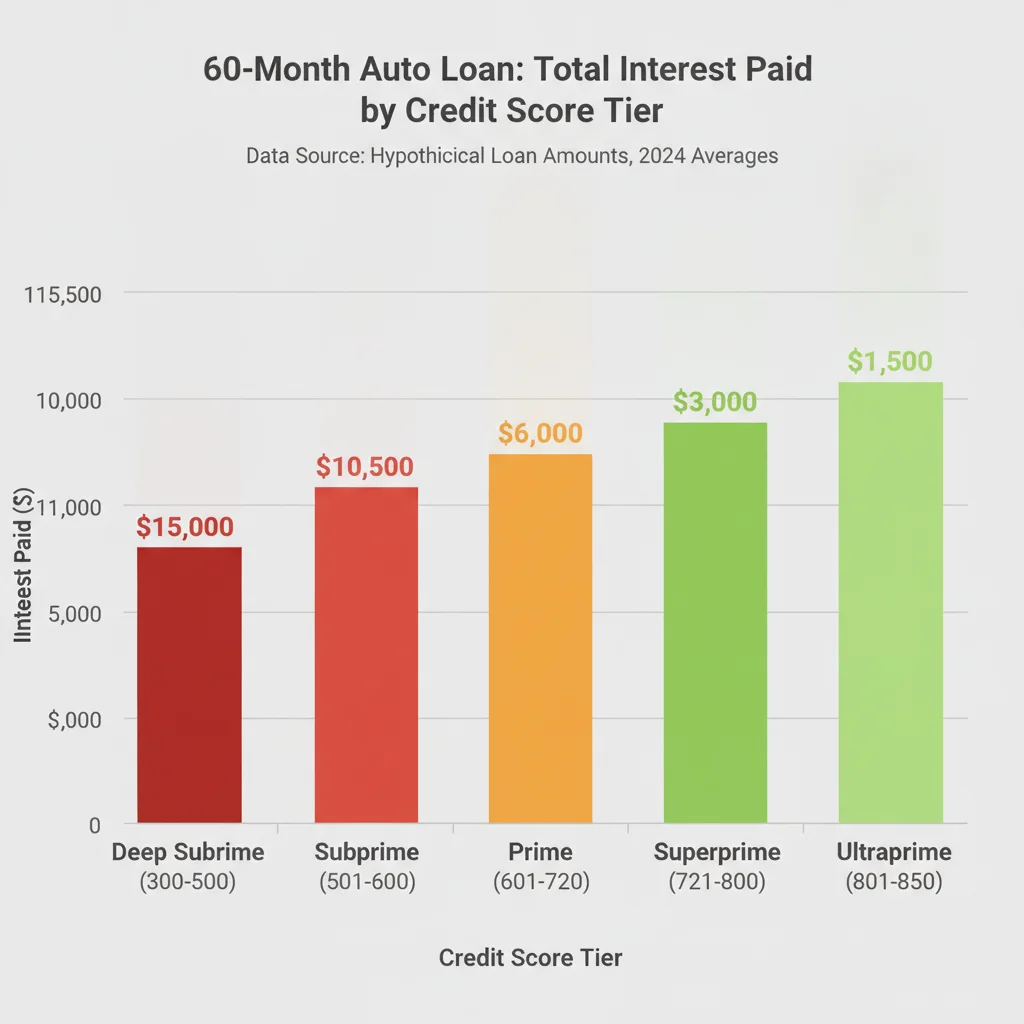
| Credit Tier | APR | Monthly Payment | Total Interest Paid | Extra Cost vs. Superprime |
|---|---|---|---|---|
| Superprime (740) | 6.0% | $580 | $4,799 | — |
| Prime (680) | 8.5% | $616 | $6,942 | +$2,143 |
| Near-Prime (640) | 12.0% | $667 | $10,019 | +$5,220 |
| Subprime (600) | 16.5% | $726 | $13,548 | +$8,749 |
| Deep Subprime (560) | 21.0% | $790 | $17,385 | +$12,586 |
Read that last column carefully. A deep subprime borrower financing the exact same $30,000 car pays over $12,500 more in interest than a superprime borrower over five years. That's a vacation, a year of groceries, or a sizable emergency fund — handed to the lender instead.
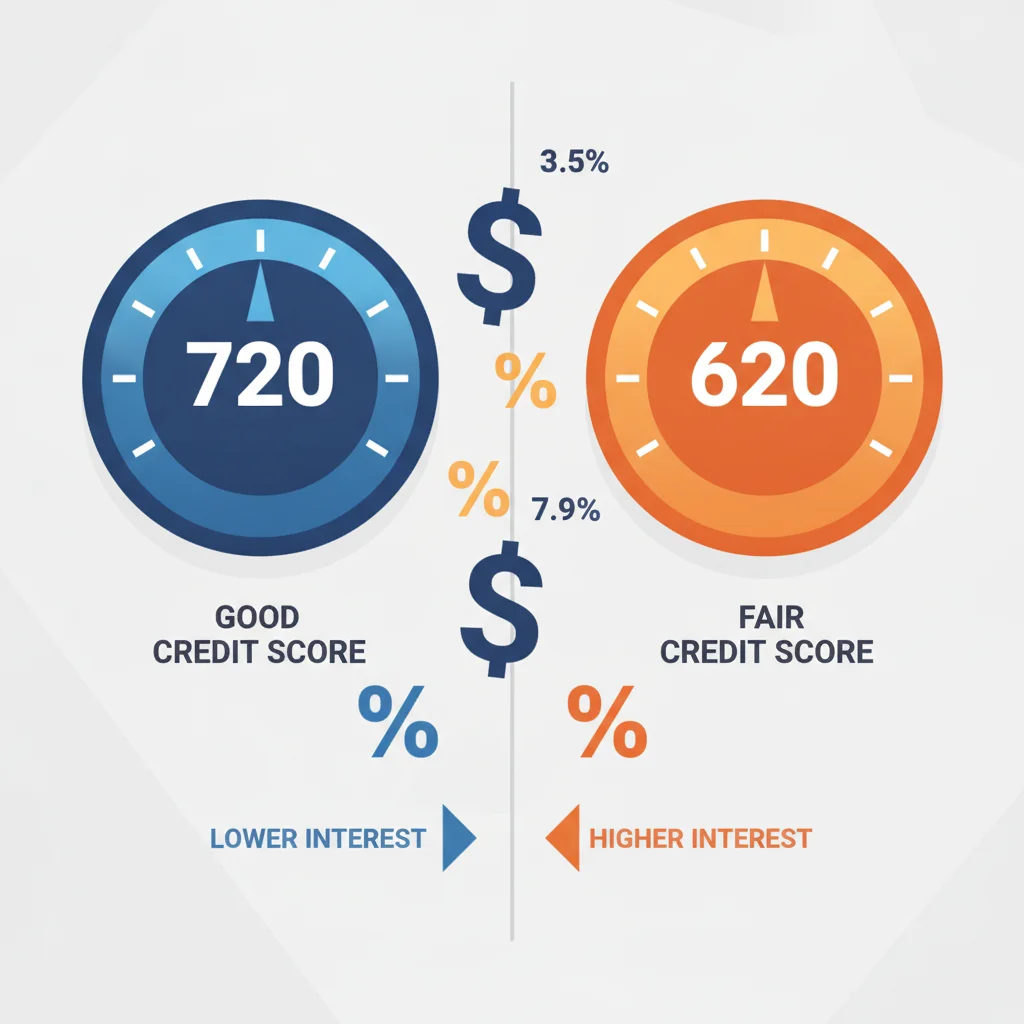
Even the jump from prime to near-prime — just 40 points on your score — costs over $2,000. For a side-by-side look at one specific 100-point gap, see our analysis of borrowing at 720 vs. 620.
Use an Amortization Calculator Before You Sign
Before agreeing to any loan, plug the APR, loan amount, and term into a free amortization calculator. Look at the total interest figure — not the monthly payment. This single number tells you the real cost of your credit score on this specific deal. Many buyers are shocked when they see it spelled out.
Track Your Score 90 Days Before Buying
Start monitoring your credit at least 90 days before you plan to buy. This gives you time to dispute errors, pay down balances, and see which actions move the needle. Even crossing one tier threshold — say, from 618 to 625 — can shift your APR meaningfully and save thousands over the loan term.
How Loan Term Amplifies the Credit Score Penalty
Dealers and lenders love to quote monthly payments because they obscure the total cost. A common tactic: stretch the term from 60 months to 72 or 84 months to lower the payment. For a subprime borrower, this is particularly dangerous.
Take that same subprime borrower at 16.5% APR on a $30,000 loan. At 60 months, they pay $13,548 in total interest. Extend to 72 months and the monthly payment drops from $726 to $636 — but total interest climbs to $15,801. Extend to 84 months and it reaches $18,428. The credit score penalty compounds with every extra month.
“The monthly payment is what dealers sell. The total cost is what you actually pay. Subprime borrowers are especially vulnerable to payment-focused selling because they're already stretched — and a lower monthly number feels like relief, even when the total cost is catastrophic.”
— Jordan Delray, Former dealership finance professional and auto loan specialist
There's also an equity problem. Longer loan terms mean you're underwater on the vehicle — owing more than it's worth — for a longer period. If the car is totaled or you need to sell, you can end up writing a check to get out of the loan. Subprime borrowers are already at greater risk here because higher payments strain budgets and increase default risk. The bad credit loans hub covers the broader set of strategies for navigating this situation.
Can a Down Payment Rescue a Bad Credit Score?
A larger down payment reduces your loan principal, which directly reduces the dollar amount of interest you pay. It does not, however, change your APR. Lenders price credit risk regardless of down payment size — a borrower at 590 gets a subprime rate whether they put 5% or 20% down.
That said, the math still helps. On a $30,000 purchase with a $5,000 down payment, you're financing $25,000. At 16.5% over 60 months, total interest is now $11,290 instead of $13,548 — a $2,258 savings. For a $10,000 down payment, it drops further. The question is whether you have the cash and whether that cash is better used elsewhere.
There's also a threshold effect: some lenders require a minimum loan-to-value ratio and won't lend above a certain percentage of the car's value to subprime borrowers. Putting more down can keep you under that ceiling and actually qualify you for the loan. For a deeper look at how down payment size interacts with credit risk, read how much down payment bad credit car loans need.
The Math on Waiting: Is Improving Your Score Worth the Delay?
If you're sitting at 595 and you can realistically hit 640 in four to six months, should you wait? Run the numbers rather than guessing. A jump from deep subprime to near-prime on a $30,000 loan at 60 months saves roughly $7,000 in total interest. If you need the car only moderately urgently, six months of patience pays you $7,000. That's not a small number.
The calculus is different if:
- You need the vehicle for work immediately (lost income exceeds the interest savings)
- Car prices in your market are rising faster than the interest savings accumulate
- Your score trajectory is unclear and improvement isn't guaranteed
But for buyers who have flexibility, credit building has an extremely high return on time. Paying down a revolving balance, disputing errors on your credit report, or simply letting recent late payments age off the report are all actions that can move your score one tier in a matter of months.
Our article on the trade-offs of waiting to improve your score walks through this decision honestly, including the scenarios where waiting doesn't make sense.
Use an Amortization Calculator Before You Sign
Before agreeing to any loan, plug the APR, loan amount, and term into a free amortization calculator. Look at the total interest figure — not the monthly payment. This single number tells you the real cost of your credit score on this specific deal. Many buyers are shocked when they see it spelled out.
Track Your Score 90 Days Before Buying
Start monitoring your credit at least 90 days before you plan to buy. This gives you time to dispute errors, pay down balances, and see which actions move the needle. Even crossing one tier threshold — say, from 618 to 625 — can shift your APR meaningfully and save thousands over the loan term.
What To Do If You Can't Wait and Have a Low Score
Sometimes you need a car now. Here's how to minimize the damage when your credit score puts you in a high-rate tier:
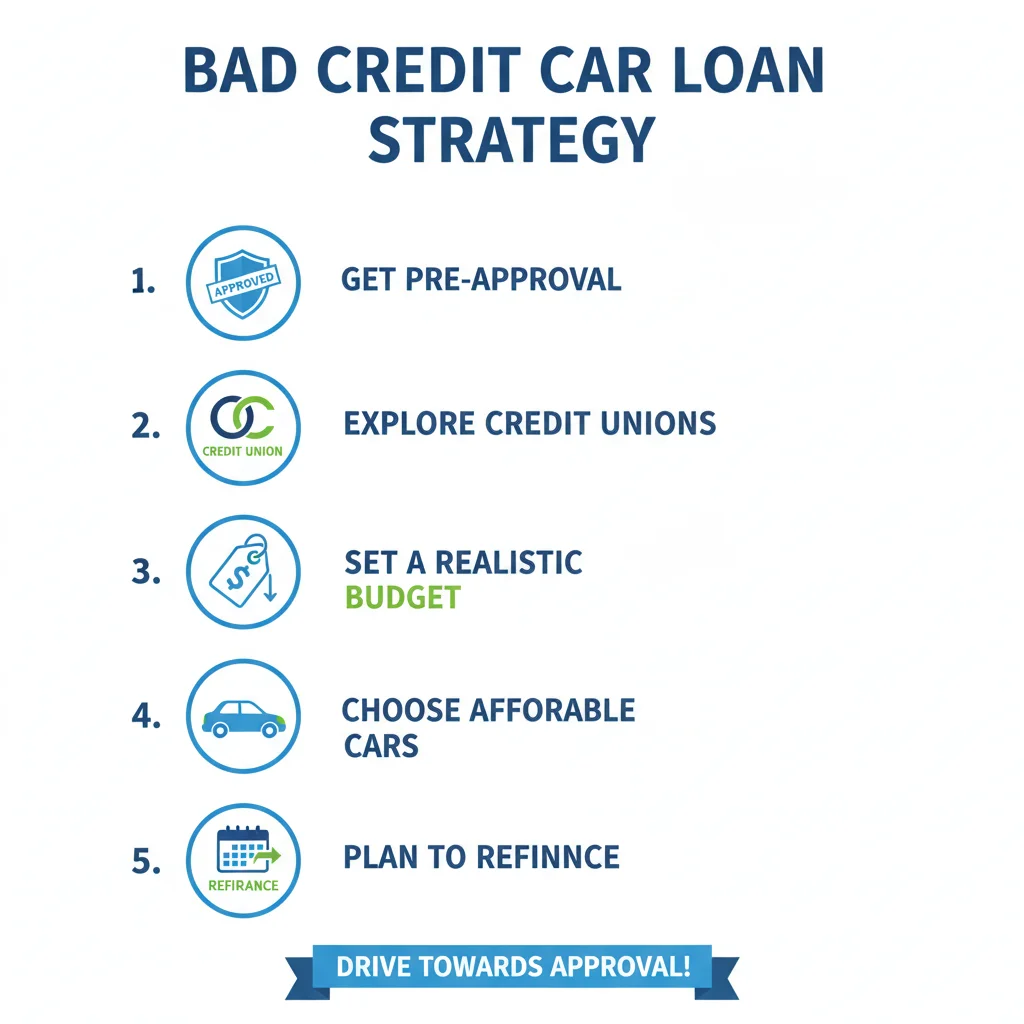
- Get pre-approved before the dealer knows your score. Apply directly with banks, credit unions, and online lenders before stepping on the lot. Dealers mark up rates — knowing your floor prevents that markup from compounding a already-high rate.
- Target credit unions specifically. Credit unions typically offer lower subprime rates than banks or captive finance arms. If you're not a member of any, many allow you to join with a small fee or donation.
- Negotiate the price, not just the payment. Even with a high rate, getting the vehicle price down reduces the loan amount and total interest paid. Don't let the finance discussion begin until the purchase price is locked.
- Borrow less by buying a less expensive car. Financing $20,000 at 17% costs far less than financing $35,000 at 17%. Credit-impaired buyers are often pushed toward more expensive vehicles on longer terms — resist that pressure.
- Plan to refinance at 12–18 months. If you make on-time payments and your score improves, you may qualify for a significantly lower rate. Build this into your plan from day one. Just verify the original loan has no prepayment penalty first.
For context on how total costs stack up across different financing scenarios, the real cost of borrowing with a low credit score article provides additional comparison data.
The interest and APR fundamentals hub is also worth reading before you sign anything — understanding exactly how your lender calculates your finance charge prevents surprises on delivery day.
All claims are backed by peer-reviewed research. Sources on request.