Key Takeaways
Credit Score (Auto Lending Context)
A credit score is a three-digit number, typically ranging from 300 to 850, that summarizes how reliably you've repaid debts in the past. To a car lender, it functions as a risk rating: the higher the number, the lower the chance they believe you'll default on the loan. That risk rating directly determines the interest rate you're offered — not as a formality, but as the lender's primary pricing tool.
Auto lenders frequently pull FICO Auto Scores (versions 2, 4, or 8) rather than the generic FICO score you see on most consumer dashboards. These industry-specific scores weight prior auto loan payment history more heavily, so your auto-specific score can differ meaningfully from your general credit score.
How a Lender Actually Reads Your Score
When you sit down at the finance desk, the lender has already translated your credit score into a single internal judgment: which risk tier do you belong to? Everything after that — the rate they offer, the terms they'll consider, whether they'll finance you at all — flows from that tier assignment.
Most auto lenders sort borrowers into five or six tiers. The labels vary by institution, but they generally follow this structure:
| Score Range | Common Label | Typical APR Range (New Car) |
|---|---|---|
| 750+ | Super Prime | 5%–7% |
| 700–749 | Prime | 7%–9% |
| 660–699 | Near Prime | 9%–13% |
| 620–659 | Subprime | 13%–18% |
| Below 620 | Deep Subprime | 18%–25%+ |
Rates shown are illustrative ranges based on general market conditions and will vary by lender, loan term, and vehicle type.
These aren't rigid cutoffs — lenders adjust them based on their own risk appetite, funding costs, and portfolio targets. But the tier structure itself is universal. The moment your score falls from 702 to 698, a lender's system may automatically route your application to a higher-rate bracket. That's not a penalty; it's a mechanical output of their pricing model.
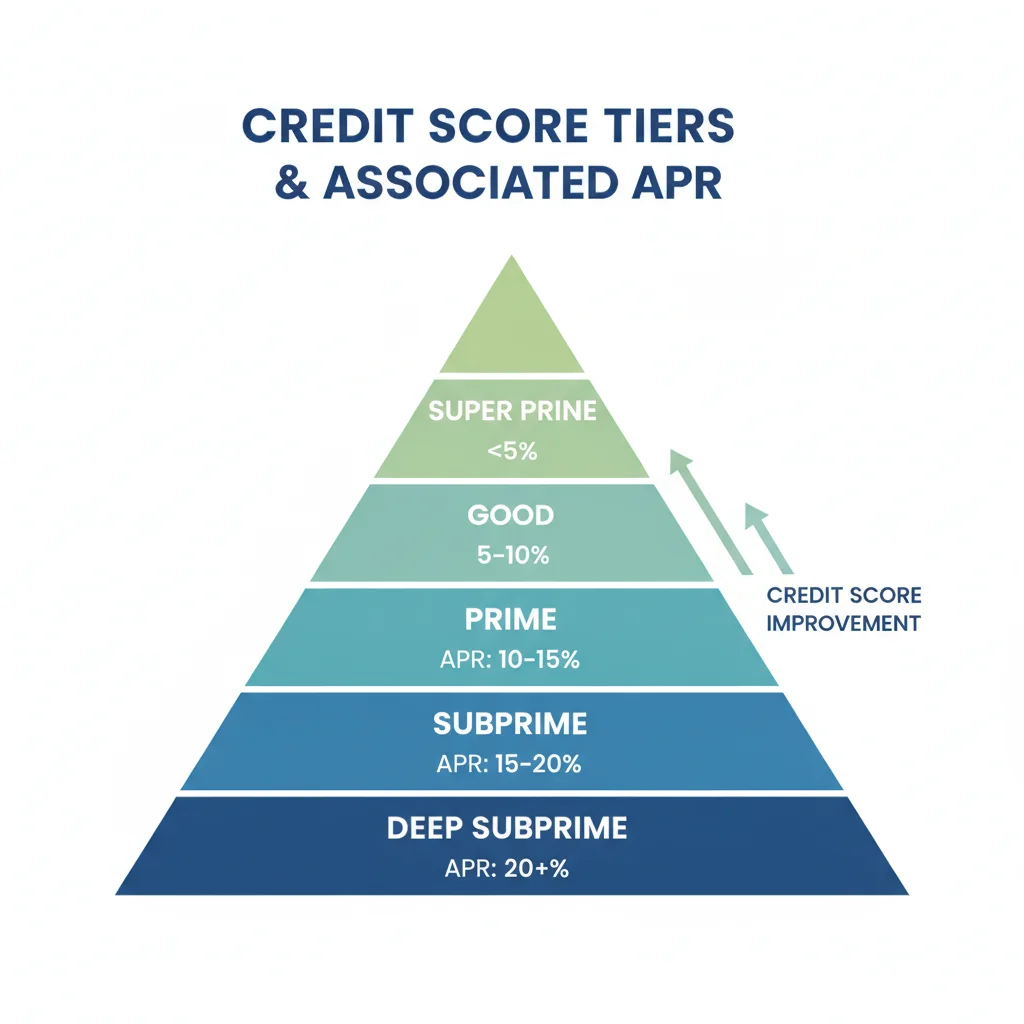
What this means practically: your score doesn't produce a single rate — it produces a rate floor. The lender sets the lowest rate they're willing to offer someone in your tier. From there, other factors can push the rate higher. For a deeper look at those additional variables, see what lenders look at beyond your credit score.
Tier Cutoffs Vary by Lender
The score ranges shown in this article reflect general market patterns, not any single lender's internal thresholds. One lender might define prime as 700+, another as 720+. Credit unions tend to have more flexible tier structures than banks or captive finance arms. This is why getting pre-approved from multiple sources — not just the dealer's preferred lender — often results in a better rate.
Rate Shopping Won't Wreck Your Score
Many buyers avoid shopping multiple lenders because they worry about multiple hard inquiries damaging their credit score. In reality, FICO and VantageScore both treat multiple auto loan inquiries made within a 14–45 day window as a single inquiry. Rate shop aggressively within that window — the credit impact is minimal and the savings potential is significant.
The Dollar Impact of Each Score Tier
Abstract percentages don't mean much until you run the numbers on an actual loan. Take a $35,000 car financed over 60 months. Here's what different APRs do to the total cost:
| APR | Monthly Payment | Total Interest Paid |
|---|---|---|
| 6% | $677 | $5,600 |
| 9% | $727 | $8,600 |
| 13% | $797 | $12,800 |
| 18% | $889 | $18,300 |
| 23% | $984 | $24,000 |
The difference between a super prime rate and a deep subprime rate on this single loan is roughly $18,400 in total interest — enough to buy a decent used car outright. That's the real cost of a low credit score, measured in cash out of your pocket.
$18,400
Extra interest cost from poor vs. excellent credit
Based on a $35,000 loan over 60 months, comparing a 6% super prime rate to a 23% deep subprime rate — illustrative of real market rate spreads.
5–8%
Typical APR range for super prime borrowers (new car)
According to Experian's State of the Automotive Finance Market reports, borrowers with scores above 750 consistently receive the lowest available market rates.
20–40 pts
Typical gap between general FICO and FICO Auto Score
FICO Auto Scores weight installment loan history more heavily, meaning borrowers with past auto loan issues often score meaningfully lower on the auto-specific version.
65%
Share of auto loans originated by subprime or below borrowers
According to Experian data, a significant share of vehicle financing each quarter goes to near-prime, subprime, and deep subprime borrowers — at substantially higher rates.
This is why your credit score has such a large effect on your car loan APR — lenders aren't being arbitrary. They're pricing in the statistically higher likelihood that lower-score borrowers will miss payments, go delinquent, or default. When you default, the lender loses not just the remaining principal but the cost of repossession and resale. That entire risk gets baked into the rate they charge everyone in your tier.
“Risk-based pricing means the rate on any loan is essentially a prediction. Lenders are betting on whether you'll repay — and your credit score is the primary input to that bet. The higher the score, the less they charge to take the risk.”
— Melinda Zabritski, Senior Director of Automotive Financial Solutions, Experian
What Score the Lender Is Actually Pulling
Here's a detail that trips up a lot of buyers: the score you see on your bank app, Credit Karma, or Experian's consumer portal is almost certainly not the score your auto lender pulls.
Most auto lenders use FICO Auto Scores — specifically versions 2, 4, or 8, depending on which credit bureau they pull from. These are industry-specific scores built to predict auto loan default rather than general credit behavior. They put heavier weight on your history with installment loans, particularly past car loans. If you've ever had a repossession or a late payment on a vehicle, your FICO Auto Score will reflect that more severely than your general FICO score will.
The practical consequence: borrowers who've been responsible with credit cards but had one rocky car loan in the past may see their FICO Auto Score run 20–40 points lower than their general score. The reverse is also true — someone with a solid car loan history and spotty credit card behavior might score better on the auto-specific version.
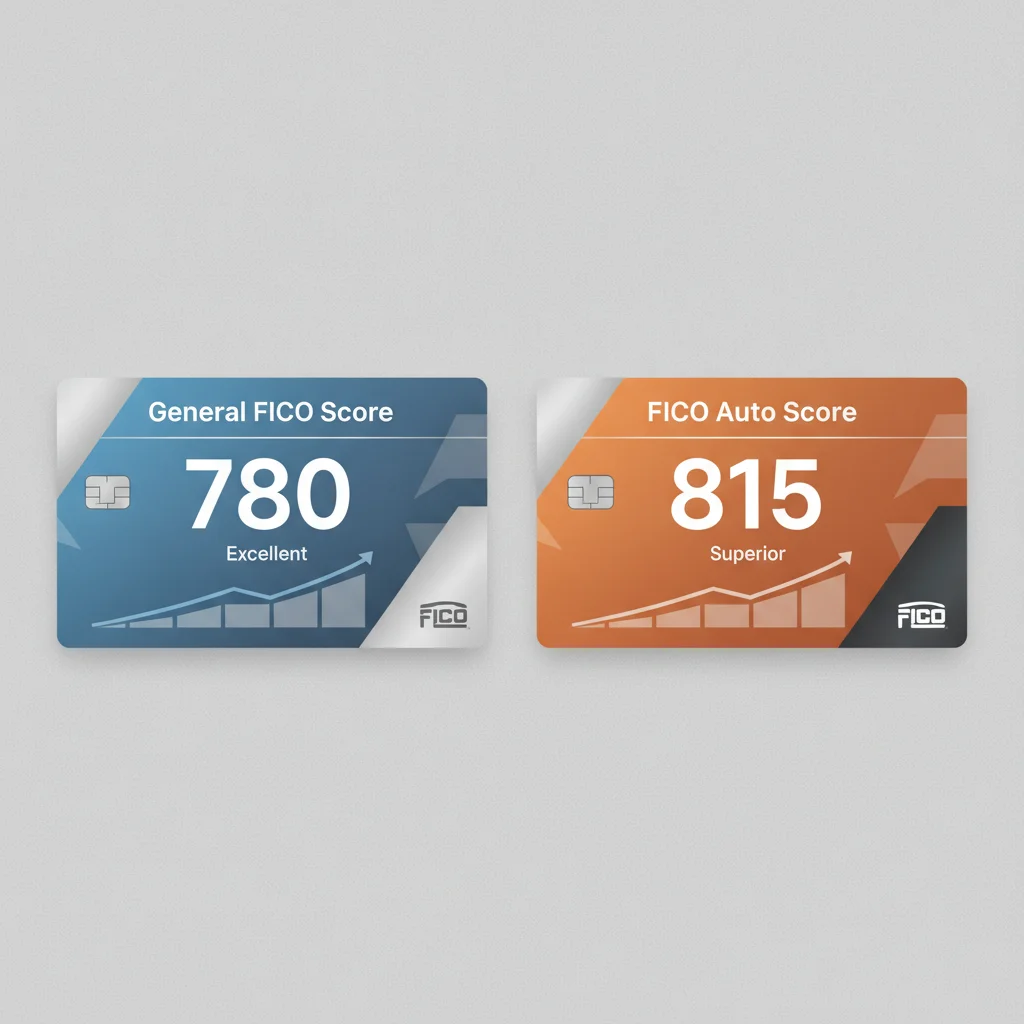
For a full breakdown of how these scores differ and how to check yours, see why your car loan score differs from your general credit score. Don't walk into a finance office assuming the number you've been watching is the number that matters.
Check Your FICO Auto Score Before Shopping
The score on Credit Karma or your bank app is a VantageScore or generic FICO — not the auto-specific version lenders actually pull. Purchase your FICO Auto Score through myFICO.com before applying for any auto loan. For about $20, you'll see the exact score tier you'll likely land in, which tells you the rate range you should realistically expect.
Get Pre-Approved Before Setting Foot in the Dealership
Apply with your bank, credit union, or an online lender like LightStream or PenFed before visiting any dealership. A pre-approval gives you a concrete rate benchmark. If the dealer's finance department can beat it, great — if not, you already have your financing locked. Either way, you negotiate from a position of information rather than dependency.
New Car vs. Used Car: The Score Isn't Worth the Same
Your credit score doesn't carry identical weight in every loan scenario. Lenders treat new and used vehicle financing differently, and borrowers often don't realize how much the vehicle type shapes the rate they receive.
New car loans typically come with lower base rates for two reasons: the collateral is worth more (a brand-new car has a known market value and full warranty coverage), and new car financing is often subsidized by manufacturer captive finance arms — think Toyota Financial Services or Ford Motor Credit — who offer promotional rates to move inventory.
Used car loans carry higher base rates across all credit tiers because the collateral depreciates faster and is harder to value precisely. A used car's worth depends on mileage, condition, and local demand — all variables that increase lender risk. That risk premium gets added on top of the credit-score-based rate adjustment.
What this means for you: the same credit score might get you 7% on a new car and 10–11% on a used car from the same lender. This isn't the lender treating you unfairly — it's a reflection of collateral risk. New and used car loan rates respond differently to your credit score, and understanding that split helps you set realistic expectations before you shop.
How Lenders Use Your Score Alongside Other Factors
Your credit score gets you into the room, but it doesn't write the final terms on its own. Once the lender has assigned you to a tier, they layer in additional variables that can move your rate within that tier or affect how much they'll lend you.
- Debt-to-income ratio (DTI): If your monthly debt obligations — including the proposed car payment — consume more than 45–50% of your gross income, many lenders will either decline or limit the loan amount, regardless of your score.
- Loan-to-value ratio (LTV): If you're financing more than the car is worth (common when rolling in negative equity from a trade-in), lenders view the loan as riskier. High LTV can push your rate up even within a favorable credit tier.
- Loan term: Longer terms (72 or 84 months) carry more risk for the lender because the car depreciates faster than the balance drops. Many lenders add a rate premium for extended terms.
- Employment and income stability: A recent job change or self-employment income can flag as a risk even when the numbers look fine on paper.
Your score is the primary input, but these secondary factors explain why two people with identical scores can receive different rates from the same lender. How lenders determine your auto loan interest rate covers the full weighting of each factor in detail.
Check Your FICO Auto Score Before Shopping
The score on Credit Karma or your bank app is a VantageScore or generic FICO — not the auto-specific version lenders actually pull. Purchase your FICO Auto Score through myFICO.com before applying for any auto loan. For about $20, you'll see the exact score tier you'll likely land in, which tells you the rate range you should realistically expect.
Get Pre-Approved Before Setting Foot in the Dealership
Apply with your bank, credit union, or an online lender like LightStream or PenFed before visiting any dealership. A pre-approval gives you a concrete rate benchmark. If the dealer's finance department can beat it, great — if not, you already have your financing locked. Either way, you negotiate from a position of information rather than dependency.
Using This Knowledge at the Dealership
Understanding how lenders read your score gives you a concrete advantage when you're sitting across from a finance manager. Here's how to put it to work:
- Pull your FICO Auto Score before you go. You can access it through myFICO.com (paid) or through some credit card issuers. Knowing your actual auto-lending score — not just your general score — tells you which tier you're likely in before anyone else runs your credit.
- Get pre-approved from a bank or credit union first. A pre-approval letter gives you a benchmark rate. If the dealer's finance manager quotes you higher, you can show the competing offer and ask them to beat it.
- Understand the dealer markup. Dealers often mark up the rate above what the lender approved them — this is called the dealer reserve. If you know your tier's benchmark rate, you'll recognize when you're being marked up. In many states, this markup is legal and common.
- Don't negotiate payment — negotiate rate and price separately. Finance managers prefer to talk monthly payment because it obscures the total cost. Anchor on the APR first, then calculate the payment yourself.

The information asymmetry in a finance office runs deep. Dealers see hundreds of credit files a month; most buyers see theirs once every few years. Closing that knowledge gap — even partially — shifts the negotiation in your favor.
For additional context on how score ranges translate into specific loan term options, see what credit score ranges mean for the loan terms you'll actually get.
Tier Cutoffs Vary by Lender
The score ranges shown in this article reflect general market patterns, not any single lender's internal thresholds. One lender might define prime as 700+, another as 720+. Credit unions tend to have more flexible tier structures than banks or captive finance arms. This is why getting pre-approved from multiple sources — not just the dealer's preferred lender — often results in a better rate.
Rate Shopping Won't Wreck Your Score
Many buyers avoid shopping multiple lenders because they worry about multiple hard inquiries damaging their credit score. In reality, FICO and VantageScore both treat multiple auto loan inquiries made within a 14–45 day window as a single inquiry. Rate shop aggressively within that window — the credit impact is minimal and the savings potential is significant.
Your Score Also Touches Your Insurance Rate
Most buyers don't realize that the same credit data affecting their loan rate also factors into their car insurance premium in most U.S. states. Insurers use a separate calculation called a credit-based insurance score, which is derived from similar underlying data but weighted differently than a FICO lending score.
The two scores aren't interchangeable — a great lending score doesn't guarantee a great insurance score, though there's strong overlap. Understanding how they differ is worth your time, especially if you're budgeting the total cost of ownership for a new vehicle. Credit-based insurance scores work differently from lending credit scores, and knowing that distinction prevents surprises when your first insurance quote comes back higher than expected.
If you want to understand the full mechanism of how credit history influences your insurance premium, the relationship between credit score and car insurance premiums walks through the pricing logic state by state.
All claims are backed by peer-reviewed research. Sources on request.