
Key Takeaways
Subprime Auto Loan APR
A subprime auto loan APR is the annual percentage rate charged to borrowers whose credit scores fall below the threshold lenders consider creditworthy — typically below 620. These rates are significantly higher than prime rates, often ranging from 15% to above 20%, because lenders price in the greater risk of default. The APR reflects the true yearly cost of the loan, including interest and certain fees, expressed as a single percentage.
APR differs from the base interest rate in that it folds in lender fees, making it the legally required disclosure under the Truth in Lending Act (TILA) and the most apples-to-apples figure for comparing loan offers.
Why Subprime Borrowers Pay a Different Kind of Price
When lenders look at your credit file, they're making a probability calculation. A borrower with a 780 credit score has demonstrated consistent, reliable repayment. A borrower with a 560 score has a history — missed payments, high utilization, possibly a collection or two — that tells lenders the risk of default is meaningfully higher. That risk gets priced in. Not slightly, but substantially.
The result is what the industry calls a subprime auto loan: a loan issued at rates that can be two, three, or even four times what a prime borrower pays for identical financing on identical collateral. The car doesn't change. The loan amount might not change. What changes is the APR — and with it, the total cost of ownership over the life of the loan.
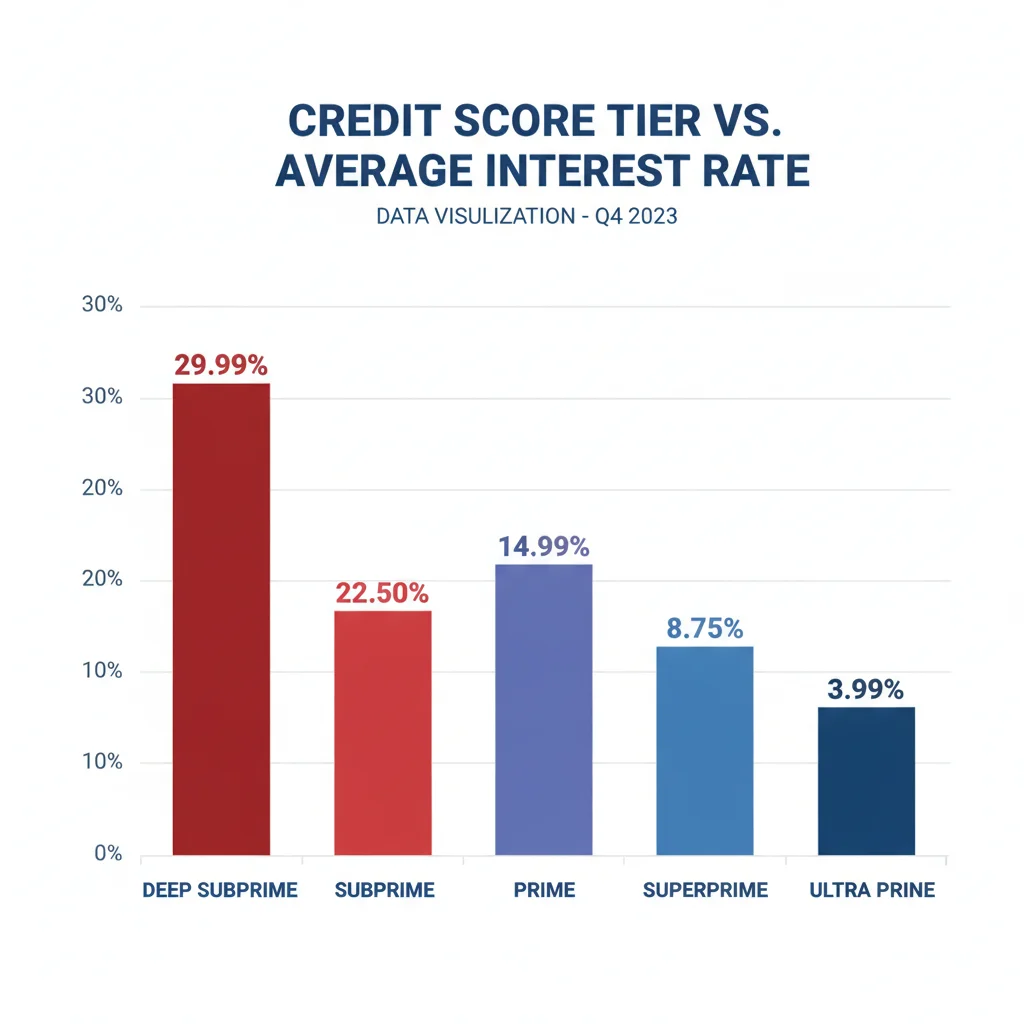
What exactly qualifies you as subprime depends on the lender, but most use FICO score thresholds. Generally:
- Deep subprime: below 500
- Subprime: 500–600
- Near-prime: 601–660
- Prime: 661–780
- Superprime: 781+
Each tier carries a meaningfully different rate range. The jump from near-prime to subprime isn't a small premium — it can represent 5–10 percentage points of APR, which translates to thousands of dollars over a standard loan term.
Rate vs. APR: The Number That Actually Matters
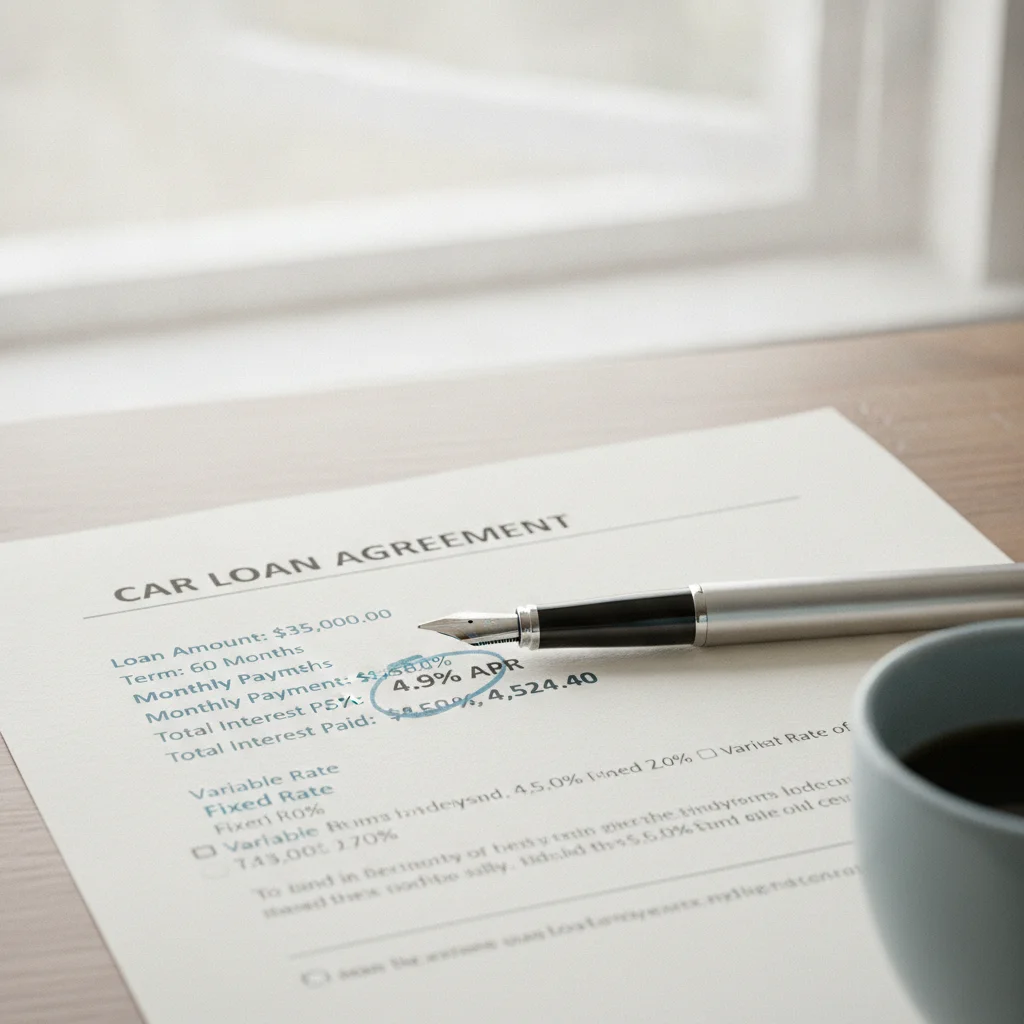
Before getting into specific dollar costs, it's worth being precise about what you're comparing. Dealers and lenders frequently quote the interest rate — sometimes called the note rate — when discussing loan terms. The APR is almost always a different number, and it's the one that matters.
APR stands for Annual Percentage Rate, and under federal law it must include not just interest but also certain fees rolled into the cost of credit. On a car loan, this typically includes origination fees or dealer finance reserve. The APR gives you a standardized, legally required measure of the annual cost of borrowing — making it the right number for comparing any two loan offers.
Rate Shopping Won't Hurt Your Credit Score
Many subprime borrowers avoid shopping multiple lenders because they fear multiple credit inquiries will further damage their score. Under FICO and VantageScore models, multiple auto loan inquiries within a short window (14–45 days depending on the model version) are counted as a single inquiry. Shop aggressively — the rate difference between lenders is worth far more than the marginal inquiry impact.
BHPH Dealers Often Don't Report to Credit Bureaus
Buy-here-pay-here dealers frequently do not report payment history to the major credit bureaus. This means on-time payments won't help rebuild your credit — eliminating one of the few potential benefits of a subprime loan arrangement. Before signing with any lender, confirm whether they report to Equifax, Experian, and TransUnion.
TILA Disclosures Are Required — Request Them Upfront
Under the Truth in Lending Act, lenders must provide a standardized disclosure of APR, finance charge, amount financed, and total of payments before you sign. Ask for this document before finalizing any loan agreement. If a lender or dealer resists providing it in advance, treat that as a red flag and slow down the process.
In practice, auto loan APRs and interest rates are often very close together — the fee component is usually smaller than with mortgages, for example. But that doesn't mean you should ignore the distinction. A loan quoted at "18% interest" with a $500 origination fee has a higher APR than one quoted at "18% interest" with no fee. Always request and compare the APR, not just the rate.
The APR is also what determines how amortization works — how each payment is split between interest and principal. At high APRs, early payments are overwhelmingly interest. You build equity in the vehicle slowly, which matters if you need to sell or refinance.
21.55%
Average APR for deep subprime used car loans
According to Experian's State of the Automotive Finance Market report, deep subprime borrowers (below 500) faced average used vehicle APRs of approximately 21.55% in recent quarters.
$10,000+
Extra interest paid vs. prime borrowers
On a $25,000 vehicle financed over 60 months, deep subprime borrowers pay over $10,000 more in total interest compared to superprime borrowers financing the same amount.
38%
Share of auto loans originated to subprime or below
Experian data shows that near-prime, subprime, and deep subprime borrowers together account for roughly 38% of auto loan originations, representing a substantial share of the market.
72 months
Most common loan term among subprime borrowers
Industry data consistently shows that subprime borrowers disproportionately select 72-month loan terms to manage monthly payments, amplifying total interest costs significantly at higher APRs.
5–10%
APR premium over prime rates
Subprime borrowers typically pay 5 to 10 percentage points above the rates offered to prime borrowers, a gap that translates directly into thousands of dollars in additional interest over the loan term.
The Real Dollar Difference at High APRs
Abstract percentages obscure what actually happens to your wallet. Let's use a concrete scenario: a $25,000 used vehicle, 60-month loan term, with no down payment.
| Credit Tier | Typical APR | Monthly Payment | Total Interest Paid | Total Cost |
|---|---|---|---|---|
| Superprime (781+) | 5.5% | $478 | $3,685 | $28,685 |
| Prime (661–780) | 7.5% | $500 | $5,009 | $30,009 |
| Near-Prime (601–660) | 11.0% | $543 | $7,562 | $32,562 |
| Subprime (501–600) | 17.0% | $621 | $12,246 | $37,246 |
| Deep Subprime (<500) | 21.0% | $675 | $15,496 | $40,496 |
A deep subprime borrower financing the same $25,000 vehicle pays $11,811 more in interest than a superprime borrower. That's money that buys nothing — no additional vehicle features, no warranty, no maintenance. It is the pure cost of credit risk as priced by the lender.
Notice also the monthly payment difference: $675 vs. $478. That $197/month gap compounds over five years into a significant quality-of-life impact. Many subprime borrowers stretch to afford the payment without fully accounting for this cumulative cost.
“The monthly payment is the most dangerous number in a car deal. It's designed to make an expensive loan feel affordable — but it hides the total cost. Ask for the finance charge, not just the payment.”
— Jordan Delray, Former dealership finance professional and auto loan analyst
See how these costs stack up across every credit tier for a full breakdown of lifetime borrowing costs by score range.
How Loan Term Length Amplifies the APR Problem
Lenders and dealers will often present long loan terms as a solution to the high monthly payment problem that comes with subprime APRs. "We can stretch it to 72 months to get that payment down" is a common line in the F&I office. The logic works for the payment — but it devastates the total cost.
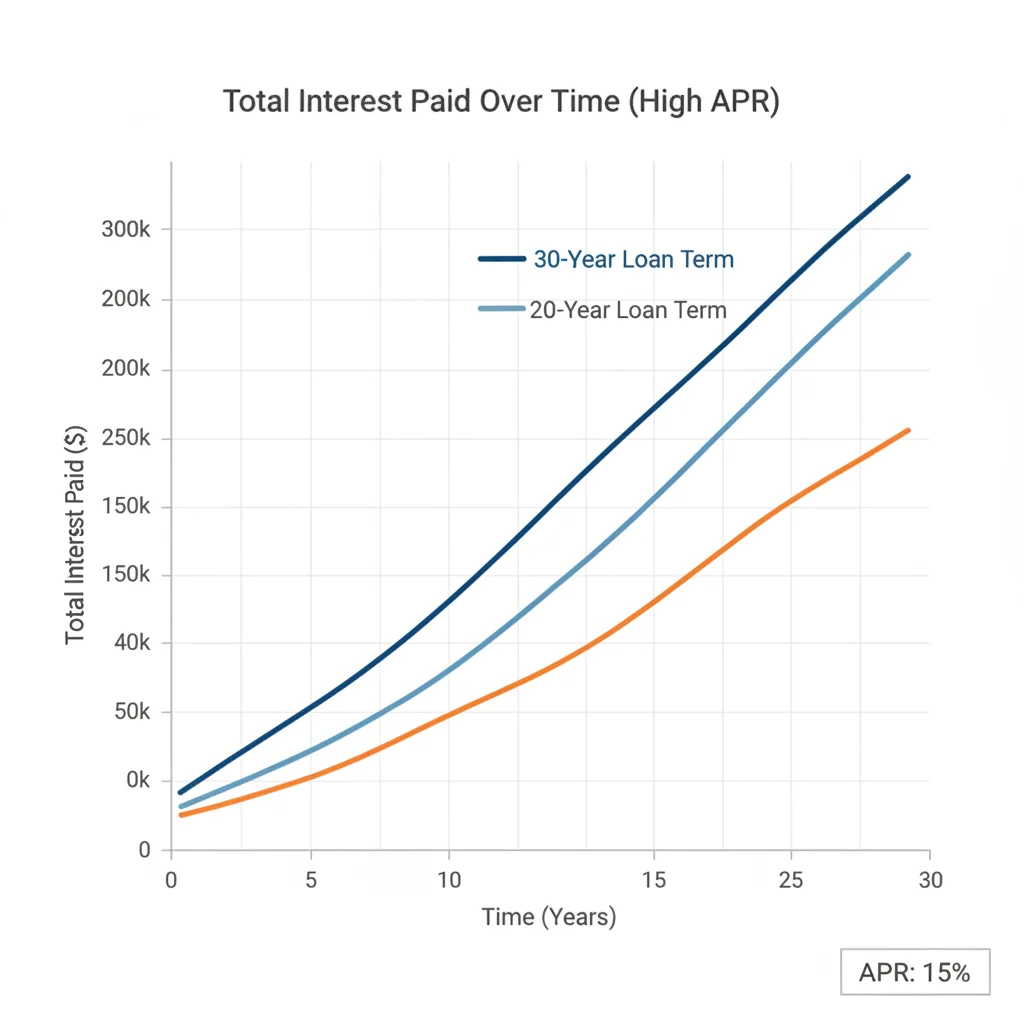
Here's what happens to a $25,000 loan at 17% APR across different term lengths:
| Term | Monthly Payment | Total Interest | Extra Cost vs. 48 months |
|---|---|---|---|
| 48 months | $712 | $9,163 | — |
| 60 months | $621 | $12,246 | +$3,083 |
| 72 months | $565 | $15,659 | +$6,496 |
| 84 months | $530 | $19,503 | +$10,340 |
Going from 48 to 84 months saves $182/month on paper. But it costs $10,340 more in total interest. At 17% APR, every additional year of loan term is extremely expensive. Understanding what loan term length actually means for your total cost is one of the most important things a borrower can do before signing.
Keep Loan Terms as Short as You Can Afford
At high APRs, every extra month of loan term is expensive. Before accepting a 72 or 84-month term, run the total interest numbers at 48 and 60 months. Even stretching your budget by $50–$80/month to shorten the term can save thousands. Use a loan amortization calculator with the exact APR you're quoted — not a round number estimate.
Get Pre-Approved Before You Visit the Dealership
Apply at a credit union or online lender before setting foot on a lot. A pre-approval letter gives you a real rate benchmark and removes the dealer's ability to anchor your expectations to whatever rate they choose to show you. Many credit unions offer subprime programs that are more competitive than dealer-arranged financing, especially for members with established banking relationships.
Where Subprime Loans Come From — and How That Affects Your Rate
Not all subprime auto lenders are the same, and the source of your loan matters both for the rate you're offered and the terms you'll face.
Captive Finance Arms
Manufacturer-backed lenders (like GM Financial, Ford Motor Credit, Toyota Financial Services) primarily target prime and near-prime borrowers. Some have subprime programs, but their criteria are tighter and their volumes in the deep subprime space are limited.
Credit Unions
Credit unions are frequently the best option for near-prime and subprime borrowers who are members. They're non-profit, often carry lower overhead, and have more flexibility in underwriting. A 580 credit score might qualify you for 12% APR at a credit union versus 18% at a buy-here-pay-here lot.
Specialty Subprime Lenders
Companies like Westlake Financial, Credit Acceptance, and DriveTime specifically underwrite subprime portfolios. They accept borrowers that banks won't touch, but their rates and fees reflect that risk tolerance. These are legitimate options, but read every term carefully.
Buy-Here-Pay-Here Dealers
BHPH dealers act as both the seller and the lender. They typically don't report to credit bureaus (so you build no credit history), charge the highest rates in the market, and may use GPS tracking and remote disabling devices as risk controls. Avoid unless it's your only option — and even then, explore credit unions and specialty lenders first.
Rate Shopping Won't Hurt Your Credit Score
Many subprime borrowers avoid shopping multiple lenders because they fear multiple credit inquiries will further damage their score. Under FICO and VantageScore models, multiple auto loan inquiries within a short window (14–45 days depending on the model version) are counted as a single inquiry. Shop aggressively — the rate difference between lenders is worth far more than the marginal inquiry impact.
BHPH Dealers Often Don't Report to Credit Bureaus
Buy-here-pay-here dealers frequently do not report payment history to the major credit bureaus. This means on-time payments won't help rebuild your credit — eliminating one of the few potential benefits of a subprime loan arrangement. Before signing with any lender, confirm whether they report to Equifax, Experian, and TransUnion.
TILA Disclosures Are Required — Request Them Upfront
Under the Truth in Lending Act, lenders must provide a standardized disclosure of APR, finance charge, amount financed, and total of payments before you sign. Ask for this document before finalizing any loan agreement. If a lender or dealer resists providing it in advance, treat that as a red flag and slow down the process.
Your credit score directly determines which lender categories will consider you and at what rates. Getting pre-approved from at least two lenders before visiting a dealership gives you a baseline the dealer must beat — or match — to earn your financing business.
Practical Ways to Reduce Your Subprime APR Exposure
If you're in the subprime tier today, you have more control over your cost than you might think. None of these strategies are magic — they require time or money — but they produce measurable outcomes.
1. Improve Your Score Before You Apply
Even moving from a 580 to a 620 credit score can shift you from deep subprime to subprime rates, potentially saving 3–5 percentage points of APR. Paying down revolving balances and disputing errors on your credit report are the fastest legal levers available.
2. Make a Larger Down Payment
A 15–20% down payment reduces the principal you're financing, which directly cuts total interest. It also improves the loan-to-value (LTV) ratio, which some lenders reward with marginally better rates. On a $20,000 vehicle, a $4,000 down payment means you're financing $16,000 instead — at 18% APR over 60 months, that alone saves about $2,600 in interest versus financing the full amount.
3. Shop Multiple Lenders
The dealership's finance office will submit your application to multiple lenders and present you the offer that works best for them — which may include dealer markup on the rate (called dealer reserve). Getting your own pre-approval from a credit union or online lender before stepping on the lot gives you a rate to anchor against. Rate shopping within a short window (14–45 days depending on the scoring model) typically counts as a single inquiry on your credit report.
4. Plan to Refinance
A subprime loan doesn't have to be your permanent arrangement. After 12–18 months of on-time payments, your score may improve enough to qualify for refinancing at a meaningfully lower rate. Check for prepayment penalties upfront. If your original loan has none, refinancing into a lower rate is usually straightforward and worth pursuing as soon as you qualify.
Keep Loan Terms as Short as You Can Afford
At high APRs, every extra month of loan term is expensive. Before accepting a 72 or 84-month term, run the total interest numbers at 48 and 60 months. Even stretching your budget by $50–$80/month to shorten the term can save thousands. Use a loan amortization calculator with the exact APR you're quoted — not a round number estimate.
Get Pre-Approved Before You Visit the Dealership
Apply at a credit union or online lender before setting foot on a lot. A pre-approval letter gives you a real rate benchmark and removes the dealer's ability to anchor your expectations to whatever rate they choose to show you. Many credit unions offer subprime programs that are more competitive than dealer-arranged financing, especially for members with established banking relationships.
See rate ranges across every credit tier to understand exactly how much each score improvement is worth in APR reduction.
Reading the Loan Disclosure Before You Sign
Federal law requires lenders to provide a Truth in Lending Act (TILA) disclosure before you sign. This document shows the APR, the total number of payments, the total amount of payments, and the finance charge (total interest and fees you'll pay over the life of the loan). Read it carefully — especially the finance charge line.
Many borrowers focus only on the monthly payment and gloss over the finance charge. At a 20% APR on a $20,000 loan over 72 months, the finance charge can exceed $14,000. That number should appear clearly in the TILA box. If the dealer is rushing you through paperwork, slow down. You have the right to read every document before signing.
Rate Shopping Won't Hurt Your Credit Score
Many subprime borrowers avoid shopping multiple lenders because they fear multiple credit inquiries will further damage their score. Under FICO and VantageScore models, multiple auto loan inquiries within a short window (14–45 days depending on the model version) are counted as a single inquiry. Shop aggressively — the rate difference between lenders is worth far more than the marginal inquiry impact.
BHPH Dealers Often Don't Report to Credit Bureaus
Buy-here-pay-here dealers frequently do not report payment history to the major credit bureaus. This means on-time payments won't help rebuild your credit — eliminating one of the few potential benefits of a subprime loan arrangement. Before signing with any lender, confirm whether they report to Equifax, Experian, and TransUnion.
TILA Disclosures Are Required — Request Them Upfront
Under the Truth in Lending Act, lenders must provide a standardized disclosure of APR, finance charge, amount financed, and total of payments before you sign. Ask for this document before finalizing any loan agreement. If a lender or dealer resists providing it in advance, treat that as a red flag and slow down the process.
Key line items to verify in the TILA disclosure:
- APR: The annual cost of borrowing, including fees — verify this matches what was quoted
- Finance Charge: Total dollars you'll pay in interest and fees over the loan life
- Amount Financed: The principal amount of your loan — verify no unauthorized fees were added
- Total of Payments: Finance charge plus principal — this is the true total cost of the vehicle through the loan
If the APR on the TILA disclosure doesn't match the rate you were quoted, stop and ask for clarification before proceeding. Errors and deliberate discrepancies both happen.
Subprime borrowing is a legitimate path to transportation when credit limits your options — but it carries real costs that compound quietly over months and years. Knowing those costs precisely, in dollars rather than percentages, is the first step toward making a decision you won't regret at payment number 47.
All claims are backed by peer-reviewed research. Sources on request.