

Key Takeaways
Why Pre-Approval Is a Rate Anchor, Not Just a Formality
Most buyers think of pre-approval as a box to check — something that tells them roughly how much they can borrow. That framing leaves money on the table every single time. A pre-approval is actually a rate anchor: a concrete, lender-backed number that restructures every conversation you have at the dealership finance desk.
Here's the dynamic without a pre-approval: the dealer's finance manager quotes you a rate — say, 7.9% APR — and that number becomes the starting point. Your entire psychological frame is "is this a good deal?" rather than "how does this compare to what I already have?" You're reacting, not negotiating.
With a pre-approval at, say, 5.4% APR from your credit union, the conversation inverts. The dealer now has to beat your number or lose the financing income entirely. They can still try to mark up the rate through what's called dealer reserve — more on that shortly — but they're working uphill against a documented benchmark you hold in your hand.
Preapproval isn't just a formality — it's the mechanism by which lenders evaluate your creditworthiness and commit to a rate before you set foot on a lot. Understanding what goes into that commitment helps you position it correctly when you negotiate.

The anchoring effect is well-documented in negotiation research, and car deals are no exception. The first number said at the table sets the tone for everything after. When you have a pre-approval, you control which number gets said first — and that's an enormous structural advantage.
Rate vs. APR: The Distinction That Costs Buyers Real Money
Before you can use a pre-approval effectively, you need to understand what you're actually comparing. Dealers and lenders sometimes blur the line between interest rate and APR, and that blurring can cost you hundreds of dollars over the life of a loan.
| Term | What It Includes | Why It Matters |
|---|---|---|
| Interest Rate | The base cost of borrowing, expressed as a percentage | Does not include fees — can look lower than actual cost |
| APR (Annual Percentage Rate) | Interest rate plus lender fees, origination charges, and certain other costs | The true cost of the loan — always compare this number |
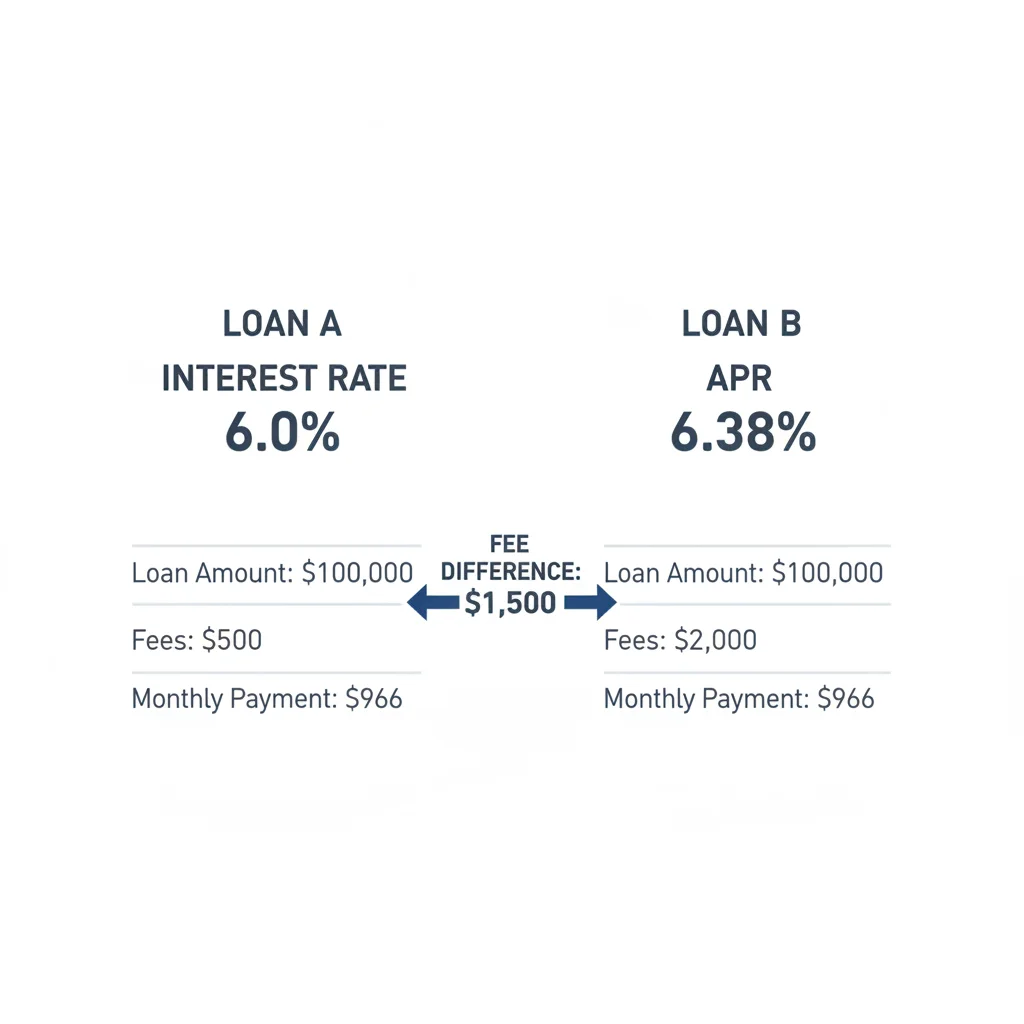
Example: A dealer quotes a 6.0% interest rate, but after adding a $400 origination fee on a $25,000 loan over 60 months, the APR climbs to 6.38%. Your credit union pre-approval is at 6.2% APR with no origination fee. On paper the dealer's rate looks lower — in practice it costs more.
Always ask for the APR, and always verify that the number you're comparing from your pre-approval letter is also stated as APR. Most bank and credit union pre-approval letters will specify this clearly. If yours doesn't, call the lender before you walk into the dealership. You need one consistent metric to anchor the negotiation.
Your credit score directly affects the loan rates lenders will offer, which is why checking your score before applying for pre-approval is a prerequisite, not an afterthought. A score that's 20 points lower than you think it is can shift you into a higher rate tier and change the math on your anchor entirely.
What You Need Before You Apply
Getting a pre-approval that's actually useful — one with a competitive rate you can walk in and deploy — requires preparation. Rushing the application with incomplete information can result in a conditional approval that falls apart later, or a rate that doesn't reflect your best credit profile.
What you will need
Credit union or community bank account
Credit unions typically offer rates 1–2 percentage points below big banks — existing membership gives you a head start on approval.
Online auto loan calculators
Lets you convert rate quotes into total interest paid so you're comparing real cost, not just percentages.
AnnualCreditReport.com
Pull your free credit reports from all three bureaus to spot errors before lenders see them.
Loan comparison spreadsheet
Track competing pre-approval offers side by side — lender, APR, loan term, fees, and expiration date.
Online lender pre-approval portals (e.g., PenFed, LightStream, Capital One Auto Navigator)
Allow rate-shopping without a hard inquiry, so you can see ballpark terms before committing to a formal application.
How to Get Pre-Approved and Use It at the Dealership
The steps below cover the full sequence: from pulling your credit to the moment you hand over the pre-approval letter at the finance desk. Don't skip the sequencing — the order matters, particularly when it comes to protecting your credit score during rate shopping.
Pull and review your credit reports
Go to AnnualCreditReport.com and pull all three bureau reports — Equifax, Experian, and TransUnion. You're looking for two things: errors that are dragging your score down, and any derogatory marks you weren't aware of. Lenders use all three reports, and a single erroneous collection account can bump you into a higher rate tier.
If you find an error, dispute it directly with the bureau online. Disputes can resolve in as little as 7–10 business days for clear-cut cases. Don't rush into applications until your reports are clean — a corrected score might qualify you for a meaningfully better rate.
Identify your target loan amount and term
Before applying anywhere, settle on a realistic vehicle price range and the loan amount you actually need. Factor in your expected down payment and any trade-in equity. Applying for $35,000 when you end up buying a $28,000 car isn't a problem, but it's helpful to be realistic — some lenders adjust rates based on loan-to-value ratio, and a larger loan than necessary can skew the pre-approval terms.
On loan term: shorter is almost always cheaper in total interest paid. Run the numbers on 48-month versus 60-month versus 72-month terms using an online auto loan calculator before you apply. Knowing your comfortable monthly payment range also helps you evaluate dealer counter-offers without getting pulled into payment-focused negotiation.
Apply to at least two lenders within a 14-day window
Start with your credit union or community bank — they consistently offer lower rates than big national banks and dealership financing. Then apply to at least one online lender (Capital One Auto Navigator, LightStream, or PenFed Credit Union are reliable starting points) for comparison.
Submit all applications within a 14-day window. Under FICO's scoring model, multiple auto loan inquiries within 14 days are treated as a single inquiry — your score takes the hit once, not once per application. Some models extend that window to 45 days. Either way, don't spread applications out over six weeks thinking you're protecting your score; you're just slowing down your shopping.
Compare offers using APR — not interest rate
When the offers come back, line them up by APR — not interest rate. Request a written disclosure of all fees included in the APR calculation from each lender. Create a simple comparison showing: lender name, APR, loan term, monthly payment, total interest paid, origination fees, and pre-approval expiration date.
The lowest APR with the fewest fees and an expiration date that gives you at least 30 days of shopping runway is your anchor. That's the letter you bring to the dealership.
Print or save the pre-approval letter and understand its terms
Get the pre-approval in writing — either a printed letter or a PDF you can pull up on your phone. Before you go to the lot, read the fine print: Does the pre-approval have vehicle age or mileage restrictions? A maximum loan-to-value ratio? A minimum loan amount? Some credit union pre-approvals won't fund on vehicles older than 7 years or with more than 100,000 miles. If the car you're eyeing falls outside those parameters, you'll need a different lender or a different car.
Also confirm whether the pre-approval is a hard commitment or still conditional on final verification. Most are conditional — the lender will verify employment and income one more time when you submit the final loan request. Make sure your situation hasn't changed since you applied.
Negotiate the car price first — before mentioning financing
At the dealership, negotiate the out-the-door price of the vehicle as a completely separate conversation from financing. Dealers prefer to blend the two discussions because it allows them to adjust margins in both areas simultaneously — making a concession on price while quietly inflating the rate, or vice versa.
Get the price in writing before you walk into the finance office. Only then reveal that you have outside financing at a specific APR. At that point, say something direct: "I have a pre-approval at X.X% APR. If you can beat that rate, I'm open to using your financing. If not, I'll fund through my lender." That's it. You've named your anchor.
Evaluate the dealer's counter-offer using total cost, not monthly payment
If the dealer comes back with a counter-offer on financing, evaluate it the same way you evaluated your pre-approval offers: total interest paid over the loan term, not monthly payment. A dealer quoting 5.1% APR over 72 months may look better than your 5.4% APR over 60 months — but run the numbers. The longer term at the lower rate could cost you $800–$1,200 more in total interest, and you'd be underwater on the vehicle for longer.
If the dealer's APR is genuinely lower than your pre-approval on the same term, take it. That's exactly what the pre-approval process is supposed to produce: competition that benefits you. If they can't beat or match your rate, thank them and fund through your lender. The paperwork is straightforward — your lender will send payment directly to the dealership.
Rate Shopping Window: Use It Strategically
FICO treats all auto loan inquiries within a 14-day window as a single inquiry. Some newer scoring models extend this to 45 days. Submit all your pre-approval applications in a tight cluster — don't drag it out over weeks. You want multiple real offers to compare without multiple score hits dragging down the creditworthiness your lenders are about to evaluate.
Manufacturer Rates Can Legitimately Beat Your Pre-Approval
Captive lenders (Toyota Financial, Ford Credit, GM Financial) sometimes offer subsidized promotional rates — 0.9% or 1.9% APR — to move specific models. These are funded by the manufacturer, not the dealer's markup. Always ask if any promotional financing is available before defaulting to your pre-approval. The pre-approval is your floor; a subsidized rate is a genuine exception worth taking.
Separate the Trade-In Conversation Too
Just as you separate price and financing, handle your trade-in as a third independent transaction. Get a written trade-in appraisal from CarMax, Carvana, or a competing dealer before you negotiate. Dealers often absorb a lower trade-in value by moving money around in the overall deal — knowing the trade's real market value closes that manipulation window.
Don't Reveal Your Pre-Approval Rate First
If you walk in and immediately announce your pre-approval rate, you've handed the dealer a ceiling to work under rather than forcing them to compete for your business. Let the finance manager quote a rate first. If they come in below your pre-approval, great — you may have found a better deal. If they come in higher, that's when you reveal your anchor and watch the conversation shift.
Monthly Payment Framing Is a Trap
Finance managers are trained to pivot every conversation to monthly payment because it obscures the true cost of the loan. A longer term at a marginally lower rate can look better month-to-month while costing thousands more in total interest. Always ask for total interest paid over the loan term — that's the real cost you're evaluating, not the monthly number.
Your Pre-Approval Has Expiration Terms — Know Them
Most pre-approvals expire within 30–60 days. If you're shopping during that window and haven't found a vehicle, you'll need to re-apply — which means another credit inquiry and potentially different rate terms if your financial situation has changed. Don't apply for pre-approval in January if you plan to buy in April. Time your application to your actual buying window. Also confirm whether the pre-approval is conditional or a firm commitment — conditions like employment verification can change your approved rate at the last minute.
Understanding Dealer Reserve and How Your Pre-Approval Neutralizes It
Dealer reserve is the mechanism by which dealerships profit from financing. Here's how it works: when a dealer submits your loan application to a bank or captive lender, that lender quotes a buy rate — the lowest rate they'll approve your loan at given your credit profile. The dealer is then allowed to mark up that rate by a set amount (often 1–2.5 percentage points) and keep the difference as compensation.
On a $30,000 loan over 72 months, a 2-point markup from 5.0% to 7.0% adds roughly $2,200 in interest charges over the life of the loan. That's money going directly to the dealership's finance department, not to anything of value to you.
Your pre-approval cuts through this cleanly. If you have a documented 5.4% APR from your credit union, the dealer either has to beat that rate — meaning they'd need a buy rate low enough to leave room for their markup — or lose the financing business to your lender. Either outcome is a win for you. Walking into a dealership without preapproval often means paying more — and now you understand the exact mechanism that makes that true.
One important note: even if you intend to use your own pre-approval, let the dealer run their financing first. They may come back with a rate lower than your pre-approval — manufacturers occasionally subsidize rates through captive lenders to move inventory. Always compare. The pre-approval is your floor; any dealer rate below it is a bonus.
For a deeper look at how to deploy your letter strategically once you arrive, see how shopping with a preapproval changes the dealership dynamic and why pre-approved financing changes everything at the dealer.
Common Mistakes That Undermine Your Pre-Approval Leverage
Having a pre-approval and using it correctly are two different things. These are the mistakes I watched buyers make repeatedly during my years on the finance desk:
- Revealing your rate too early. If you announce your pre-approval rate before the dealer quotes anything, you've given away the anchor. Let them quote first. If their number is higher than yours, you have room to negotiate or simply decline.
- Focusing on monthly payment instead of total cost. A dealer can make almost any rate look palatable by stretching the loan term. A 7.5% APR over 72 months will have a lower monthly payment than a 5.4% APR over 48 months — but the total interest paid is dramatically higher. Always evaluate total loan cost.
- Letting the pre-approval expire before shopping. Most pre-approvals are valid for 30–60 days. If you're close to expiration, the dealer knows your leverage is time-limited. Apply fresh if yours is more than 45 days old.
- Not reading the pre-approval terms carefully. Some pre-approvals have vehicle age, mileage, or loan-to-value restrictions. If you buy a car that falls outside those parameters, the pre-approval may not fund. Confirm the terms before you commit to a vehicle.
- Assuming the pre-approved rate is already your best rate. It's a starting point, not an endpoint. A preapproval letter changes the dealership conversation entirely — but it's your job to shop multiple lenders before settling on the one you bring to the lot.
The pre-approval process is documented in detail in our step-by-step walkthrough of the preapproval process, including what documents to gather and how to compare competing offers side by side. For the broader context on what lenders are actually evaluating when they issue a pre-approval, the Loan Preapproval hub is a solid reference before you start applications.
All claims are backed by peer-reviewed research. Sources on request.