
Key Takeaways
Loan-to-Value Ratio (LTV)
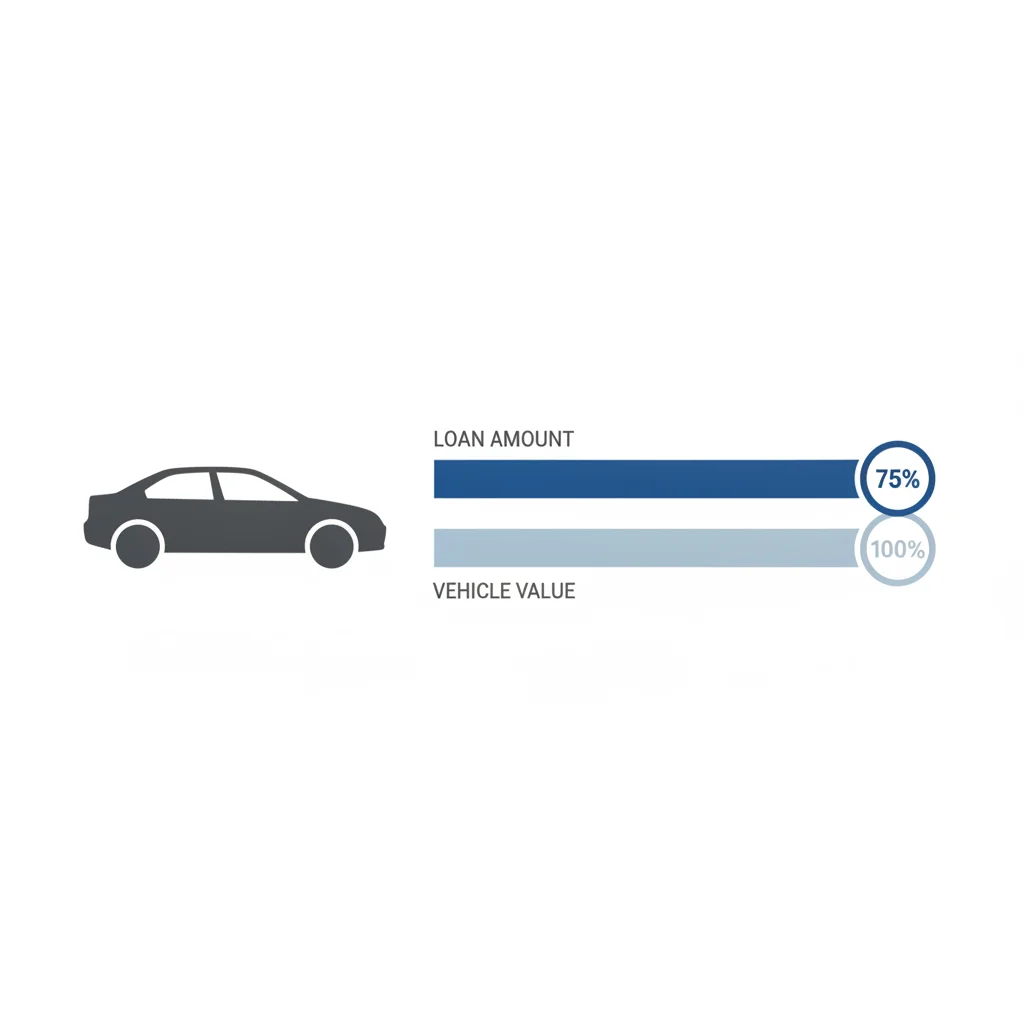
Loan-to-value ratio (LTV) is a percentage that compares how much you're borrowing to how much the vehicle is actually worth. For example, if you borrow $18,000 to buy a car valued at $20,000, your LTV is 90%. The lower your LTV, the less risk a lender takes on — and the better your chances of approval and a reasonable interest rate.
Lenders typically calculate LTV using the vehicle's wholesale value (often from sources like Kelley Blue Book or Black Book), not the sticker price. This means the dealer's asking price and the lender's appraised value can differ, sometimes significantly.
What LTV Actually Measures — and How It's Calculated
Loan-to-value ratio sounds technical, but the math is straightforward. You take the amount you're borrowing, divide it by the car's appraised value, and multiply by 100 to get a percentage.
The formula: LTV = (Loan Amount ÷ Vehicle Value) × 100
Let's make this concrete. Say you're buying a used sedan that a lender values at $16,000. You've saved $2,000 for a down payment, so you need to borrow $14,000. Your LTV is ($14,000 ÷ $16,000) × 100 = 87.5%.
Now imagine you're buying the same car with no down payment. You'd be borrowing the full $16,000, giving you an LTV of exactly 100%. Add in dealer fees or a service contract rolled into the loan, and your LTV could jump to 110% or higher — meaning you're borrowing more than the car is worth from day one.
That gap matters enormously when credit is already a concern. Lenders see a high LTV as a double risk: a borrower who's statistically more likely to default, combined with a loan where they'd struggle to recover their money if they had to repossess and resell the vehicle.
It's also worth noting that lenders don't use the price you negotiate with a dealer. They apply their own valuation — typically from Kelley Blue Book, NADA, or Black Book — to calculate LTV. If you paid $18,500 for a car the lender values at $16,000, your LTV is based on $16,000. That's why overpaying at the dealership can quietly worsen your loan terms without you realizing it.
Why LTV Cuts Deeper for Subprime Borrowers
Every lender balances two questions: Can this borrower repay? and What can we recover if they can't? For borrowers with strong credit, the first question carries most of the weight. For subprime borrowers — those with credit scores typically below 620 — lenders lean harder on the second question. That's where LTV becomes a make-or-break factor.
“Collateral quality and loan-to-value are among the most significant underwriting variables for nonprime auto lenders. When a borrower's credit history is thin or troubled, the vehicle itself becomes the primary risk mitigant — and how much of it the borrower actually owns from day one changes everything about the lender's exposure.”
— Melinda Zabritski, Senior Director of Automotive Financial Solutions, Experian
When your credit score signals a higher probability of default, lenders look at the collateral — the car — as a safety net. A low LTV means that if the loan goes sideways, they can repossess the vehicle and sell it to recover most of what they're owed. A high LTV leaves them exposed. That exposure translates directly into higher interest rates, stricter terms, and, in some cases, outright denial.
38%
New-car buyers with negative equity at trade-in
According to Edmunds data, approximately 38% of trade-in vehicles used toward a new car purchase carried negative equity — a direct result of high LTV financing in prior loans.
~20%
First-year depreciation on new vehicles
Industry data consistently shows new cars lose roughly 15–25% of their value in the first year, making high-LTV new-car loans especially risky for subprime borrowers.
125%
Maximum LTV many subprime lenders will approve
Subprime auto lenders frequently cap LTV at 125% of book value — but this ceiling comes with significantly higher interest rates that compound total loan cost.
5–8%
APR gap between low and high LTV subprime loans
Consumer Financial Protection Bureau research indicates subprime borrowers with high LTV ratios often pay 5–8 percentage points more in APR than those with comparable credit but lower LTV.
Subprime lenders — those who specialize in bad-credit auto loans — will often approve higher LTVs than traditional banks or credit unions, but they compensate with steeper rates. It's not uncommon to see APRs of 18–24% for subprime borrowers with LTVs above 100%. That combination is expensive in the short term and dangerous in the long term.
There's another layer to this: the impact of your credit score on auto loan rates doesn't exist in isolation. Lenders look at LTV and credit score together. A borrower with a 580 score and a 90% LTV is in a meaningfully different position than one with the same score and a 115% LTV — even though both are technically subprime. Getting your LTV down, even by a small amount, can shift which lenders are willing to work with you and what rates they'll offer.
The Underwater Risk — and Why It Starts at Signing
Vehicles depreciate fast. A new car loses roughly 15–25% of its value in the first year. Used cars depreciate more slowly, but they're not immune. When you finance at a high LTV, you start your loan in a precarious position: you may owe more than the car is worth from the moment you drive off the lot.
This condition — owing more than the vehicle's current market value — is called being underwater or having negative equity. It's common, but it's especially dangerous for subprime borrowers who may already be stretched financially.
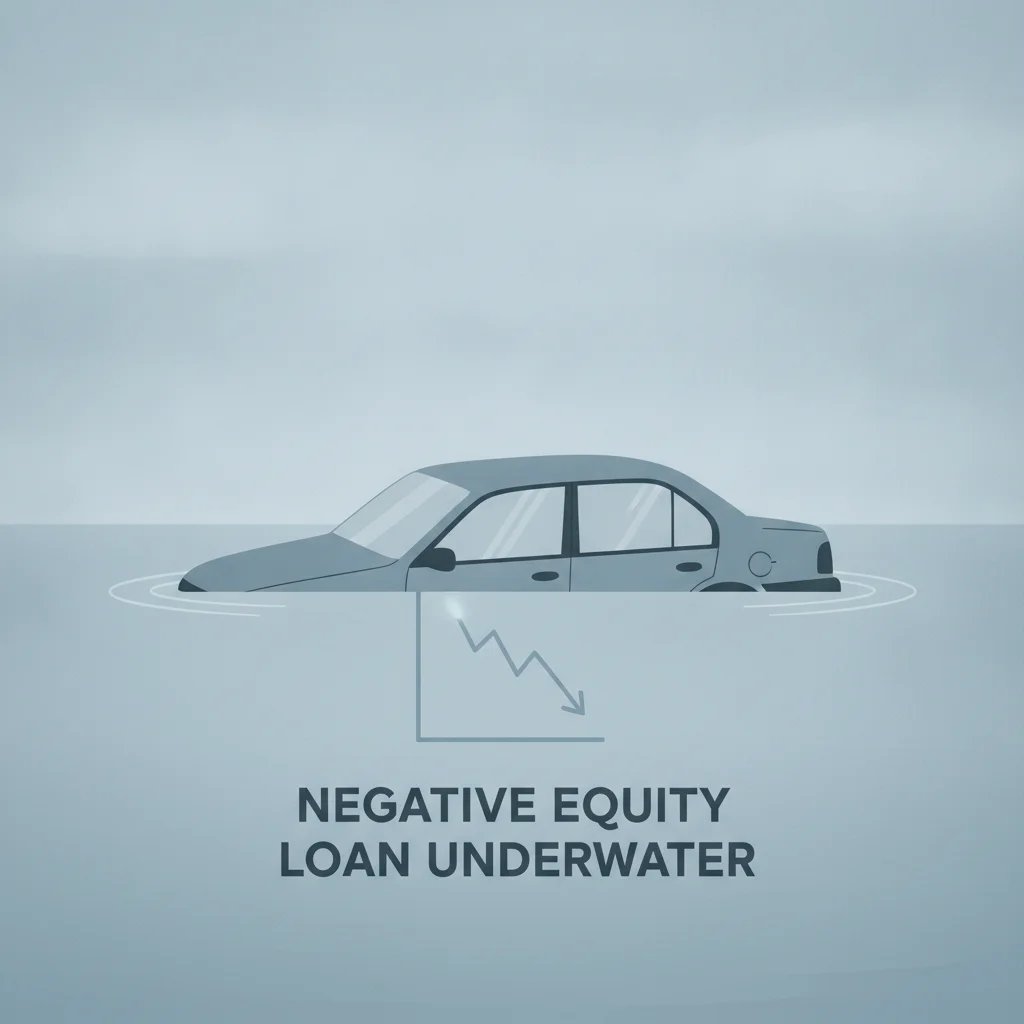
Here's why it matters in practice:
- If you need to sell: You can't sell the car for enough to pay off the loan. You'll have to cover the difference out of pocket or carry that debt forward.
- If the car is totaled: Your insurance pays the car's current market value — not what you owe. Gap insurance can cover the shortfall, but only if you have it.
- If you want to refinance: Most lenders won't refinance a loan where you're deeply underwater. Your options shrink.
- If you want to trade in: Dealers will roll your negative equity into the new loan, pushing your next LTV even higher and deepening the cycle.
The longer a high-LTV loan runs, the longer you remain underwater. Extended loan terms — 72 or 84 months — are particularly risky because the slow amortization schedule means you're paying mostly interest in the early years, building equity very slowly while the car depreciates steadily.
Gap Insurance Is Non-Negotiable at High LTV
If you're financing above 90% LTV — especially as a subprime borrower — gap insurance should be considered essential, not optional. It covers the difference between your loan balance and the car's market value if the vehicle is totaled or stolen. Purchase it from an insurer directly rather than rolling it into the dealer's financing, where it's typically two to three times more expensive.
Target Vehicles With Strong Residual Value
Not all used cars depreciate at the same rate. Vehicles known for reliability and long ownership cycles — many Japanese and Korean models — hold value better than average, meaning you'll exit negative equity faster. Before committing to a vehicle, look up its projected 3-year residual value to understand how depreciation will interact with your LTV over time.
For subprime borrowers, the practical takeaway is this: the vehicle you choose matters as much as the rate you negotiate. A car that holds its value well — think Japanese brands with strong reliability records — reduces how long you'll be underwater compared to a vehicle that depreciates aggressively.
How Down Payments Directly Control Your LTV
The cleanest lever you have over your LTV is your down payment. Because LTV is calculated as loan amount divided by vehicle value, anything that reduces the amount you borrow lowers the ratio. That means your down payment directly controls your position before the loan even starts.
Consider this comparison on a $15,000 vehicle:
| Down Payment | Loan Amount | LTV | Risk Level |
|---|---|---|---|
| $0 | $15,000 | 100% | High — immediately at breakeven |
| $1,500 (10%) | $13,500 | 90% | Moderate — some equity buffer |
| $3,000 (20%) | $12,000 | 80% | Better — likely above water even after early depreciation |
That $3,000 difference in down payment doesn't just change your LTV on paper — it can determine whether a lender approves you at all, what rate they offer, and how long you'll be underwater. For subprime borrowers, a 10–20% down payment is often the threshold that separates approval from denial with better lenders.
There's also the matter of trade-in equity. If you're trading in a vehicle that you own outright or have equity in, that equity can serve as part of your down payment — reducing your LTV without requiring additional cash. Just be cautious: if your trade-in has negative equity (you owe more than it's worth), that balance will be rolled into your new loan and will push your LTV up, not down.
LTV Is Calculated on Book Value, Not Purchase Price
This distinction catches many buyers off guard. If you negotiate a purchase price of $15,500 but the lender's book value for that vehicle is $13,800, your LTV is calculated on $13,800. You may end up with a higher LTV than your math suggested — and a lender asking for more money down before they'll approve the loan. Always ask a lender what value they're using before you finalize your down payment calculation.
DTI and LTV Work Together in Lender Decisions
Lenders evaluate LTV alongside your debt-to-income ratio, not in isolation. A favorable LTV can partially offset a weak DTI, and vice versa. If both figures are strained, approval becomes significantly harder regardless of which subprime lender you approach. Understanding how <a href="/auto-loans/credit-and-approval/credit-score-impact/how-lenders-use-your-debt-to-income-ratio-alongside-your-credit-score">lenders balance DTI and credit score</a> together gives you a more complete picture of your application.
For a deeper look at how down payments interact with LTV, see our guide to LTV and down payments, which walks through the math and thresholds in more detail.
What Lenders Actually Do with Your LTV Number
Understanding how lenders use LTV helps you anticipate what they'll offer — and negotiate from a more informed position.
Approval decisions
Many lenders have hard LTV caps. A credit union might cap auto loans at 100% of book value, period. A subprime lender might go to 125%, but only for certain vehicle types or credit profiles. If your requested loan exceeds their LTV cap, they'll either require a larger down payment or decline the application.
Interest rate pricing
LTV is a direct input in how lenders price risk. Higher LTV = higher rate, even for borrowers at the same credit score. Two applicants with identical 590 scores might receive different APR offers if one is financing at 85% LTV and the other at 110% LTV. The gap can be several percentage points — which adds thousands of dollars over the life of the loan.
Loan term limits
Some lenders restrict available loan terms based on LTV. If your LTV is high and the vehicle is older or has high mileage, lenders may only offer shorter terms to limit their exposure. This can push your monthly payment up in ways you didn't anticipate. For a fuller picture of how this dynamic plays out, see how LTV shapes your loan terms across every dimension of the offer.
Lender type selection
Your LTV also determines which type of lender is realistically available to you. Traditional banks and credit unions typically want LTVs below 100%. Captive finance arms (manufacturer lenders) have their own criteria. Subprime-specialist lenders will take higher LTVs but charge accordingly. Knowing where you stand lets you target the right lender rather than collecting hard inquiries from lenders who will never approve you.
This connects closely to your overall application picture. Lenders aren't just looking at LTV in isolation — they're also evaluating your debt-to-income ratio and how your income holds up against your existing obligations. A manageable LTV paired with a high DTI can be just as problematic as the reverse.
LTV Is Calculated on Book Value, Not Purchase Price
This distinction catches many buyers off guard. If you negotiate a purchase price of $15,500 but the lender's book value for that vehicle is $13,800, your LTV is calculated on $13,800. You may end up with a higher LTV than your math suggested — and a lender asking for more money down before they'll approve the loan. Always ask a lender what value they're using before you finalize your down payment calculation.
DTI and LTV Work Together in Lender Decisions
Lenders evaluate LTV alongside your debt-to-income ratio, not in isolation. A favorable LTV can partially offset a weak DTI, and vice versa. If both figures are strained, approval becomes significantly harder regardless of which subprime lender you approach. Understanding how <a href="/auto-loans/credit-and-approval/credit-score-impact/how-lenders-use-your-debt-to-income-ratio-alongside-your-credit-score">lenders balance DTI and credit score</a> together gives you a more complete picture of your application.
Practical Steps to Improve Your LTV Before You Apply
If your credit is already working against you, you need your LTV to work for you. Here are concrete actions that move the number in the right direction.
1. Save more before you buy
Even an extra $500–$1,000 in down payment can shift your LTV meaningfully on a lower-priced used car. If your timeline allows, delaying the purchase by a few months to save more is usually the highest-return financial move available to you.
2. Choose a less expensive vehicle
Financing a $12,000 car instead of an $18,000 car doesn't just reduce your payment — it gives you more control over your LTV with the same down payment. A smaller loan on a reliable, lower-cost vehicle often produces better total outcomes for subprime borrowers than stretching for something more expensive.
3. Avoid rolling extra costs into the loan
Dealer fees, service contracts, GAP insurance, and accessories all inflate the loan amount and push LTV up. Pay these out of pocket where possible, or skip the add-ons entirely. A GAP insurance policy purchased independently is usually far cheaper than what dealers bundle into the financing.
4. Get an independent vehicle appraisal
If you're buying from a private seller or a smaller dealer, knowing the book value before you negotiate helps you avoid overpaying — which would artificially raise your LTV in the lender's eyes, even if you think you got a fair deal.
5. Consider the vehicle's depreciation curve
All cars depreciate, but some drop faster than others. Financing a vehicle with a strong residual value — one that's known to hold its price — means depreciation works less against you. This reduces how long you'll be underwater and makes refinancing more feasible once your credit improves.
Gap Insurance Is Non-Negotiable at High LTV
If you're financing above 90% LTV — especially as a subprime borrower — gap insurance should be considered essential, not optional. It covers the difference between your loan balance and the car's market value if the vehicle is totaled or stolen. Purchase it from an insurer directly rather than rolling it into the dealer's financing, where it's typically two to three times more expensive.
Target Vehicles With Strong Residual Value
Not all used cars depreciate at the same rate. Vehicles known for reliability and long ownership cycles — many Japanese and Korean models — hold value better than average, meaning you'll exit negative equity faster. Before committing to a vehicle, look up its projected 3-year residual value to understand how depreciation will interact with your LTV over time.
Once you're further in the process, understanding how your full credit profile fits together — including how subprime lenders evaluate DTI thresholds alongside LTV — will help you approach lenders with realistic expectations and a stronger negotiating position.

All claims are backed by peer-reviewed research. Sources on request.