
Key Takeaways
Why Preapproval Fundamentally Rewires the Dealership Conversation
Most car buyers walk onto a lot without financing lined up. Dealers know this, and they've built an entire playbook around it. The first question a salesperson is trained to ask — directly or indirectly — is how much can you afford per month? Once you answer that, you've handed them the steering wheel. They can inflate the loan term, mark up the interest rate, fold in extras, and still technically stay within your number. You never see the full cost of the deal because you're focused on a single monthly figure.
A preapproval dismantles that playbook. When you arrive with a loan commitment from a bank or credit union already in hand, the conversation has to move to the vehicle's actual price — because you've already settled your financing question elsewhere. Walking in pre-approved shifts the entire frame of the negotiation, from "what can you afford" to "what is this car actually worth."
That reframe is worth hundreds — sometimes thousands — of dollars. Here's exactly how to use that advantage from the moment you drive onto the lot to the moment you sign.
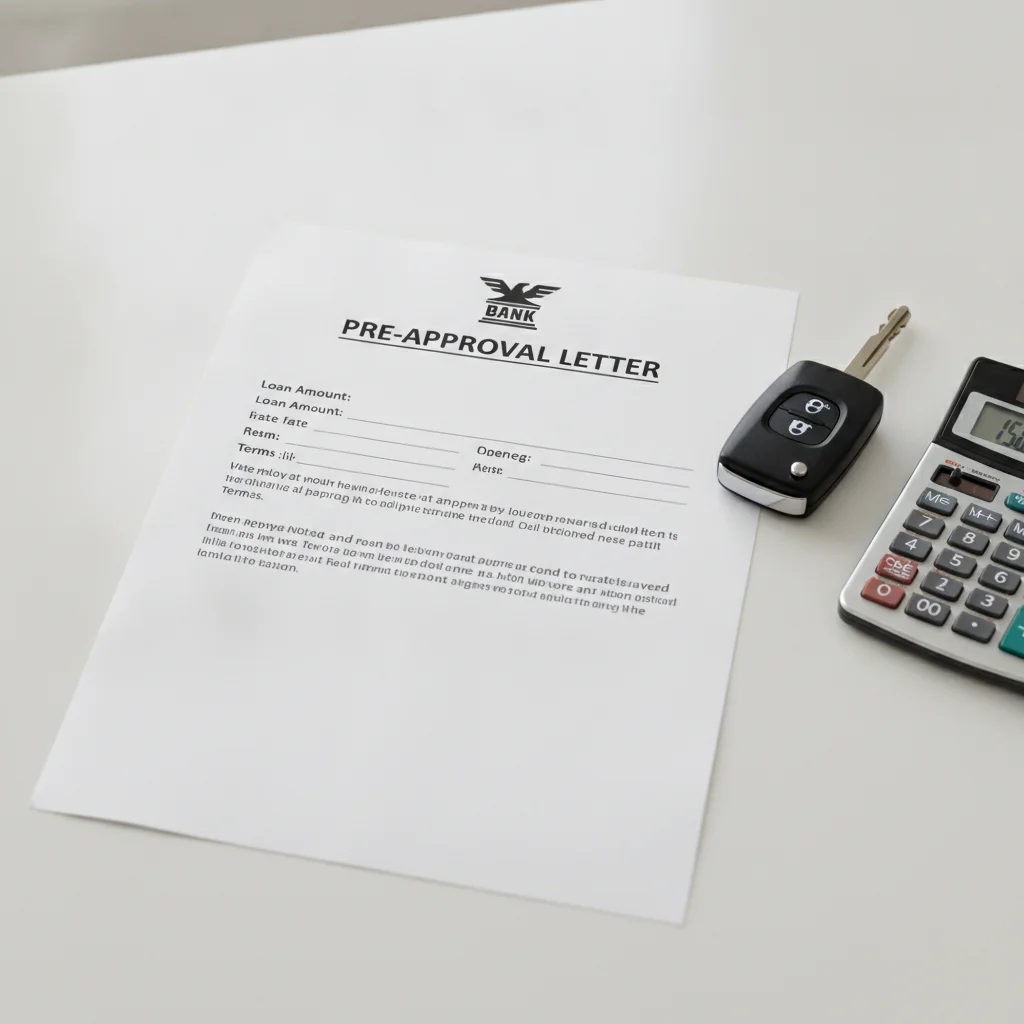
Before we get into the steps, one clarification: a preapproval is not the same as a prequalification. A prequalification is a soft, estimate-based inquiry. A preapproval involves a hard credit pull and results in an actual loan commitment with a specified rate and amount. If you haven't secured a true preapproval yet, follow this step-by-step walkthrough of the preapproval process before you go any further.
What to Bring and How to Prepare Before You Arrive
Your preapproval letter is your most important document, but it doesn't work in isolation. The way you present it — and what surrounds it — determines whether it gives you leverage or just reassures the dealer that you're already committed to buying.
What you will need
Beyond the documents, preparation means knowing three numbers cold before you walk in:
- Your preapproved rate — the APR your lender committed to.
- Your target out-the-door price — the total you're willing to pay including taxes, title, and fees. Not a monthly payment.
- Your trade-in's market value — pulled from at least two sources (Kelley Blue Book and CarMax's online offer, for example). Keep this number separate from your purchase negotiation.
Print the preapproval letter. Yes, physically print it. Digital documents on a phone screen are easy to dismiss or redirect. A printed letter on a lender's letterhead sitting on the desk in front of a salesperson is a tangible signal that you've done the work. It changes how seriously they treat you from the first handshake.
Preapproval Letter (Printed)
Serves as your financing commitment and primary negotiating anchor throughout the dealership visit.
Out-the-Door Price Calculator
Used to calculate the true total cost of the vehicle including taxes and fees before agreeing to any number.
Trade-In Valuation (Kelley Blue Book / CarMax Offer)
Provides an independent benchmark for your trade-in so you can negotiate it as a separate transaction.
Loan Amortization Calculator
Lets you compare the true dollar cost of competing loan offers when a dealer claims to beat your rate.
Notepad or Spreadsheet
Track each negotiation element — vehicle price, fees, trade-in, and add-ons — separately to prevent blending.
Step-by-Step: Using Your Preapproval at the Dealership
The sequence in which you reveal information at a dealership matters enormously. Dealers are trained to gather information early and use it later to construct deals that favor their margin. Your job is to control the flow. Follow these steps in order.
Negotiate the vehicle price before mentioning financing
When you sit down with a salesperson, your opening position is simple: you want to discuss the out-the-door price of the vehicle. Nothing else yet. Do not mention your preapproval, your trade-in, or your down payment at this stage.
Ask the salesperson for their best out-the-door price on the specific vehicle. Get it in writing — even a handwritten number on a business card is enough to anchor the conversation. This is your starting point for negotiation.
Most salespeople will push you toward a monthly payment discussion. Redirect firmly: "I'm focused on the total price today. What's your best number on this vehicle?" Repeat as needed. This single discipline prevents payment-packing before it starts.
Agree on a firm vehicle price in writing
Once the salesperson presents a price — or you counter and they respond — work toward a specific, agreed-upon purchase price before moving forward. This number should be the vehicle price only, excluding taxes and fees, so you can verify those line items separately later.
Push for a number at or near invoice, factoring in any current manufacturer-to-dealer incentives. If the dealer claims there's no room, ask to see the invoice. Not every dealer will show it, but the willingness to ask signals that you're an informed buyer — which alone often moves the number.
Get the agreed price confirmed in writing — typically on a buyer's order or worksheet — before proceeding to any other discussion.
Introduce your preapproval and invite the dealer to compete
Once you have a firm purchase price agreed upon, now you introduce your financing. Hand the salesperson your printed preapproval letter and say something direct: "I have financing arranged at [your rate]. If your finance office can beat that rate on the same terms, I'm open to hearing the offer. Otherwise, I'll use my own lender."
This is the moment your preapproval works hardest. You've anchored the price already. Now you're inviting a rate competition rather than letting the dealer use rate as a way to obscure the price.
Your preapproval rate is a negotiating anchor that dealers must actively beat — and many will try, because dealer-arranged financing generates backend profit they don't want to lose entirely.
Handle the trade-in as a completely separate transaction
If you're trading in a vehicle, introduce it only after the purchase price and financing are both settled. Tell the salesperson explicitly: "I'd like to handle the trade-in separately once we've nailed down the purchase details."
Present your independent valuation — your KBB instant cash offer or CarMax quote — as your benchmark. The dealer needs to meet or beat that number, and because you negotiated the vehicle price first, there's no room for them to inflate your trade value while quietly raising the purchase price.
If the dealer insists on blending all four elements at once, hold firm. A buyer who separates the transactions is demonstrably harder to overcharge. Some dealers will respect that and some won't — either way, the posture protects you.
Calculate and verify your out-the-door total before moving to the F&I office
Before you walk into the Finance and Insurance office, ask for a complete buyer's order that itemizes every cost: vehicle price, documentation fee, state sales tax, title and registration fees, and any agreed-upon accessories. Add these up yourself.
Compare this total to your pre-calculated out-the-door target. If the number is higher than expected, identify which line item is the discrepancy and address it now — not in the F&I office where the pressure intensifies.
Documentation fees (often called "doc fees") are the most common inflation point. These fees vary by state and dealer, but they're often negotiable or at least worth questioning. In some states they're capped by law; in others, dealers set them freely.
Make your final financing decision and confirm all documents match
In the F&I office, you'll be presented with the retail installment contract if you're using dealer financing, or you'll finalize delivery arrangements if you're using your preapproval lender. Either way, read every document fully before signing.
If you're using your external preapproval: the dealer will contact your lender, who will fund the loan and pay the dealer directly. Confirm with your lender before the visit how this process works on their end — some require you to sign documents at their branch; others handle it entirely electronically.
If the dealer beat your preapproval rate: verify that the rate on the retail installment contract matches exactly what was offered verbally. Check the loan term too — a lower rate over a longer term can cost you more in total interest than your preapproval would have.
Handling the F&I Office With a Preapproval in Hand
Even with a preapproval, you will sit across from a Finance and Insurance (F&I) manager before you leave. This is the room where dealerships make a significant portion of their profit — and where buyers with preapprovals sometimes let their guard down because they think the hard part is over.

The F&I manager's primary tools are add-on products: extended warranties, GAP insurance, paint protection packages, tire-and-wheel coverage, credit life insurance, and more. These are often presented as a monthly payment increase rather than a lump-sum cost, which obscures how expensive they are over the life of the loan.
Don't Sign Anything Under Time Pressure
F&I managers are trained to create urgency — a deal that expires tonight, a rate that's only good until closing. These are almost never real constraints. If you feel rushed into signing documents you haven't fully read, say clearly that you need more time. A legitimate deal will still be there tomorrow.
Watch for Add-Ons Rolled In Without Consent
Extended warranties, paint sealants, and fabric protection packages sometimes appear on the retail installment contract even if you didn't explicitly agree to them. Read every line of the contract before signing, and question any product you don't recognize or didn't request.
Here's how to handle this room with a preapproval:
- Evaluate each product individually. Ask for the stand-alone price of every add-on, not the monthly impact. Then decide if it's worth buying at that price from this source. GAP insurance, for example, is often available through your own insurer for a fraction of the dealership price.
- Don't let add-ons roll into your preapproval loan without recalculating. If you add products to the deal, the total financed amount may exceed your preapproval limit. Know your ceiling.
- Use your preapproval as an exit signal. If the F&I manager tries to switch you to dealer financing with a rate only marginally better, remind them that you have committed financing in hand. The burden is on them to meaningfully beat your rate — not to match it by a tenth of a percent while layering in extras.
Your preapproval letter is a negotiating tool that extends deep into the F&I room — most buyers don't realize it's still working for them at that stage of the deal.
GAP Insurance Is Cheaper Elsewhere
If you're financing more than 80% of the vehicle's value, GAP insurance is genuinely worth having. But buying it from the dealership's F&I menu typically costs $400–$900 rolled into your loan. Your own auto insurer can usually add GAP coverage for $20–$40 per year. Buy it from them, not the dealer.
Multiple Preapprovals Won't Hurt Your Credit
Rate shopping with multiple lenders within a 14–45 day window (depending on the scoring model) counts as a single hard inquiry. Get preapprovals from your bank, a credit union, and one online lender before your dealership visit. The extra options give you leverage without any meaningful credit score impact.
Common Dealer Tactics That Still Work on Preapproved Buyers
A preapproval neutralizes the payment-packing trick, but dealers have other moves. Knowing them is the difference between walking away with a clean deal and realizing three days later that you overpaid.
The four-square worksheet
Some dealers still use a four-square sheet that combines vehicle price, trade-in value, down payment, and monthly payment into one visual. The goal is to make concessions in one quadrant while quietly making up margin in another. With a preapproval, demand that each item be negotiated on a separate, clean sheet. Refuse to work from a four-square.
Payment switching after the handshake
You agree on a price in the showroom. By the time you get to the F&I office, the numbers on the paperwork look slightly different — a fee added here, a protection package rolled in there. Always re-read every line of every document before signing. Pay particular attention to any documents that grant the dealer authority over your financing or title work.
The rate-beat distraction
A dealer may offer to beat your preapproval rate by 0.1–0.2% as a way to pull you into their financing — where they earn reserve on the loan. That tiny rate difference may not be worth it if it means losing transparency on the deal structure. Calculate the actual dollar difference in interest paid before agreeing to switch.
Trade-in blending
If you're trading in a vehicle, the dealer may offer a high trade value while quietly raising the purchase price, or vice versa. Always negotiate the vehicle purchase price to a firm number before introducing the trade-in. This forces both transactions to stand on their own merits. For a full breakdown of dealership negotiation tactics, explore our dealer negotiation hub.

None of these tactics become invisible just because you have a preapproval. What the preapproval does is eliminate the biggest source of confusion — financing — so you have more mental bandwidth to catch these others.
Never Reveal Your Monthly Payment Target
If a salesperson asks what monthly payment you're comfortable with, do not answer with a number — ever. Disclosing a payment ceiling is the single most expensive mistake a buyer can make at a dealership. It gives the dealer permission to work backward from that number, extending loan terms and padding margins while staying inside your stated budget. Direct every conversation to the total vehicle price instead.
After the Deal: Confirming Your Final Financing
Once you've agreed on a price and decided on your financing source — whether that's your preapproval lender or a dealer-arranged loan that genuinely beats your rate — there are a few final checks before you drive off the lot.
Review the retail installment contract line by line
The retail installment contract (RIC) is the legally binding financing document. Verify that the APR, loan term, total amount financed, and monthly payment match exactly what was agreed verbally. If anything differs — even by a small amount — ask for a corrected document before signing.
Confirm the total out-the-door figure
Add up the vehicle price, documentation fee, state taxes, title and registration fees, and any add-ons you agreed to. This should match your pre-negotiated out-the-door number. If it doesn't, get an itemized breakdown of every line.
Understand your preapproval's expiration window
Most preapprovals are valid for 30 to 60 days. If you didn't use your external preapproval because the dealer beat the rate, keep that letter on file anyway. If the dealer financing falls through (called a "spot delivery" or "yo-yo financing" situation), having a backup is critical. Understanding the full scope of your preapproval's limitations helps you avoid surprises after the sale.
Finally, if dealer financing beats your preapproval rate by a meaningful margin, notify your original lender that you didn't use the loan. This keeps your credit file clean and your relationship with that institution in good standing for future borrowing.
The bottom line: a preapproval doesn't guarantee a perfect deal — but it gives you the structure to negotiate one. Every step of this process is designed to keep the conversation where you want it: on price, not payments, and on facts, not dealer-constructed confusion. That's the edge buyers who arrive prepared consistently have over those who don't.

All claims are backed by peer-reviewed research. Sources on request.