
| Most Common Auto Loan Terms | 48, 60, and 72 months (Experian State of the Automotive Finance Market, 2024) |
| Average New Car APR (Good Credit) | Approximately 6–7% (Experian, Q1 2024) |
| Typical Dealer Rate Markup (Buy Rate) | 1–3 percentage points (Consumer Financial Protection Bureau (CFPB)) |
| Recommended Max DTI for Auto Loans | Under 43% (General lender guidance) |
| Preapproval Credit Inquiry Window | 14–45 days (treated as one inquiry) (FICO and VantageScore scoring models) |
| Preapproval Validity Period | Typically 30–60 days (Varies by lender) |
Why These Terms Matter Before You Walk In
Here's what most car buyers don't realize: the moment you sit down in a dealership finance office, you're already behind. The F&I manager speaks a language built around monthly payments — not total cost, not APR, not finance charges. That language is designed to obscure what you're actually agreeing to.
A preapproval from a bank or credit union flips that dynamic. It hands you a document with exact numbers — APR, loan term, maximum principal — that you can hold up against anything the dealer offers. But only if you understand what those numbers mean.
This glossary covers every key term you'll encounter in a preapproval offer. Learn these before you apply, and you'll walk into any dealership negotiation with your eyes open. For a broader look at how lenders decide whether to preapprove you in the first place, see what lenders evaluate before issuing a preapproval.
| Most Common Auto Loan Terms | 48, 60, and 72 months (Experian State of the Automotive Finance Market, 2024) |
| Average New Car APR (Good Credit) | Approximately 6–7% (Experian, Q1 2024) |
| Typical Dealer Rate Markup (Buy Rate) | 1–3 percentage points (Consumer Financial Protection Bureau (CFPB)) |
| Recommended Max DTI for Auto Loans | Under 43% (General lender guidance) |
| Preapproval Credit Inquiry Window | 14–45 days (treated as one inquiry) (FICO and VantageScore scoring models) |
| Preapproval Validity Period | Typically 30–60 days (Varies by lender) |
The Core Terms in Every Preapproval Offer
Every preapproval letter contains a handful of numbers. Here's exactly what each one means and why it matters at the negotiating table.
APR (Annual Percentage Rate)
APR is the most important number on your preapproval. It represents the total yearly cost of borrowing — interest rate plus any lender fees — expressed as a single percentage. Because it wraps in fees that a plain interest rate doesn't show, APR is the correct number to compare across lenders.
A dealer who quotes you a 7.9% "interest rate" while your preapproval shows 6.4% APR is offering you a worse deal, full stop. Don't let a conversation about monthly payments distract you from that gap. For a deeper breakdown of how APR is calculated, the Interest & APR hub covers the mechanics in detail.

Principal
Principal is the raw amount you borrow — the vehicle price minus your down payment and any trade-in credit, plus taxes, fees, and any add-ons you roll in. Every dollar you add to principal costs you more in interest over time, which is why dealers love selling you extended warranties, paint protection, and gap insurance through the loan rather than upfront in cash.
Your preapproval will state a maximum loan amount. You don't have to use all of it. Borrowing less than your approved limit is always smarter if the vehicle price allows it.
Loan Term
Loan term is the repayment period, almost always expressed in months. Standard terms are 36, 48, 60, and 72 months, with 84-month loans now appearing more frequently on new vehicles. The Loan Terms Explained hub breaks down exactly how term length affects what you pay.
Dealers push longer terms because they reduce the monthly payment — making an expensive car feel affordable — while dramatically increasing total interest paid. A 72-month loan at 7% APR on $35,000 costs nearly $4,400 more in interest than the same loan at 48 months. Know your term before you walk in.
Monthly Payment
The monthly payment is what you'll pay each month until the loan is paid off. It's calculated from your principal, APR, and loan term. It's also the number dealerships use to anchor every conversation, because it hides the real cost of the loan.
If a dealer asks "what monthly payment are you comfortable with?" before discussing price or APR — that's a red flag. Always negotiate the vehicle price and loan terms separately.
72%
New car buyers who finance through the dealership
According to Experian's 2024 Automotive Finance Market report, most buyers still take dealer-arranged financing despite outside options.
2.4%
Average dealer interest rate markup
The CFPB has documented dealer markups averaging well over two percentage points above the lender's buy rate on discretionary pricing arrangements.
$1,600+
Extra interest from a 2-point rate markup on a $30K loan
On a 60-month, $30,000 loan, a 2-percentage-point rate increase from 5% to 7% adds over $1,600 in total interest paid.
60 days
Typical preapproval validity window
Most bank and credit union preapprovals remain valid for 30–60 days, giving you time to shop without rushing.
Terms That Define What Borrowing Actually Costs
Beyond the headline numbers, a few less-prominent terms determine how much you'll actually spend over the life of the loan.
Finance Charge
The finance charge is the total dollar amount you pay in interest and fees over the full loan term. It's the single clearest measure of a loan's cost. A preapproval with a 6.5% APR on a 72-month term might carry a larger finance charge than a 7.0% APR on 48 months — because time is expensive. Always ask for or calculate the total finance charge before comparing offers.
Amortization
Amortization describes how each payment is split between interest and principal. In the early months of a loan, a disproportionate share of your payment goes toward interest. By the midpoint of a 60-month loan, you've paid well over half your total interest but reduced your principal balance by far less than half.
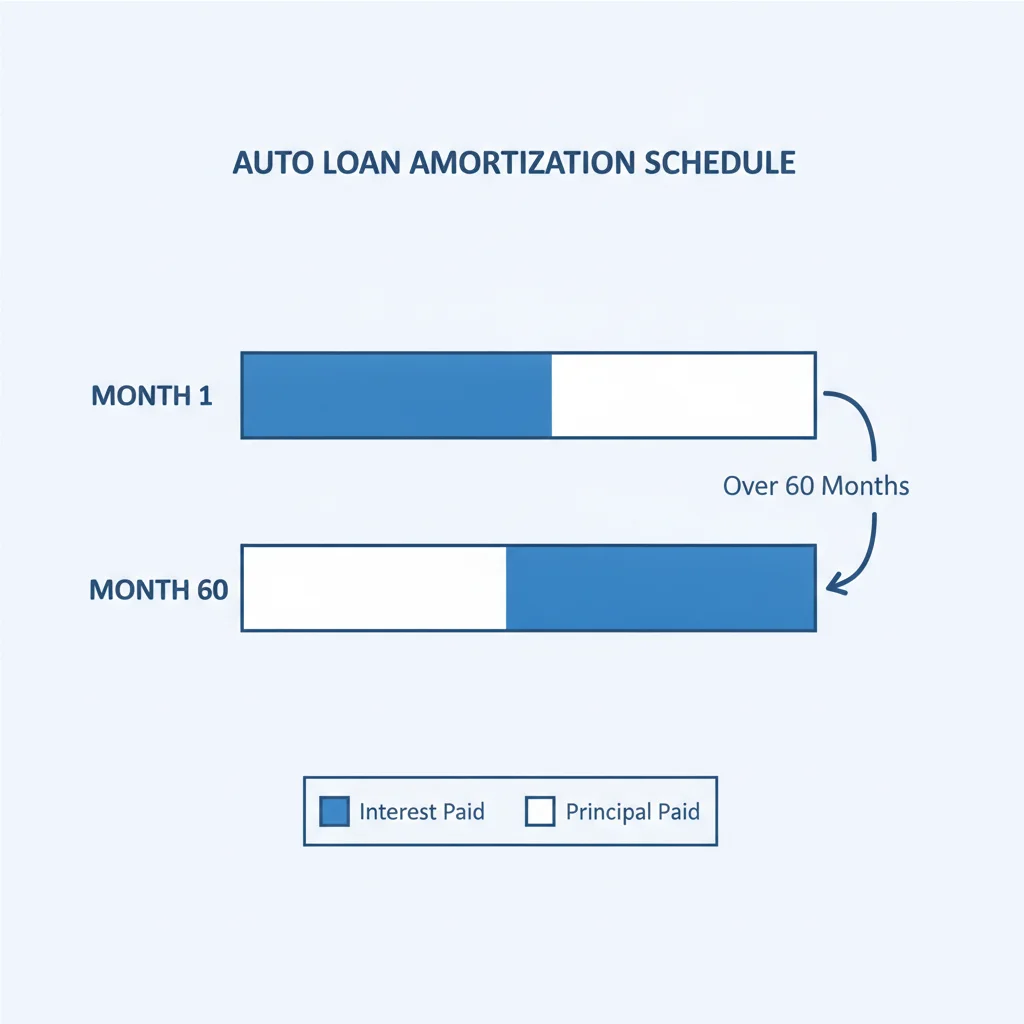
This matters because it affects your equity position. If you sell or trade the car in year two, you may owe more than the car is worth — a situation called being "underwater" or having negative equity. Understanding amortization helps you plan trade-in timing intelligently.
Simple Interest vs. Precomputed Interest
Most auto loans use simple interest — interest accrues daily on your outstanding balance. Pay early, pay extra, and you'll save real money. Precomputed interest loans calculate and lock in total interest upfront. If you pay these off early, you don't save as much as you'd expect. Check which structure your preapproval uses — it's usually in the fine print. The auto loan interest glossary covers these structures in plain English.
Preapproval Is Not a Final Commitment
A preapproval offer is conditional — it can change if the car you choose doesn't meet the lender's criteria, if your financial situation changes, or if the loan amount differs significantly from what was evaluated. Treat it as a firm starting point, not a locked-in contract. Always confirm final terms before you sign.
Rate Shopping Won't Hurt Your Credit Score
Most credit scoring models treat multiple auto loan inquiries made within a 14–45 day window as a single inquiry. This means you can — and should — apply to several lenders to collect competing preapproval offers without damaging your score. Use that window strategically.
The Dealer's Rate Is Usually Marked Up
When you finance through a dealership, the F&I (finance and insurance) manager works with lenders who set a base 'buy rate.' The dealer is typically allowed to add a markup — sometimes 1–3 percentage points — as compensation. A preapproval from an outside lender gives you a baseline that removes this leverage entirely.
Terms That Determine Your Rate and Approval
The rate you're offered in a preapproval isn't random. It's driven by a specific set of financial signals lenders examine before deciding how much risk they're taking on.
Loan-to-Value Ratio (LTV)
LTV compares the loan amount to the vehicle's actual market value. A $28,000 loan on a car worth $30,000 is an LTV of about 93% — relatively safe for the lender. A $32,000 loan on the same car is 107% LTV — the lender is now exposed if you default and they have to sell the car to recover the debt. Higher LTV typically means a higher rate or a declined application.
Dealers can push your LTV above 100% by rolling fees, add-ons, and negative equity from a trade-in into the loan. Your preapproval's maximum loan amount is the ceiling — the lender has already calculated an acceptable LTV for your situation.
Debt-to-Income Ratio (DTI)
DTI is your total monthly debt obligations divided by gross monthly income. If you earn $5,000/month and pay $1,800 in existing debts (rent, credit cards, student loans), your DTI is 36%. Most lenders prefer DTI under 43% for auto loans; lower is better.
Your DTI directly affects whether you're approved and at what rate. See what lenders look at before issuing a preapproval for the full picture of how this calculation works.
The Buy Rate (and Why It Matters at a Dealership)
The buy rate is the actual interest rate a lender quotes to a dealer for your loan — before any dealer markup. When you finance through a dealership, the F&I manager can legally mark up that rate and keep the difference as compensation. The CFPB has flagged this practice repeatedly for its potential to add significant cost without the buyer's knowledge.
Your preapproval from an outside lender is your defense. It gives you a number no dealer can mark up. If the dealer can beat your preapproval rate legitimately, great — take it. If not, use what you walked in with. See the full auto loan glossary for more terms like this one that affect your costs in non-obvious ways.
Annual Percentage Rate (APR)
The true yearly cost of borrowing, expressed as a percentage. APR includes the interest rate plus any lender fees rolled into the loan, making it a more accurate cost comparison tool than the interest rate alone.
Principal
The original amount of money you borrow, before interest is added. Every payment you make reduces your principal balance, though early payments are weighted heavily toward interest under a standard amortization schedule.
Loan Term
The length of time you have to repay the loan, typically expressed in months (e.g., 36, 48, 60, or 72 months). Longer terms lower your monthly payment but increase total interest paid.
Preapproval
A conditional lending commitment from a bank, credit union, or online lender stating the maximum amount they will lend you, at a specific rate and term, based on a review of your credit and financial profile.
Debt-to-Income Ratio (DTI)
Your total monthly debt payments divided by your gross monthly income, expressed as a percentage. Lenders use DTI to gauge whether you can handle additional loan payments without financial strain.
Amortization
The process of paying off a loan through scheduled payments over time. Each payment covers both interest and principal, with the interest share shrinking and the principal share growing as the loan matures.
Finance Charge
The total dollar cost of borrowing, including all interest and fees paid over the full life of the loan. It's the single clearest number for comparing the absolute cost between two loan offers.
Loan-to-Value Ratio (LTV)
The ratio of your loan amount to the vehicle's actual cash value. A high LTV (borrowing close to or above the car's value) signals higher risk to lenders and often triggers a higher interest rate.
Down Payment
The upfront cash amount you pay toward the vehicle purchase. A larger down payment reduces your principal, lowers your LTV, and typically helps you qualify for a better rate.
Precomputed Interest
A loan structure where total interest is calculated upfront and added to the principal, meaning early payoff does not save you the full amount of remaining interest you might expect.
Simple Interest
The most common auto loan structure, where interest accrues daily on your outstanding balance. Paying early or making extra payments directly reduces interest costs.
Buy Rate
The actual interest rate a lender offers to a dealer for your loan. Dealers are often allowed to mark up this rate and pocket the difference — your preapproval eliminates this vulnerability.
Using Your Preapproval as a Negotiating Tool
A preapproval offer is leverage — but only if you know how to use it. Here's how to put these terms to work at the dealership.
Never Lead With the Preapproval
Walk in as a cash buyer. Negotiate the vehicle purchase price first, without revealing that you have financing arranged. Once you have an agreed-upon price, then introduce your preapproval. The dealer's F&I office may try to beat it — let them try. But the baseline is set by your lender, not their rate sheet.
Compare APR, Not Monthly Payments
If a dealer offers you financing, compare their APR directly to your preapproval APR. Don't let them reframe the conversation around payment amounts — a lower payment achieved through a longer term is almost always a worse deal in total cost. For a structured approach to comparing multiple offers, see how to compare preapproval offers without getting overwhelmed.
Watch What Gets Rolled Into the Principal
Gap insurance, extended warranties, paint sealant, tire protection — these products are often presented as must-haves and rolled into the loan without clearly stating the cost. Every dollar added to principal is a dollar you're paying interest on for the life of the loan. If you want any of these products, price them separately and pay cash if possible.
Verify the Final Loan Terms Before Signing
Before you sign any contract, confirm the APR, loan term, principal, and total finance charge match what you were quoted. Errors — intentional or not — do happen. The Truth in Lending Act (TILA) requires lenders to disclose these numbers clearly in the loan contract. Read that disclosure before you pick up the pen.
Preapproval Is Not a Final Commitment
A preapproval offer is conditional — it can change if the car you choose doesn't meet the lender's criteria, if your financial situation changes, or if the loan amount differs significantly from what was evaluated. Treat it as a firm starting point, not a locked-in contract. Always confirm final terms before you sign.
Rate Shopping Won't Hurt Your Credit Score
Most credit scoring models treat multiple auto loan inquiries made within a 14–45 day window as a single inquiry. This means you can — and should — apply to several lenders to collect competing preapproval offers without damaging your score. Use that window strategically.
The Dealer's Rate Is Usually Marked Up
When you finance through a dealership, the F&I (finance and insurance) manager works with lenders who set a base 'buy rate.' The dealer is typically allowed to add a markup — sometimes 1–3 percentage points — as compensation. A preapproval from an outside lender gives you a baseline that removes this leverage entirely.
The Auto Loan Preapproval Process, Start to Finish
A comprehensive walkthrough of the preapproval process from first application to walking into the dealership with an offer in hand. Essential reading before you apply.
How to Compare Preapproval Offers Without Getting Overwhelmed
A structured method for evaluating APR, loan term, fees, and monthly payment side by side across multiple lenders so you can choose confidently.
Auto Loan Glossary: 25 Terms Every Borrower Should Know
A broader plain-language reference covering amortization, LTV, precomputed interest, and more — a useful companion to this preapproval-specific glossary.
Interest & APR Hub
Deep-dive explainers on how interest rates and APR affect the true cost of your car loan, including how lenders calculate what you owe.
Quick Reference: What to Check on Your Preapproval Letter
When your preapproval arrives — by email, mail, or through a lender portal — here's the checklist of terms to locate and record before you go car shopping:
- Maximum loan amount — the ceiling on what you can borrow. Plan to stay well below it if possible.
- APR — your comparison baseline for any dealer financing offer.
- Loan term — the number of months the lender is approving you for. You can negotiate a shorter term.
- Monthly payment estimate — useful for budgeting, but don't let this drive your negotiation.
- Expiration date — most preapprovals expire in 30–60 days. Know your deadline.
- Any conditions — some preapprovals require the vehicle to meet certain age, mileage, or value criteria.
Once you have this information in hand, you're equipped to evaluate any financing offer you receive — from the dealer or another lender. The full preapproval process guide walks you through applying and comparing offers from start to finish.
Preapproval Is Not a Final Commitment
A preapproval offer is conditional — it can change if the car you choose doesn't meet the lender's criteria, if your financial situation changes, or if the loan amount differs significantly from what was evaluated. Treat it as a firm starting point, not a locked-in contract. Always confirm final terms before you sign.
Rate Shopping Won't Hurt Your Credit Score
Most credit scoring models treat multiple auto loan inquiries made within a 14–45 day window as a single inquiry. This means you can — and should — apply to several lenders to collect competing preapproval offers without damaging your score. Use that window strategically.
The Dealer's Rate Is Usually Marked Up
When you finance through a dealership, the F&I (finance and insurance) manager works with lenders who set a base 'buy rate.' The dealer is typically allowed to add a markup — sometimes 1–3 percentage points — as compensation. A preapproval from an outside lender gives you a baseline that removes this leverage entirely.

All claims are backed by peer-reviewed research. Sources on request.