
Key Takeaways
Start here
What Is Loan Preapproval and Why Does It Matter?
Next
How Preapproval Gives You Negotiating Power
Then
What Lenders Look at When You Apply
When you're ready
Where to Get Preapproved as a First-Time Buyer
Avoid these
Common Mistakes First-Time Buyers Make with Preapproval
Take action
Your Next Steps After Reading This Guide
What Is Loan Preapproval and Why Does It Matter?
Loan preapproval is a lender's written commitment to finance your car purchase up to a specific dollar amount at a specific interest rate — before you've picked a single vehicle. Think of it as going to the dealership with a check already written. You know your budget, you know your rate, and the finance manager knows you're serious.
Here's why that matters from someone who spent years on the other side of the desk: without preapproval, dealers control the entire financial conversation. They'll ask what monthly payment you're comfortable with, then build a deal around that number by stretching the loan term or burying fees. With a preapproval, you're negotiating on purchase price — the only number that actually matters.
Loan Preapproval
A lender's written commitment to loan you a specific amount of money at a specific interest rate before you've chosen a vehicle. It's a real offer, not just an estimate.
Hard Inquiry
A formal credit check that a lender runs when you apply for financing. It temporarily lowers your credit score by a few points and stays on your report for two years.
Annual Percentage Rate (APR)
The true yearly cost of borrowing money, expressed as a percentage. It includes the interest rate plus any lender fees, making it the best number to compare across loan offers.
Debt-to-Income Ratio (DTI)
The percentage of your gross monthly income that goes toward debt payments. Lenders use it to judge whether you can afford an additional loan payment.
Loan-to-Value Ratio (LTV)
The loan amount divided by the vehicle's market value, expressed as a percentage. A lower LTV means less risk for the lender and often results in a better interest rate for you.
Rate Markup
The difference between the interest rate a lender approves you for and the higher rate a dealer quotes you. The dealer pockets the difference as profit.
Captive Finance Arm
A financing company owned by an automaker — like Toyota Financial Services or Ford Motor Credit — that provides loans exclusively or primarily for that brand's vehicles.
Spot Delivery
When a dealer lets you drive a car home before financing is finalized, then contacts you later claiming the terms changed. It's a high-pressure tactic that preapproval neutralizes.
If you're just starting to map out the full car-buying process, this guide to the new car buying cycle for first-timers gives you the full picture from budgeting through signing. Preapproval is one of the earliest and most impactful steps in that cycle.
Preapproval is also distinct from prequalification. Prequalification is a soft check — the lender gives you a ballpark estimate based on basic information, with no binding commitment. Preapproval is a hard inquiry and a real offer. When you walk into a dealership, only one of those carries weight.
How Preapproval Gives You Negotiating Power
The moment you hand a finance manager a preapproval letter, you've changed the dynamic of every conversation that follows. You've already solved the financing question. What's left is negotiating the price of the car.
Dealers make significant money through their finance office — markups on loan interest rates, add-on products like extended warranties, GAP insurance, and paint protection packages. None of that is possible if you're not relying on them for financing. That's exactly why they'll often try to steer you toward their in-house loans early in the conversation. A preapproval letter is the cleanest way to sidestep that pressure.

Here's a tactic I saw used constantly: a finance manager would present an interest rate that appeared competitive but was actually 1–2% above what the lender actually approved — the dealer keeps the markup. With your own preapproval rate in hand, you have a benchmark. If the dealer can beat your rate, great — use their financing. If they can't, you already have your loan.
Let the Dealer Try to Beat Your Rate
Always show your preapproval to the finance manager and ask if they can beat it. Dealers have access to wholesale rates that aren't always advertised, and they occasionally can offer a lower APR — especially on new vehicles with manufacturer incentives. If they beat it, great. If not, you've already won.
A preapproval also protects you from the "spot delivery" trap, where a dealer lets you drive home in a car before financing is finalized, then calls days later claiming the terms changed. When your financing is already secured externally, that tactic has no leverage over you.
The bottom line: preapproval turns financing from a dealership profit center into a competitive tool that works for you. It's the single highest-leverage step a first-time buyer can take before ever setting foot on a lot.
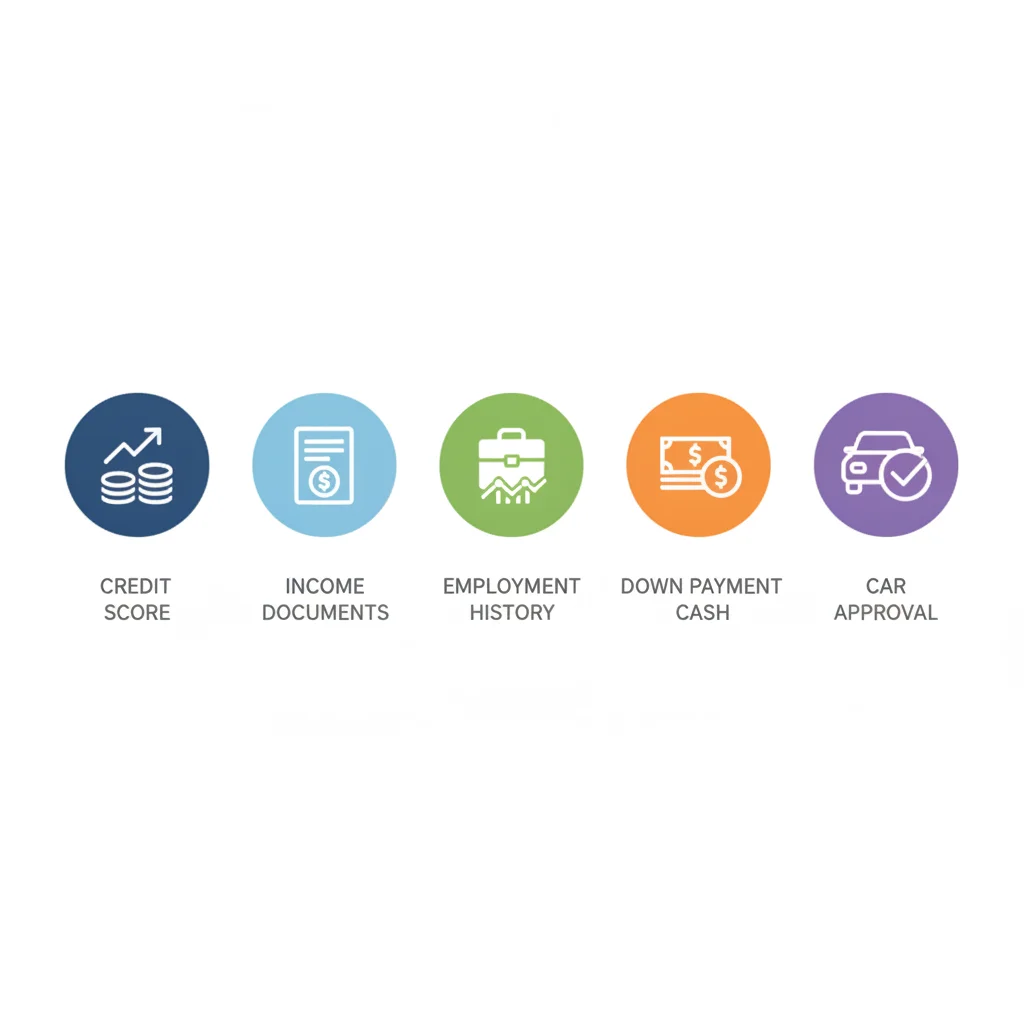
What Lenders Look at When You Apply
Understanding what lenders evaluate helps you know where you stand before you apply — and what you might need to fix first. Lenders use several factors to decide whether to approve you and at what rate.
Credit Score
Your credit score is the first filter. Most traditional lenders prefer a score of 660 or higher for standard rates. Scores above 720 typically unlock the best offers. Scores below 600 narrow your options but don't eliminate them — see our guide to auto loans for bad credit for a full breakdown of what's available when your score is working against you.
Income and Debt-to-Income Ratio
Lenders want to see that your monthly debt obligations — including the new car payment — don't exceed roughly 40–45% of your gross monthly income. This is your debt-to-income ratio (DTI). The lower it is, the better your approval odds and rate.
Employment History
Most lenders want to see at least six months with your current employer, or two years of self-employment with tax returns to prove stable income. Gaps in employment raise flags.
Down Payment
A larger down payment reduces the loan amount, which reduces lender risk — often translating into a lower interest rate. As a first-time buyer, putting down at least 10% on a used car or 20% on a new car is a solid target. Our complete guide to auto loan down payments walks through exactly how much to save and why it matters.
The 14-Day Rate Shopping Window
FICO and VantageScore both have rules that group multiple auto loan inquiries made within a short window into a single inquiry for scoring purposes. FICO's window is 45 days for newer scoring models, though 14 days is the safest assumption across all versions. Apply to all your target lenders within that window to minimize the credit impact of rate shopping.
Loan-to-Value Ratio
Lenders also look at how the loan amount compares to the vehicle's actual market value. If you're borrowing more than the car is worth — common with add-ons and fees rolled into the loan — some lenders will decline or require a larger down payment.
Where to Get Preapproved as a First-Time Buyer
The best place to start is not the dealership. Here are your real options, ranked by typical value for first-time buyers:
Credit Unions
Credit unions consistently offer the lowest auto loan rates among retail lenders. They're member-owned and not driven by the same profit margin requirements as banks. If you're not already a member, many credit unions allow you to join with a small deposit. This is where I'd tell any first-time buyer to apply first.
Your Personal Bank
If you have an existing checking or savings relationship with a bank, that relationship works in your favor. Banks often offer loyalty rate discounts for existing customers. Apply here as your second stop.
Online Lenders
Online lenders like LightStream, Capital One Auto Finance, and PenFed (a credit union) allow you to get preapproved entirely digitally, often within minutes. They're particularly useful for comparing rates quickly without visiting a branch. Many also offer rate-match guarantees.
Dealer Financing (As a Last Resort or Negotiating Tool)
Dealerships work with a network of lenders called captive finance arms (like Toyota Financial or Ford Motor Credit) and third-party banks. They can sometimes offer promotional rates — 0% APR on new vehicles — that genuinely beat external lenders. But use dealer financing only after you've secured an outside preapproval and can compare the two side by side.
AnnualCreditReport.com
The federally mandated free source for your credit reports from all three major bureaus — Experian, Equifax, and TransUnion. Pull yours before applying so you can catch and dispute errors in advance.
CFPB Auto Loan Worksheet
The Consumer Financial Protection Bureau offers a printable auto loan comparison worksheet to help you line up multiple lender offers side by side and identify the true lowest-cost option.
Credit Union Locator (MyCreditUnion.gov)
Find federal credit unions you're eligible to join based on your location, employer, or affiliations. Credit unions frequently offer the most competitive auto loan rates available to retail borrowers.
Capital One Auto Navigator
One of the few tools that lets you get prequalified and browse real dealer inventory at the same time, showing estimated payments without a hard credit pull until you're ready to commit.
For a full step-by-step walk through the application itself — documents to gather, what to expect during the credit check, how to compare offers — see Getting Preapproved for a Car Loan Before You Step on the Lot.
Avoid Applying for Other Credit Before Closing
Once you have a preapproval in hand, resist opening any new credit cards, financing furniture, or taking on other debt before your auto loan closes. New credit obligations can change your debt-to-income ratio and potentially void your preapproval. Hold off until the car loan is funded and you have keys in hand.
Common Mistakes First-Time Buyers Make with Preapproval
Getting preapproved is straightforward. But there are several ways first-time buyers undercut themselves in the process.
Applying to Dozens of Lenders Spread Over Weeks
Every hard credit inquiry can affect your score. The key exception: multiple auto loan inquiries within a 14-day window are treated as a single inquiry by the major credit bureaus. Apply to all your target lenders within that window. Staggering applications over a month doesn't save you anything — it costs you.
Accepting the First Offer
Getting one preapproval and calling it done leaves money on the table. Apply to two or three lenders minimum. Even a 0.5% difference in APR on a $25,000 loan over 60 months is roughly $350 in interest. That's real money for minimal extra effort.
Shopping for a Payment Instead of a Price
A preapproval gives you a budget ceiling. Some buyers then let dealers extend that budget by stretching the loan term — moving from 48 to 72 months to keep monthly payments low. A longer term means significantly more interest paid over time. Focus on the total cost of the loan, not the monthly number.
Forgetting About the Expiration Date
Most preapprovals expire in 30–60 days. If you apply in January but don't buy until March, your offer may be gone and you'll need to reapply — possibly at a different rate if market conditions changed. Time your application within four weeks of when you expect to close.
Not Checking Your Credit Before Applying
Errors on credit reports are more common than most people think. Pulling your own report (which is a soft inquiry and doesn't affect your score) before you apply lets you dispute inaccuracies in advance. A corrected error can meaningfully improve your rate tier.
Your Next Steps After Reading This Guide
You now understand what preapproval is, why it shifts the power dynamic at the dealership, what lenders evaluate, and where to apply. Here's how to move from knowledge to action:
- Pull your free credit report at AnnualCreditReport.com and review it for errors. Dispute anything inaccurate before you apply.
- Gather your documents: government-issued ID, two recent pay stubs, a utility bill or lease for proof of address, and your Social Security number.
- Apply to two or three lenders — a credit union, your bank, and one online lender — all within a 14-day window.
- Compare the offers side by side. Look at APR, loan term, total interest paid, and any prepayment penalties.
- Take your best offer to the dealership and let them try to beat it. If they can't, use your preapproval.
For a deeper look at the full preapproval timeline — from the initial application through walking into the dealership with an offer in hand — The Auto Loan Preapproval Process, Start to Finish covers every stage in detail.
If your credit history is limited or damaged, the path is longer but still navigable. Bad Credit Auto Loans From Start to Funded maps out the full timeline for buyers working with a lower score.
Preapproval isn't complicated. It's just a step most first-time buyers skip because nobody explains why it matters. Now you know — and that knowledge is worth hundreds or thousands of dollars on your next vehicle purchase.

All claims are backed by peer-reviewed research. Sources on request.