Key Takeaways
Our Verdict
For most buyers, the smartest move is to start with a credit union and supplement it with at least one online lender quote — this combination captures competitive rates and flexibility. Buyers with excellent credit (720+) can often secure the best rate by leading with an online marketplace like LightStream or PenFed Online before visiting the dealer. Those with challenged credit should prioritize credit unions and subprime-focused online lenders, not traditional banks.
| Best for | Recommended |
|---|---|
| Buyers with excellent credit seeking the absolute lowest rate | Online Lender |
| Buyers with good to fair credit who value flexibility and lower fees | Credit Union |
| Buyers who want a single-institution relationship for convenience | Bank |
| Buyers with poor or thin credit who have been declined elsewhere | Credit Union + Online Subprime Lender |
Why Where You Apply First Actually Matters
Most buyers treat the loan as an afterthought — something the dealer handles while you're admiring the new-car smell. That's exactly what dealers count on. When you walk onto a lot without a preapproval, you hand the finance office an enormous amount of control. They control the interest rate conversation, they control the monthly payment framing, and they control how much of the vehicle's true cost gets buried inside a 72-month term.
A preapproval changes the dynamic entirely. It converts you from a captive borrower into a cash-equivalent buyer. The dealer still earns a reserve — the markup between your rate and what the lender actually charges — but they know you have an exit. That competitive pressure is real, and it moves rates.
But not all preapprovals are created equal. The lender type you approach first determines your starting rate, how much flexibility you'll have on loan terms, and how quickly you can walk into a dealership ready to negotiate. Before you fill out a single application, it's worth understanding what each channel actually delivers — and where each one falls short. See our step-by-step preapproval walkthrough to understand exactly what documents you'll need before applying.

Traditional Banks: Familiarity With a Rate Premium
Your existing bank is often the first call buyers make — and it's understandable. You already have a login, a relationship, and a sense of how the institution treats you. Large national banks like Chase Auto, Bank of America, and Wells Fargo all offer preapproval programs, some of which can be completed entirely online in under 15 minutes.
Here's what banks do well: they're fast, their systems are integrated, and if you already have checking, savings, or other loan products with them, you may qualify for a loyalty rate discount — typically 0.25% to 0.50% off the standard rate. Some banks also have long-standing relationships with specific automakers, which occasionally unlocks captive-rate promotions.
Where banks consistently underperform: the rates. Traditional banks carry significant overhead and answer to shareholders. That translates into higher APRs compared to credit unions, particularly for borrowers in the 640–720 credit score range. Banks are also notably less flexible on loan structure — if your debt-to-income ratio is slightly elevated or your employment situation is non-standard, expect a faster decline with less explanation.
Don't Accept "We'll Handle Financing" Without a Preapproval
When a salesperson says "don't worry about the loan, our finance team will take care of you," that's a cue to slow down — not speed up. Without your own preapproval benchmark, you have no way to evaluate whether the rate they offer is competitive or inflated. Always arrive with at least one outside offer in hand, even if you end up not using it.
Banks are also the most likely to quietly add dealer reserve markup if you end up financing through a dealer that has a captive relationship with them. Always compare the rate on your preapproval letter to whatever the F&I office presents as their "bank rate."
Bottom line on banks: if you have an excellent existing relationship, significant deposits, or a credit score above 740, your bank deserves a quote. But don't stop there.
Credit Unions: The Underdog With Real Rate Advantages
Credit unions are member-owned, not-for-profit financial cooperatives. That structure matters for borrowers. Because they don't distribute profits to shareholders, credit unions routinely return value through lower loan rates. According to the National Credit Union Administration, the average new-car loan rate at credit unions has historically run 1.5% to 2.0% lower than at commercial banks for equivalent borrowers.
1.5%–2.0%
Average rate advantage of credit unions over banks
According to NCUA data, credit union auto loan rates have historically run 1.5–2.0 percentage points below commercial bank rates for equivalent borrowers.
14 days
Rate-shopping window under FICO scoring
FICO treats multiple auto loan inquiries within a 14-day window as a single inquiry, minimizing credit score impact for comparison shoppers.
$3,900+
Extra interest on 72-month vs. 48-month loan
On a $35,000 vehicle, extending a loan from 48 to 72 months at similar rates adds thousands in total interest paid, even if the monthly payment appears manageable.
0.5%–2.5%
Typical dealer finance reserve markup
Dealers routinely add a financing markup above the lender's buy rate — a preapproval gives buyers leverage to cap or eliminate this hidden cost.
The membership barrier — once a genuine obstacle — has shrunk considerably. Many credit unions now offer membership to anyone who lives, works, or worships in a particular area, and some have opened eligibility nationally through small charitable donations ($5–$25). PenFed Credit Union, Alliant, and NFCU are three examples that serve broad national membership bases with competitive auto loan rates.
Credit unions also tend to show more underwriting flexibility for members. If your credit score is in the 620–680 range, a credit union that knows your banking history may still approve you at a reasonable rate — a bank might not approve you at all. For the full picture of what any lender is actually evaluating, read about everything lenders examine before issuing a preapproval.

The tradeoff: credit unions are slower. Application processing can take 24–48 hours rather than minutes. Their online portals are often less polished than major banks. And if you're not already a member, you'll need to open an account before borrowing — add a few days for that process. For buyers on a tight timeline, this matters.
Join a Credit Union Before You Need a Loan
Many credit unions require you to be a member before you can borrow. Opening a membership account — usually just a $5–$25 deposit — takes a few days. If you're planning a vehicle purchase in the next 30–90 days, join now so you're eligible when you're ready to apply. Alliant, PenFed, and NFCU are three nationally accessible options worth considering.
Let the Dealer Try to Beat Your Rate
Always give the dealer's finance office a chance to beat your preapproval — this costs you nothing and occasionally pays off. Dealer captive lenders sometimes have access to buy rates you won't find externally, especially during manufacturer incentive periods. Just ensure the competing offer has the same loan term and no additional back-end product fees baked into the comparison.
Online Lenders: Speed and Comparison Efficiency
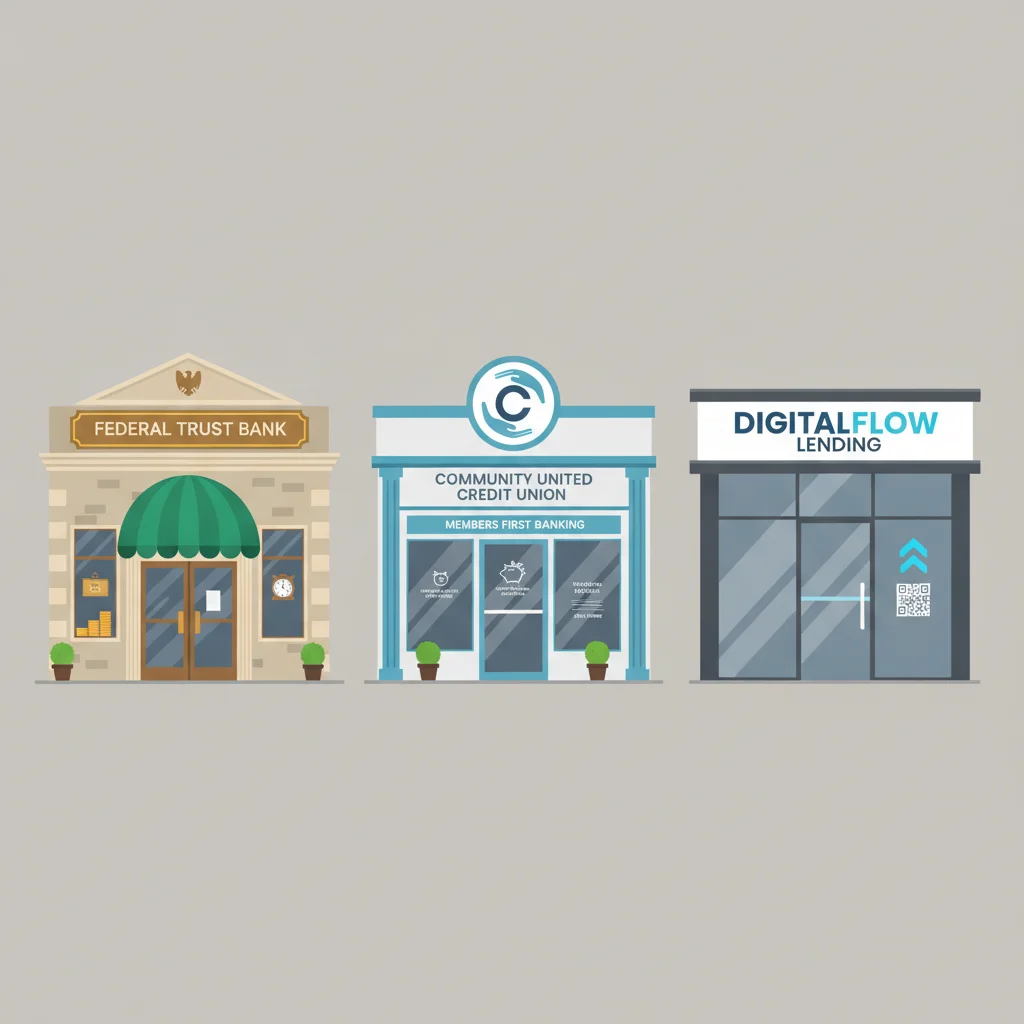
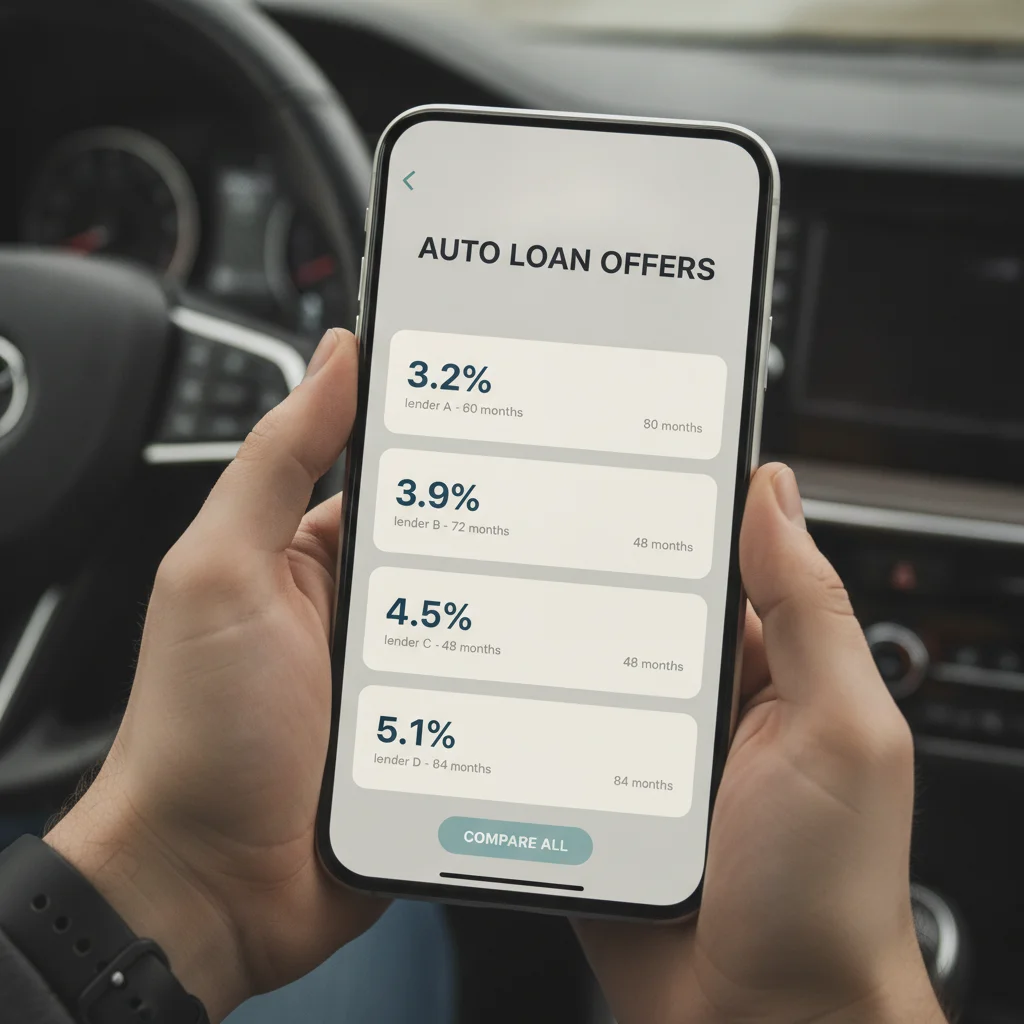
The online lending landscape has matured significantly. Platforms like LightStream, LendingClub, Carvana Financing, Capital One Auto Navigator, and rate-comparison aggregators like LendingTree or myAutoloan let you receive multiple loan offers with a single soft-pull inquiry in minutes. This is the fastest way to establish a rate baseline before you visit any dealership.
Online lenders compete aggressively on rate for borrowers with strong credit. If your score is above 720, running a comparison through an aggregator takes 10 minutes and can surface offers from 20+ lenders simultaneously. The best online rates for prime borrowers have regularly beaten both bank and dealer financing.
Where online lenders diverge sharply is at the lower end of the credit spectrum. Many traditional online lenders have hard floors — they won't touch scores below 600, and some require 640 or higher. Those that do serve subprime borrowers often charge rates that reflect that risk in ways that are difficult to distinguish from predatory structures. If your credit is challenged, the comparison of online subprime lenders versus traditional bank financing is worth reading before you apply anywhere.
| Traditional Bank | Credit Union | Online Lender | |
|---|---|---|---|
| Typical APR Competitiveness | Moderate — higher overhead | Best for most borrowers | Best for 720+ credit scores |
| Approval Speed | Fast (minutes to hours) | Slower (1–2 business days) | Fastest (minutes) |
| Credit Score Flexibility | Low — strict cutoffs | High — relationship-based | Varies by lender |
| Membership Requirement | None | Yes (often easy to join) | None |
| Online Application Experience | Strong (major banks) | Often limited | Excellent |
| Best For | Existing customers with loyalty discounts | Fair to good credit borrowers | Excellent credit rate shoppers |
| Rate Shopping Ease | One lender at a time | One lender at a time | Multiple offers at once |
| Hard Inquiry on Application | Yes | Yes | Soft pull available (some) |
One practical advantage of online lenders: many issue preapproval letters that specify a loan amount and term but don't lock you into a specific vehicle. This gives you flexibility to negotiate the car price before committing to the financing, which is the correct sequence of events — and one that far too many buyers get backwards.
A word on loan term framing: online lenders, like dealers, sometimes surface the monthly payment rather than the total cost of the loan. Always calculate the full interest paid across the entire term. A $35,000 loan at 7.9% over 72 months costs you over $8,700 in interest. The same loan over 48 months at 6.5% costs about $4,800. The monthly number hides that gap.
How to Use the Rate-Shopping Window Strategically
One of the most persistent myths among car buyers is that applying to multiple lenders will destroy their credit score. The reality is more nuanced and far more buyer-friendly than most people realize.
Under FICO scoring models, multiple auto loan inquiries made within a 14-day window are treated as a single inquiry. VantageScore extends that window to 45 days. This means you can apply to your credit union, a bank, and two or three online lenders in a single week and absorb only one hard inquiry's worth of credit impact — typically a 5–10 point temporary dip.
The strategic sequence most buyers should follow:
- Check your credit reports first. Pull free reports from AnnualCreditReport.com. Dispute errors before applying anywhere — a misreported late payment can cost you a full credit tier and hundreds of dollars in interest.
- Apply to your credit union. Do this first. Get a member rate baseline. Credit unions often give you a real conditional offer, not just an estimate.
- Run one online aggregator comparison. This surfaces competing rates without requiring you to fill out eight separate forms. Capital One Auto Navigator offers a prequalification that uses a soft pull, letting you see estimated rates before a hard inquiry.
- Apply to your bank only if you have a loyalty relationship worth leveraging. Otherwise, skip it — you already have competitive offers in hand.
- Complete all applications within 14 days. Staying inside the rate-shopping window keeps your credit impact minimal.
Understand that applying before you've chosen a vehicle has real advantages — most preapprovals are vehicle-agnostic up to a dollar amount, giving you flexibility to negotiate car price independently from financing.
Matching Lender Type to Your Credit Profile
The right starting lender depends heavily on where you sit on the credit spectrum. Here's how to map your profile to the best first application:
Excellent Credit (720+)
Start with online lenders and aggregators. You'll get the most competitive rates here, and your profile is attractive enough that multiple lenders will compete for your business. Credit unions are worth a check too — particularly PenFed or Alliant — but you're likely to find your floor rate online.
Good Credit (680–719)
Lead with your credit union. You're in the prime tier at most credit unions but may hit slightly elevated rates at traditional banks. Follow up with one or two online lender quotes. Dealer financing is worth checking only if the manufacturer is running a captive low-rate promotion (e.g., 1.9% or 2.9% through their own finance arm).
Fair Credit (620–679)
Credit unions are your best bet. Their member-relationship underwriting means they look at more than just your score. Some online lenders will serve this range — look specifically at Capital One Auto Navigator and myAutoloan, which work with a broader credit spectrum. Avoid banks as your first stop; their automated underwriting systems are less forgiving at this tier.
Poor or Thin Credit (Below 620)
This tier requires a different strategy. Traditional lenders will either decline or charge rates that create a debt trap. Comparing subprime auto lenders and credit unions can help you weigh your options. If your applications are coming back denied, read about paths forward after repeated loan rejections before you accept a high-rate dealer offer in desperation. Also check bad credit auto loan resources for strategies specific to your situation.
Note that employment type affects outcomes across all credit tiers. If you're self-employed or on contract, lenders require different documentation and may apply different scrutiny. How employment status shapes preapproval outcomes explains what each lender type will want to verify.

Turning Your Preapproval Into Dealership Leverage
Getting preapproved is step one. Using it correctly at the dealership is step two — and where most buyers give back the advantage they worked to earn.
The single most important rule: do not reveal your preapproval rate or payment budget until after you've negotiated the vehicle price. The moment you say "I can do $450 a month" or "I'm preapproved at 6.2%," the finance office knows your ceiling. They'll structure a deal that hits your number while maximizing what they extract from you elsewhere — in the vehicle price, the trade-in valuation, or the back-end products they layer in (warranties, GAP insurance, paint protection).
The correct sequence:
- Negotiate the out-the-door vehicle price as if you're paying cash.
- Only after agreeing on price, reveal that you have a preapproval and ask if they can beat your rate.
- If the dealer comes back with a lower rate through their lending partners, verify the loan terms match (same loan amount, same term length, no hidden fees).
- Accept the better rate — whether it's yours or theirs — and walk out with the deal you negotiated.
Dealers earn a finance reserve on most loans they originate — typically 0.5% to 2.5% added to your buy rate. A preapproval doesn't eliminate this, but it puts a ceiling on it. The dealer knows they can't go too far above your preapproval without losing the deal.
Join a Credit Union Before You Need a Loan
Many credit unions require you to be a member before you can borrow. Opening a membership account — usually just a $5–$25 deposit — takes a few days. If you're planning a vehicle purchase in the next 30–90 days, join now so you're eligible when you're ready to apply. Alliant, PenFed, and NFCU are three nationally accessible options worth considering.
Let the Dealer Try to Beat Your Rate
Always give the dealer's finance office a chance to beat your preapproval — this costs you nothing and occasionally pays off. Dealer captive lenders sometimes have access to buy rates you won't find externally, especially during manufacturer incentive periods. Just ensure the competing offer has the same loan term and no additional back-end product fees baked into the comparison.
One more tactic worth knowing: dealer captive financing (through Toyota Financial, Ford Motor Credit, GM Financial, etc.) sometimes offers promotional rates — 0%, 1.9%, 2.9% — that genuinely cannot be beaten by outside lenders. These promotions are usually attached to specific models and trim levels and require strong credit. If a promotion is running on the vehicle you want, compare the promotional rate against your preapproval and take whichever is cheaper. The promotional rate wins if it's below your best outside offer; your preapproval wins if it isn't.

All claims are backed by peer-reviewed research. Sources on request.