


Key Takeaways
Auto Loan Co-Signer
A co-signer is a second person who agrees to be legally responsible for repaying your auto loan if you default. Lenders use the co-signer's credit profile alongside yours when deciding whether to approve the loan and what interest rate to assign. Because a stronger co-signer reduces the lender's risk, it can unlock rates your own credit score would never have qualified for.
Unlike a co-borrower, a co-signer typically has no ownership interest in the vehicle but carries full liability for the debt. The loan appears on both parties' credit reports and affects both credit utilization and payment history.
Why Your Credit Score Alone Sets the Floor, Not the Ceiling
When you apply for an auto loan, a lender runs your credit and slots you into a risk tier. That tier determines your interest rate before a single word is spoken at the dealership. Borrowers with scores above 750 typically land in prime or super-prime categories, where rates can be in the 5–7% APR range for new vehicles. Drop to the mid-500s, and you're looking at subprime territory — rates that can run 14–20% APR or higher.
Those aren't arbitrary numbers. They represent the lender's estimate of the probability you'll stop paying. A higher risk of default means the lender needs to collect more interest from the loans that do perform in order to cover the losses from the ones that don't. It's actuarial math, not personal judgment.
The problem is that credit scores take time to build. A 22-year-old with a thin file, or someone rebuilding after a bankruptcy, may be a perfectly responsible borrower — but the score doesn't reflect that yet. That's the gap a co-signer can bridge.
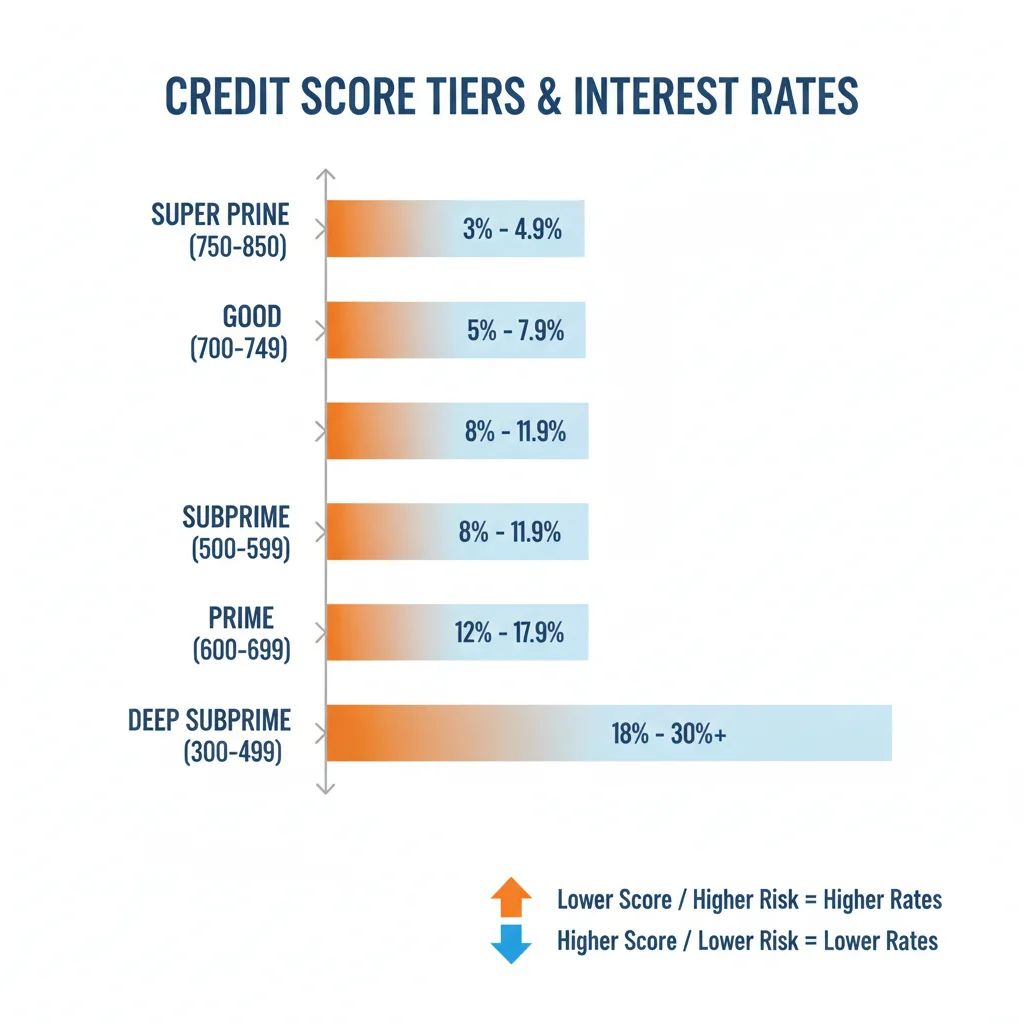
Understanding this matters because it tells you what you're actually solving when you add a co-signer. You're not changing your credit history. You're adding a second guarantor whose track record shifts the lender's risk calculation. The loan gets priced partly on their reliability, not solely yours.
To see the full list of inputs lenders actually use, see how lenders determine your auto loan interest rate. Credit score is one factor, but loan term, vehicle age, and loan-to-value ratio all play roles too.
The Math: What Rate Differences Actually Cost You
Abstract percentages are easy to dismiss. Dollars are not. Here's what the rate gap looks like on a real loan.
Assume you're financing $25,000 over 60 months on a used vehicle.
| Credit Tier | Approx. Score Range | Typical APR (Used Car) | Monthly Payment | Total Interest Paid |
|---|---|---|---|---|
| Super Prime | 781–850 | 5.5% | $479 | $3,740 |
| Prime | 661–780 | 7.5% | $501 | $5,040 |
| Near Prime | 601–660 | 11.5% | $549 | $7,920 |
| Subprime | 501–600 | 16.5% | $611 | $11,650 |
| Deep Subprime | 300–500 | 20%+ | $661 | $14,640+ |
If a co-signer moves a lender's effective pricing from the subprime tier to the prime tier on that same $25,000 loan, the borrower saves roughly $6,600 in interest over five years. That's not a rounding error — it's a used car down payment.
~10%+
APR gap between deep subprime and prime auto loans
Experian's State of the Automotive Finance Market reports consistently show a 10–14 percentage point spread between the highest and lowest auto loan rate tiers.
$6,000+
Extra interest paid over 60 months in subprime vs. prime tier
Based on a $25,000 used vehicle loan at 16.5% vs. 7.5% APR over 60 months — a difference borrowers in lower credit tiers routinely absorb.
20%
Share of auto loans originated with a co-borrower or co-signer
Industry estimates suggest roughly one in five auto loans involves a second applicant, reflecting how common credit-assistance arrangements are.
35%
FICO score weight given to payment history
According to myFICO, on-time payments are the single largest factor in credit scoring — which is why a co-signed loan, paid perfectly, can materially rebuild a credit profile.
The co-signer doesn't need to be a billionaire. They need a credit score and debt-to-income profile that pushes the lender's risk assessment into a better bucket. Even moving one tier — say, from near-prime to prime — can save $2,000–$3,000 on a mid-sized loan.
“A co-signer isn't a loophole — it's a risk transfer. The lender's exposure doesn't shrink; it just gets spread across two people. What changes is the probability that at least one of them pays.”
— Melinda Zabritski, Senior Director of Automotive Financial Solutions, Experian
How Lenders Actually Use the Co-Signer's Credit Profile
This is where buyers often have the wrong mental model. Many assume the co-signer's score simply replaces theirs. That's not always how it works, and the difference matters when you're choosing who to ask.
Lenders generally handle co-signer credit in one of three ways:
- Higher score wins: Some lenders — particularly credit unions and community banks — take the better score of the two applicants and price the loan off that. If you have a 590 and your co-signer has a 760, they lend as though the borrower has a 760. This is the most favorable approach for primary borrowers.
- Primary borrower score drives rate, co-signer provides backup: Other lenders, especially indirect lenders working through dealerships, will price the rate based on your score but approve the loan (rather than reject it) because the co-signer is on the hook. You might get approved but still pay a higher rate.
- Blended evaluation: A minority of lenders look at both applicants holistically — income, debt loads, scores — and price the loan based on the combined picture. A co-signer with strong income and low debt can help even if their score is only moderate.
This is why it pays to ask lenders directly: How do you use the co-signer's credit when pricing the rate? The answer will tell you whether you're getting full benefit from the arrangement or just easier approval at the same rate you'd have gotten alone.
Co-Signer vs. Co-Borrower: Not the Same Thing
A co-borrower is typically a spouse or partner who shares ownership of the vehicle and the debt. A co-signer is liable for the debt but usually has no ownership claim on the car. Some lenders use these terms interchangeably, so confirm exactly what role is being assigned — and what the legal implications are in your state — before signing anything.
Your Co-Signer Can't Force a Lender to Release Them
Unlike some student loan programs, most auto lenders do not offer a formal co-signer release after a period of on-time payments. The only reliable way to remove a co-signer from an auto loan is to pay it off or refinance it into your name alone. Make sure both parties understand this before entering the arrangement.
If you want to see how different lenders compete for your business before you ever set foot in a dealership, getting preapproved is the move. It gives you a rate baseline with no co-signer, so you can judge exactly how much adding one actually helps.

The Real Risks a Co-Signer Accepts
No article about co-signers is complete without a direct conversation about what the co-signer actually takes on. This isn't a formality. It's a significant financial commitment.
When someone co-signs your auto loan:
- They are equally liable for the entire debt. If you stop paying, the lender calls them — not you first, not as a last resort. Immediately.
- The loan appears on their credit report just as it does on yours. Their credit score moves with every payment or missed payment.
- The loan counts against their debt-to-income ratio. If they're planning to apply for a mortgage or business loan, your car payment could affect their approval odds.
- If the vehicle is repossessed and sold at a loss, both of you are liable for the deficiency balance — the gap between what the car sold for and what was still owed.
These aren't edge cases. They happen regularly. Before asking someone to co-sign, understand that you're asking them to absorb all of this risk in exchange for no ownership of the vehicle and no legal mechanism to compel you to pay.
Talk Numbers Before Anyone Signs Anything
Before asking someone to co-sign, show them the actual loan terms — the total amount, the monthly payment, and the total interest cost. Walk through what happens if you miss a payment. A co-signer who fully understands the commitment is more likely to stay supportive through the loan term than one who was vaguely told 'it won't affect you.'
Set Up Autopay From Day One
If you're in a co-signed loan, missed payments damage two credit profiles at once. Set up autopay immediately so that the 'I forgot' scenario is eliminated entirely. Many lenders also offer a 0.25% APR discount for autopay enrollment, which adds up over 60 months.
For a thorough breakdown of the co-signer dynamic from both perspectives, see getting a co-signer for a bad credit car loan. The risks to the co-signer deserve as much attention as the rate benefits to you.
When a Co-Signer Makes Sense — and When It Doesn't
A co-signer is a tool, not a solution. Used correctly, it's a bridge between your current credit profile and the rate you'll eventually earn on your own. Used poorly, it creates resentment and damaged relationships.
Situations where a co-signer genuinely helps
- Thin credit file: Young buyers or recent immigrants may have no derogatory marks but also no established history. A co-signer's profile fills that gap for the lender.
- Recent credit score recovery: If you've rebuilt your score but it's still in the 620–660 range, a co-signer at 740+ can push you into a meaningfully better rate tier.
- High-value loan on a modest income: Some lenders require a minimum income relative to the loan amount. A co-signer with higher income can satisfy that requirement.
Situations where it may not be worth it
- Your score is already near-prime or better: If you're at 680+, the rate improvement from adding a co-signer may be marginal — perhaps 1–1.5 percentage points. That's not nothing, but weigh it against the burden you're placing on the co-signer.
- The co-signer's credit isn't significantly stronger: A co-signer at 660 helping a borrower at 640 may not move the lender's pricing at all. The delta needs to be meaningful — ideally 80–100+ points — to produce a real rate improvement.
- Your loan term is already optimized: Rate is just one lever. Choosing a shorter loan term on a reasonably priced vehicle can reduce total interest cost significantly without involving another person's credit.
If your score has recently improved, it's worth checking whether refinancing without a co-signer is already within reach. See what a credit score jump means for your car loan to understand when that gap becomes actionable.
Building a Path Out of the Co-Signer Arrangement
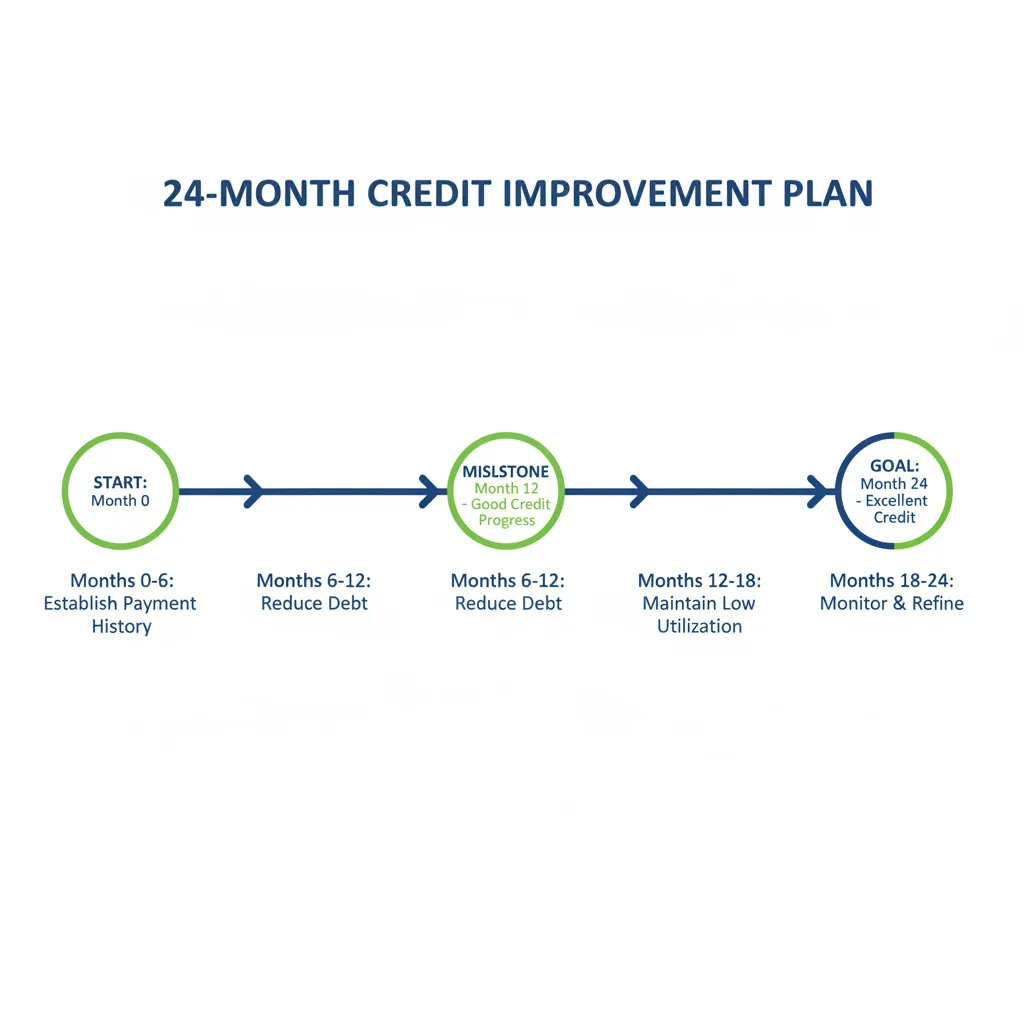
The best co-signer agreements are temporary ones. From day one, treat this loan as a credit-building tool with a planned exit.
Here's a realistic timeline:
- Months 1–12: Make every payment on time, ideally early or on the exact due date. Payment history is 35% of your FICO score and is the single highest-impact action you can take.
- Month 12–18: Pull your credit reports. Look for score movement. If you started at 580 and you're now at 640–660, you're not done yet. If you're at 680+, start shopping refinance rates.
- Month 18–30: With consistent payments and ideally some other positive credit activity (a credit card used responsibly, a second installment account paid down), many borrowers can clear the 700 threshold. At that point, refinancing in your name alone becomes viable.
When you refinance, the original co-signed loan is paid off and replaced with a new loan in your name only. The co-signer's obligation ends. Their credit report will show the account as closed and paid in full — which is actually positive for their history.
Talk Numbers Before Anyone Signs Anything
Before asking someone to co-sign, show them the actual loan terms — the total amount, the monthly payment, and the total interest cost. Walk through what happens if you miss a payment. A co-signer who fully understands the commitment is more likely to stay supportive through the loan term than one who was vaguely told 'it won't affect you.'
Set Up Autopay From Day One
If you're in a co-signed loan, missed payments damage two credit profiles at once. Set up autopay immediately so that the 'I forgot' scenario is eliminated entirely. Many lenders also offer a 0.25% APR discount for autopay enrollment, which adds up over 60 months.
It's worth understanding how credit inquiries work during this process. When you're shopping refinance rates or preapproval offers, rate shopping affects your credit score less than most people fear — the bureaus cluster auto loan inquiries made within a short window into a single event.
Your credit score isn't just about the co-signed loan. Lenders also look at income, existing debt, and loan-to-value ratios when deciding whether to let you refinance solo. See what lenders look at beyond your credit score for the full picture of what they're evaluating.
For borrowers who need more structured options while credit is being rebuilt, the bad credit loans hub covers the full range of financing strategies available when your score isn't where it needs to be yet.
Co-Signer vs. Co-Borrower: Not the Same Thing
A co-borrower is typically a spouse or partner who shares ownership of the vehicle and the debt. A co-signer is liable for the debt but usually has no ownership claim on the car. Some lenders use these terms interchangeably, so confirm exactly what role is being assigned — and what the legal implications are in your state — before signing anything.
Your Co-Signer Can't Force a Lender to Release Them
Unlike some student loan programs, most auto lenders do not offer a formal co-signer release after a period of on-time payments. The only reliable way to remove a co-signer from an auto loan is to pay it off or refinance it into your name alone. Make sure both parties understand this before entering the arrangement.
All claims are backed by peer-reviewed research. Sources on request.