

Key Takeaways
Rate Shopping Window
The rate shopping window is a period — typically 14 to 45 days depending on which credit scoring model a lender uses — during which multiple auto loan inquiries from different lenders are counted as a single hard inquiry on your credit report. This built-in protection lets you compare loan offers without each application dragging your score down separately. The goal is to encourage consumers to shop for the best rate rather than accept the first offer they receive.
FICO Score 8 uses a 45-day window for auto loan inquiries, while older FICO models (versions 2, 4, and 5 used by mortgage lenders) use a 14-day window. VantageScore 3.0 and 4.0 also consolidate rate-shopping inquiries but apply their own window logic.
Why Rate Shopping Feels Risky (But Usually Isn't)
Here's a fear I heard constantly on the dealership floor: "I don't want to apply to too many lenders because it'll wreck my credit." It's understandable — the idea that each application chips away at your score sounds terrifying when you're already watching every point. But this fear causes real harm, because it pushes buyers to accept the first loan offer they see instead of shopping around for a better one.
The reality is that credit scoring models anticipated this problem decades ago and built in a specific protection for rate shoppers. Multiple auto loan applications submitted within a defined time window are bundled together and treated as a single hard inquiry. You get to shop; your score takes one small, temporary hit instead of several.
The problem is that most buyers don't know the rules, so the fear wins by default. Let's fix that.
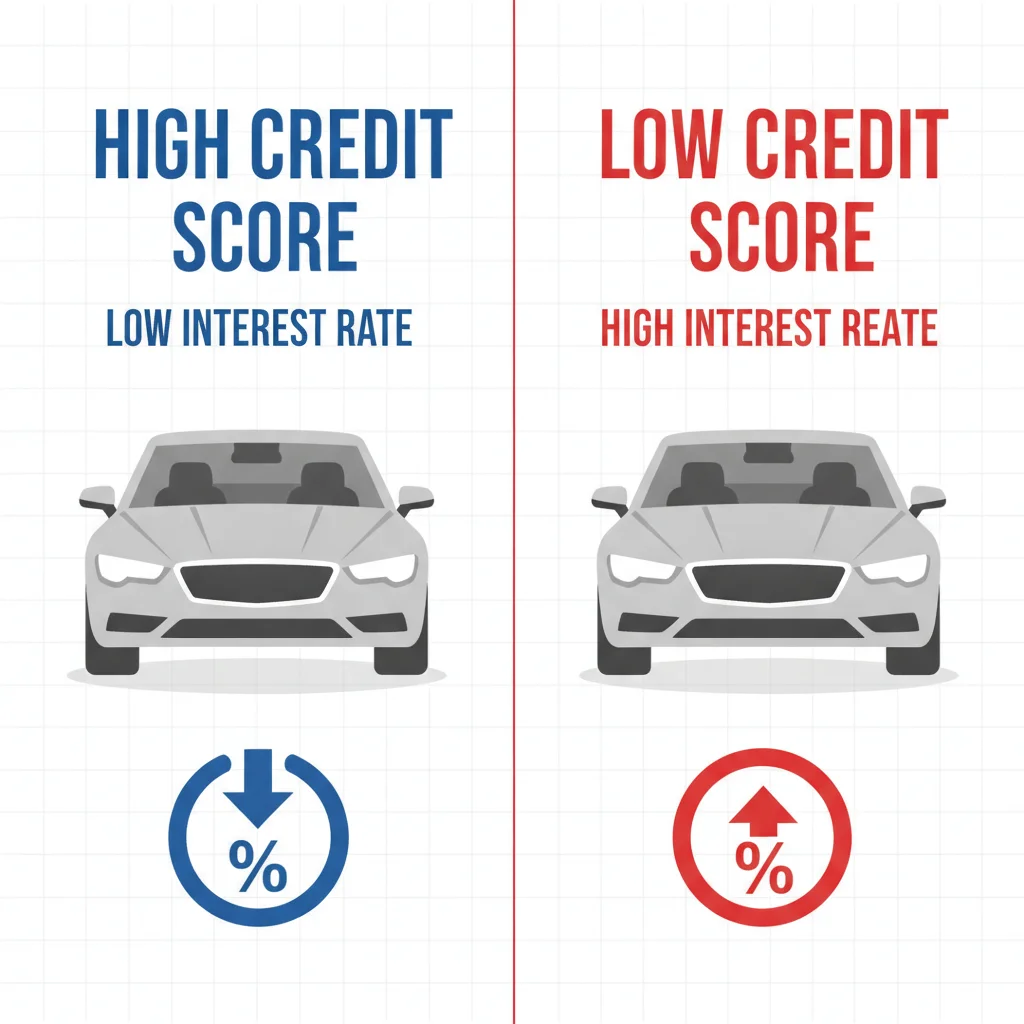
Understanding exactly how inquiries work — and what the actual score impact is — turns rate shopping from something that feels reckless into something that's clearly the smartest financial move you can make before signing any loan paperwork.
Hard Inquiries vs. Soft Inquiries: What Actually Hits Your Score
Not all credit checks are created equal. There are two types, and only one affects your score.
- Soft inquiries happen when you check your own credit, when a lender prequalifies you for an offer, or when an employer does a background check. These are invisible to other lenders and have zero effect on your score.
- Hard inquiries happen when you formally apply for credit — a loan, a credit card, a mortgage. These show up on your credit report and can nudge your score down slightly.
For auto loans specifically, the sequence matters: prequalification is a soft pull; a formal application is a hard pull. That distinction gives you a powerful tool. You can use soft-pull prequalifications to compare estimated rates from multiple lenders without any score impact, then only submit full applications to the top two or three you've already vetted.
Soft Pulls Don't Count — Ever
Prequalification checks, rate estimators, and your own credit monitoring are all soft pulls. They appear only on your personal credit report — not the version lenders see — and they have no effect on your score whatsoever. You can run as many soft-pull prequalifications as you want without any consequence. Only a formal credit application triggers a hard pull.
Dealer Applications May Hit Multiple Lenders at Once
When you apply for financing at a dealership, the finance desk often submits your application to several lenders simultaneously rather than one at a time. This is called a "shotgun application." The good news: because all those inquiries land on the same day, they almost certainly fall within the shopping window. The less-good news: you don't always know which lenders received your application or what data was shared.
Your Score Can Differ Between Bureaus
Equifax, Experian, and TransUnion each maintain separate files and may have different information on you. Your credit score can vary meaningfully between the three. Some auto lenders pull all three and use the middle score; others use a specific bureau. Check all three before applying so you're not blindsided by a lower score than you expected on one of your reports.
Once you do trigger hard inquiries, here's what FICO says about the damage: for most consumers, a single hard inquiry reduces a credit score by fewer than 5 points. That's a rounding error compared to the hundreds of dollars — sometimes thousands — you can save by finding a rate that's even one percentage point lower.
See how rate shopping actually affects your credit for a deeper look at the mechanics behind inquiry scoring.
The Rate-Shopping Window: How the 45-Day Rule Works
This is the core protection every car buyer should understand before they apply anywhere.
When credit bureaus and scoring models detect multiple loan inquiries of the same type within a short timeframe, they recognize the behavior as rate shopping — not as a sign of financial distress. Rather than penalizing each application separately, they bundle the inquiries and count them as one.
The window length depends on which model a lender uses:
| Scoring Model | Shopping Window | Common Users |
|---|---|---|
| FICO Score 8 | 45 days | Most auto lenders, banks |
| FICO Score 2, 4, 5 | 14 days | Mortgage lenders, some auto |
| VantageScore 3.0/4.0 | 14 days (rolling) | Credit monitoring services, some lenders |
In practice, assume a 14-day window if you're unsure which model a lender uses. Compressing all your applications into two weeks guarantees you'll be protected under any version of the scoring rules. If you know your lenders use FICO Score 8, you have a more comfortable 45-day runway.
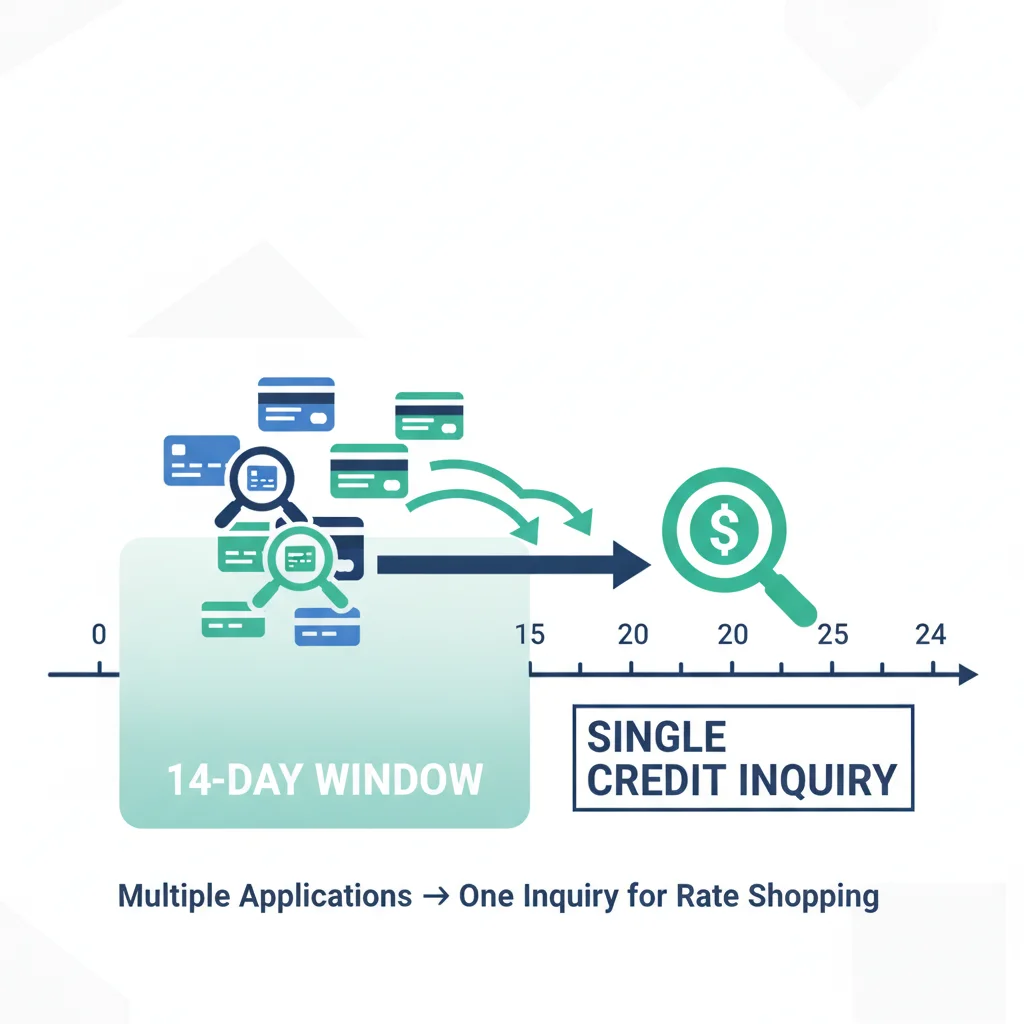
There's one more nuance worth knowing: the inquiry itself may appear on your credit report even if it doesn't count separately in your score. Future lenders reviewing your report can see the activity, but the scoring model has already adjusted for the shopping behavior. In practice, this rarely affects lending decisions for auto loans.
For more on how multiple preapproval applications affect your credit score, the mechanics are the same — the window protection applies whether you're applying for preapproval or a final loan.
<5 pts
Typical score drop from one hard inquiry
According to FICO, a single hard inquiry reduces most consumers' credit scores by fewer than 5 points, and the effect typically fades within 12 months.
45 days
Rate-shopping window under FICO Score 8
FICO Score 8, the most widely used scoring model among auto lenders, bundles all auto loan inquiries within a 45-day period into a single inquiry.
$12,000+
Extra interest paid by subprime vs. super prime borrower
On a $30,000, 60-month auto loan, the difference between a 6% APR (super prime) and a 20% APR (deep subprime) exceeds $12,000 in total interest paid.
1 in 5
Credit reports with material errors
A Federal Trade Commission study found that roughly 1 in 5 consumers had an error on at least one credit bureau report significant enough to affect their credit score.
~$1,400
Savings from 1.6% APR difference on $30K loan
On a $30,000, 60-month loan, the difference between a 10.5% and an 8.9% APR — a gap easily found by shopping lenders — saves approximately $1,400 over the loan term.
What Your Credit Score Range Actually Means for Your Interest Rate
This is where abstract credit score numbers connect to real dollars. The rate tiers below are based on typical market ranges — your actual offer will vary by lender, loan term, vehicle age, and down payment — but the pattern is consistent across the industry.
| Credit Score Range | Tier Label | Typical New Car APR Range | Typical Used Car APR Range |
|---|---|---|---|
| 750+ | Super Prime | 4%–6% | 5%–7% |
| 700–749 | Prime | 6%–9% | 7%–11% |
| 650–699 | Near Prime | 9%–14% | 11%–16% |
| 600–649 | Subprime | 14%–19% | 16%–21% |
| Below 600 | Deep Subprime | 19%–25%+ | 21%–28%+ |
Run the numbers on a $30,000 loan over 60 months to feel the real weight of those tiers:
- At 6% APR: Monthly payment ≈ $580 | Total interest paid ≈ $4,800
- At 12% APR: Monthly payment ≈ $667 | Total interest paid ≈ $10,000
- At 20% APR: Monthly payment ≈ $794 | Total interest paid ≈ $17,640
The gap between a super prime borrower and a subprime borrower on the same loan, same car, same term: over $12,000 in extra interest. That's not a rounding error — that's a used car payment sitting on top of your loan.
“The No. 1 thing consumers can do to lower their auto loan cost isn't to improve their credit score — it's to shop multiple lenders. Most people don't realize that lenders pricing the same credit tier can vary by two or three percentage points on the same loan.”
— Melinda Zabritski, Senior Director of Automotive Financial Solutions, Experian
This is why rate shopping matters so much. Even within the same credit tier, lenders don't all price the same. One bank might offer 10.5% to a 670-score borrower while a credit union offers 8.9%. On a $30,000 loan, that 1.6% difference is worth roughly $1,400 over the life of the loan. You find that gap by shopping — not by accepting the first number the dealership finance office puts in front of you.
How lenders determine your auto loan interest rate goes beyond credit score to show you all the variables that move the needle — including loan-to-value ratio, term length, and vehicle type.
Use Prequalification to Scout Rates Risk-Free
Before submitting any formal application, use soft-pull prequalification tools at banks, credit unions, and online lenders like LightStream or Capital One Auto Navigator. These tools give you estimated rate ranges without triggering a hard inquiry. Use them to identify your best two or three options, then compress your formal applications into a single week.
Get Your Bank Approval Before Visiting the Dealer
Walking into a dealership with a pre-approved loan offer from your bank or credit union shifts the entire negotiation. You're no longer asking what rate you can get — you're daring the dealer's finance desk to beat a number you already have. Most of the time, they either match it or improve on it. Occasionally they can't, and your bank deal stands.
How to Execute a Smart Rate-Shopping Campaign
Knowing the theory is one thing. Here's a practical sequence that keeps your credit protected while maximizing your leverage at the table.
- Pull your own credit report first. Go to AnnualCreditReport.com — it's free and it's a soft pull. Review all three bureau reports for errors. Roughly 1 in 5 credit files contains an error material enough to affect lending decisions. Dispute anything inaccurate before you apply anywhere.
- Know your tier before you walk in. Based on your score, match yourself to the rate tier table above. This sets your expectations and tells you whether you're shopping in prime territory or subprime territory — two very different markets.
- Start with soft-pull prequalifications. Most banks, credit unions, and online lenders offer prequalification without a hard pull. Use these to collect estimated rate ranges from four to six lenders without touching your score.
- Set a start date for your hard-pull window. Once you've narrowed your list to the top two or three lenders, pick a day and submit all formal applications within that same week. This ensures every hard inquiry lands inside the shopping window regardless of which FICO version your lenders use.
- Get your financing arranged before you set foot in the dealership. Walking in with a bank approval letter in hand completely changes the negotiation. The dealer's financing desk now has to beat your number — not set it.
If you're working with a lower credit score and worried about your options, the bad credit auto loans hub covers lender options and strategies specific to subprime borrowers. And if your score alone isn't getting you into the rate tier you need, adding a co-signer is one of the fastest ways to access a rate you wouldn't qualify for on your own.

For borrowers who already have an existing loan and are thinking about refinancing, the same shopping window logic applies. Rate shopping without wrecking your credit score walks through how to apply the window strategy when you're refinancing rather than buying new.
Use Prequalification to Scout Rates Risk-Free
Before submitting any formal application, use soft-pull prequalification tools at banks, credit unions, and online lenders like LightStream or Capital One Auto Navigator. These tools give you estimated rate ranges without triggering a hard inquiry. Use them to identify your best two or three options, then compress your formal applications into a single week.
Get Your Bank Approval Before Visiting the Dealer
Walking into a dealership with a pre-approved loan offer from your bank or credit union shifts the entire negotiation. You're no longer asking what rate you can get — you're daring the dealer's finance desk to beat a number you already have. Most of the time, they either match it or improve on it. Occasionally they can't, and your bank deal stands.
Common Mistakes That Undermine Your Rate Shopping
Even buyers who know about the shopping window sometimes make moves that reduce its effectiveness. Here's what to avoid.
Spreading applications out over months
If you apply to one lender in January, another in February, and a third in March, each application is a separate hard inquiry with no bundling benefit. Treat it like a sprint, not a marathon — all your applications need to land within the window.
Relying only on dealer financing
Dealers earn a cut of your loan — called dealer reserve — which is built into the rate the lender approves. A dealer approved you at 7% might be marking up a lender's actual approval of 5.5%. You have no way to know unless you have a competing offer in hand. Applying to multiple lenders is the only way to surface what the market will actually give you.
Ignoring credit unions
Credit unions are consistently among the lowest-rate auto lenders in any credit tier, and many have relaxed their membership requirements significantly. They don't operate on the same profit margin as banks, which means they can pass savings to borrowers. If you're not including at least one credit union in your comparison, you're probably leaving money on the table.
Assuming your score is correct
Lenders pull from all three credit bureaus, and your score often differs between Equifax, Experian, and TransUnion. A lender might use the middle score of the three, or the lowest, depending on their policy. An error on one bureau — a duplicate account, a fraudulent inquiry, an incorrectly reported late payment — can cost you a full rate tier. Check all three before you apply.
Soft Pulls Don't Count — Ever
Prequalification checks, rate estimators, and your own credit monitoring are all soft pulls. They appear only on your personal credit report — not the version lenders see — and they have no effect on your score whatsoever. You can run as many soft-pull prequalifications as you want without any consequence. Only a formal credit application triggers a hard pull.
Dealer Applications May Hit Multiple Lenders at Once
When you apply for financing at a dealership, the finance desk often submits your application to several lenders simultaneously rather than one at a time. This is called a "shotgun application." The good news: because all those inquiries land on the same day, they almost certainly fall within the shopping window. The less-good news: you don't always know which lenders received your application or what data was shared.
Your Score Can Differ Between Bureaus
Equifax, Experian, and TransUnion each maintain separate files and may have different information on you. Your credit score can vary meaningfully between the three. Some auto lenders pull all three and use the middle score; others use a specific bureau. Check all three before applying so you're not blindsided by a lower score than you expected on one of your reports.
The Bottom Line: Shopping Is Worth the Inquiry
The math here is simple and decisive. A hard inquiry from rate shopping costs you, on average, fewer than 5 points and fades from your score within months. The benefit from finding a rate that's 1–2 percentage points lower on a $30,000 loan is worth $1,000–$3,000 over the life of the loan. There is no reasonable scenario where the inquiry cost outweighs the rate savings.
The fear of credit damage is the most expensive myth in auto financing. It keeps buyers passive at exactly the moment they should be most aggressive. Use the shopping window the way it was designed to be used — apply to multiple lenders, compress your applications into a single window, and walk into the dealership already knowing your number.
Your credit score is just the starting price. Shopping is how you negotiate it down.
All claims are backed by peer-reviewed research. Sources on request.