

Key Takeaways
Hard Inquiry (Hard Pull)
A hard inquiry is what happens when a lender formally checks your credit report to make a lending decision. Unlike a soft pull — which you can't feel — a hard inquiry gets recorded on your credit file and can temporarily lower your credit score by a small amount. When you apply to refinance your auto loan, the new lender will almost always run a hard pull before offering you a rate.
Hard inquiries are logged under the "inquiries" section of your credit report and remain visible to future lenders for 24 months, though FICO and VantageScore models only factor them into your score for the first 12 months.
Why Refinancing Triggers a Hard Inquiry
When you decide to refinance your auto loan, you're essentially applying for a brand-new loan from a different lender. That lender needs to assess the risk of lending to you — and to do that, they pull your full credit report. This is called a hard inquiry, or hard pull, and it's a non-negotiable step in the formal application process.
Think of it this way: the lender is about to take on a loan worth thousands of dollars. Before they agree to your rate and terms, they want to see your payment history, your existing debt load, how long you've had credit, and whether you've applied for a lot of new credit recently. The hard pull gives them access to all of that.
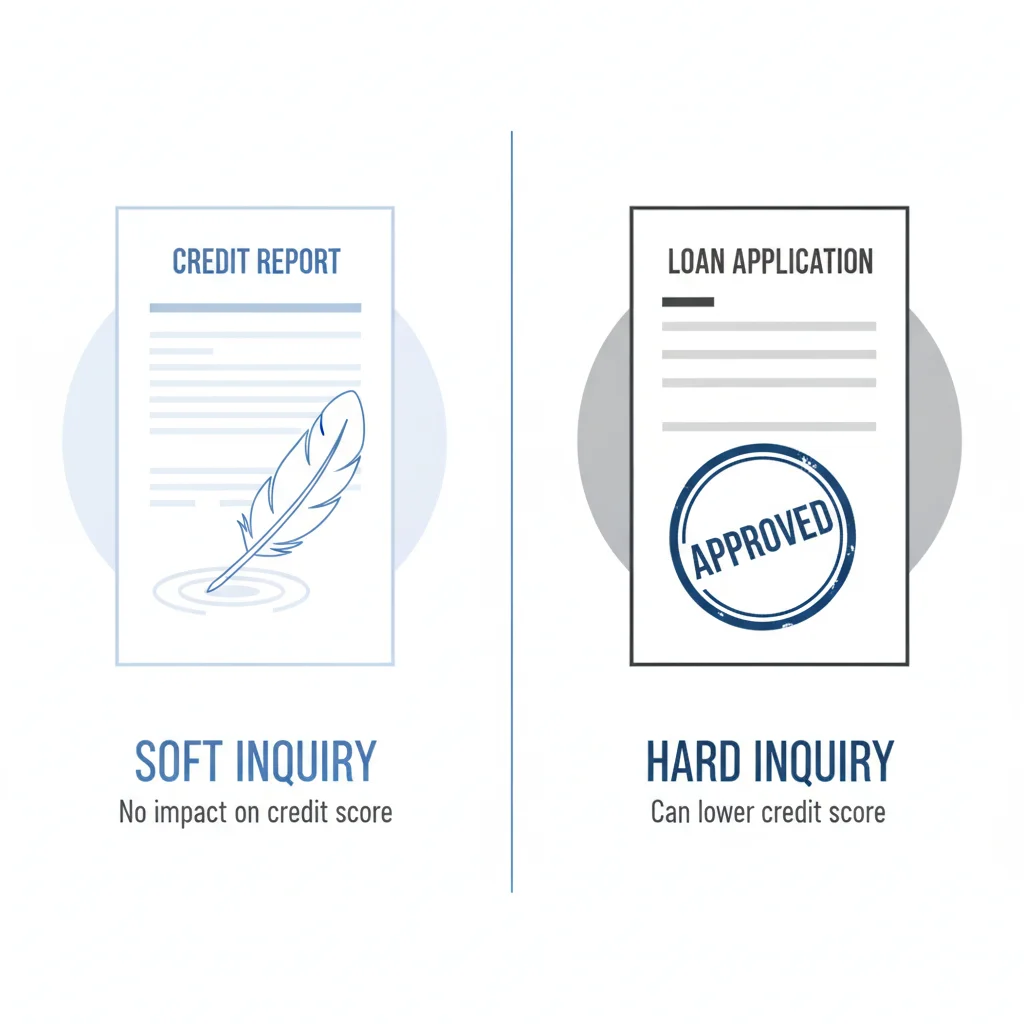
This is different from the kind of check a lender does when you request a prequalification quote. Prequalification typically uses a soft pull, which doesn't appear on your report the same way and doesn't affect your score. But once you move from "I'm interested" to "I'm applying," the hard pull kicks in. Understanding this distinction can save you from unnecessary inquiries — see our breakdown of soft pull vs. hard pull for the full picture.
The key takeaway here is that the hard inquiry is unavoidable when you formally apply to refinance — but that doesn't mean it's something to fear.
How Much Does a Hard Inquiry Actually Hurt Your Score?
This is the question most borrowers really want answered, and the honest answer is: less than you probably think.
According to FICO, a single hard inquiry typically causes a score drop of fewer than 5 points for most people. That's a small fraction of the 850-point scoring range. If your score is 680 today, one refinance inquiry might bring it to 676 or 677 — temporarily.
<5 pts
Typical score drop from one hard inquiry
According to FICO, a single hard inquiry lowers most consumers' scores by fewer than 5 points.
12 months
How long inquiries affect your FICO score
FICO scoring models only factor hard inquiries into your score for approximately one year after they appear.
45 days
Rate-shopping window under FICO Score 8
All auto loan inquiries made within 45 days are treated as a single inquiry under FICO Score 8 and newer models.
24 months
How long inquiries stay on your credit report
Hard inquiries remain visible on your credit report for two years, even after they stop affecting your score.
That said, the impact isn't identical for everyone. A few factors influence how much a hard pull moves your score:
- Depth of your credit file: If you have a long, well-established credit history, one inquiry barely registers. If your file is thin — meaning you don't have many accounts or much history — the same inquiry hits harder.
- Recent inquiry activity: If you've already had several hard pulls in the past 12 months, adding another one raises more of a red flag to scoring models than if you have a clean inquiry history.
- Overall score level: Higher-score borrowers tend to see smaller absolute drops from inquiries. The closer your score is to 850, the less a single inquiry moves the needle in percentage terms.
Importantly, the impact is temporary. Most borrowers see their score begin to recover within a few months as the inquiry ages and other positive credit behaviors (like on-time payments) accumulate. After 12 months, the inquiry no longer factors into your score at all, though it remains visible on your report for two years.
“A hard inquiry is one of the least important factors in your credit score. Payment history and amounts owed carry far more weight. Consumers often avoid beneficial financial decisions because they're afraid of a small, temporary score dip — and that fear usually costs them more than the inquiry ever would.”
— John Ulzheimer, Credit expert and former FICO and Equifax industry professional
The Rate-Shopping Window: Your Built-In Protection
Here's where things get genuinely useful: credit scoring models are designed to encourage consumers to shop around for loans. The people who built FICO and VantageScore understood that responsible borrowers compare rates before committing — and they didn't want the scoring system to punish that behavior.
The solution is called the rate-shopping window. When multiple auto loan inquiries occur within a defined period, scoring models treat them as a single inquiry for scoring purposes. You get the same score impact whether you applied to one lender or ten — as long as they all happened close together.
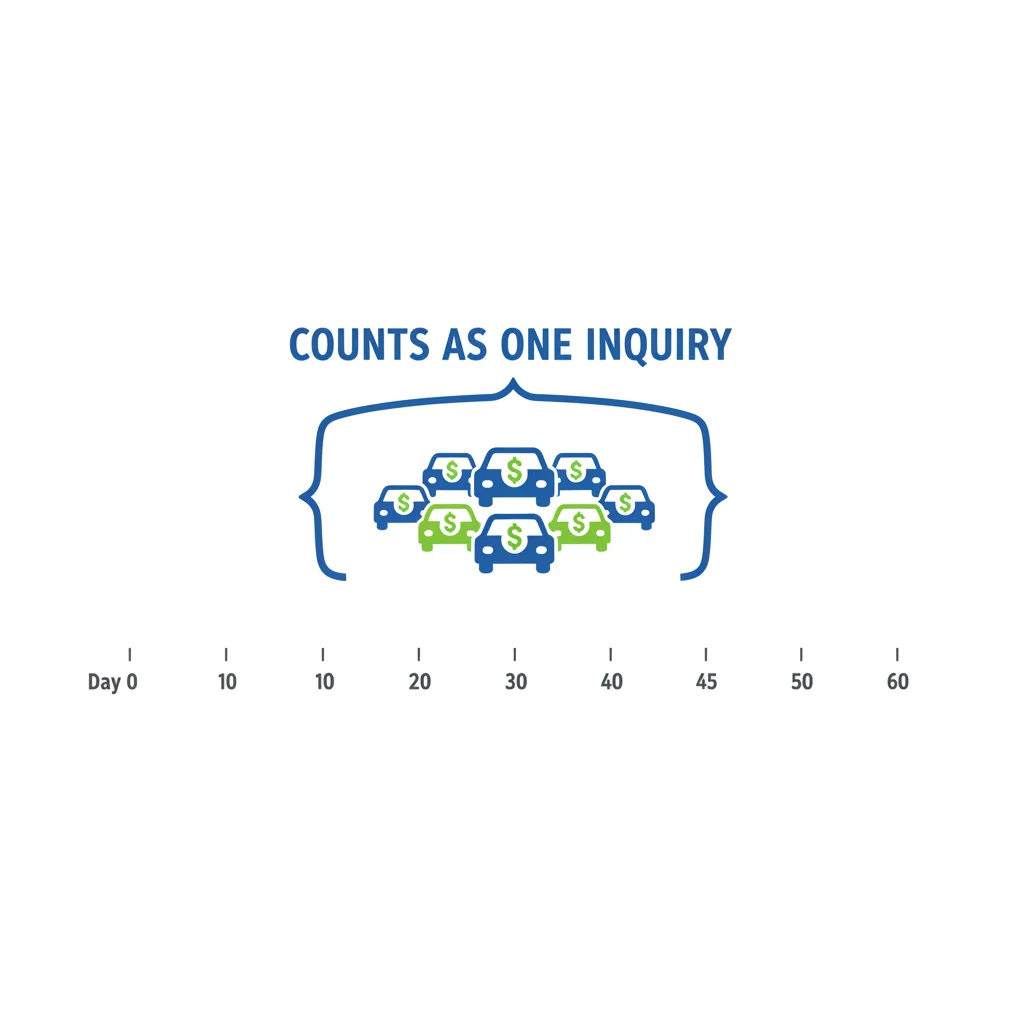
Here's how the windows break down by scoring model:
| Scoring Model | Rate-Shopping Window |
|---|---|
| FICO Score 8 and newer | 45 days |
| Older FICO models | 14 days |
| VantageScore 3.0 and 4.0 | 14 days |
In practice, this means you can apply to three, four, or even five refinance lenders within a 45-day window and your score takes the same hit as a single application. This is powerful, because it lets you legitimately compare offers from multiple lenders — credit unions, online lenders, banks — without compounding your score damage.
Prequalify Before You Commit to Applying
Use soft-pull prequalification tools at three to five lenders before submitting any formal applications. This gives you a realistic sense of the rates you'd qualify for without touching your score. Once you've narrowed your list to the most competitive options, submit your formal applications within the same 14–45 day window to keep inquiry impact to a minimum.
Set a Calendar Deadline for Rate Shopping
Once you decide to refinance, set a firm 30-day window for completing all your applications. Put a deadline on your calendar. Without a deadline, it's easy to spread applications across months and accidentally multiply your inquiry impact. Treating rate shopping like a focused sprint — not a casual process — protects your score and gets you to a decision faster.
For a deeper look at how inquiry clustering works across the full loan shopping process, see how multiple loan applications affect your credit when shopping lenders. And if you want to understand how lenders use your credit report once they have it, what lenders look at before approving an auto refinance walks through every factor they weigh.
When the Score Dip Matters — and When It Doesn't
Knowing that a hard inquiry causes a small, temporary score drop is only half the picture. The other half is deciding whether that dip matters to you, given your specific situation right now.
Here are the circumstances where the inquiry impact deserves real consideration:
- You're about to apply for another major loan: If you're planning to finance a home purchase, take out a personal loan, or apply for significant new credit within the next 3–6 months, a temporary score dip could affect those applications. Timing matters here.
- Your score is right on the edge of a credit tier: Lenders often use score bands (for example, 660–679 might qualify for one rate, 680–699 for a better one). If you're at 681 and a hard pull drops you to 677, you could slip into a less favorable tier. Check where you sit before applying.
- You've already had multiple recent inquiries: If you've applied for several loans or credit cards in the past six months, your report already shows elevated inquiry activity. Adding more reinforces the appearance of credit-seeking behavior, which can concern lenders.
Not All Lenders Use the Same Scoring Model
The 45-day rate-shopping window applies to FICO Score 8 and newer versions, which are the most widely used. Some lenders use older FICO versions or VantageScore, which have a shorter 14-day window. When in doubt, compress your application window to 14 days to ensure you're protected under any model your lender might use.
Refinancing Near a Major Credit Application
If you plan to apply for a mortgage, personal loan, or other significant credit within the next three to six months, consider whether the timing of your auto refinance creates any risk. A 3–5 point dip rarely derails a well-qualified borrower, but if your score is already borderline for the other loan, a small drop could matter. Consult with that lender before proceeding with the auto refinance.
On the other hand, here's when the score dip almost certainly doesn't matter:
- You're refinancing to escape a high-interest loan and the monthly savings are substantial.
- Your score is comfortably above the threshold for your target rate tier.
- You have no major credit applications planned for the next six to twelve months.
- Your credit file is deep and well-established, so a single inquiry barely moves your score.
For the vast majority of borrowers, the long-term financial benefit of a lower rate — even savings of $20 or $30 per month — will far exceed any consequence from a temporary 3–5 point score decrease. The math almost always favors refinancing when you genuinely qualify for a better rate.
How to Minimize Inquiry Damage When You Refinance
A few strategic steps can help you protect your score as much as possible while still getting the best refinance deal available to you.
Start With Prequalification
Before submitting a single formal application, use prequalification tools at multiple lenders. These use soft pulls and give you a realistic estimate of the rates you'd qualify for without touching your score. This lets you narrow your list of serious contenders before the hard pulls begin. Most major online auto lenders — and many credit unions — offer this. The loan preapproval hub explains how preapproval works and why it strengthens your negotiating position.
Cluster Your Formal Applications
Once you're ready to apply in earnest, submit all your formal applications within the same 14–45 day window. Do not spread them over several months. Applying to four lenders within two weeks gives you the same score impact as applying to one. Spread those same four applications over four months and you get four separate inquiry hits.
Check Your Credit Report First
Before any lender sees your report, you should. Pull your free credit reports from AnnualCreditReport.com and look for errors — incorrect account balances, payments wrongly marked late, accounts that don't belong to you. A dispute that resolves in your favor can improve your score before you apply. See what to verify before applying for a full pre-application checklist.
Know Your Score Tier Before You Apply
Understanding where you sit in lenders' scoring tiers helps you assess whether a small inquiry dip could push you into a worse rate bracket. If you're safely in the middle of a tier, you have more cushion. If you're right at the boundary, it's worth waiting a few months for your score to climb before refinancing. The credit score impact hub covers how score ranges translate into rate outcomes.

Prequalify Before You Commit to Applying
Use soft-pull prequalification tools at three to five lenders before submitting any formal applications. This gives you a realistic sense of the rates you'd qualify for without touching your score. Once you've narrowed your list to the most competitive options, submit your formal applications within the same 14–45 day window to keep inquiry impact to a minimum.
Set a Calendar Deadline for Rate Shopping
Once you decide to refinance, set a firm 30-day window for completing all your applications. Put a deadline on your calendar. Without a deadline, it's easy to spread applications across months and accidentally multiply your inquiry impact. Treating rate shopping like a focused sprint — not a casual process — protects your score and gets you to a decision faster.
Weighing the Short-Term Cost Against the Long-Term Gain
The fundamental question isn't "will this hurt my credit?" — it's "is the benefit worth the cost?" Let's put some real numbers to it.
Suppose you have a $22,000 remaining balance on your auto loan at 11% APR with 48 months left. Your monthly payment is approximately $571. If you refinance to 7% APR, your new payment drops to roughly $527 — a savings of $44 per month, or $2,112 over the remaining loan term.
The cost of making that happen? A temporary 3–5 point score decrease that recovers within a few months. Even for someone on the edge of a scoring tier, the math is difficult to argue with unless timing with another major loan application is a genuine concern.
Not All Lenders Use the Same Scoring Model
The 45-day rate-shopping window applies to FICO Score 8 and newer versions, which are the most widely used. Some lenders use older FICO versions or VantageScore, which have a shorter 14-day window. When in doubt, compress your application window to 14 days to ensure you're protected under any model your lender might use.
Refinancing Near a Major Credit Application
If you plan to apply for a mortgage, personal loan, or other significant credit within the next three to six months, consider whether the timing of your auto refinance creates any risk. A 3–5 point dip rarely derails a well-qualified borrower, but if your score is already borderline for the other loan, a small drop could matter. Consult with that lender before proceeding with the auto refinance.
Where refinancing becomes less compelling is when the rate improvement is minimal (say, dropping from 6.9% to 6.5%), the remaining loan term is very short (under 12 months), or fees and prepayment penalties on the existing loan eat into the savings. In those cases, the score hit — even a small one — may not pay for itself.
If you're weighing whether now is the right time to refinance, look at both sides: what the inquiry costs you in the short term, and what a lower rate saves you over the life of the loan. For most borrowers in a high-rate loan who now qualify for something better, the answer is clear. See auto loan rate shopping and your credit score for more context on balancing inquiry risk with competitive lender shopping.

All claims are backed by peer-reviewed research. Sources on request.