

Key Takeaways
Option A
Soft Pull (Soft Inquiry)
The invisible credit check that leaves no mark.
Best for: Prequalification, rate estimates, and any early-stage shopping where you want loan options without risking your credit score.
Option B
Hard Pull (Hard Inquiry)
The official credit check that lenders require to approve you.
Best for: Submitting a formal loan application when you're ready to commit to a lender and lock in financing.
If you're still comparing rates and haven't chosen a lender
Soft Pull (Soft Inquiry)
Prequalification via soft pull lets you see real rate estimates from multiple lenders with zero score impact. Use this phase to narrow your shortlist before committing.
If you're ready to formally apply and lock in a loan
Hard Pull (Hard Inquiry)
A hard pull is unavoidable at the approval stage — but if you cluster your applications within 14 days, most scoring models treat them as one inquiry, minimizing damage.
If you have a credit score below 620 and every point matters
Soft Pull (Soft Inquiry)
Thin or damaged credit amplifies the impact of each hard inquiry. Use soft-pull prequalification to vet lenders carefully before triggering any hard pulls.
If you're financing through a dealership's F&I office
Hard Pull (Hard Inquiry)
Dealer financing requires formal applications, which always generate hard pulls — sometimes to five or more lenders at once. Know this going in and time it within the rate-shopping window.
The Core Difference: Visibility and Consequence
When a lender or financial institution looks at your credit file, that look is logged. But not every look counts against you. The two types of credit inquiries — soft and hard — differ in one critical way: whether they affect your credit score.
A soft pull is any credit check that does not factor into your score. Your own credit checks, employer background screenings, insurance company reviews, and most prequalification inquiries all fall into this bucket. The lender sees your file, but the inquiry is invisible to other lenders and has no scoring consequence.
A hard pull is what happens when you formally apply for credit. The lender requests your full credit report specifically to make a lending decision. This inquiry is visible to all future lenders and is factored into your FICO or VantageScore calculation — at least for a period of time.
For auto loan shoppers, this distinction matters because the car-buying process naturally involves checking rates with multiple lenders before settling on one. Understanding which type of inquiry each step triggers determines how you sequence your shopping strategy.
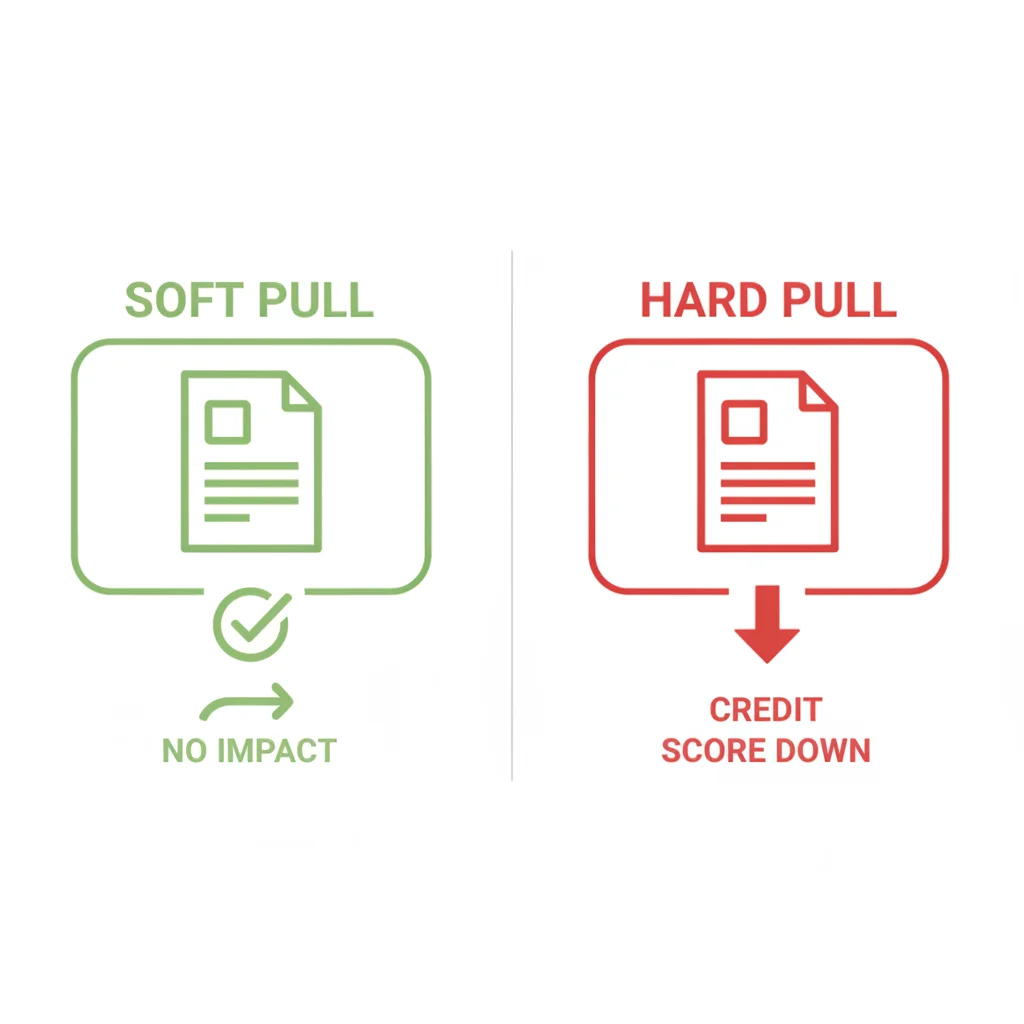
Here's the practical reality: every lender that issues you a formal approval or denial has run a hard pull. Every prequalification estimate you get from an online tool, a credit union, or a bank's "check your rate" page may or may not be a soft pull — and the answer varies by lender. Always ask explicitly before you submit any personal information beyond your name and income.
How Each Type of Inquiry Affects Your Credit Score
The mechanics of credit scoring treat soft and hard pulls completely differently.
Soft Pulls: Zero Impact
Soft inquiries appear only on the version of your credit report that you see — not on the report lenders access. Because of this, credit scoring algorithms at FICO and VantageScore don't include them in score calculations at all. You could have 50 soft pulls in a month and your score would be identical to what it was before the first one.
Hard Pulls: A Measurable but Limited Hit
Hard inquiries do matter — but less than most buyers assume. A single hard pull typically reduces your FICO score by fewer than 5 points for most people. The exact impact depends on the overall health of your credit profile. Someone with an 800+ score and a long, clean history might see a 2-point dip. Someone with a 620 score, two late payments, and a short credit history might see a 7–10 point drop from the same inquiry.
The inquiry's influence on your score fades gradually after 12 months and disappears entirely from score calculations after 12 months — even though it remains visible on your report for 24 months.
| Criterion | Soft Pull | Hard Pull |
|---|---|---|
| Score impact | None — zero points affected | Typically 2–5 points; up to 10 for thin files |
| Visible to other lenders | No — only visible to you | Yes — visible on shared credit report |
| Stays on report how long | Appears on your report only; no time limit | 24 months, affects score for ~12 months |
| When it occurs | Prequalification, rate checks, background screens | Formal loan application, final approval |
| Requires your SSN | Usually no — partial data only | Yes — full identity verification required |
| Rate-shopping consolidation | Not applicable — no scoring impact | Multiple pulls in 14–45 days count as one |
| Binding loan offer result | No — estimate only, not guaranteed | Yes — generates an actual approval with confirmed APR |
This is where the scoring models get smarter than most car buyers realize. Both FICO and VantageScore have built-in protections for rate-shoppers. When you apply to multiple auto lenders within a short window, the models recognize this as a single decision, not multiple new debt obligations. See exactly how those shopping windows work before you start submitting applications.
5 pts
Typical score drop from one hard inquiry
FICO reports that a single hard inquiry affects most consumers' scores by fewer than five points, with the impact fading after 12 months.
10%
Weight of inquiries in FICO score calculation
New credit inquiries account for roughly 10% of your total FICO score — far less than payment history (35%) or credit utilization (30%).
45 days
Rate-shopping window under FICO Auto Score
FICO's auto-specific scoring versions allow up to 45 days for rate shopping before counting multiple hard pulls as more than one inquiry.
$1,700
Interest difference between 7% and 9% APR
On a $30,000 auto loan over 60 months, a 2-percentage-point rate difference results in approximately $1,700 more in total interest paid.
24 months
How long hard inquiries remain on your report
Hard inquiries are visible on your credit file for two years, but FICO and VantageScore stop factoring them into your score after approximately 12 months.
Where Each Type of Pull Actually Shows Up in the Auto Loan Process
Understanding when each type of inquiry occurs helps you navigate the process without triggering unnecessary hard pulls too early.
Prequalification — Almost Always Soft
Most banks, credit unions, and online lenders now offer prequalification tools that use a soft pull to give you a rate range. You enter your income, approximate credit score tier, and desired loan amount, and the tool returns an estimated APR and monthly payment. This estimate is not a guarantee, but it's accurate enough to compare lenders and eliminate long shots.
Examples of lenders that explicitly use soft pulls for prequalification include many major credit unions and large online auto lenders. The loan preapproval process is the right place to explore your options before committing.
Formal Loan Application — Always Hard
The moment you move from "check my rate" to "submit my application," you will trigger a hard pull. This is non-negotiable. The lender needs your complete, verified credit file to issue a binding approval with a confirmed APR. There is no way around this step — nor should there be. The hard pull at this stage is a reasonable trade-off for locking in real financing.
Dealership Financing — Hard, Often Multiple
This is the scenario that surprises the most buyers. When you sign the credit authorization form in the finance and insurance (F&I) office, you're typically authorizing the dealership to send your application to their network of lenders — which can include five to fifteen different financial institutions. Each one runs a hard pull. If those pulls happen within the same rate-shopping window (14 to 45 days depending on the scoring model), they'll be consolidated. But if the dealer runs them over a longer period, or if you came back two weeks after your first visit, the timing may work against you.

The practical defense: get preapproved by your own bank or credit union before you set foot in the dealership. Then you only need one hard pull on your terms, and you walk in with a competing offer that typically results in better rates from the dealer's financing desk too. Run through this checklist before you apply if your credit is less than ideal.
Not All "Prequalification" Is a Soft Pull
Some lenders use the term "prequalification" loosely and actually run a hard pull at that stage. This is more common with smaller dealerships and certain subprime lenders. Before submitting any application — even one labeled as prequalification — ask the lender directly: "Will this generate a hard inquiry on my credit report?" Get the answer in writing or in a chat transcript if possible. A lender that won't answer this question clearly is itself a red flag.
Your Credit Score Is Not Your Only Qualification Factor
Lenders evaluate more than just your score. Debt-to-income ratio, employment stability, down payment size, and the age of your credit accounts all factor into approval decisions and the rate you receive. A 680 score with a strong income and 20% down may get a better rate than a 720 score with high existing debt and no money down. Focus on the full picture, not just protecting your score from inquiry points.
The Rate-Shopping Window: Your Built-In Protection
Credit scoring models are not naive. FICO and VantageScore both recognize that a consumer applying to six auto lenders in one week is almost certainly shopping for the best rate on a single car purchase — not attempting to take on six new car loans simultaneously. Their response: deduplicate those inquiries.
FICO's Approach
FICO 8 (the most widely used scoring version) consolidates auto loan inquiries that occur within a 14-day window and counts them as a single inquiry. Older FICO models use a 30-day window. FICO 9 and the auto-specific FICO Auto Score versions use a 45-day window.
VantageScore's Approach
VantageScore uses a rolling 14-day window and deduplicates inquiries of the same loan type. So if you apply to four lenders over 12 days for an auto loan, VantageScore counts that as one hard inquiry.
The strategic implication is straightforward: compress your formal applications into a 14-day window to guarantee consolidation regardless of which scoring model your lender uses. Apply to your top three or four candidates on the same day if possible. The score impact is then equivalent to a single hard pull — typically 2 to 5 points — not a cumulative hit for each application.
For a deeper breakdown of how this works across lenders, see how multiple applications affect your credit when shopping lenders.
Hard Inquiries in Context: How Much Should You Actually Worry?
The fear of credit inquiries causes some buyers to avoid shopping altogether — which is a much more expensive mistake than accepting a few inquiry points. Let's put the numbers in perspective.
Payment history accounts for 35% of your FICO score. Credit utilization accounts for 30%. Hard inquiries account for roughly 10% — and only the ones from the past 12 months. A single auto loan hard pull that drops your score by 4 points is unlikely to move you from one rate tier to another unless you're sitting right on a threshold (say, 660 or 720).
Where inquiries do matter more: if you have a limited credit history, the inquiry's weight is proportionally larger. And if you're already carrying high utilization or have a recent derogatory mark, the hard pull lands on a weaker foundation and the drop may be steeper.
The more important consideration is what a better rate saves you. On a $30,000 auto loan over 60 months, the difference between a 7% APR and a 9% APR is roughly $1,700 in total interest. If shopping three lenders costs you 5 points temporarily, that's a trade most buyers should make without hesitation. Understand how APR affects your total loan cost before you decide how aggressively to shop.
If you're refinancing rather than buying new, the same logic applies but the timing considerations shift slightly. Here's what a hard inquiry does to your credit when you refinance and how the shopping window still protects you.

Practical Steps: Using Soft Pulls to Shop, Hard Pulls to Close
The optimal approach combines both inquiry types in sequence — using soft pulls to research broadly, then concentrating hard pulls at the final decision point.
- Start with soft-pull prequalification across at least three lenders. Use your bank, a credit union, and one or two online lenders. This costs you nothing in score terms and gives you real rate ranges to compare.
- Eliminate lenders whose rates don't compete. If your bank's prequalified rate is 8.9% and the credit union is at 6.4%, your bank is off the list before any hard pull happens.
- Ask explicitly whether the next step triggers a hard pull. Before you click "complete application" or hand over your Social Security number for verification, ask. Reputable lenders will tell you clearly.
- Compress your formal applications into a single day or weekend. Once you've narrowed to your top two or three candidates, apply to all of them within the same session. One rate-shopping window, one consolidated inquiry impact.
- Get preapproval in writing before visiting the dealership. Armed with a preapproval letter, you negotiate the car price separately from the financing. The dealer's F&I office will try to beat your rate — sometimes they can, sometimes they can't — but you're never without a fallback.
Learn more about how to handle multiple applications strategically if you're concerned about cumulative inquiry impact. And if you want to understand the full mechanics of how rate shopping affects your score, this breakdown explains the scoring model protections in detail.
Not All "Prequalification" Is a Soft Pull
Some lenders use the term "prequalification" loosely and actually run a hard pull at that stage. This is more common with smaller dealerships and certain subprime lenders. Before submitting any application — even one labeled as prequalification — ask the lender directly: "Will this generate a hard inquiry on my credit report?" Get the answer in writing or in a chat transcript if possible. A lender that won't answer this question clearly is itself a red flag.
Your Credit Score Is Not Your Only Qualification Factor
Lenders evaluate more than just your score. Debt-to-income ratio, employment stability, down payment size, and the age of your credit accounts all factor into approval decisions and the rate you receive. A 680 score with a strong income and 20% down may get a better rate than a 720 score with high existing debt and no money down. Focus on the full picture, not just protecting your score from inquiry points.
All claims are backed by peer-reviewed research. Sources on request.