

Key Takeaways
Trade-In Tax Credit (Sales Tax Offset)
In most U.S. states, when you trade in a vehicle at a dealership and buy a new one, you only pay sales tax on the difference between the new car's price and your trade-in's value — not on the full purchase price. This reduction in your taxable amount is called the trade-in tax credit or sales tax offset. It can save you hundreds or even thousands of dollars compared to selling your car privately and then buying new.
The offset is applied at the point of sale by the dealer, who reports the net taxable amount (new car price minus trade-in allowance) to the state DMV. Not all states offer this benefit — California, Hawaii, Michigan, and a few others do not allow the trade-in deduction.
Why Most Car Buyers Miss This Tax Benefit
Walk into any dealership and the finance manager will hand you a contract with a dozen line items. Sales tax is buried somewhere in the middle, presented as a fixed cost you simply pay. What most buyers don't realize is that the taxable amount on that contract — if you're trading in a vehicle — should already be reduced by the value of your trade-in. That's money you never have to hand over to the state, and it doesn't require any special action on your part other than understanding it exists.
The confusion is understandable. Dealers don't advertise this benefit. They're focused on the monthly payment, the new car price, the financing rate, and the trade-in offer as separate levers they can pull. If you don't know the tax offset is part of the equation, you can't use it to your advantage when deciding whether to trade in or sell privately.
Trade-in strategies are about more than just getting the highest offer from a dealer. They're about understanding the full financial picture — and the sales tax offset is one of the most overlooked pieces of that picture.

How the Sales Tax Offset Actually Works
Here's the mechanics in plain terms. When you buy a car, you pay sales tax on the vehicle's purchase price. In states that allow the trade-in deduction, the taxable base is reduced by the amount the dealer credits you for your trade-in. The formula looks like this:
Taxable amount = New car price − Trade-in allowance
So if you're buying a $35,000 SUV and the dealer offers you $12,000 for your trade-in, you pay sales tax on $23,000 — not $35,000. At a 7% state sales tax rate, that's $1,610 in tax instead of $2,450. You've saved $840 just by trading in rather than selling privately and then walking in as a straight buyer.
$700–$1,500
Typical trade-in tax savings range
Based on average new car prices of $35,000–$45,000 and state sales tax rates of 5%–9%, a $10,000–$15,000 trade-in generates this range of tax savings in participating states.
~40
U.S. states offering full trade-in deduction
Approximately 40 states allow buyers to reduce the taxable base by the full trade-in allowance; several others impose caps or partial deductions.
6.35%
Average U.S. state auto sales tax rate
According to NCSL data, the average combined state auto sales tax rate across the U.S. is approximately 6.35%, making the trade-in offset worth several hundred to over a thousand dollars in most transactions.
$1,000+
Max tax savings on high-value trade-ins
On a $20,000 trade-in allowance applied in a state with an 8% tax rate, a buyer saves $1,600 in taxes versus purchasing without a trade-in.
The offset only applies to the trade-in allowance the dealer gives you, not any separate payment you might negotiate for your old car. And it applies in the state where you're registering the new vehicle — so the rules of your home state govern the calculation, even if you're buying from a dealer across the border.
To understand the broader tax picture, see our article on sales tax vs. use tax when buying a car, which explains how in-state versus out-of-state purchases can change what you owe.
State Rules Change — Verify Before You Buy
Trade-in deduction rules are set at the state level and can change year to year. Illinois, for example, has adjusted its cap on the deduction multiple times. Before finalizing any deal, check your state's DMV or department of revenue website for the current rules, or ask the dealer to show you exactly how the taxable amount was calculated on your contract.
The Offset Applies to Dealer Allowance, Not Market Value
The trade-in tax deduction is based on whatever the dealer credits you, not on what your car is actually worth on the open market. If a dealer lowballs your trade-in at $8,000 when it's worth $12,000, your tax offset is calculated on $8,000. This is another reason to get competing offers from CarMax, Carvana, or other dealers before you negotiate — a higher offer means both more money and a larger tax offset.
Trading In With Negative Equity
If you owe more on your trade-in than it's worth, the dealer typically rolls the negative equity into your new loan. In this case, the trade-in allowance on the contract may still reduce your taxable amount, but you're adding that shortfall to your new car balance. The tax offset is real, but it doesn't undo the financial hole created by rolling over negative equity — make sure you understand both sides of that transaction.
States That Don't Offer the Trade-In Deduction
This is the part where geography matters. Not every state participates in the trade-in sales tax offset. As of 2024, the following states do not allow you to reduce your taxable amount by your trade-in value:
- California — no trade-in deduction; you pay full sales tax on the new car price
- Hawaii — no deduction; trade-in value does not reduce the taxable base
- Michigan — no deduction on the full trade-in amount (though there is a partial exemption in some scenarios)
- Montana, New Hampshire, Oregon, Alaska, and Delaware — these states have no general sales tax at all, so the deduction question is moot
In all other states, the trade-in deduction applies — but the specific rules on caps, eligible vehicle types, and documentation requirements vary. Illinois, for example, capped the trade-in deduction at $10,000 for several years before eventually raising it. Always verify your state's current rules before you finalize a deal.
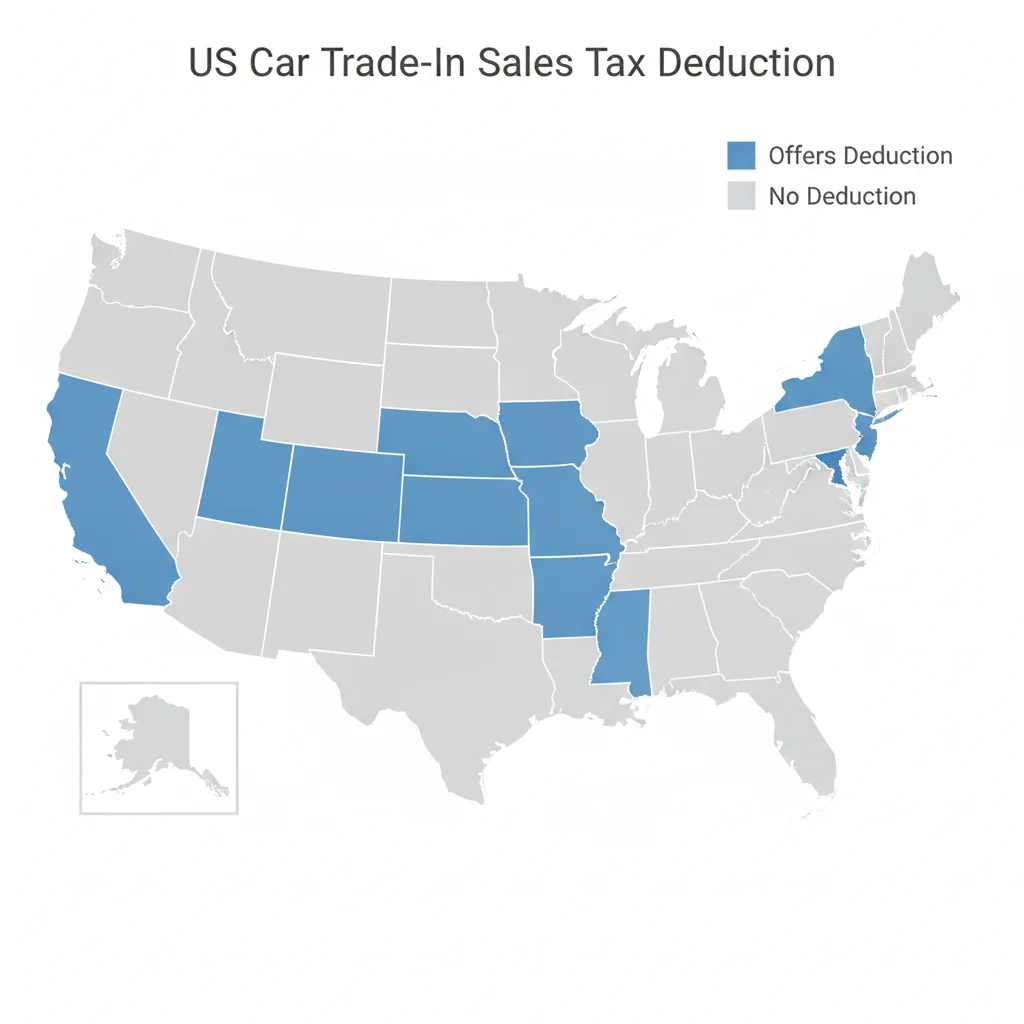
If you're in a state without the offset, the financial comparison between trading in and selling privately changes significantly. You lose the tax advantage, which means the dealer's trade-in offer needs to stand on its own against what you'd net from a private sale after time, effort, and fees.
The Private Sale vs. Trade-In Math (Including Tax)
Most sellers focus only on the dollar difference between the dealer's trade-in offer and the private party value of their car. That's the right instinct, but it's incomplete without folding in the tax offset. Here's a worked example:
| Scenario | New Car Price | Trade-In / Sale Value | Taxable Amount | Tax (7%) | Effective Net |
|---|---|---|---|---|---|
| Trade-In at Dealer | $35,000 | $12,000 (dealer offer) | $23,000 | $1,610 | $12,000 − $0 (tax saving = $840) |
| Private Sale + New Purchase | $35,000 | $14,000 (private sale) | $35,000 | $2,450 | $14,000 − $840 tax penalty = $13,160 net advantage |
In this example, the private sale still comes out ahead by about $1,160 after accounting for the tax offset. But if the dealer's offer were $13,000 instead of $12,000, the gap shrinks to $160 — and that's before you factor in the time, advertising costs, and risk of a private sale. At $13,500, the trade-in is the better deal once you account for the tax benefit.
Calculate Your True Breakeven Before Negotiating
Before you step into a dealership, calculate the private-party value of your car using Kelley Blue Book or Edmunds, then subtract the additional sales tax you'd pay if you sold privately (full price × your state's rate). That adjusted number is your real minimum acceptable trade-in offer. Dealers won't do this math for you — and knowing it keeps you from accepting a lowball offer that looks close but costs you more overall.
Verify the Taxable Amount Before Signing
In the finance office, ask to see the itemized purchase agreement before it's finalized. Confirm the taxable amount equals the new car price minus the trade-in allowance. If the numbers look off, ask the finance manager to show you the calculation. Errors in this line item are not uncommon, and they always favor the dealer's bottom line, not yours.
This is why you should always run the numbers before walking in. The tax offset doesn't automatically make a lowball offer acceptable — but it does change the breakeven point between trading in and selling privately, often by $500 to $1,500 depending on your state's tax rate and the new car's price.
For a deeper look at how dealers structure their offers, see the hidden math behind your trade-in offer. Understanding their cost structure helps you push back more effectively.
“The trade-in tax credit is one of the few legitimate, underused advantages available to car buyers at a dealership. Most people focus entirely on the trade-in number itself and never account for the hundreds of dollars in tax savings that come with it — savings that change the entire private-sale-versus-trade-in calculation.”
— Philip Reed, Senior Consumer Advice Editor, Edmunds
Using the Tax Offset as a Negotiating Tool
Once you know the tax offset exists, you can use it in two ways during a negotiation.
1. Set a more accurate private-sale breakeven. Before you even walk into the dealer, calculate what private-sale net you'd actually pocket after the tax you'd owe on the full new car price. That's your true floor. If the dealer's offer — after applying the tax offset savings — comes within $500 to $800 of that number, trading in is often the smarter play when you price in your time and the hassle of private-party transactions.
2. Don't let the dealer bundle everything into one monthly payment. When trade-in, new car price, and financing are all blended into a single payment, the tax offset disappears from view. Negotiate the trade-in value and the new car price as separate line items, then verify the contract shows the correct taxable amount before you sign. See our guide on separating your trade-in from the new car deal for step-by-step tactics.

One common dealer trick: they'll inflate the new car price slightly and give you a higher trade-in number so the contract looks favorable, while the actual net cost to you stays the same or increases. The tax offset is calculated on the stated prices, so inflated numbers on both sides can actually increase your tax bill while making the deal look better on paper. Always check the math yourself.
State Rules Change — Verify Before You Buy
Trade-in deduction rules are set at the state level and can change year to year. Illinois, for example, has adjusted its cap on the deduction multiple times. Before finalizing any deal, check your state's DMV or department of revenue website for the current rules, or ask the dealer to show you exactly how the taxable amount was calculated on your contract.
The Offset Applies to Dealer Allowance, Not Market Value
The trade-in tax deduction is based on whatever the dealer credits you, not on what your car is actually worth on the open market. If a dealer lowballs your trade-in at $8,000 when it's worth $12,000, your tax offset is calculated on $8,000. This is another reason to get competing offers from CarMax, Carvana, or other dealers before you negotiate — a higher offer means both more money and a larger tax offset.
Trading In With Negative Equity
If you owe more on your trade-in than it's worth, the dealer typically rolls the negative equity into your new loan. In this case, the trade-in allowance on the contract may still reduce your taxable amount, but you're adding that shortfall to your new car balance. The tax offset is real, but it doesn't undo the financial hole created by rolling over negative equity — make sure you understand both sides of that transaction.
Also worth knowing: the trade-in deduction competes with another strategy — trading in vs. donating your car. In some situations, donating a high-value vehicle and claiming the charitable deduction can outperform both a trade-in and a private sale, particularly for vehicles valued above $10,000 where the donor itemizes deductions.
How to Verify the Tax Offset on Your Contract
Before you sign anything, review the purchase agreement carefully. The taxable amount should be clearly listed. Here's what to look for:
- Vehicle selling price — the agreed new car price after any negotiated discounts
- Trade-in allowance — the value the dealer is crediting you for your old vehicle
- Net taxable amount — this line should equal price minus trade-in allowance
- Sales tax line — calculated as your state's rate applied to the net taxable amount
If the sales tax line is calculated on the full vehicle price rather than the net amount, flag it immediately. In states that allow the offset, this is either an error or an intentional omission. Either way, it costs you real money and the dealer is required to apply the deduction correctly under state law.
Calculate Your True Breakeven Before Negotiating
Before you step into a dealership, calculate the private-party value of your car using Kelley Blue Book or Edmunds, then subtract the additional sales tax you'd pay if you sold privately (full price × your state's rate). That adjusted number is your real minimum acceptable trade-in offer. Dealers won't do this math for you — and knowing it keeps you from accepting a lowball offer that looks close but costs you more overall.
Verify the Taxable Amount Before Signing
In the finance office, ask to see the itemized purchase agreement before it's finalized. Confirm the taxable amount equals the new car price minus the trade-in allowance. If the numbers look off, ask the finance manager to show you the calculation. Errors in this line item are not uncommon, and they always favor the dealer's bottom line, not yours.
Some dealers use electronic desking software that calculates everything automatically — but errors still happen, and some systems have configuration options that affect how the trade-in is applied. Don't assume the computer got it right. Run your own numbers with a simple calculator before you sit down in the finance office.
For a broader view of how the trade-in offset fits into your overall deal structure, revisit the trade-in strategies hub for articles on valuation, timing, and negotiation sequencing.

All claims are backed by peer-reviewed research. Sources on request.