
Key Takeaways
Market Supply and Depreciation
Market supply and depreciation describes how the number of similar vehicles available for sale directly influences how fast — and how far — your car's price falls. When lots of comparable cars flood the market, buyers have more choices and less reason to pay a premium. The result is accelerated depreciation that has nothing to do with your car's condition or mileage.
Economists call this demand-supply equilibrium: as supply increases relative to demand, the market-clearing price drops. For vehicles, this plays out in real time across dealer lots, rental fleet liquidations, and lease-return cycles.
Why Supply Is a Hidden Driver of Your Car's Price
Most sellers obsess over mileage and condition when pricing a vehicle — and those factors matter. But there's a third force that can move your car's price by thousands of dollars with no warning: market supply. The moment too many nearly identical vehicles compete for the same pool of buyers, prices fall. Not because your car got worse. Because the market got crowded.
This is what economists call a supply shock — a sudden or gradual increase in available inventory that outpaces buyer demand. In the auto market, it happens regularly, often on a predictable calendar, and most private sellers never see it coming.
Before diving into the mechanics, it helps to understand the baseline: normal depreciation already costs you value every month you own a car. Market supply pressure is an additional layer on top of that standard decline — and it can accelerate your losses dramatically if you're selling at the wrong moment.
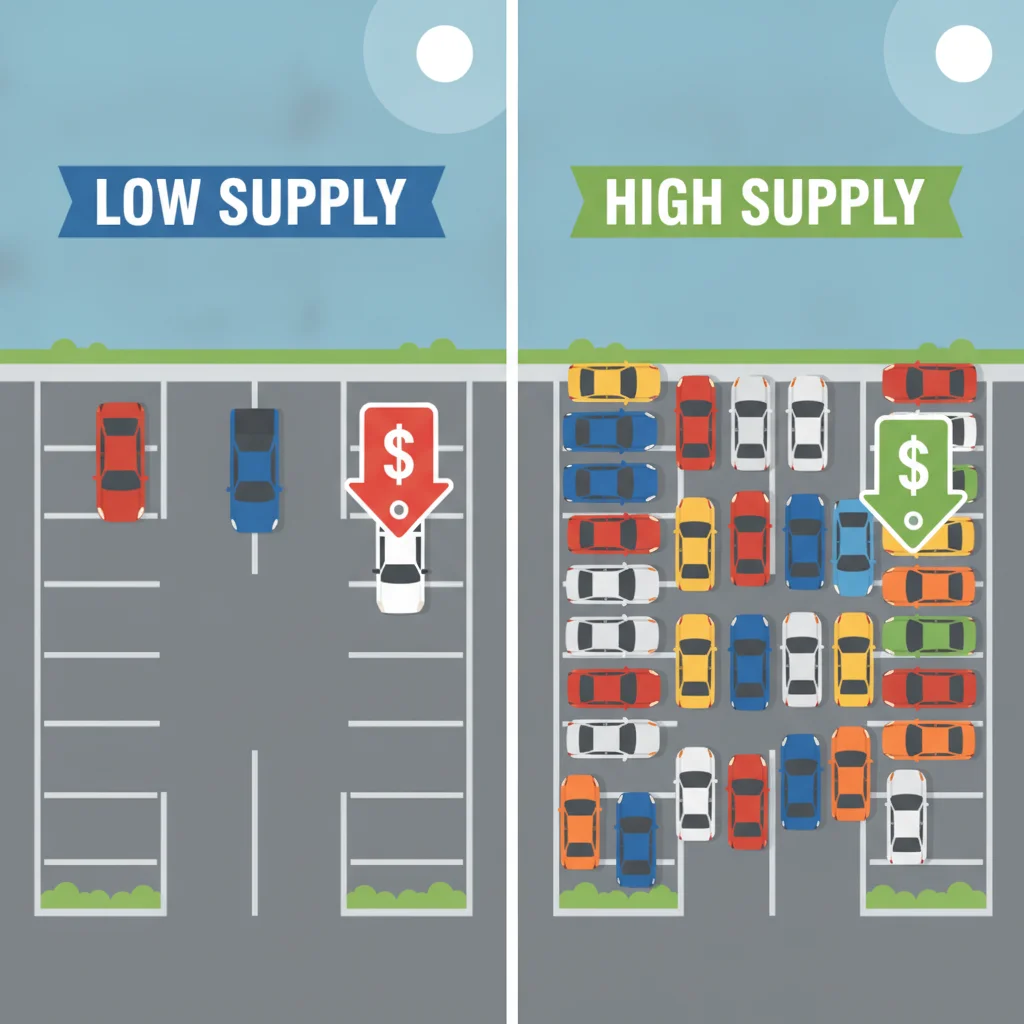
Think of it this way: if you own a 2021 Honda CR-V and so do 400 other people in your metro area who are all trying to sell at the same time, why would any buyer pay your asking price when they have 399 alternatives? They won't — and that competition forces prices down. That dynamic is market supply at work.
The Biggest Supply Events in the Used Car Market
Supply waves don't appear randomly. Several predictable events reliably push large volumes of similar vehicles into the used market at once. Knowing what they are gives you a real advantage as a seller.
Rental Fleet Liquidations
Major rental companies — think Enterprise, Hertz, and Avis — operate massive fleets, often numbering in the hundreds of thousands of vehicles. When they rotate fleet models (typically every 12–24 months) or face financial pressure, they sell those cars in bulk. A company liquidating 50,000 mid-size sedans in a short window dumps enormous supply into the used market.
Because fleet vehicles are typically well-maintained but have higher mileage, they get priced aggressively — undercutting private sellers. If you're trying to sell a 2022 Toyota Camry at the same time a rental company offloads 10,000 of them, your negotiating position evaporates.
Rental Fleet Vehicles Aren't Always a Bad Buy
From a buyer's perspective, fleet liquidations can offer good value — these vehicles are typically serviced on strict schedules and come with documented maintenance records. From a seller's perspective, though, fleet liquidations are your competition. They're priced to move quickly, and they will pull market prices down around them. If your vehicle is the same make, model, and year as a recently liquidated fleet car, plan your pricing accordingly.
Lease-Return Surges
Auto leases typically run 24–36 months. That means vehicles leased during a high-volume sales period return to market in a predictable cluster. Spring and fall are historically peak seasons for off-lease returns. Dealers get first crack at buying them at auction, then filter them into certified pre-owned programs or retail lots — adding fresh supply just as you might be listing your own vehicle.
New Model Year Launches
When manufacturers release a significantly updated model, demand for the outgoing version drops sharply. Buyers who were considering a used 2023 version suddenly want the new 2025 instead. That reduced demand, combined with unchanged supply of older models, pushes used prices down for the prior generation.
3.6M
Off-lease vehicles returned annually in the US
According to Cox Automotive, roughly 3.6 million off-lease vehicles re-enter the used market each year, creating predictable supply surges.
20–30%
Price drop during peak supply events
Industry analysts at Edmunds have observed used vehicle prices in heavily-supplied segments drop 20–30% within months of major fleet liquidations.
47%
Used car price appreciation in 2021
Manheim's Used Vehicle Value Index recorded nearly 47% year-over-year appreciation in used car prices during the 2021 supply shortage driven by chip constraints.
90 days
Average days on market during oversupply
CarGurus data shows that overpriced listings during high-inventory periods average 90+ days on market before a sale — versus under 30 days during tight supply.
Economic Downturns
Recessions push more people to sell cars — either voluntarily to cut expenses or involuntarily through repossession. Simultaneously, buyer financing tightens and demand weakens. The result is a classic oversupply scenario: more cars for sale, fewer buyers able to purchase them.
How Supply Reshapes the Depreciation Curve
Standard depreciation follows a fairly predictable curve: a new car might lose 15–20% of its value in year one, another 10–15% in year two, then slow to a more gradual decline. That's the baseline. Market supply events bend that curve — sometimes dramatically.
Here's a concrete example. Imagine a 2020 Ford Escape in good condition with 45,000 miles. Based purely on age and mileage, it might be worth $18,500. Now imagine it's April and 600 off-lease 2020 Escapes just hit dealer lots within 150 miles of your zip code. Competing dealers price them at $17,200 with certified pre-owned warranties attached. Your private-sale asking price of $18,500 becomes nearly impossible to defend. You might realistically sell for $16,800 — nearly $1,700 below your baseline expectation.
That $1,700 gap isn't your car deteriorating. It's the supply curve doing its work. And if you don't understand that mechanic, you'll either overprice your listing and sit unsold for months, or you'll eventually drop your price without understanding why.
The opposite is also true. When supply tightens — as it did dramatically during the 2021–2022 semiconductor shortage, which slashed new vehicle production — used car prices actually appreciated. Buyers had fewer options and competed aggressively for available inventory. Sellers who understood the dynamic priced confidently and got it.
Set a Price That Moves in 30 Days
When supply is high, a listing that sits unsold for 60+ days signals to buyers that something is wrong — even if the issue is just overpricing. Aim to price so that you receive serious inquiries within the first two weeks. A faster sale at a competitive price almost always beats a long, painful negotiation that ends lower anyway. Use live local listings — not just valuation tools — to set a price that reflects today's real market.
Check Inventory Before You List, Not After
Many sellers research pricing, list their car, and then discover a surplus of competition. Reverse the order: search your specific vehicle's local inventory first, then set your price. If you count more than 40 similar listings within 100 miles, price at or slightly below the middle of that range rather than at the top. Getting ahead of the market — rather than reacting to it — is the single most effective pricing move you can make.
For a deeper look at how to calculate exactly where your car sits on the depreciation curve right now — factoring in age, mileage, and condition — see how to calculate your car's depreciated value before you list.
Regional Markets: Supply Is Local, Not National
One of the most common mistakes sellers make is treating national valuation numbers as gospel. Tools like Kelley Blue Book and Edmunds produce estimates based on broad market data — and they're a solid starting point. But supply dynamics are intensely local.
A three-quarter-ton pickup truck is in huge demand in rural Montana and western Texas. That same truck might sit on a lot for 90 days in downtown Seattle where few buyers need towing capacity. If you live in a truck-demand market and there are only 12 comparable pickups listed within 100 miles, your leverage is strong. If you live in a market with 180 similar trucks competing for the same buyers, you're pricing into a very different situation.
“Used vehicle values are not set in isolation — they are a direct reflection of supply and demand at the local level. A car worth $22,000 in Dallas can be worth $19,500 in a market flooded with identical inventory three counties over.”
— Ivan Drury, Director of Insights at Edmunds
The practical implication: always do a live inventory search before you set your asking price. Go to AutoTrader, CarGurus, or Cars.com and search your exact vehicle — year, make, model, trim, and approximately your mileage — within a 50- to 100-mile radius. Count the listings. Note the price range. That local snapshot tells you more about your real negotiating position than any national estimate.
Supply can also vary by season and region simultaneously. Convertibles command premiums in warm-weather states year-round but lose value quickly when listed in Michigan in November. AWD vehicles spike in demand in the Mountain West during October. Timing your regional sale to when demand for your vehicle type peaks locally is one of the most effective ways to minimize supply-driven depreciation pressure.
To understand how market shifts interact with other depreciation triggers — like accident history, recalls, or tech obsolescence — check out hidden depreciation triggers most sellers overlook.
Timing Your Sale Around Supply Cycles
You can't control the market, but you can observe it and act strategically. Here's how to think about timing your sale to minimize supply-driven price pressure.
Watch for Upcoming Fleet Sales
Major rental company fleet disposals are often announced or can be inferred from industry news. If you hear that Hertz or Enterprise is rotating fleet inventory — which happens on roughly 12-to-18-month cycles — that's your signal that a wave of mid-range sedans and SUVs is coming. Sell before, not during.
Beat Lease-Return Season
If your vehicle is the type that gets heavily leased (think compact SUVs, sedans, and entry-luxury models), avoid listing in peak lease-return windows: typically February–April and September–November. January and July–August often have lower competing supply for many segments.
List Before New Model Announcements
If you know a manufacturer is releasing a significantly redesigned version of your car, try to sell before the announcement generates buzz. Once buyers know a newer, more capable version is coming, demand for your current generation softens immediately.
Move Fast When Supply Is Tight
When you notice that inventory of your specific vehicle is low in your area — say, fewer than 20 listings within 100 miles — that's a seller's window. Price confidently at the top of the range and don't drag your feet. Low-supply conditions can shift quickly.
It's also worth understanding how market-driven depreciation differs from physical wear-and-tear. A car with 80,000 miles and excellent maintenance loses value differently than one with 80,000 miles of neglected service. The distinction between depreciation and mechanical wear matters when buyers inspect your car and when you justify your asking price.
Using Valuation Tools Alongside Supply Data
Valuation tools — KBB, Edmunds, and the CarGurus Instant Market Value calculator — are genuinely useful, but they're not real-time supply monitors. They aggregate transaction data from the recent past, which means they can lag current supply conditions by weeks or even months. During a fast-moving supply event, they may still show prices from before the wave hit.
The best approach is to use them as a baseline, then adjust based on what you actually see in local listings.
- Get the baseline estimate from KBB or Edmunds using your car's exact specs and condition.
- Search live local inventory on AutoTrader, CarGurus, and Cars.com within 100 miles.
- Compare your baseline to actual asking prices. If you see 40 competing listings averaging $1,500 below your KBB estimate, that gap reflects current supply pressure — not an error in the tools.
- Price to compete, not to match your original expectation. A listing that sells at $500 below your hoped-for price is better than one that sits for 60 days and requires multiple drops.
For a broader look at how these tools estimate value and where their limitations lie, see the overview of car valuation tools — including how to read their outputs critically rather than treating them as fixed answers.
And if you want to understand the foundational mechanics of how and why vehicles lose value before you layer in supply dynamics, car depreciation explained from the ground up is the right starting point. Understanding both forces — standard depreciation and market supply — gives you the complete picture you need to price your car with confidence.

All claims are backed by peer-reviewed research. Sources on request.