Key Takeaways
Our Verdict
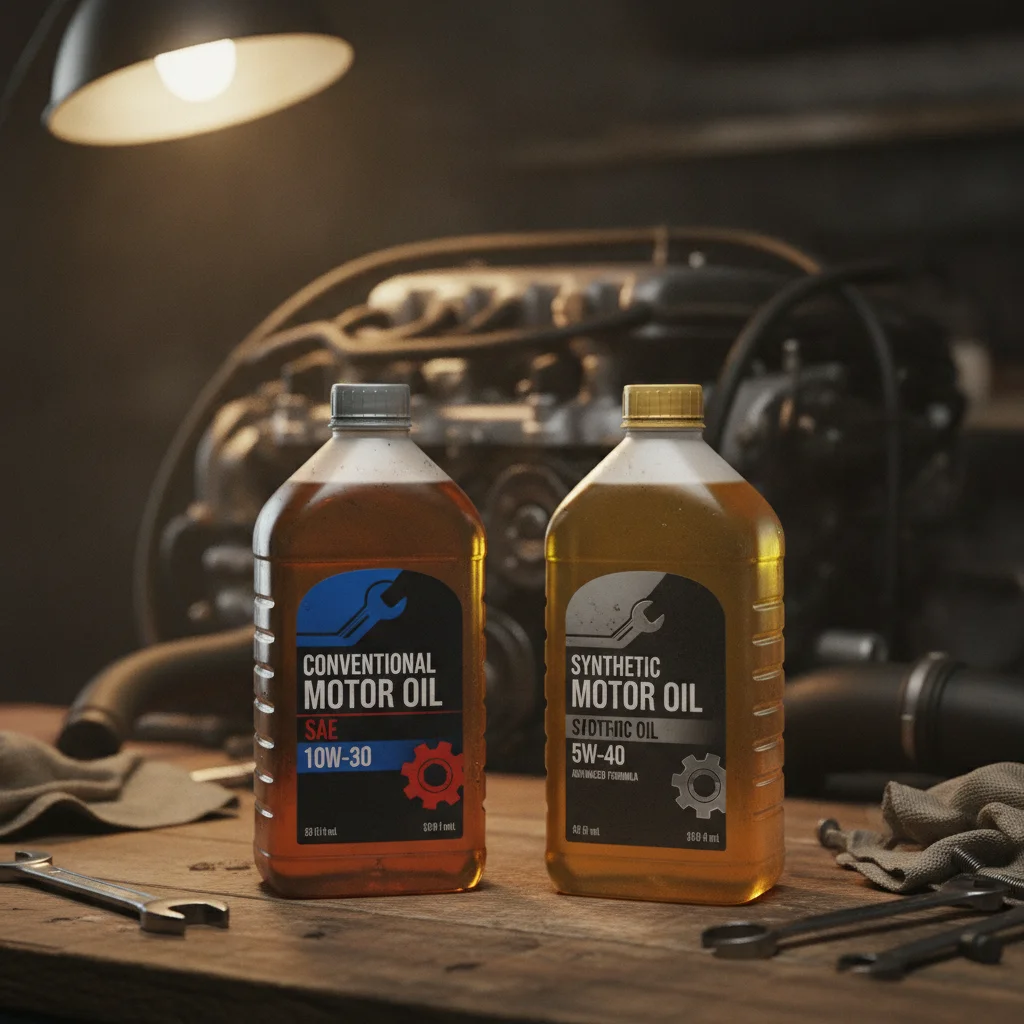
Synthetic oil earns its price premium for drivers with turbocharged engines, vehicles operated in temperature extremes, or anyone stretching oil change intervals past 5,000 miles. For straightforward commuter cars driven gently under normal conditions, quality conventional oil changed on schedule does the job without the extra cost. Synthetic blends sit comfortably in the middle for drivers who want better protection without fully committing to the premium price.
| Best for | Recommended |
|---|---|
| Turbo engines, performance vehicles, or extreme climates | Full Synthetic |
| Simple commuter cars with normal driving patterns | Conventional |
| Drivers wanting better protection on a tighter budget | Synthetic Blend |
| High-mileage vehicles with older seals and gaskets | High-Mileage Synthetic or Blend |
The Real Price Difference — and What You're Actually Paying For
Walk into any auto parts store and the sticker shock is real. A five-quart jug of conventional oil runs $20–$28. The same amount of full synthetic costs $35–$55 depending on the brand and viscosity. That's a meaningful gap, especially if you're changing your own oil and watching every dollar.
But here's the thing: price per quart isn't the whole picture. What matters is price per mile of protection. Conventional oil is typically good for 3,000–5,000 miles between changes. Quality synthetic oil holds up for 7,500–10,000 miles, and some formulations — paired with the right filter — are rated for 15,000 miles or more.
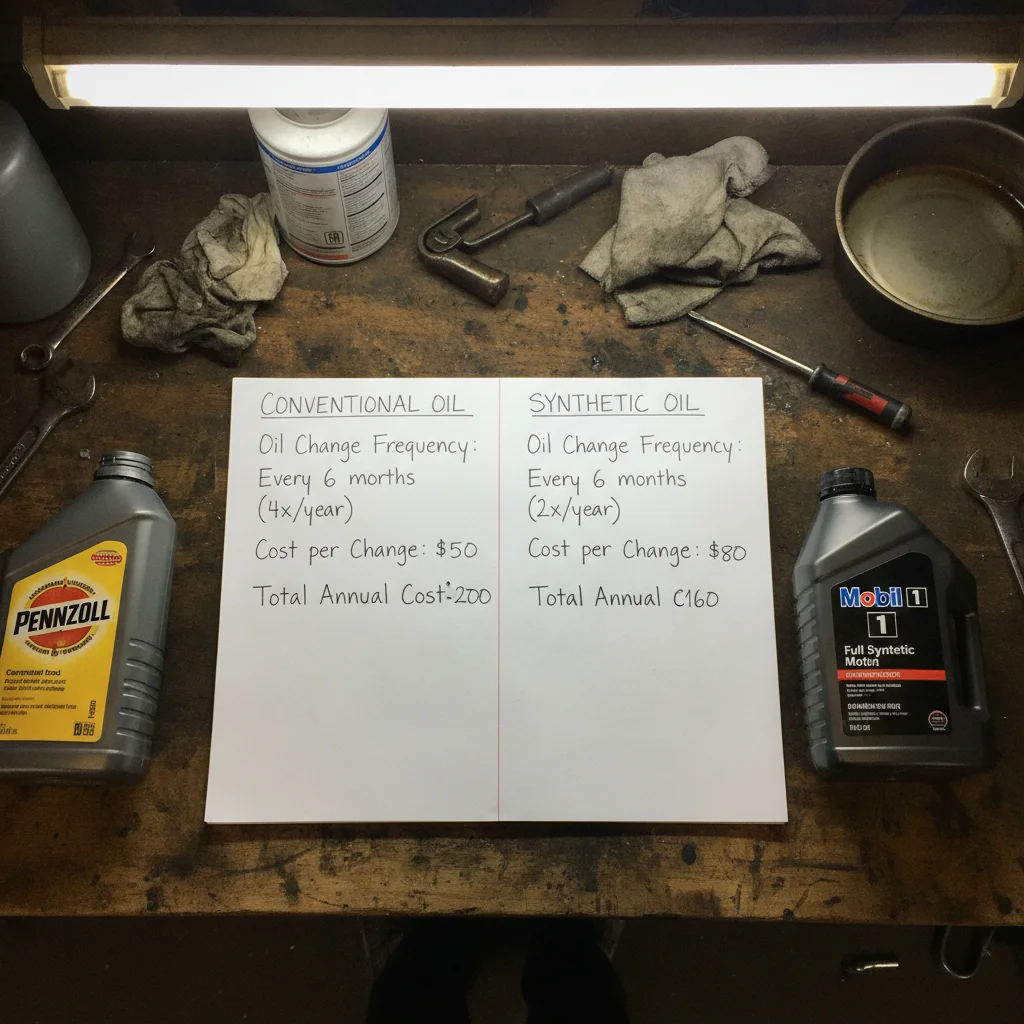
Do the math on a 10,000-mile driving year and you might need three conventional oil changes versus one synthetic change. The cost-per-mile gap narrows considerably, and sometimes disappears entirely. That doesn't mean synthetic always wins on cost — it depends on your specific engine, your driving patterns, and whether you're actually stretching those intervals or just spending more money to change oil at the same schedule.
For a deeper breakdown of how the two oil types are made differently at a molecular level, see our guide to conventional vs. synthetic oil — it covers what actually happens inside your engine with each type.
2–3×
Longer drain intervals with full synthetic
Most full synthetic oils are rated for 7,500–15,000 miles versus 3,000–5,000 miles for conventional, per manufacturer testing data.
40%
Of engine wear occurs at cold start
The American Petroleum Institute estimates the majority of engine wear happens in the first seconds after a cold start, before oil reaches all components.
$200–$300
Annual oil change cost, full synthetic DIY
Based on one to two full synthetic oil changes per year at current retail prices for a typical passenger vehicle with a 5-quart capacity.
When Synthetic Oil Is Genuinely Worth the Extra Money
There are specific situations where synthetic isn't just a nice upgrade — it's clearly the smarter choice. If any of these describe your vehicle or driving life, pay the premium without guilt.
Turbocharged and Direct-Injection Engines
Turbos run hot. The bearing inside a turbocharger can spin at 100,000–200,000 RPM and reach temperatures that would cook conventional oil quickly. When you shut a turbocharged engine off, the oil in the system stops circulating but the turbo is still shedding heat — a phenomenon mechanics call heat soak. Conventional oil breaks down faster under those conditions and can form carbon deposits called coking that restrict oil passages. Synthetic oil handles heat soak significantly better and protects turbo bearings more reliably during cold starts, which is when the most wear actually happens.
If you drive a modern turbocharged four-cylinder — and they're everywhere now — your owner's manual almost certainly specifies synthetic. That spec exists for a reason.
Very Cold or Very Hot Climates
Motor oil is rated using the W (winter) number on the label — 5W-30 means the oil flows like a 5-weight at cold temperatures. But synthetic oil's flow characteristics at sub-zero temperatures are measurably better than conventional oil of the same rating. In a Minnesota January, synthetic reaches critical engine components faster on a cold start, which is when the majority of engine wear occurs.
On the other end, if you're towing in July heat or sitting in traffic with the AC running on a 100-degree day, synthetic's higher resistance to thermal breakdown gives you a real margin of protection.
Extended Oil Change Intervals
If your schedule makes it hard to get under the car every 3,000–4,000 miles, or your manufacturer specifies 7,500–10,000 mile intervals (increasingly common), synthetic is the right call. It simply holds its protective properties longer. Running conventional oil past its service life isn't just inefficient — it causes real engine wear.
Check Your Interval — Not Just the Oil
Synthetic oil's extended life only saves you money if you actually extend your change intervals accordingly. If you're running synthetic but still changing it every 3,000 miles out of habit, you're throwing money away. Set your interval based on what the oil is rated for and what your owner's manual recommends — not what the quick-lube sticker says.
Don't Mix Certification Grades
When topping off between changes, always use oil that matches your current oil's API or ILSAC certification level, not just the viscosity. Mixing oils of the same viscosity but different additive packages can compromise the protective properties of both. If you're unsure what's in the engine, a full change is safer than a guess.
High-Performance or Racing Applications
High-revving performance engines generate more heat and put more stress on the oil film between moving parts. Full synthetic is standard practice here, not a luxury option.
New Engines From the Factory
Many new vehicles come filled with full synthetic from the factory, particularly from European and Asian manufacturers. If your car shipped that way, stick with it. The manufacturer engineered the engine with that protection level in mind.
When Conventional Oil Does the Job Just Fine
Here's where I'll give you the honest mechanic's answer rather than the upsell: for a lot of cars and a lot of drivers, conventional oil is completely adequate. If you're disciplined about changing it on schedule, quality conventional oil will not shorten your engine's life meaningfully compared to synthetic.
Older, Naturally Aspirated Engines
A 2008 Honda Civic with a simple 1.8-liter naturally aspirated four-cylinder running normal commute duty doesn't need $50 synthetic oil. The engine wasn't designed around it, the tolerances are more generous than modern engines, and the operating temperatures stay well within conventional oil's capabilities. Change it every 4,000–5,000 miles with a quality conventional oil and a good filter and that engine will run a long time.
Short-Trip Commuters Who Change Oil Regularly
Ironically, if you're doing a lot of very short trips — say, a 3-mile commute where the engine never fully warms up — synthetic's extended-life benefit is largely wasted because you should be changing oil more frequently anyway due to moisture accumulation. Short-trip driving is actually harder on oil than highway miles. In that scenario, paying for synthetic's 10,000-mile rating while changing at 3,000 miles is money left on the table.
Vehicles You're Planning to Sell Soon
If you're 8,000 miles from trading in a car, switching to full synthetic buys you nothing. Keep using whatever the car has been running and spend that difference elsewhere.
Don't Skip Changes Thinking Synthetic Is Bulletproof
Full synthetic oil is more durable than conventional, but it still degrades. The additive package that neutralizes acids, disperses contaminants, and fights oxidation gets used up over time regardless of the base oil type. Running synthetic well past its rated interval is still harmful to your engine — the oil just fails more slowly, not never.
Tight Budget, Disciplined Maintenance Schedule
I'll say it plainly: a vehicle maintained with conventional oil on a correct schedule will outlast one running synthetic oil that gets changed whenever the owner gets around to it. Discipline matters more than the oil grade. If conventional oil means you can afford to change it on time every time, that's the right choice for your situation.
Synthetic Blend: The Middle Ground That Actually Makes Sense
Synthetic blend — sometimes called semi-synthetic — is exactly what it sounds like: a mix of conventional base oil and synthetic base oil, with additives. It typically costs $25–$35 for five quarts, splitting the difference between conventional and full synthetic.
The blend gives you improved cold-start flow compared to straight conventional, better heat resistance, and slightly extended change intervals — usually good for 5,000–7,500 miles depending on conditions. It's a practical choice for older vehicles that weren't designed for full synthetic tolerances but could benefit from better protection, or for drivers in moderate climates who do mixed city and highway driving.
High-mileage synthetic blends are a specific formulation worth mentioning. They include seal conditioners that help aging gaskets and seals stay pliable, which is genuinely useful in engines with 75,000+ miles. If you've got an older vehicle that's been running conventional and you want to step up protection without committing to full synthetic, high-mileage blend is a sensible move.
| Conventional | Synthetic Blend | Full Synthetic | |
|---|---|---|---|
| Typical cost (5 qts) | $20–$28 | $25–$35 | $35–$55 |
| Recommended change interval | 3,000–5,000 miles | 5,000–7,500 miles | 7,500–15,000 miles |
| Cold-start protection | Adequate | Good | Best |
| Heat resistance | Moderate | Good | Excellent |
| Turbo engine suitability | Not recommended | Acceptable short-term | Strongly recommended |
| High-mileage engine fit | Fine if maintained | Good with HM formula | Use HM synthetic version |
| Best for | Older simple engines, tight budgets | Mixed driving, moderate climates | Turbos, extremes, long intervals |
Switching From Conventional to Synthetic in a High-Mileage Engine
This is where I hear the most misinformation. The old story about synthetic causing leaks in older engines is mostly a myth — but there's a kernel of truth buried in it worth understanding.
Early synthetic formulations in the 1970s and 1980s contained additives that were hard on certain rubber seals. Modern synthetic oil doesn't have that problem. The real issue is this: if an older engine has small leaks being sealed by accumulated oil sludge and deposits, synthetic oil's superior cleaning properties can dissolve that gunk and reveal leaks that were already there. The synthetic didn't cause the leak — it exposed a pre-existing problem.

Practically speaking, if you're switching a high-mileage engine from conventional to full synthetic, do it in stages. Run a synthetic blend for one or two oil change cycles first. This lets the improved cleaning happen gradually rather than all at once. Watch for any new oil spots under the car after each change. If you're seeing significant leaks, that's a sign the engine has seal issues that need addressing regardless of oil type.
For the actual process of doing this yourself, our DIY oil change guide walks through the full procedure with the precautions you need to know before draining that first quart.
Also worth checking before you buy anything: how to read motor oil specifications on the label so you know exactly what viscosity and certification your engine actually requires. The wrong grade, synthetic or not, is worse than the right grade of anything.
What Your Owner's Manual Actually Says (and Why It Overrules Everything)
I've been a mechanic long enough to know that most drivers never look at their owner's manual after the first week of ownership. For oil, that's a mistake worth correcting right now.
Your manufacturer tested your specific engine and specified an oil viscosity and type based on real engineering decisions. If the manual says full synthetic is required, that's not a suggestion — running conventional oil in that engine can void your powertrain warranty and, more importantly, may not provide adequate protection under normal operating conditions. This is especially true for newer turbocharged engines, European imports, and vehicles with variable valve timing systems that use oil pressure to operate.
If the manual says conventional is acceptable, synthetic is still a fine upgrade — it just isn't required. You're paying for insurance and convenience, which is a completely rational choice, but not a mechanical necessity.
Check Your Interval — Not Just the Oil
Synthetic oil's extended life only saves you money if you actually extend your change intervals accordingly. If you're running synthetic but still changing it every 3,000 miles out of habit, you're throwing money away. Set your interval based on what the oil is rated for and what your owner's manual recommends — not what the quick-lube sticker says.
Don't Mix Certification Grades
When topping off between changes, always use oil that matches your current oil's API or ILSAC certification level, not just the viscosity. Mixing oils of the same viscosity but different additive packages can compromise the protective properties of both. If you're unsure what's in the engine, a full change is safer than a guess.
The manual will also tell you the correct viscosity (5W-30, 0W-20, etc.) and any relevant API or ILSAC certification requirements. Matching those specs matters more than the conventional vs. synthetic debate. A 5W-30 conventional oil that meets the required API SN specification is a better choice than a 5W-40 full synthetic that doesn't match your engine's viscosity requirement.
If you're weighing other fluid and fuel upgrade decisions the same way, the same logic applies — see how we break it down in our look at when paying more for premium gas actually pays off.
Making the Right Call for Your Specific Situation
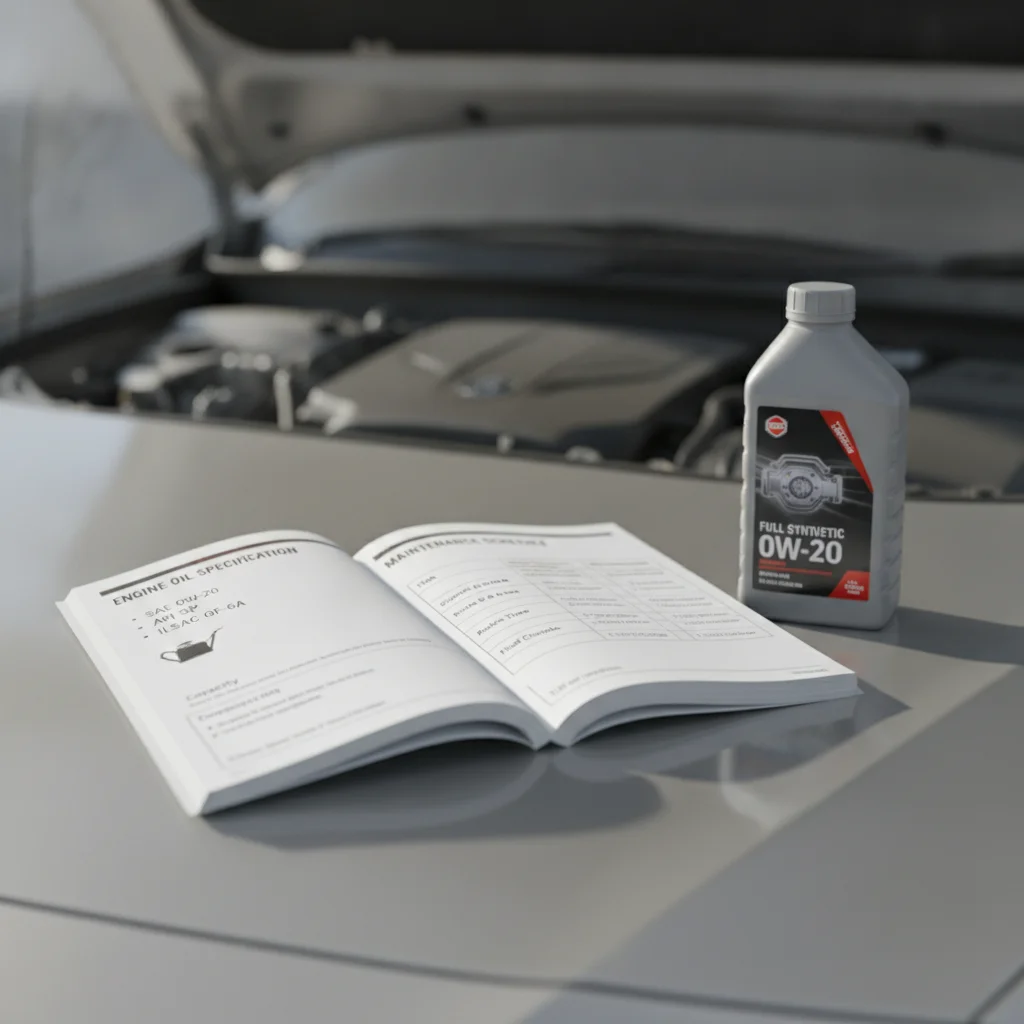
Let me put it in plain terms. Pull out your owner's manual, find the oil specification section, and read what it says. If it says full synthetic required — that's your answer. If it says conventional is acceptable, you have a choice to make based on the factors above.
Ask yourself these four questions:
- Is my engine turbocharged or do I live in a climate with temperature extremes? If yes, synthetic is worth it.
- Do I drive mostly short trips and change oil religiously on schedule? If yes, conventional may actually serve you better economically.
- Am I trying to extend oil change intervals beyond 5,000 miles? If yes, you need synthetic to do that responsibly.
- Does my high-mileage engine have a history of conventional oil? If yes, consider a high-mileage blend before jumping to full synthetic.
The honest truth is that the oil industry has an interest in selling you the most expensive product, and the quick-lube industry has an interest in you coming back as often as possible. Neither of those pressures should drive your decision. Your engine type, your driving patterns, your climate, and your maintenance discipline — those are the actual variables that determine the right answer for you.
If you're doing your own oil changes and want to make sure you're getting the full value out of the process, our balanced look at DIY oil changes covers what you actually gain, what can go wrong, and what tools you realistically need to do it right.

All claims are backed by peer-reviewed research. Sources on request.