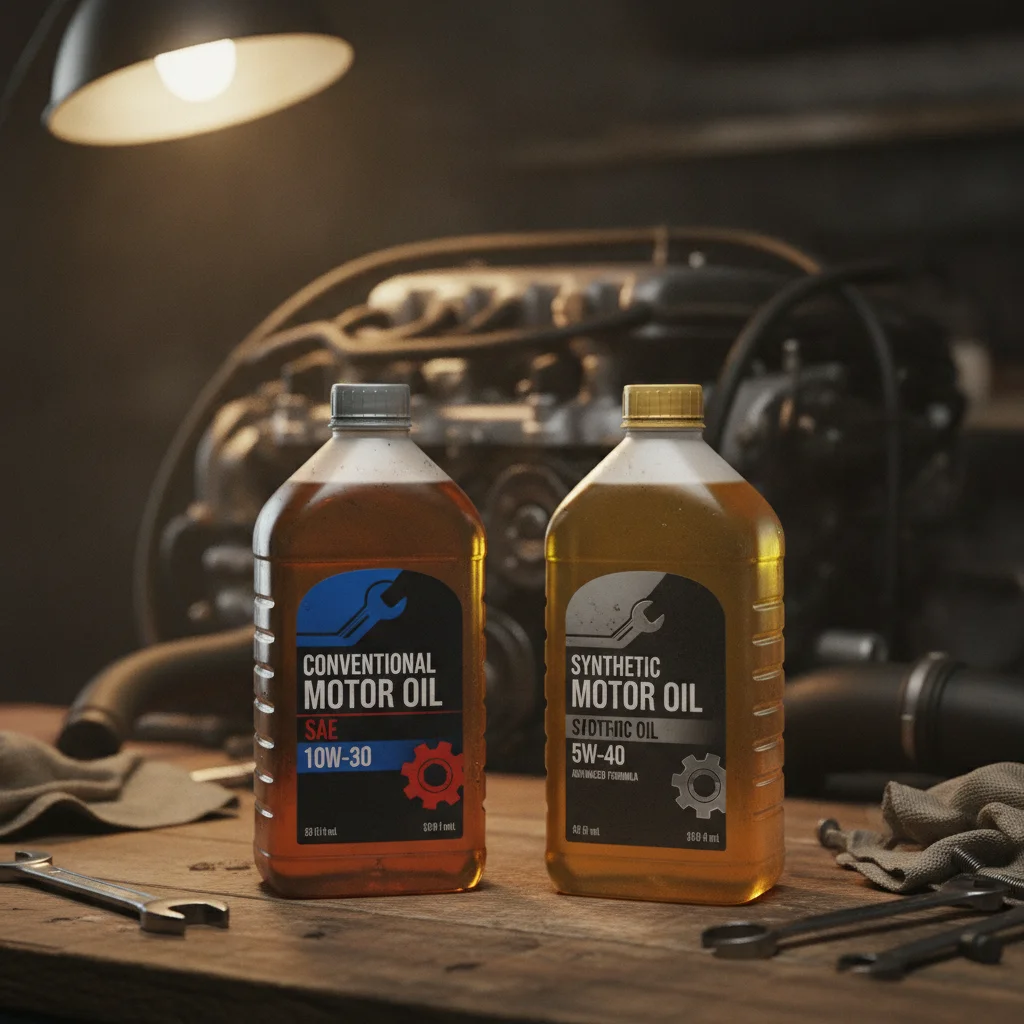
Key Takeaways
Motor Oil Specification
A motor oil specification is the standardized coding system printed on every oil container that tells you how the oil performs under heat and cold, what quality standard it meets, and whether it suits your engine's design. These codes — like 5W-30 or API SP — aren't marketing language; they're engineering shorthand developed by industry bodies so your engine gets exactly what it needs. Reading them correctly means you buy the right oil every time.
Oil specifications are set by organizations including the Society of Automotive Engineers (SAE) for viscosity grades, the American Petroleum Institute (API) for quality ratings, and the International Lubricant Standardization and Approval Committee (ILSAC) for fuel economy standards.
Why the Label Matters More Than the Brand
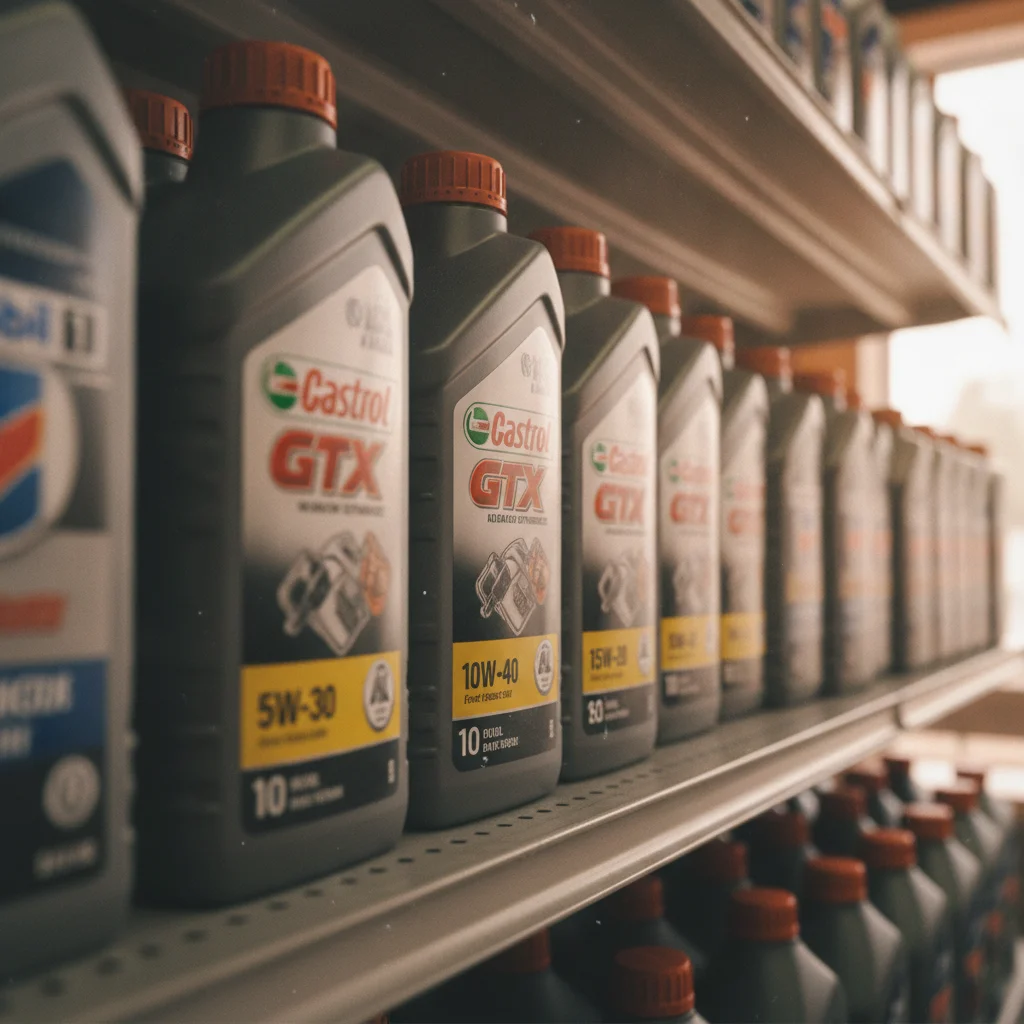
Walk down any auto parts store aisle and you'll see dozens of oil containers with bold logos, bright colors, and marketing phrases like "maximum protection" or "advanced formula." Here's the honest truth: the brand name is the least important thing on that label. What matters is the cluster of codes, numbers, and certifications printed in smaller text — because those are the actual specifications your engine was engineered to use.
Putting the wrong oil in your engine isn't necessarily catastrophic right away, but over thousands of miles it contributes to increased wear, reduced efficiency, and in some cases sludge buildup. If your car is still under a powertrain warranty, the wrong oil specification can even give a dealer grounds to deny a claim. So this is worth five minutes of your time.
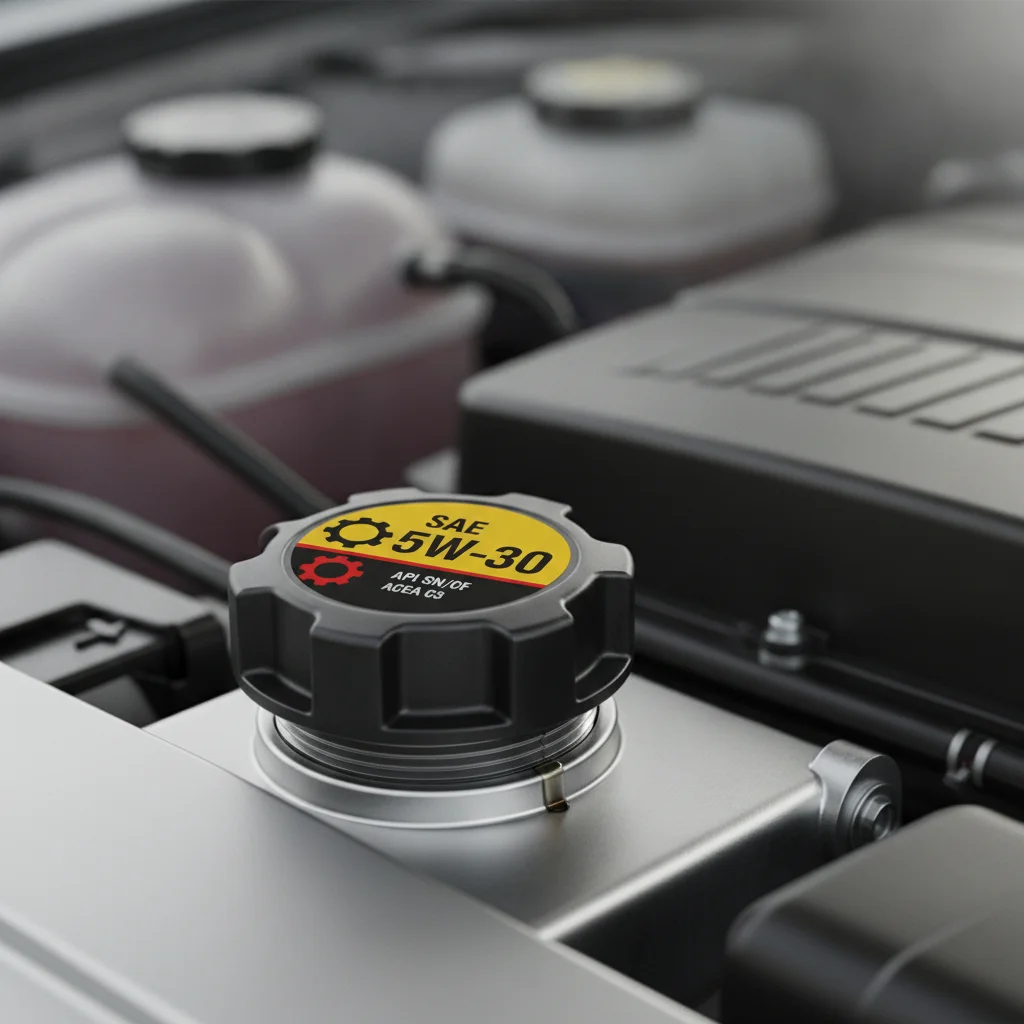
Before you reach for a bottle, take a look under the hood — specifically the oil filler cap or a sticker near the valve cover. Most automakers print the required viscosity grade right there. If not, it's in your owner's manual. That spec is your starting point, and everything else on the label is there to confirm you've got the right match. For a broader look at what else you can learn from a quick underhood inspection, see our guide Under the Hood: What to Look at Even If You're Not a Mechanic.
Decoding Viscosity: What 5W-30 Actually Tells You
The viscosity grade is the most prominent code on any oil bottle, and it's also the one that confuses people the most. Let's break it down clearly.
The Cold Number (Before the W)
The number before the W — 0, 5, 10, 15 — describes how the oil flows when your engine is cold. This matters enormously because the first few seconds after a cold start are when most engine wear occurs. Thinner oil at startup means it reaches critical engine components faster. A 0W oil flows more freely in freezing temperatures than a 10W oil. In a Minnesota winter, that difference is measurable.
The Hot Number (After the W)
The number after the W — 20, 30, 40, 50 — describes the oil's viscosity at normal operating temperature (around 212°F). A higher number means the oil is thicker at that temperature. A 5W-40 oil is thicker at operating temp than a 5W-20. Thicker isn't automatically better — your engine's clearances are machined to work with a specific viscosity. Too thick and the oil doesn't circulate as efficiently; too thin and it doesn't maintain the film needed to prevent metal-to-metal contact.
Why This Matters in Practice
Modern engines — especially turbocharged ones and those with variable valve timing — often specify lower-viscosity oils like 0W-20 or 5W-20 because tighter tolerances and hydraulic actuators need thinner oil to function correctly. Older V8s and high-output performance engines sometimes call for 5W-40 or 10W-30 because they need a robust oil film to protect larger clearances. Neither is universally superior — it depends on what your engine was designed around.
“The single biggest mistake drivers make with oil is thinking that viscosity is about how 'thick' or 'heavy' the oil is in some general sense. It's actually a very precise engineering parameter — and using the wrong one is like using the wrong tire pressure. It works, until it doesn't.”
— Bob Storck, SAE Technical Committee Member and Lubricants Engineer
Your Filler Cap Is Your Cheat Sheet
Most modern cars print the required viscosity grade directly on the oil filler cap — it's usually right on top of the engine. Before you ever look at a store shelf, check the cap. If it says 5W-30, that's your grade. You can confirm in the owner's manual, but for viscosity, the cap is usually reliable and right in front of you.
Exceeding the Spec Is Usually Fine, Going Under Isn't
If your car calls for API SN and you find API SP, that's fine — SP is backward compatible and meets a higher standard. But don't go in the other direction: using an older, lower-rated oil in an engine that requires SP can leave you short on deposit control and oxidation resistance. Think of API ratings like a minimum bar, not an exact match requirement.
API and ILSAC Ratings: The Quality Certifications
Once you've confirmed viscosity, look for the certification marks. These tell you the oil has been independently tested and meets minimum quality standards — not just that a marketing department called it "premium."
API Donut
The API Service Symbol (commonly called the donut) appears as a circular badge on the back of most oil containers. The top half shows the service category:
- SP — Current top rating for gasoline engines (as of 2020). Handles oxidation, deposits, and timing chain wear better than its predecessors.
- SN, SM, SL — Older ratings, still valid for older vehicles that specified them, but don't offer the deposit and wear protection of SP.
- CK-4, CJ-4 — Ratings for diesel engines. If you're running a diesel pickup, these are the relevant letters to look for.
The bottom half of the donut indicates whether the oil meets energy-conserving requirements — useful if fuel economy matters to you.
ILSAC Starburst
Look for the starburst-shaped seal marked ILSAC GF-6 (or the older GF-5). This certification combines quality testing with fuel economy performance requirements. GF-6A covers typical viscosity grades. GF-6B is reserved for ultra-low viscosity grades (0W-16 and similar) designed specifically for maximum fuel efficiency in newer engines. If your owner's manual specifies an ILSAC-certified oil, don't skip this seal.
~40%
Of engine wear occurring at cold start
Industry engineering studies estimate that a significant share of total engine wear occurs in the first seconds after startup, before oil pressure builds — underscoring why cold-flow viscosity ratings matter.
10,000–15,000 mi
Typical full synthetic oil change interval
Many full synthetic oils carry drain interval recommendations of 10,000 to 15,000 miles under normal driving conditions, compared to 3,000–5,000 miles for conventional oil.
0W-16
Lowest viscosity now in widespread use
Ultra-low viscosity grades like 0W-16 are now factory-specified in several Toyota and Honda models, reflecting a broader industry move toward thinner oils to improve fuel economy in newer engine designs.
2020
Year API SP rating was introduced
The API SP rating, which added improved oxidation resistance and timing chain wear protection versus the previous SN rating, became the current top standard for gasoline engine oils as of May 2020.
OEM-Specific Approvals
Some manufacturers go beyond API and ILSAC with their own approval standards. BMW specifies oils that meet BMW Longlife ratings. Mercedes-Benz uses its own MB-Approval numbers. Volkswagen uses VW 504.00 or 508.00 designations. These are not interchangeable with standard API ratings — if your vehicle requires an OEM-specific approval, you need to see that exact designation on the label. Running a generic SP-rated oil in a car that requires BMW LL-04 approval can lead to longer-term engine issues, particularly in turbocharged engines that operate at high temperatures.
European OEM Approvals Are Not Optional
Vehicles from BMW, Mercedes-Benz, Volkswagen, Audi, and Porsche often carry specific OEM oil approval requirements that are distinct from API or ILSAC ratings. These approvals (e.g., BMW LL-04, MB 229.5, VW 504.00) reflect the manufacturer's own testing for their specific engine designs. Using a non-approved oil — even one that's technically high quality — may not provide the right additive balance for these engines. Always verify OEM approvals on the back of the bottle if you drive a European import.
Mixing Oil Types Is Not Ideal, But Not Catastrophic
If you're topping off and you don't have the exact oil on hand, mixing a small amount of a different type or brand isn't going to destroy your engine. Modern oils use compatible base stocks and additives. The issue is that you dilute the performance characteristics of the oil already in your engine. For routine top-offs, get as close to spec as possible. For a full drain-and-fill, always start fresh with the correct spec.
Conventional, Synthetic Blend, and Full Synthetic: The Actual Differences
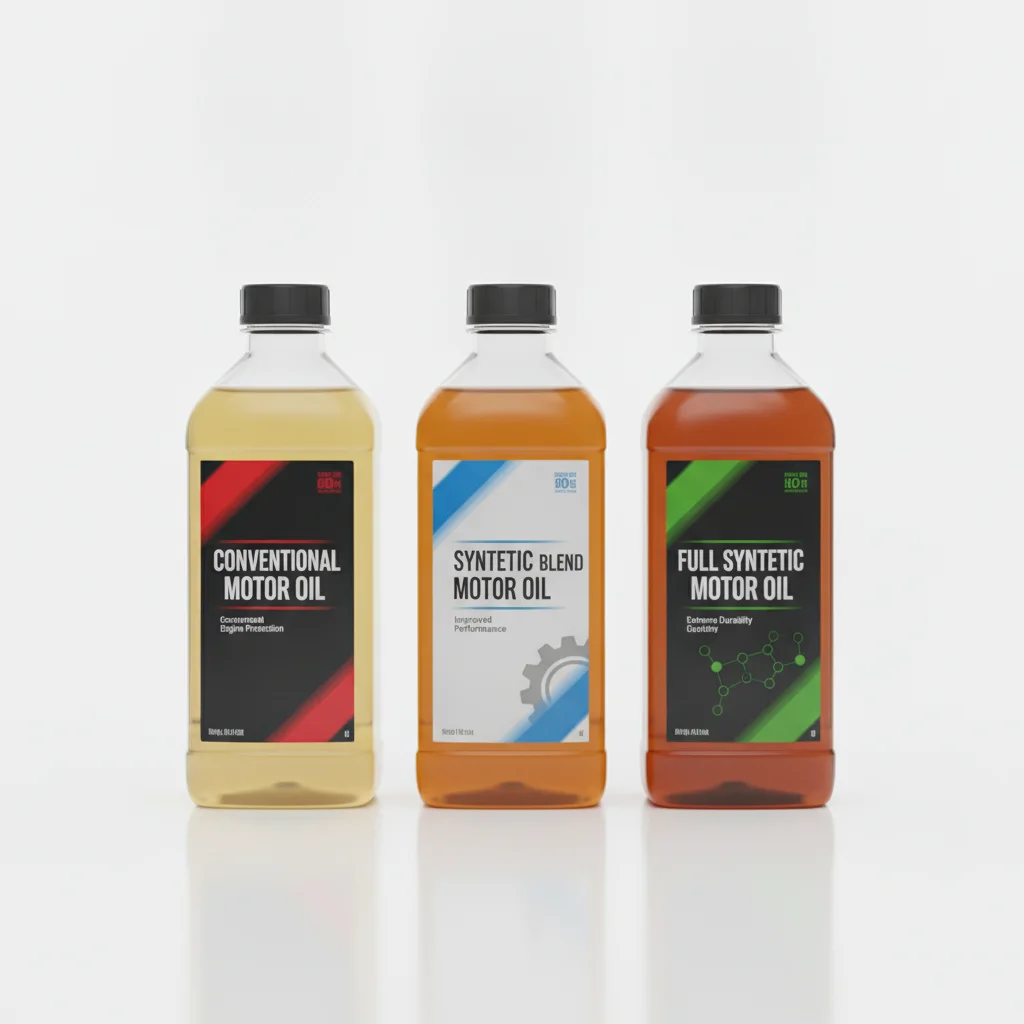
The oil type — conventional, synthetic blend, or full synthetic — is usually printed prominently on the front of the bottle. Here's what those terms actually mean, stripped of the marketing spin.
Conventional Oil
Conventional motor oil is refined directly from crude oil. It works perfectly well for most passenger vehicles under normal driving conditions and is the least expensive option. The downside is that it breaks down faster under heat stress and oxidizes more quickly than synthetic alternatives, which is why conventional oil has traditionally required more frequent changes.
Synthetic Blend
A synthetic blend is a mix of conventional base oil and synthetic base oil. It offers better cold-start performance and slightly better thermal stability than straight conventional, at a price point between the two. It's a reasonable middle ground for drivers who do a lot of short trips or live in climates with cold winters but don't want to pay full synthetic prices.
Full Synthetic
Full synthetic oil is built from chemically engineered base stocks — either Group III highly refined oil or Group IV/V PAO and ester-based oils. The molecules are more uniform, which means more consistent viscosity behavior, better resistance to oxidation and thermal breakdown, and longer drain intervals. It costs more per quart, but you change it less often. For a detailed look at when that trade-off is actually worth it, see our article When Synthetic Oil Is Worth It — and When It Isn't.
If you want an even more thorough breakdown of how the two main oil types compare head-to-head, Conventional vs. Synthetic Oil: Which Does Your Engine Actually Need? walks through the decision in full detail.
Your Filler Cap Is Your Cheat Sheet
Most modern cars print the required viscosity grade directly on the oil filler cap — it's usually right on top of the engine. Before you ever look at a store shelf, check the cap. If it says 5W-30, that's your grade. You can confirm in the owner's manual, but for viscosity, the cap is usually reliable and right in front of you.
Exceeding the Spec Is Usually Fine, Going Under Isn't
If your car calls for API SN and you find API SP, that's fine — SP is backward compatible and meets a higher standard. But don't go in the other direction: using an older, lower-rated oil in an engine that requires SP can leave you short on deposit control and oxidation resistance. Think of API ratings like a minimum bar, not an exact match requirement.
Special Formulations: High-Mileage, Racing, and Diesel Oils
Beyond the standard categories, you'll see some specialized labels that deserve a quick explanation.
High-Mileage Oil
Bottles labeled "high-mileage" — typically for vehicles over 75,000 miles — contain added seal conditioners that swell aging rubber gaskets and O-rings slightly, reducing minor seepage. They also carry more antioxidants to fight sludge in engines that may have some deposit buildup, and they're sometimes available in slightly thicker viscosities to compensate for worn engine clearances. If your car is leaking a little oil or burning some between changes, a high-mileage formula is worth trying before you assume the worst.
Racing Oil
Racing oils are formulated for high-RPM, high-temperature, short-duration use. They often contain high levels of zinc dialkyldithiophosphate (ZDDP), an anti-wear additive that was phased down in modern API-rated oils due to its effect on catalytic converters. Racing oil is great for track days — not for daily drivers with catalytic converters and oxygen sensors. Some flat-tappet engine enthusiasts use high-ZDDP oils for classic cars without catalytic converters, which is a legitimate use case.
Diesel Engine Oil
If you drive a diesel pickup or work truck, don't grab the first bottle labeled with the right viscosity. Diesel oils carry different API ratings (CK-4 is the current standard) and contain different additive packages to handle soot and the higher combustion pressures of diesel engines. Some diesel-specific oils are not backward-compatible with gasoline engines, so keep the two categories separate.
Putting It Together at the Store
Here's a practical workflow for picking the right oil without second-guessing yourself in the aisle.
- Find your spec first. Check the oil filler cap, the underhood sticker, or your owner's manual. Write down the viscosity grade (e.g., 5W-30) and any certification required (e.g., API SP, ILSAC GF-6, or an OEM approval number).
- Match the viscosity exactly. Don't substitute a different grade unless it's an emergency and you're topping off rather than doing a full change. Even one number off affects how the oil performs at cold start or operating temperature.
- Look for the certification marks. Find the API donut and confirm the service category matches or exceeds what your manual specifies. Check for the ILSAC starburst if your manual calls for it.
- Choose your oil type. If your manual specifies full synthetic, use full synthetic. If it's silent on the matter, check your driving conditions and mileage. Turbocharged engines, extreme climates, and high-mileage vehicles generally benefit from full synthetic.
- OEM approval numbers last. If your car is a European import or a newer model with proprietary oil standards, scan the back label for the specific approval code. Generic API-rated oil may not be enough.
Once you've got the right oil picked out, the next natural question is how often you actually need to change it. The 3,000-mile rule is largely outdated, but the right interval varies a lot by vehicle and driving habits. Our article Oil Change Intervals: What Every Driver Actually Needs to Know covers that in full.
European OEM Approvals Are Not Optional
Vehicles from BMW, Mercedes-Benz, Volkswagen, Audi, and Porsche often carry specific OEM oil approval requirements that are distinct from API or ILSAC ratings. These approvals (e.g., BMW LL-04, MB 229.5, VW 504.00) reflect the manufacturer's own testing for their specific engine designs. Using a non-approved oil — even one that's technically high quality — may not provide the right additive balance for these engines. Always verify OEM approvals on the back of the bottle if you drive a European import.
Mixing Oil Types Is Not Ideal, But Not Catastrophic
If you're topping off and you don't have the exact oil on hand, mixing a small amount of a different type or brand isn't going to destroy your engine. Modern oils use compatible base stocks and additives. The issue is that you dilute the performance characteristics of the oil already in your engine. For routine top-offs, get as close to spec as possible. For a full drain-and-fill, always start fresh with the correct spec.


All claims are backed by peer-reviewed research. Sources on request.