Key Takeaways
Why Your Driving Record Is More Complex Than You Think
Most drivers assume their driving record is a simple list of tickets. It's not. An MVR is a legal document that tracks every interaction you've had with the traffic enforcement and court system — and each entry contains multiple data fields that mean very different things to different audiences: the DMV, your insurer, a potential employer, and a court.
The gap between what a driver thinks their record says and what it actually communicates is where costly mistakes happen. Drivers pay inflated premiums because dismissed charges still look like convictions to an untrained eye. Employers reject applicants because they didn't know a decade-old DUI was still visible. And license suspensions catch people off guard because they never tracked their rolling point total.
This guide walks you through the process of pulling your record, reading each component accurately, and taking action on what you find. It's a skill that pays dividends every time you shop for insurance, apply for a job, or face a traffic court decision.
Note: If you've ever pulled a vehicle history report and found it confusing, the experience is similar — records contain coded data that requires context to interpret correctly. See how to read a vehicle history report without getting misled for a parallel breakdown on that document type.
What you will need
State DMV Online Portal
Used to request and download your official motor vehicle record (MVR).
AAMVA Violation Code Reference
The American Association of Motor Vehicle Administrators publishes standardized violation codes used across many states.
Your Auto Insurance Declarations Page
Cross-reference your record entries against what your insurer has on file to catch discrepancies.
State-Specific Points Schedule
Most state DMV websites publish a chart showing how many points each violation category carries.
Step-by-Step: Decoding Every Entry on Your Record
Follow these steps in order. Each one builds on the last — you need your record in hand before you can decode entries, and you need to understand dispositions before you can accurately calculate your point total.
Obtain your official motor vehicle record (MVR)
Start by pulling your actual record — not a third-party summary. Every state DMV offers some form of MVR request, and most now provide an online portal where you can download a PDF within minutes. Costs typically range from $0 to $15 depending on the state and record type.
There are two common MVR types:
- Informal/personal record: Shows your current license status, point totals, and recent violations. Good for self-review.
- Official certified record: A stamped, legally binding document. Required for employment background checks, court proceedings, or contesting insurance rates.
Request the certified version if you plan to dispute anything or share it with an employer. For self-review, the informal copy is fine.
Identify the sections of your record
MVR formats vary by state, but most include the same core sections. Learn to find each one before diving into specific entries:
- Personal information: Name, date of birth, address, license number, and license class (Class A, B, C, or D in most states).
- License status: Active, suspended, revoked, expired, or restricted. This is the most consequential field for insurers and employers.
- Endorsements and restrictions: Endorsements (like H for hazmat or M for motorcycle) expand driving privileges; restrictions (like corrective lenses required) limit them.
- Violations and convictions: The chronological list of infractions, each with a date, code, description, disposition, and point value.
- Accidents on record: Some states include at-fault accident entries separately from violations.
Decode violation codes and descriptions
This is where most people get stuck. Violations appear as a code (e.g., M41, S15, or a state-specific numeric code) followed by a short description that may be abbreviated. Here's how to interpret them:
Federal ACD Codes
Many states use the AAMVA Accident, Conviction, and Disposition (ACD) code system. These are two-letter or alphanumeric codes organized by category:
- A-codes: Alcohol/drug-related offenses (e.g.,
A20= DUI/DWI) - B-codes: License offenses (e.g.,
B26= driving while suspended) - D-codes: Driver condition/medical (e.g.,
D72= failure to carry insurance) - M-codes: Moving violations (e.g.,
M40= following too closely) - N-codes: Right-of-way violations (e.g.,
N01= failure to yield) - S-codes: Speeding violations (e.g.,
S15= speeding 15 mph over limit) - W-codes: Point accumulation or withdrawal actions (e.g.,
W01= points accumulated)
If your state uses its own proprietary codes, search your state DMV website for a violation code lookup table. They're publicly available in nearly every state.
Understand disposition statuses
Each violation entry will carry a disposition — the legal outcome of the charge. This is critical. A conviction and a dismissed charge look very different to an insurer, but they can appear in the same list without obvious visual distinction. Here are the most common dispositions:
| Disposition | What It Means | Insurance Impact |
|---|---|---|
| Convicted / Guilty | You were found guilty or pled guilty. The violation is on your record. | High — full surcharge applied |
| No Contest / Nolo Contendere | You did not admit guilt but accepted the penalty. Treated as a conviction in most states. | High — same as conviction |
| Dismissed | The charge was dropped. Most states still show the entry but it carries no points. | Low to none |
| Deferred / Diversion | You completed a program (e.g., traffic school) and the conviction was withheld. | Low — often treated as no conviction if completed |
| Reduced | The original charge was lowered (e.g., reckless driving reduced to improper driving). | Moderate — depends on the reduced charge |
| Pending | The case has not been adjudicated. No point assignment yet. | None until resolved |
Pay close attention to any entry marked Pending — once resolved, the disposition could trigger a retroactive rate change on your insurance policy.
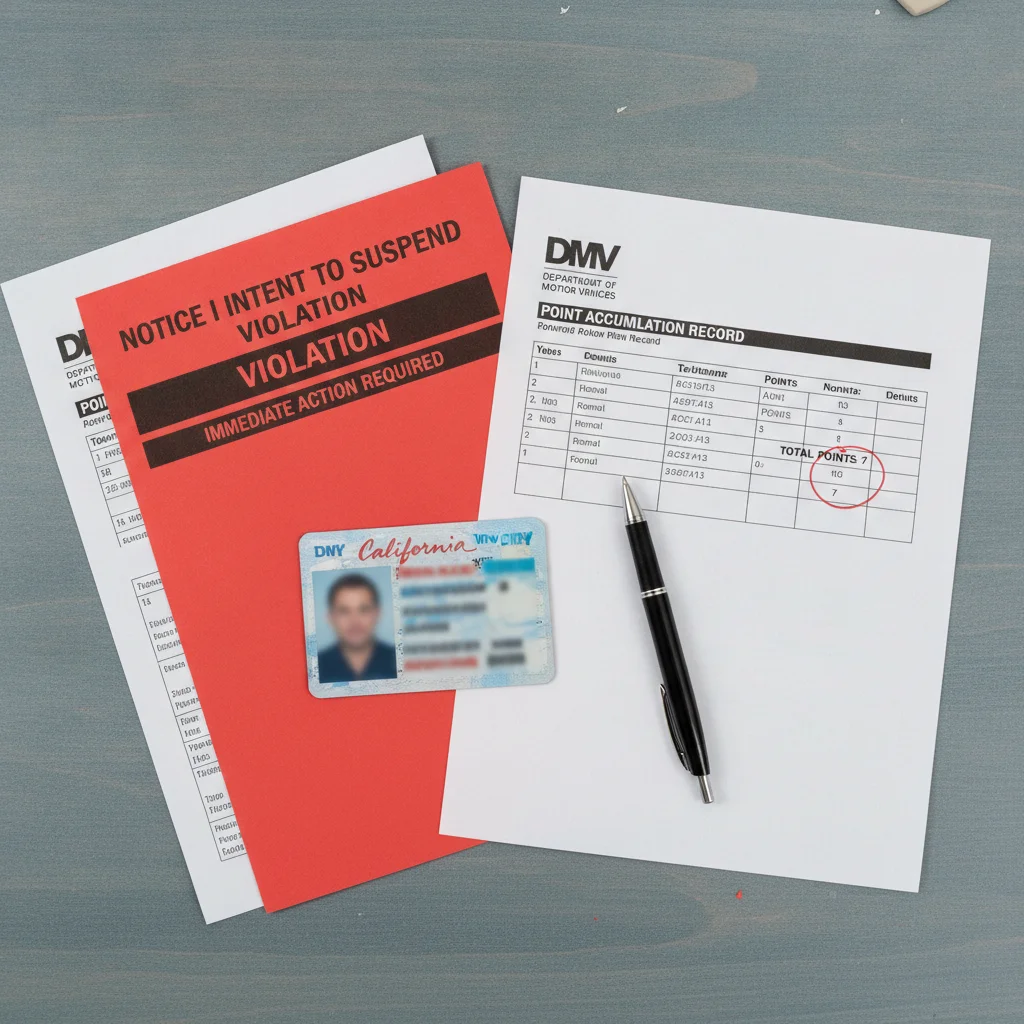
Calculate your current point total and identify active entries
Points only count while they're active. States use different windows — typically 1–3 years from the conviction date — after which points expire. But expiration doesn't necessarily mean the violation disappears from the record; it may remain visible but no longer count toward your point total or trigger suspension.
To calculate your active point total:
- List every conviction with its conviction date (not the violation date — the date it was adjudicated).
- Cross-reference against your state's point expiration window.
- Add up only the points from convictions still within that window.
- Compare your total to your state's suspension threshold.
Most states suspend licenses at 12–15 active points, though thresholds vary significantly. For a deeper look at how accumulation works and what thresholds to watch, see how states track driving violations.
[in_content_images:1]Check the lookback window for insurance purposes
Insurers don't necessarily use the same lookback window as the DMV. They set their own policies, but standard industry practice is:
- Minor violations (speeding under 15 mph over, improper lane change): 3 years
- Major violations (reckless driving, hit-and-run, DUI): 5–10 years depending on the state and insurer
- At-fault accidents: 3–5 years
This means a violation that no longer generates DMV points can still trigger an insurance surcharge. An insurer pulling your MVR sees the full entry history, not just what's 'active' for DMV purposes. Always read an insurer's rating manual language carefully — it specifies exactly how far back they look and how each violation category is weighted.
Understanding what your insurer sees is just as important as understanding your policy. Cross-reference your driving record with your auto insurance declarations page to see whether your current premiums reflect your record accurately.
Identify and dispute errors
Record errors are more common than people think. Clerical mistakes at the courthouse, mismatched license numbers, and outdated entries that should have been expunged all appear on real MVRs. Here's what to look for:
- Violations you don't recognize (possible identity mix-up or data entry error)
- Dismissed charges still showing active points
- Entries beyond your state's maximum reporting period that haven't been purged
- Incorrect conviction dates that extend a violation's active window
- Duplicate entries for the same incident
To dispute an error, contact your state DMV's Driver Records division in writing. Include your license number, the specific entry in question, and any supporting documentation (court disposition paperwork, case numbers). Most states have a formal dispute process that resolves within 30–60 days.
For incidents involving crashes, it's also worth understanding how different official documents relate to each other — your driving record entry is separate from the police report or DMV crash filing. See the difference between accident reports, police reports, and DMV filings for a breakdown of how each one works.
Use your record proactively
Reading your record is only useful if you act on what you find. Here's what to do with the information:
- Before shopping for insurance: Know your violations and their dispositions so you can accurately answer application questions and anticipate surcharges.
- Before a job application: Employers with driving requirements will pull your MVR. Know what they'll see before they do.
- When approaching a suspension threshold: If you're within 2–3 points of your state's limit, treat every traffic stop as high-stakes. Consider a defensive driving course — many states allow you to reduce active points by completing one. Use the points accumulation red flags checklist to assess exactly where you stand.
- After a deferred or diversion program: Confirm that the violation was properly updated on your record once you completed the program. Don't assume it was handled automatically.
Common Misunderstandings That Cost Drivers Money
Even drivers who've looked at their MVR before often misread it in ways that cost them. Here are the most common mistakes:
Don't Rely Solely on Third-Party Record Services
Services that sell driving records often pull from databases that lag behind real-time DMV updates. For any consequential use — insurance disputes, employment applications, court matters — always request your record directly from your state DMV. Third-party data may be weeks or months out of date.
Pending Violations Are Not Safe to Ignore
A pending entry can convert to a conviction with points at any time, and some insurers factor in pending charges at renewal. Don't plan your insurance shopping or license management strategy around violations that haven't been adjudicated yet — resolve them first.
Confusing the violation date with the conviction date
The violation date is when the infraction occurred. The conviction date is when the case was resolved — and that's the date that matters for both point accumulation and insurance lookback windows. A ticket you received three years ago might have a conviction date that's only two years old if the court case dragged out. Use the conviction date, not the violation date, for all calculations.
Assuming 'on your record' means 'counting against you'
Entries remain on MVRs for years — sometimes permanently for serious offenses — even after they stop generating active points or triggering insurance surcharges. An entry being visible doesn't mean it's currently affecting your rates or license status. What matters is the disposition and the date relative to the relevant lookback window.
Treating all moving violations as equivalent
Insurers and courts categorize violations into tiers. A minor speeding ticket (under 10 mph over the limit) is weighted entirely differently from a major speeding violation (20+ mph over), and both are categorically different from a serious violation like reckless driving or leaving the scene of an accident. The ACD code on your record tells you exactly which tier a violation falls into — look it up before assuming the impact.
Dismissed Charges Still Appear on Your MVR
A charge being dismissed does not erase it from your driving record in most states — it simply changes the disposition field to 'dismissed' or 'not guilty.' Most insurers and employers will still see the entry. The key is that a dismissed charge should carry zero points and typically carries no insurance surcharge. If a dismissed entry shows active points, that is a recordkeeping error and must be disputed in writing with your DMV immediately.
Ignoring pending entries
Pending violations sit on your record without a point assignment until the case is resolved. If you're counting your points to assess suspension risk and skipping pending items, you may be significantly underestimating your exposure. Resolve pending matters quickly — delays extend the uncertainty and can complicate insurance renewals.
Annual MVR Pulls Are Worth the Habit
Pulling your driving record once a year is one of the lowest-effort, highest-value things a driver can do. It takes minutes online in most states, costs little to nothing, and gives you a complete picture of what insurers and employers will see. Don't wait for a problem to motivate you.
Deferred Dispositions Don't Always Update Automatically
If you completed a traffic diversion or deferred adjudication program, verify the outcome was actually posted to your MVR. Courts and DMVs don't always communicate in real time. A call to your DMV 60 days after program completion is worth the effort — an unconverted deferral sitting as 'pending' can quietly hurt you.
Traffic Attorneys Are Often Worth the Cost for Major Violations
The surcharge from a single DUI or reckless driving conviction can add $1,000–$3,000 per year to your insurance for 5–7 years. A traffic attorney consultation typically costs $100–$300. Run the math before deciding to simply pay the fine on any serious charge.
How Insurers Actually Use Your MVR
When you apply for or renew auto insurance, the carrier almost always pulls your MVR — typically through a data service like LexisNexis or Verisk/ISO, which aggregates state MVR data. Here's what that process looks like from their side:
- They pull your MVR and cross-reference it against their internal rating tables, which assign surcharge factors to specific violation categories.
- They apply their own lookback window — which may differ from your state DMV's active point window.
- They combine your driving record with other factors (credit score in most states, vehicle type, location, claims history) to calculate your final premium.
The violation categories that trigger the largest surcharges — typically 30–100%+ rate increases — are DUI/DWI, reckless driving, hit-and-run, street racing, and major at-fault accidents. Minor violations like a single speeding ticket may cause only a 5–15% increase depending on the carrier.
One practical implication: if you've had a major violation age out of an insurer's lookback window, you should actively shop your policy. Many insurers don't automatically re-rate downward when a violation expires — they wait until your next renewal, and even then, you may get better pricing by switching carriers. Your insurance declarations page will show the coverage currently in place, but it won't tell you whether you're being overcharged relative to your current record.

Keeping Your Record Clean Going Forward
Reading your record is the diagnostic step. Keeping it clean is the ongoing practice. A few concrete habits that make a material difference:
Contest borderline tickets strategically
Not every ticket is worth fighting, but major violations almost always are — the surcharge impact over 3–5 years of insurance premiums far outweighs the cost of a traffic attorney. Get at least a consultation before paying a fine on anything that codes as a major or serious violation.
Use traffic school when available
Many states allow a once-every-12-or-18-months traffic school option for minor violations. This withholds or removes points without requiring a court appearance. Confirm eligibility before your court date — some states only allow it if you request it proactively.
Monitor your record annually
Pull your MVR once a year. It takes 10 minutes and costs nothing in most states. Catching a data entry error or an improperly posted conviction early saves significant hassle compared to discovering it when you're mid-application for a job or insurance policy.
Understand what's coming next
If you're tracking your points and recognize you're approaching a threshold, use the points accumulation red flags guide to assess your specific situation and understand exactly what steps to take before your license is at risk.
Annual MVR Pulls Are Worth the Habit
Pulling your driving record once a year is one of the lowest-effort, highest-value things a driver can do. It takes minutes online in most states, costs little to nothing, and gives you a complete picture of what insurers and employers will see. Don't wait for a problem to motivate you.
Deferred Dispositions Don't Always Update Automatically
If you completed a traffic diversion or deferred adjudication program, verify the outcome was actually posted to your MVR. Courts and DMVs don't always communicate in real time. A call to your DMV 60 days after program completion is worth the effort — an unconverted deferral sitting as 'pending' can quietly hurt you.
Traffic Attorneys Are Often Worth the Cost for Major Violations
The surcharge from a single DUI or reckless driving conviction can add $1,000–$3,000 per year to your insurance for 5–7 years. A traffic attorney consultation typically costs $100–$300. Run the math before deciding to simply pay the fine on any serious charge.

All claims are backed by peer-reviewed research. Sources on request.