Key Takeaways
Option A
License Suspension
A temporary, fixable setback with a defined endpoint.
Best for: Drivers who have accumulated points, missed a court date, or let insurance lapse — situations where the privilege can be restored after meeting specific conditions.
Option B
License Revocation
A permanent cancellation that requires full reapplication.
Best for: Understanding the consequences of the most serious offenses — DUI, vehicular manslaughter, habitual violations — where simply waiting out a clock is not an option.
If you received a notice for unpaid tickets or an insurance lapse
License Suspension (context)
This is almost certainly a suspension, which means you have a clear path back. Pay the fines, restore coverage, and file the required paperwork with your DMV to get reinstated.
If you were convicted of DUI, vehicular assault, or are classified as a habitual offender
License Revocation (context)
You are likely facing revocation, which means the reinstatement clock does not start until a waiting period ends — and you will need to pass tests and meet state requirements all over again.
If you need to maintain any car insurance during either status
License Suspension (context)
Even while suspended, you may need to keep a policy active on a parked vehicle or meet SR-22 requirements. A revoked license creates deeper coverage complications that require immediate insurer notification.
If you are an employer or fleet manager assessing a driver's eligibility
License Revocation (context)
A revoked license disqualifies a driver from operating company vehicles indefinitely until the state formally issues a new one — a suspended license may only be a temporary restriction.
If you are comparing long-term insurance cost impact
License Revocation (context)
Revocation stems from major offenses that linger on your record for years, often making standard market insurance unavailable and pushing you into high-risk pools at significantly higher premiums.
What Each Term Actually Means
Most drivers use 'suspension' and 'revocation' as if they mean the same thing. They do not — and confusing them can lead to bad decisions at exactly the wrong time.
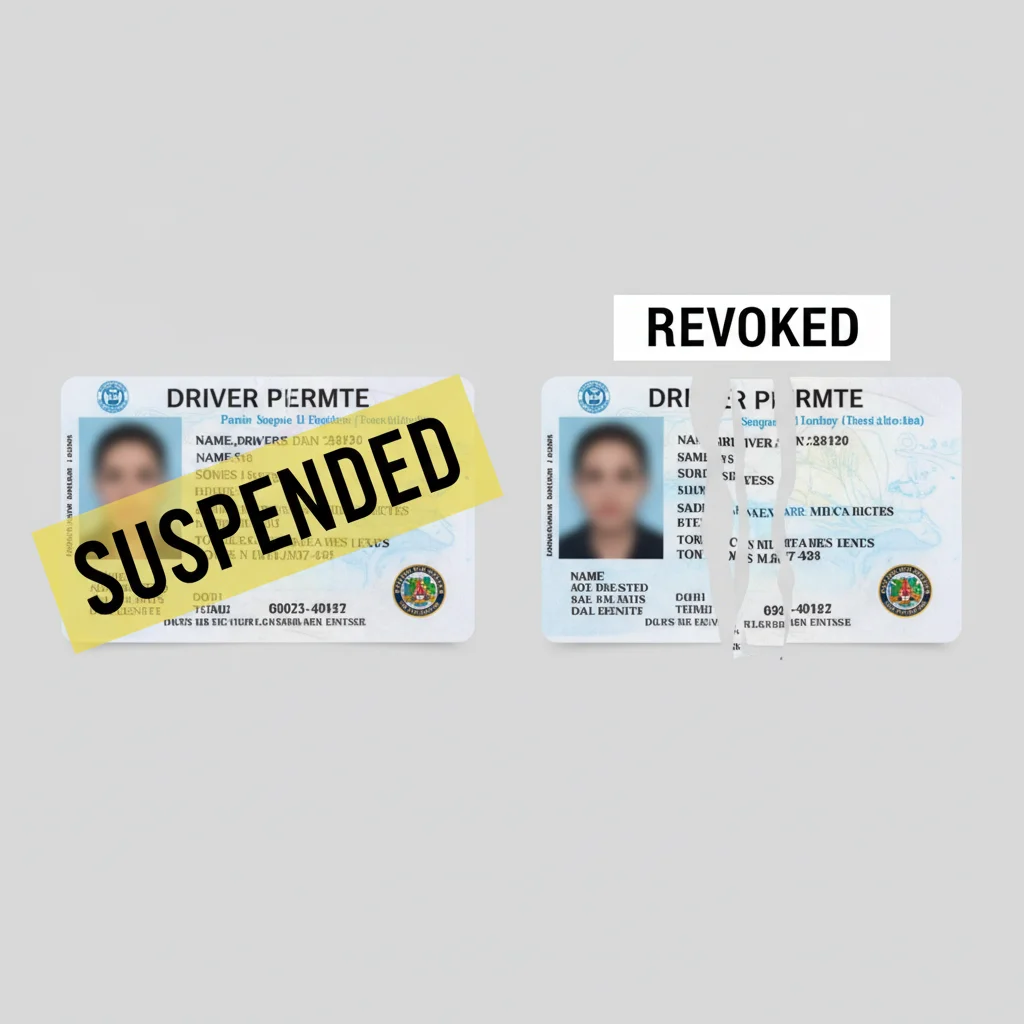
A license suspension is a temporary withdrawal of your driving privilege. Think of it as a pause. Your license still exists; the state has simply put a hold on your right to use it. Once you satisfy whatever conditions triggered the suspension — paying fines, reinstating insurance, completing a program — you can get back on the road, usually without reapplying for an entirely new license.
A license revocation is a termination. The state has canceled your license outright. There is no hold, no pause button — the license is gone. To drive legally again, you must wait out a mandatory period, then go through the full application process: written exam, driving test, vision screening, fees. You are treated largely as a new applicant.
This distinction matters for everything that follows — how long you wait, what paperwork you file, what you pay, and what your insurance company does with your policy.
It is also worth noting that these are state-level actions administered by your DMV (or equivalent agency). Federal driving privileges do not exist for passenger vehicles. That means the rules, timelines, and reinstatement requirements vary by state — sometimes significantly. Always verify the specific procedures with your state's motor vehicle authority.
What Triggers Each One
The offenses that lead to suspension versus revocation are not random — they follow a rough severity ladder. Understanding where common violations fall helps you anticipate consequences before a court date arrives.
Administrative vs. Criminal Suspensions
Not all suspensions come from court convictions. Administrative suspensions are issued directly by the DMV for non-criminal issues like failing to maintain insurance or not responding to a license renewal. Criminal suspensions follow a court conviction and are often longer and harder to clear. Both appear on your driving record, but they may have different reinstatement requirements. Always confirm which type you are dealing with when you receive a suspension notice.
Ignition Interlock Devices and Conditional Licenses
Some states offer a conditional or hardship license during a suspension or after partial completion of a revocation waiting period. These often require installation of an ignition interlock device (IID), which prevents the vehicle from starting if alcohol is detected on the driver's breath. An IID program can allow limited driving — typically for work or medical appointments — before full reinstatement. Eligibility depends entirely on your state's laws and the nature of the underlying offense.
Out-of-State Drivers: The National Driver Register
States share information through the National Driver Register (NDR) and the Driver License Compact. If your license is suspended or revoked in one state, other participating states can see that record. Simply moving to a new state and applying for a fresh license will not erase the prior action — most states will deny the new application until the original state's issue is resolved.
Common Suspension Triggers
- Point accumulation: Most states use a point system. Exceed the threshold within a rolling window and the DMV suspends your license automatically.
- Unpaid traffic fines or failure to appear: Ignore a court summons or let tickets pile up and many states will flag your license for suspension.
- Lapsed auto insurance: Driving uninsured — or simply letting coverage lapse without notifying the state — can trigger an administrative suspension in states with continuous coverage requirements.
- Failure to pay child support: Many states are authorized to suspend licenses for non-payment of child support under federal law.
- Medical fitness concerns: A physician or court may flag a driver for re-evaluation, triggering a temporary suspension pending review.
- DUI first offense (in some states): Some states treat a first DUI as a suspension, especially when the BAC is close to the legal limit, before escalating to revocation for repeat offenses.
See our full breakdown of traffic violation severity tiers to understand how different offenses are legally classified before they reach the point stage.
Common Revocation Triggers
- DUI/DWI convictions (especially repeat): A second or third DUI in most states results in automatic revocation, not suspension.
- Vehicular manslaughter or assault: Causing death or serious injury while operating a vehicle almost universally results in revocation.
- Habitual offender designation: Accumulate a certain number of serious violations within a defined period and the state may permanently revoke rather than suspend.
- Racing on a public roadway: In many jurisdictions, a conviction for street racing triggers mandatory revocation.
- Fraud or identity crimes related to licensing: Using a fake license or registering a vehicle under a false identity can result in revocation of all driving privileges.
| Criterion | License Suspension | License Revocation |
|---|---|---|
| Nature of action | Temporary withdrawal of privilege | Permanent cancellation of license |
| License status | License exists but is on hold | License is fully terminated |
| Common triggers | Unpaid fines, point accumulation, lapsed insurance | DUI conviction, vehicular manslaughter, habitual offender |
| Typical duration | 30 days to 2 years | 1 year to permanent |
| Reinstatement process | Meet conditions, pay fee, receive reinstatement | Wait mandatory period, reapply, pass all tests |
| Retesting required | Rarely | Almost always |
| SR-22 required | Often (especially for DUI or insurance lapse) | Nearly always after reinstatement |
| Insurance impact | Rate increase; possible non-renewal | Likely declination by standard carriers |
| Penalty for driving anyway | Misdemeanor; extended suspension | Criminal charge; revocation period reset |
| New license issued? | No — existing license restored | Yes — entirely new license issued |
The key pattern: suspensions tend to follow administrative and lower-level criminal violations; revocations follow felony-level driving conduct and repeat serious offenses. How long those violations stay on your record is a separate but closely related question — one that directly affects your insurance premiums long after reinstatement.
How Long Each Lasts
Duration is where the practical difference between suspension and revocation hits hardest.
1 in 7
U.S. drivers with a suspended or revoked license
A 2017 study by the Governors Highway Safety Association estimated approximately 1 in 7 drivers on American roads are operating with a suspended or revoked license.
75%
Suspended drivers who continue driving
Research cited by AAA Foundation for Traffic Safety found roughly three in four suspended drivers continue driving at some point during their suspension period.
3–5 years
SR-22 requirement period after serious offense
Most states require SR-22 insurance filings for three to five years following DUI convictions or license revocation, per state DMV guidelines.
2–3x
Insurance premium increase after DUI suspension
Drivers with a DUI on record typically pay two to three times the standard premium, according to rate comparison data from major insurance aggregators.
Suspension Duration
Suspensions range from 30 days to several years depending on the offense and the state. Many are condition-based rather than time-based: your suspension ends when you pay the fine, provide proof of insurance, or complete a required course — not necessarily after a fixed calendar period. Some states have indefinite suspensions that only lift after compliance, meaning a driver who ignores the trigger could technically be suspended for decades.
Administrative suspensions — those triggered by insurance lapses or unpaid fees — are often the shortest and most straightforward to resolve. Criminal suspensions tied to DUI or reckless driving convictions typically come with mandatory minimum periods that cannot be shortened by compliance alone.
Revocation Duration
Revocations almost always carry a mandatory minimum waiting period before you can even apply for reinstatement. Depending on the state and offense:
- A first DUI revocation might carry a one-year mandatory minimum.
- A second DUI could push that to three to five years.
- Vehicular manslaughter convictions can result in revocations that last ten years or more — or are permanent in some states.
After the waiting period, you do not automatically get your license back. You apply. The state reviews your application, may require a hearing, and can deny reinstatement if you do not meet all conditions. There is no guarantee.

This distinction — time-based versus application-based reinstatement — is the most operationally important difference between the two statuses. With a suspension, compliance restores your license. With a revocation, compliance only makes you eligible to ask for a new one.
Reinstatement: What You Actually Have to Do
Reinstatement procedures differ significantly between the two statuses, and skipping steps is one of the most common ways drivers end up back in trouble.
Reinstating After a Suspension
- Satisfy the underlying condition. Pay fines, complete a program, restore insurance, or address whatever triggered the suspension.
- Obtain required documentation. Depending on the state and offense, you may need an SR-22 certificate — a form your insurer files with the state certifying that you carry at least the minimum required liability coverage. Managing your policy during a suspension requires its own set of decisions.
- Pay the reinstatement fee. Most states charge a flat fee ranging from $25 to $150, though some offenses carry higher fees.
- Receive written confirmation. Do not assume you are legal to drive until you have documentation from the DMV. Driving one day too early still counts as driving on a suspended license.
Reinstating After a Revocation
- Wait out the mandatory period. There are no shortcuts. Applying before the waiting period ends will be denied.
- File a formal application. Some states require a hearing before the DMV or a state board.
- Retake all required tests. Written exam, vision test, and road test in most cases — just like a first-time applicant.
- Obtain SR-22 or SR-1P (in some states). High-risk insurance filings are almost always required after revocation.
- Pay all applicable fees. Application fees, licensing fees, and any outstanding fines or judgments must be cleared.
- Receive a new license. If approved, you are issued a new license — your previous one is not reactivated.
One more thing: reinstatement does not erase the underlying offense from your driving record. Insurers will still see it. Employers running background checks will still see it. The reinstatement is a legal restoration of your driving privilege — not an expungement.
The Insurance Consequences You Need to Know
Both suspension and revocation have insurance implications, but they play out differently in both severity and duration.
When your license is suspended, your insurer may not immediately know about it — but they will find out at your next policy renewal when they run a motor vehicle report (MVR). At that point, expect a rate increase. The size of the increase depends on why you were suspended. A lapsed-insurance suspension is treated differently than a DUI-related suspension. Either way, you are now a higher-risk driver in the eyes of the carrier.
If your suspension stems from a DUI or serious moving violation, many standard-market insurers will non-renew your policy rather than raise your rate. You may find yourself shopping in the non-standard or assigned-risk market — often at two to three times your previous premium.
Revocation hits harder. The underlying offense that caused the revocation — a DUI felony, vehicular manslaughter — is exactly the kind of item that gets you declined by standard carriers outright. During the revocation period, you may still need to insure a vehicle you own but cannot drive. After reinstatement, expect SR-22 requirements to remain in place for several years, and expect insurers to treat you as a high-risk driver for the full duration that the offense appears on your record.
The parallel in the insurance world is worth noting: just as suspension and revocation are two very different outcomes, so are policy cancellation and non-renewal. Understanding cancellation versus non-renewal helps you interpret what your insurer is actually telling you when your driving record changes.

One practical step: if you know a suspension or revocation is coming, contact your insurer before it hits your MVR. Some carriers have more flexibility when the disclosure is proactive rather than discovered at renewal. It will not eliminate the rate impact, but it may prevent an abrupt mid-term cancellation.
Driving Anyway: Why the Risk Is Never Worth It
A significant portion of suspension and revocation cases compound into something worse because the driver chose to keep driving. Let's be direct about what that looks like legally.
Driving on a suspended license is a criminal offense in virtually every U.S. state — typically a misdemeanor on a first offense, carrying fines up to $1,000, possible jail time of up to a year, and an extended suspension period. In some states, a second offense escalates to a felony.
Driving on a revoked license is treated more harshly because there is no license to suspend further. You are driving without any legal authorization to operate a vehicle. Penalties typically include mandatory jail sentences, substantial fines, and the mandatory extension of the revocation period — sometimes resetting the waiting period entirely.
Beyond the criminal exposure, consider the insurance dimension: if you are in an accident while driving on a suspended or revoked license, your insurer may have grounds to deny your claim entirely based on a policy exclusion for unlawful operation. You could be personally liable for damages — medical bills, property repair, legal fees — without any coverage backstop.
The calculus here is simple. The financial and legal cost of a traffic stop while suspended or revoked is orders of magnitude higher than the inconvenience of using alternative transportation or waiting for reinstatement.
If you are in a situation where your license has been suspended for insurance-related reasons specifically, review your options carefully. Adjusting your coverage during unusual situations walks through how to handle your policy correctly while you work through the reinstatement process.

All claims are backed by peer-reviewed research. Sources on request.